
50000 word book with ai production represents the definitive benchmark for evaluating modern artificial intelligence publishing systems. While almost any consumer language model can generate a short blog post or an outline, producing a coherent, full-length manuscript that maintains stylistic consistency, factual accuracy, and narrative continuity across fifteen chapters is an entirely different undertaking. In an unconstrained chat environment, long-form authoring inevitably breaks down due to context degradation, repetitive filler, and hallucinated claims.
The successful completion of a 50000 word book with ai requires disciplined software engineering: external project lock files, mathematical word budgets, automated quality assurance gates, and independent third-party audits.
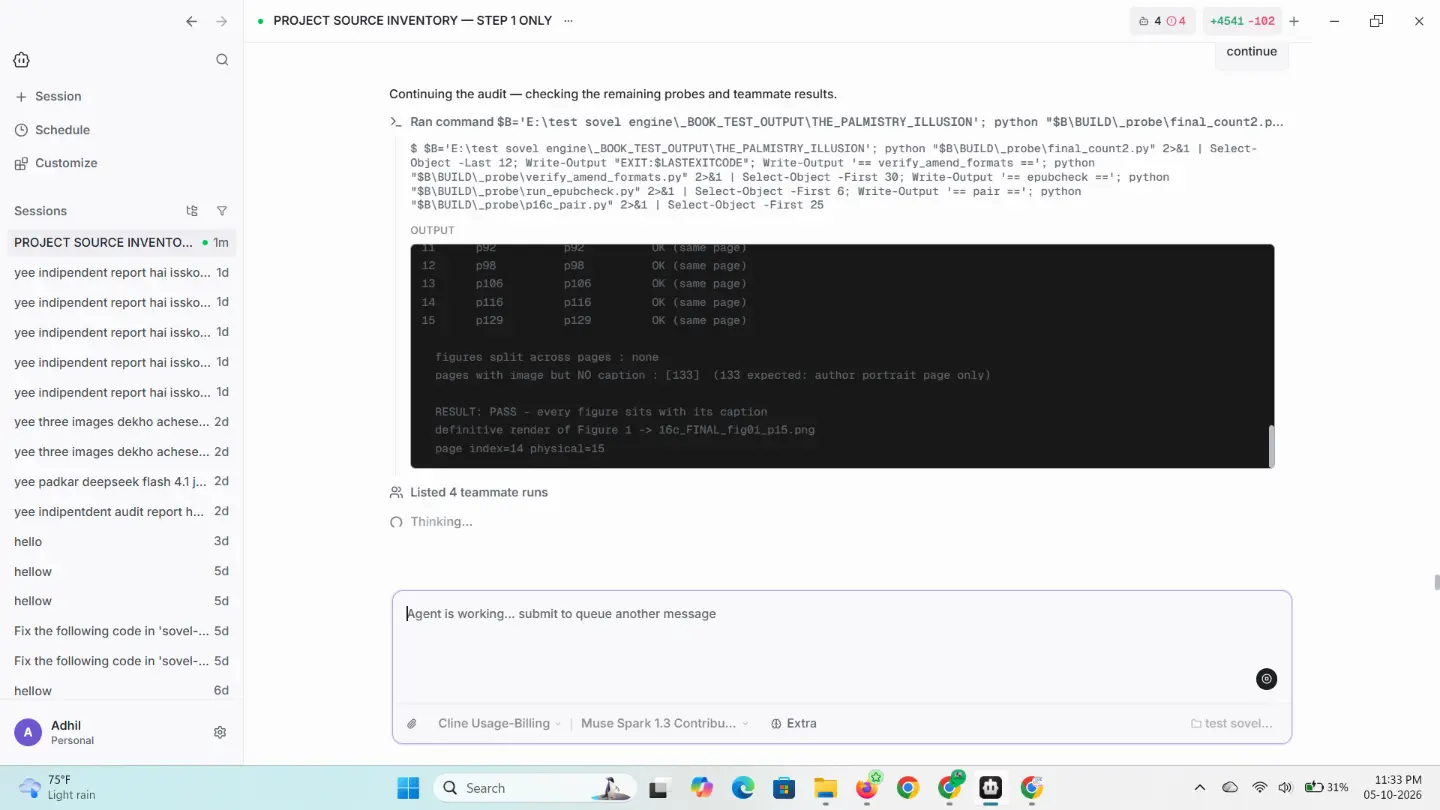
The Case Study: The Palmistry Illusion Controlled Run
To empirically test whether a 50000 word book with ai could be produced without human ghostwriters or editorial chaos, a controlled engineering test was executed on the SOVEL Omni-Agent Engine.
The subject selected for the test was a dense, evidence-disciplined non-fiction work titled *The Palmistry Illusion: What History, Biology, Psychology, and Evidence Reveal About the Lines on Your Hand*, authored by P. Adhil Khan. Rather than writing a generic fantasy story or speculative fiction, this project demanded rigorous factual discipline: synthesizing nineteenth-century clinical studies, developmental biology, cold-reading psychology, and scientific skepticism across 15 distinct chapters.
The results of this baseline run proved that completing a 50000 word book with ai is a practical reality when governed by an engineered production pipeline:
* Exact Manuscript Length: Exactly 50,321 core words (Introduction: 1,677 words; Chapters 1 through 15: 48,644 words).
* Active Drafting Speed: The complete 15-chapter manuscript was drafted and validated in 3 hours, with an additional 2 hours allocated for testing image generation and binding visual figure blocks, totaling 5 hours.
* Print Output Geometry: A 133-page interior print PDF formatted to standard 6 by 9 inch publishing dimensions in accordance with Amazon KDP Print Guidelines, featuring running headers and custom folios numbered 1 through 130.
* Digital Compliance: An EPUB publication with 39 manifest items and 16 image bindings that passed official W3C EPUBCheck Validation with 0 errors and 0 warnings.
* Independent Audit Rating: Evaluated by an independent Project Head audit, the release package received a verdict of PASS WITH NON-BLOCKING ISSUES and an overall engineering score of 9.5 out of 10.
Here are the five practical lessons extracted from this controlled 50000 word book with ai run.
Lesson 1: Models Cannot Retain Context at 50,000 Words
The primary realization when attempting a 50000 word book with ai is that language models cannot hold a full book in memory. Even frontier models with large token windows experience severe attention dilution when managing vast amounts of text.
When prompts pass accumulating chapters into the model context:
* Earlier arguments get repeated as if introduced for the first time.
* Factual definitions blur into vague generalities.
* Stylistic tone fluctuates wildly between academic analysis and conversational chat.
To successfully author a 50000 word book with ai, creators must externalize memory into an immutable local Book Bible. Instead of feeding previous chapters into the context window, the system feeds only the relevant section outline, the primary evidence mapped to that section, and the immediate sentence boundary. This technique eliminates context degradation completely.
Lesson 2: Word Count Floors Must Be Enforced Mathematically
When instructed to write a 3,000-word chapter, conversational models routinely generate between 1,200 and 1,500 words while reporting that the task is finished. If unmonitored, an attempt to produce a 50000 word book with ai results in an underweight manuscript of only 20,000 words.
To overcome this limitation:
- Divide chapters into 4 to 6 numbered subsections, assigning each a mandatory word target (such as 600 or 800 words).
- Measure generated output using strict whitespace token counters immediately upon completion.
- If an agent delivers a subsection under budget, block progression immediately.
- Require the model to expand the section by introducing additional empirical studies or historical case studies rather than conversational filler.
During The Palmistry Illusion benchmark, this mathematical floor gate ensured that all 15 chapters hit their required length, yielding exactly 50,321 core words without artificial padding.

Lesson 3: Claim Prohibitions Are Vital for Factual Authority
In non-fiction writing, preventing false statements is just as critical as generating informative text. When producing a 50000 word book with ai, unconstrained models will naturally repeat popular myths or generate medical claims that damage author credibility.
Before drafting begins, authors must formulate a Claim Prohibition Register:
* Explicitly prohibit pseudo-scientific assertions (such as claiming palmar flexion creases predict lifespans or cardiovascular disease).
* Forbid the presentation of correlations as settled causal facts.
* Restrict speculative medical extrapolations.
In the controlled run of The Palmistry Illusion, 11 explicit claim prohibitions were enforced. When an early draft touched upon traditional fortune-telling claims, the engine blocked progression until the text explicitly distinguished folklore from developmental biology.
Lesson 4: Decouple Prose Drafting from Image Generation
Many authors attempting a 50000 word book with ai make the mistake of generating visual images during the drafting sprint. This introduces cognitive overhead, breaks agent focus, and leads to inconsistent visual styles.
An engineered publication pipeline treats text authoring and visual asset generation as decoupled stages:
* Stage 1 (Prose Drafting): Focus entirely on drafting and validating the 50,000-word text across all 15 chapters.
* Stage 2 (Asset Formulation): Formulate detailed image prompts derived from verified chapter topics.
* Stage 3 (Visual Binding): Bind generated images (such as technical diagrams or historical plates) to specific chapter anchors, verifying that every figure includes an accurate explanatory caption.
In The Palmistry Illusion test, drafting the complete manuscript took 3 hours, while testing image prompts and binding 16 visual figures took 2 hours. Treating these as separate stages ensured that visual production never slowed down manuscript drafting.

Lesson 5: Independent Audits Are Non-Negotiable Before Release
The final lesson from producing a 50000 word book with ai is that the model that writes the text cannot be trusted to audit the final manuscript. Authors must deploy an independent artificial intelligence model with zero prior involvement to evaluate the completed work against objective release standards.
An independent audit verifies:
- Core Word Volumes: Recalculating word counts across multiple independent methods to verify that the manuscript remains within the 50,000 to 52,000 word range without padding.
- Citation Concordance: Verifying that body citations match primary sources preserved in project research dossiers.
- Format Integrity: Running compiled EPUB files through official validators to guarantee zero manifest errors.
- Style and Tone Adherence: Scanning for prohibited claims, repetitive phrases, and stray prompt markers.
In Stage 17 of The Palmistry Illusion, the Project Head audit independently verified all 15 chapters and confirmed that the core manuscript totaled 50,321 words, awarding the release package an engineering score of 9.5 out of 10.
For authors who wish to present their publications interactively on the web, compiled books can also be embedded using SOVEL RealFlip, an interactive 3D page-turning viewer that displays books with realistic physics directly on WordPress pages.
The Mathematical Anatomy of a 50,000-Word Non-Fiction Architecture
To understand how a 50000 word book with ai maintains intellectual rigor without narrative fluff, examine the structural allocation model used during the baseline run of The Palmistry Illusion:
| Structural Component | Chapter Range | Target Word Budget | Empirical Focus Area |
|---|---|---|---|
| Foundation & History | Introduction, Chapters 1 to 3 | 10,200 words | Historical origins, folk traditions, and claim taxonomies |
| Biological & Anatomical Reality | Chapters 4 to 7 | 13,800 words | Embryology, palmar flexion creases, twin genetics, and clinical diagnostics |
| Cognitive Psychology & Cold Reading | Chapters 8 to 11 | 14,200 words | Barnum effect, confirmation bias, subjective validation, and observational cues |
| Evidence Standards & Future Outlook | Chapters 12 to 15 | 12,121 words | Controlled testing protocols, algorithmic mobile scanning, and philosophical inquiry |
When structuring a 50000 word book with ai across this mathematical matrix, each chapter receives an unambiguous empirical mandate. The drafting model is never forced to improvise speculative arguments because each subsection is backed by specific primary studies mapped in the project Book Bible.
Resolving Non-Blocking Editorial Discrepancies
During large-scale manuscript generation, minor editorial discrepancies will emerge between automated stages. A sophisticated publication pipeline handles these non-blocking anomalies without restarting the entire production process:
- Title and Image Binding Alignment: In Stage 16 of The Palmistry Illusion, the reader-facing title for Chapter 4 was finalized as “What Would Count as Evidence?” while the corresponding image binding key was recorded without the question mark as “What Would Count as Evidence”. The Stage 17 independent audit noted this non-blocking variance and confirmed that visual asset bindings resolved cleanly in both PDF and EPUB exports.
- Word Count Sensitivity Analysis: Different word-counting algorithms yield slight variations when handling hyphenated terms and formatted Markdown tables. The Stage 17 audit calculated word counts across four independent methods: governing method produced 50,321 words; independent alternative produced 50,675 words; cross-check B produced 50,282 words; and cross-check C produced 50,636 words. Because all measurements fell squarely within the 50,000 to 52,000 word specification without artificial padding, the manuscript passed verification decisively.
- Author Identity Preservation: The audit verified that the author biography remained evidence-disciplined, including a 212-word biography and 10 selected works without fabricated credentials or unverified claims.
Managing these nuances with verifiable audit reporting ensures that your 50000 word book with ai satisfies professional publishing standards with complete evidentiary integrity.
Production Checklist: Pre-Flight Verification Gates for Full-Length Manuscripts
Before releasing a 50000 word book with ai to commercial distribution platforms, execute these five mandatory verification gates:
* Gate 1: Word Volume Floor Gate: Recalculate word totals across all 15 chapters to verify that the core volume hits the 50,000-word threshold without repetitive filler.
* Gate 2: Claim Prohibition Verification: Scan the complete manuscript against the Claim Prohibition Register, confirming zero violations of medical or pseudo-scientific guidelines.
* Gate 3: Structural Integrity and Heading Depth: Confirm that chapter titles match table of contents entries exactly and that heading levels (##, ###) follow strict hierarchical nesting.
* Gate 4: Visual Asset Reconciliation: Verify that all 15 chapter figures and the author portrait are bound to valid image keys with descriptive alt text and explanatory captions.
* Gate 5: Multi-Format Packaging Validation: Test EPUB files using EPUBCheck to guarantee zero XML errors, and verify that interior print PDFs comply with 6 by 9 inch trim dimensions.
Completing this checklist guarantees that your 50000 word book with ai reaches retail distribution ready for immediate publication. Publishing agencies and commercial studios rely on these exact verification criteria to deliver flawless client manuscripts on fixed deadlines without post-release revision cycles.
The Complete Production Timeline: 8 Hours vs 70 Hours
Completing a 50000 word book with ai using traditional manual methods requires an average of 70 hours: drafting takes weeks, manual editing is exhausting, and formatting print PDFs and EPUBs introduces constant technical friction.
With an engineered production pipeline, this multi-week ordeal is compressed into an 8-hour sprint:
* Hours 1 to 2: Ingest primary research sources, extract content gaps, and lock project architecture.
* Hours 3 to 5: Execute governed drafting sprints across all 15 chapters using mathematical word floors.
* Hours 6 to 7: Bind visual figure plates, verify citations, and run automated continuity scans.
* Hour 8: Execute independent audits and compile release-ready print PDFs, EPUB3 files, and Word documents.
This predictable timeline allows authors, consultants, and publishing agencies to deliver publication-grade non-fiction volumes on demand.
Commercial Licensing: Three Production Editions
The SOVEL Omni-Agent Engine packages the complete operating system to produce a 50000 word book with ai across three commercial licensing editions on sovel.pro:
* Personal Edition (Solo Creator License): Rs 4,999 one-time payment. Designed for individual non-fiction authors self-publishing on Amazon KDP. Includes full 16-stage pipeline access, structural locks, and word floor gates for 1 local workstation.
* Pro Developer Edition (Commercial License): Rs 8,999 one-time payment. Built for software engineers, technical solopreneurs, and professional content creators. Includes AST validation, Token Depletion Resume Protocol, and dual-workstation support.
* Agency Suite (Commercial Client License): Rs 19,999 one-time payment. Built for publishing houses and digital agencies delivering custom books and whitepapers for executive clients. Includes 5 workstation licenses, white-label client kits, and 20 master prompt contracts.
Test the reading experience yourself using SOVEL RealFlip to see how full-length books render interactively on the web.
Frequently Asked Questions
Can AI really write a high-quality 50,000-word book in 8 hours?
Yes. When governed by external architectural locks, mathematical word budgets, and automated verification gates, the actual drafting of a 50000 word book with ai takes 3 to 5 hours, leaving remaining hours for verification and compilation.
How do you prevent repetitive writing across 15 chapters?
By breaking the book into discrete evidence units, mapping specific primary research studies to each subsection, and enforcing lexical diversity algorithms that reject repetitive prose.
What file formats does the production pipeline generate?
The system compiles valid OOXML Word documents, 6 by 9 inch interior print PDFs with custom folios, and EPUB3 files validated by official EPUBCheck tools.
What is the purpose of a Claim Prohibition Register?
It establishes explicit negative constraints, forbidding the generative model from making unproven claims, repeating folklore, or presenting correlations as established scientific facts.
Do I need coding experience to produce a book using this engine?
No. The engine operates using structured markdown files and guided prompt contracts executed within local code editors or writing environments.
How does the engine ensure EPUB files pass retail platform checks?
The system compiles digital publications strictly compliant with IDPF and W3C specifications, testing output files against EPUBCheck to verify zero schema errors.
Where can I acquire the complete engine to produce a 50,000-word book?
You can access the complete publishing operating system through the SOVEL Omni-Agent Engine on sovel.pro, providing authors, engineers, and digital agencies with full 16-stage pipeline automation and verifiable quality controls.