SYSTEMMethodologyDeveloperSystems family

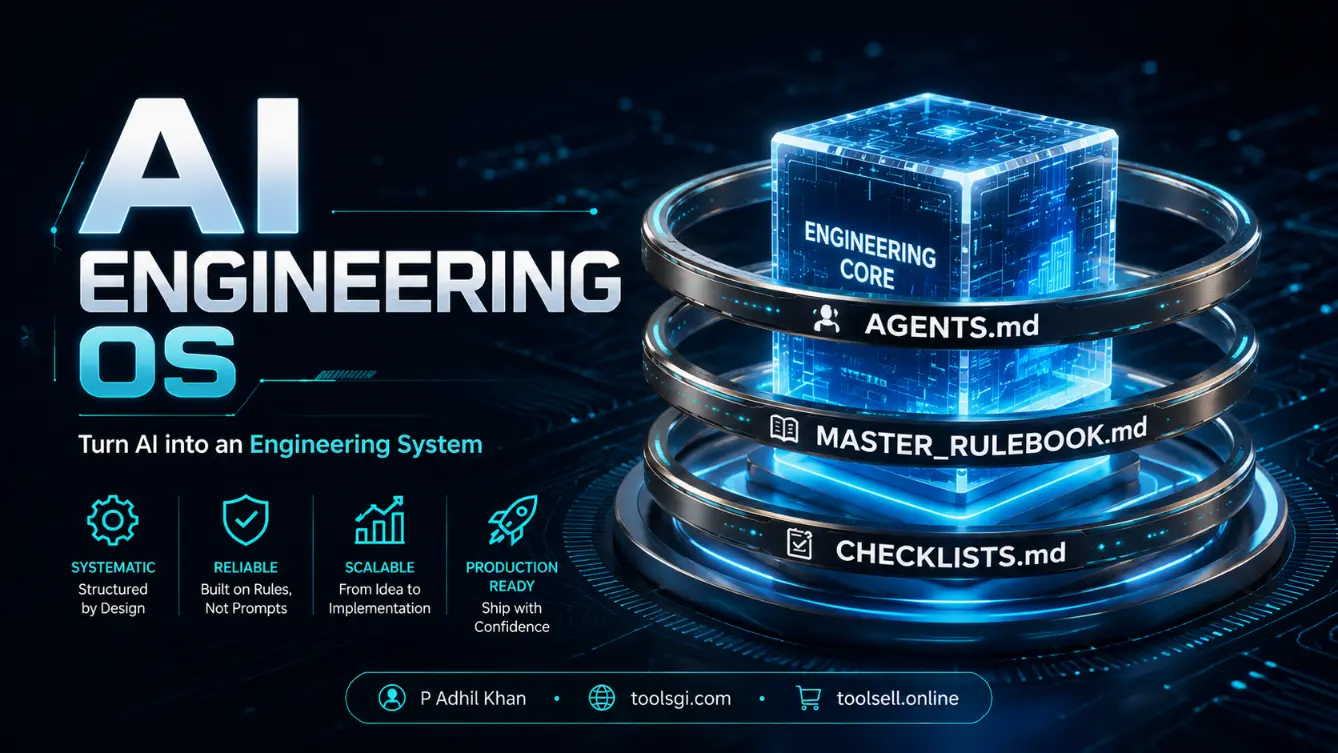
AI Engineering OS

Turn unstructured AI engineering into repeatable, verified delivery with 42 checklists and a 7-stage lifecycle.

Overview

AI Engineering OS is an AI-assisted engineering methodology and project operating system. It provides repeatable engineering structure around whichever supported AI environment you choose.

It is not a chatbot, a prompt pack or a generic AI tool. It is the structure that surrounds the AI: context, requirements, research, planning, architecture, controlled implementation, verification, documentation, quality gates, evidence, project state and reusable workflow.

“Operating system” is a product-layer metaphor. AI Engineering OS is not a computer operating system and does not replace your operating system, editor or toolchain.
Engineering Lifecycle Flow

  1. IdeaConcept & scope
  2. ResearchMulti-model investigation
  3. RequirementsSystem constraints
  4. PlanArchitecture & schema
  5. BuildAgentic execution
  6. Test42 checklist gates
  7. ReviewQuality verification
  8. ReleaseVerified completion
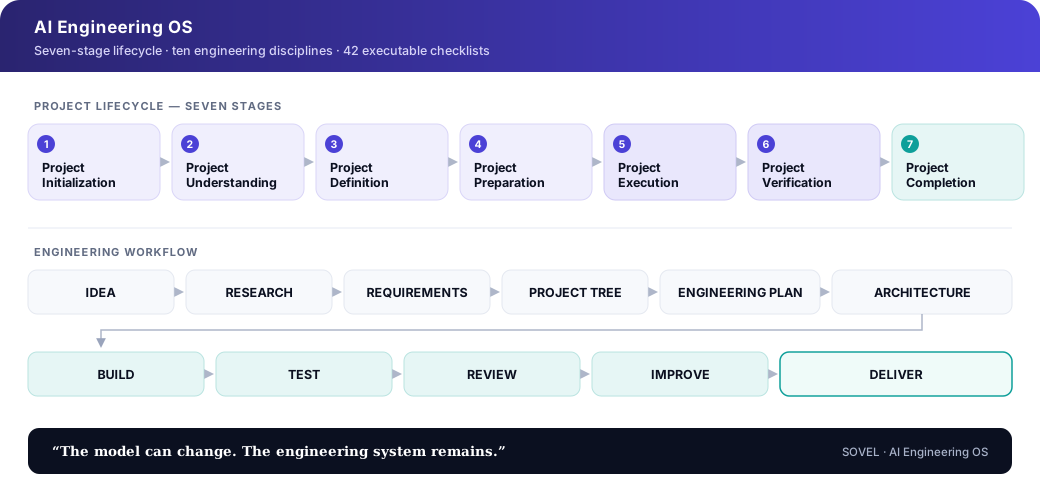
Diagram showing the AI Engineering OS seven-stage project lifecycle — Project Initialization, Project Understanding, Project Definition, Project Preparation, Project Execution, Project Verification and Project Completion — above the engineering workflow: Idea, Research, Requirements, Project Tree, Engineering Plan, Architecture, Build, Test, Review, Improve, Deliver.
The seven-stage lifecycle and the engineering workflow the system enforces.
Core principle

The model can change. The engineering system remains.

Because the structure is independent of any single AI environment, switching model or assistant does not invalidate the project.

Primary class
SYSTEM
Family
Systems
Lifecycle
7 stages
Disciplines
10
Checklists
42

Problem solved

AI-assisted development is usually unstructured. Work begins without agreed requirements, research is not consolidated, architecture is improvised, and “done” is a subjective claim rather than a verified state. The result is work that cannot be reviewed, repeated or handed over.

AI Engineering OS addresses unstructured AI engineering by enforcing a defined sequence with explicit entry and exit conditions and quality gates at each stage — so progress is evidenced rather than asserted.

Who it is for

  • Developers and engineers running AI-assisted projects who need repeatable structure rather than ad-hoc prompting.
  • Technical founders and small teams who must take a project from an idea to a maintainable, documented deliverable.
  • Anyone handing work over — the system produces the project state, decisions and evidence a second person needs to continue.

It is not intended for one-off questions, casual prompting, or tasks with no deliverable and no review step.

How it works

The system layers three structures on top of each other.

1 · Seven-stage lifecycle

Every project moves through Project Initialization, Understanding, Definition, Preparation, Execution, Verification and Completion. Each stage has a purpose, entry and exit conditions, and quality gates.

2 · Ten engineering disciplines

Engineering Foundation, Project Discovery, Requirement Analysis, Research, Planning, Architecture, Development, Verification, Deployment, and Operations & Maintenance.

3 · 42 executable checklists

The checklists convert subjective claims such as “finished” into evidence-backed PASS, FAIL or CONDITIONAL PASS states.

Visual overview

A short overview of the system. The video is optional and loads only on request.
AI Engineering OS
Turn unstructured AI engineering into repeatable, verified delivery with 42 checklists and a 7-stage lifecycle.

Real workflow

The documented workflow runs in this order:

  1. IDEA
  2. RESEARCH
  3. REQUIREMENTS
  4. PROJECT TREE
  5. ENGINEERING PLAN
  6. ARCHITECTURE
  7. BUILD
  8. TEST
  9. REVIEW
  10. IMPROVE
  11. DELIVER

The documented founder workflow

The reference workflow the system was built around:

  • Idea definition with an AI
  • External research using multiple models
  • Consolidation of findings
  • Outline generation
  • Project tree
  • Checklist
  • Source repository
  • Master prompt
  • Coding agent execution

Key features

Governed execution

  • Stage gates, not vibes — each lifecycle stage has entry and exit conditions, so work cannot silently skip a step.
  • Evidence-backed completion — 42 checklists produce PASS, FAIL or CONDITIONAL PASS instead of a subjective “done”.

Portability

  • Environment-independent — designed to wrap whichever supported AI environment you use.
  • Project state that survives handover — decisions, structure and evidence are recorded, not held in one person’s head.

Reuse

  • Reusable across projects — the same structure applies to a new project without rebuilding the process each time.
  • Documentation as an output — the process produces the record of what was built and why.

What’s included

Core system

The master rulebook defining the lifecycle, disciplines and gates, agent guidance for AI assistants and coding agents, and the 42 executable engineering checklists.

Prompt library — 24 prompts

Covering new projects, existing codebases, software products, websites, WordPress plugins and themes, WooCommerce, AI agents, API integration, automation, refactoring, debugging, research, architecture, verification, documentation, maintenance, multi-model review, and beginner and developer modes.

Workflow guides — 15

Including the full engineering lifecycle, idea-to-product, local testing, model handoff and multi-model review, plus dedicated workflows for WordPress plugins and themes, WooCommerce, software products, websites, APIs, AI agents, automation, existing projects and book engines.

Worked examples — 12

Starting points across project types: a non-coder idea, a website, a software tool, a WordPress plugin, a WordPress theme, a browser extension, a mobile application, an AI agent, an existing codebase, a client freelance project, a book engine and a multi-model collaboration.

Platform guides — 7

Guidance for the AI environments the system is designed to wrap, so the methodology is not tied to a single vendor.

Getting started

User guide, quick start, beginner and developer mode guides, build-from-scratch and existing-codebase workflows, product overview, FAQ and changelog.

On package size

The package is substantial in volume, but volume is not the product. The value is the reusable structure — the size is evidence of depth, not the reason to buy.

For a breakdown of how this documentation is organised, see Documentation.

Requirements & compatibility

Environment
A Markdown-capable editor or workspace.
AI access
Access to an AI assistant or coding agent of your choice.
Compatibility
Environment-independent by design — the engineering structure is not tied to a single model or vendor.
Platform guides
Seven platform guides ship with the package, covering major AI environments and coding agents.
Skill level
Comfortable running a technical project from requirements through to delivery. The package also includes a beginner mode guide.

Full package contents are summarised on Documentation.

Examples & usage

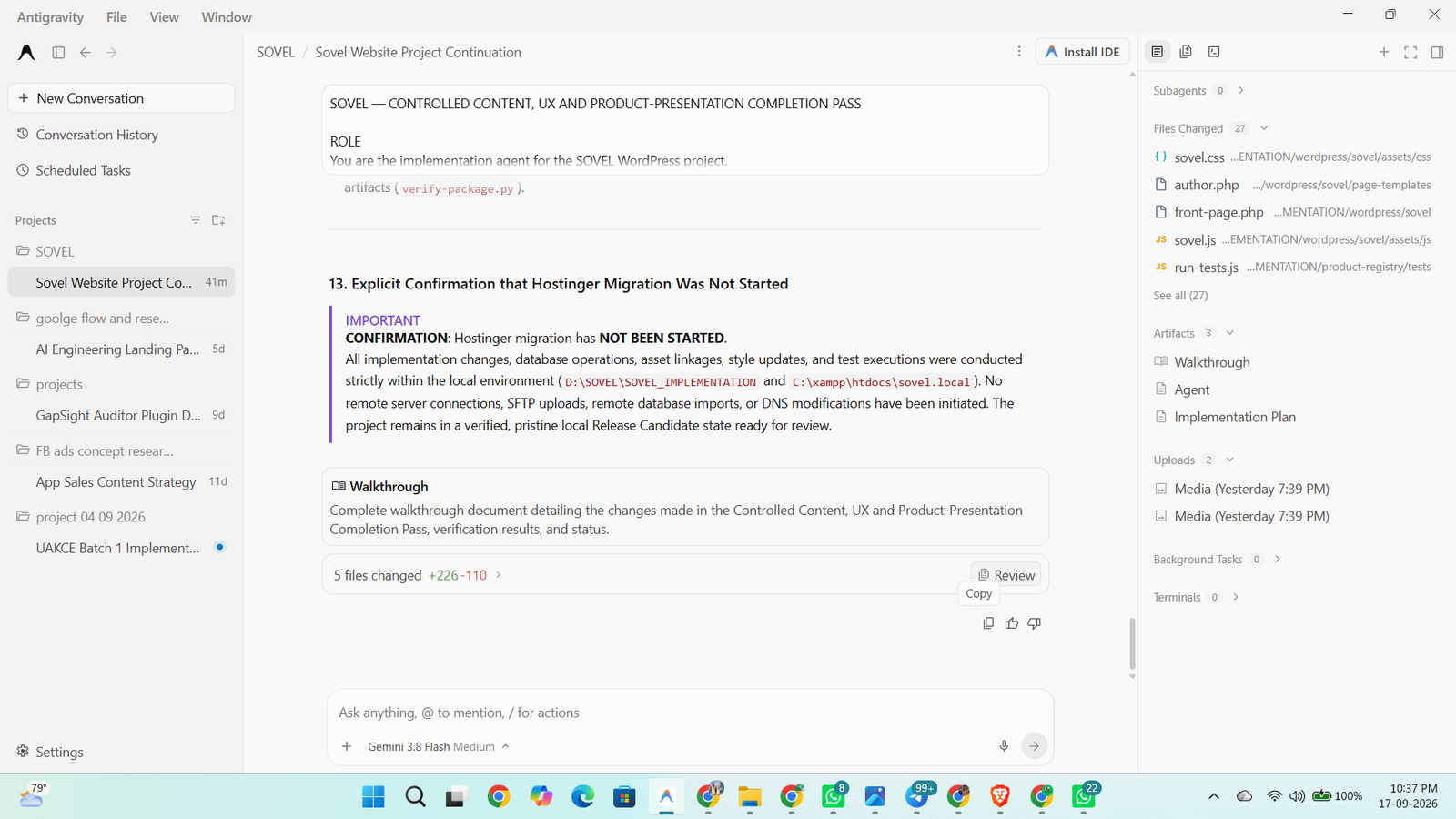
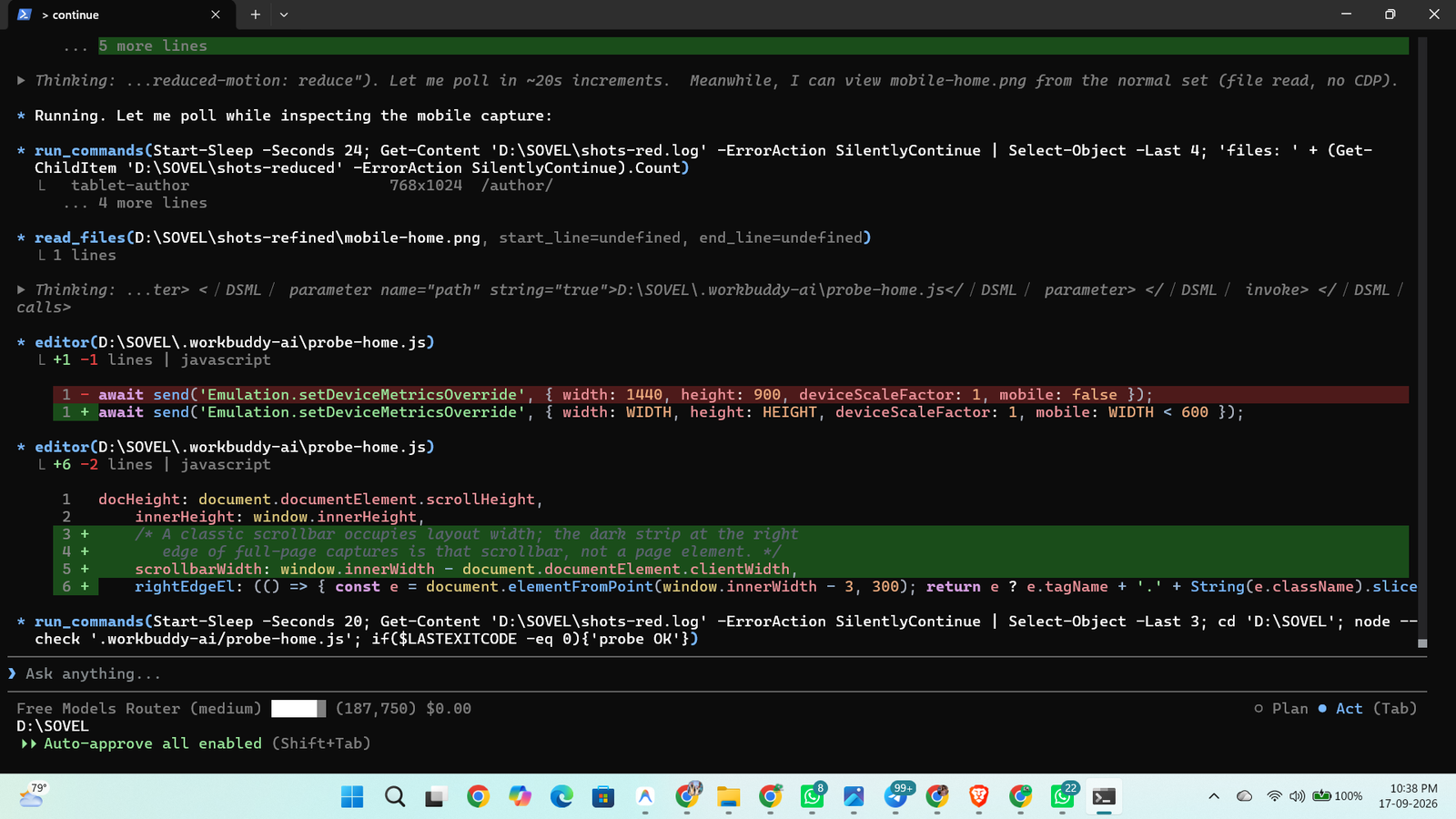
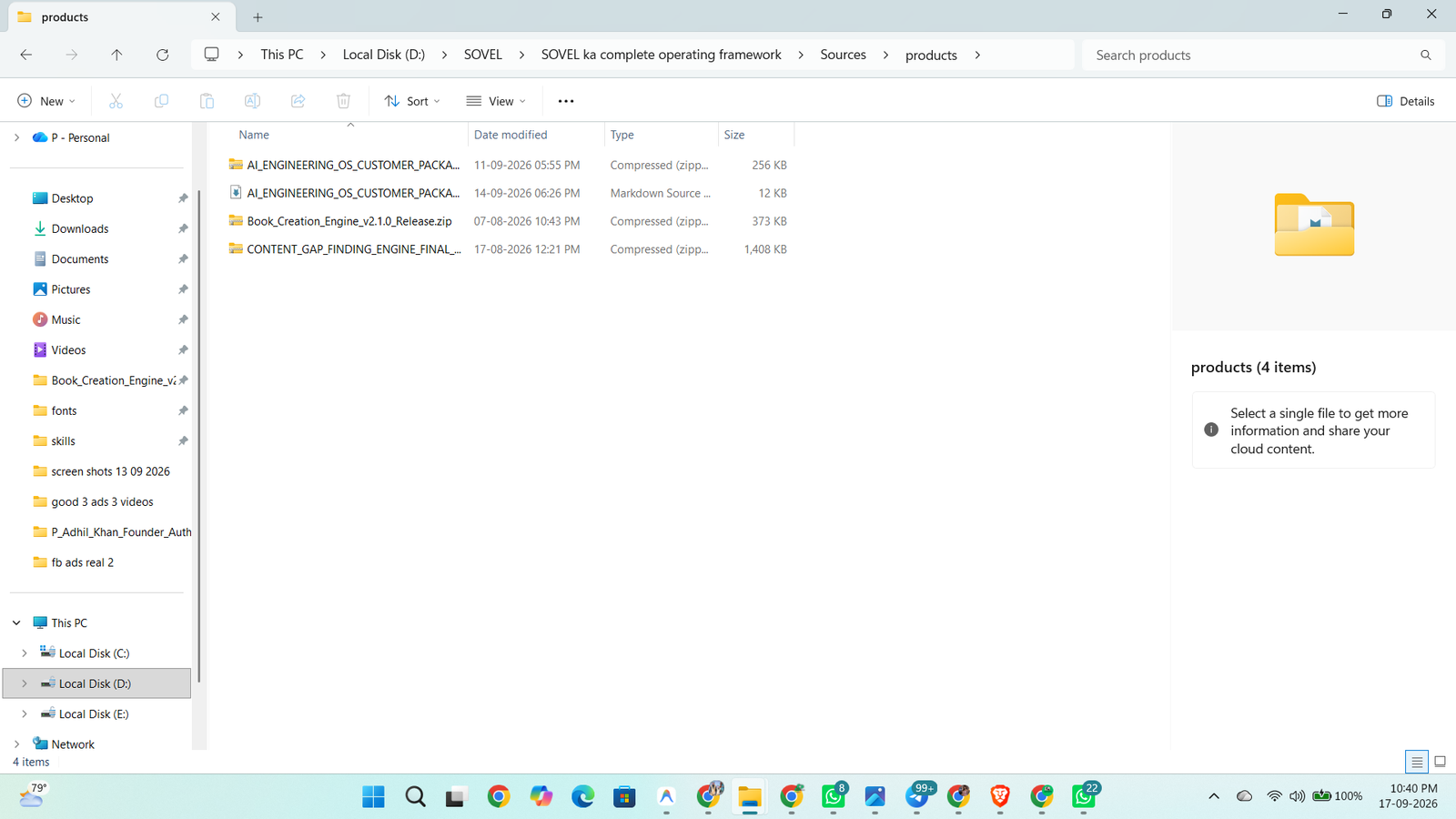
The worked workflow below demonstrates how the AI Engineering OS methodology governs real-world technical delivery. In practice, an engineering project progresses through eight disciplined phases: Source material → Requirements → Project structure → Architecture → Agent-assisted implementation → Testing → Review → Correction → Regression verification. The evidence panels below show genuine artifacts captured during active implementation and verification of the SOVEL platform.

STAGE 5 · AGENT EXECUTION
Antigravity workspace showing the SOVEL website project and implementation workflow.

Antigravity Workspace & Implementation Workflow

Antigravity workspace showing the SOVEL website project and implementation workflow.

Captured during local SOVEL development · project workspace repository
STAGE 6 · VERIFICATION GATES
WorkBuddy development session showing responsive and mobile verification testing inside the SOVEL project.

WorkBuddy Automated Responsive & Mobile Testing Session

WorkBuddy development session showing responsive and mobile verification work for the SOVEL project.

Automated headless browser capture session · probe-home.js
STAGE 7 · RELEASE ARTIFACTS
Windows Explorer showing SOVEL product source packages including AI Engineering OS, Book Creation Engine and Content Gap Finding Engine.

Customer Package Archives & Source File Structure

Windows Explorer showing SOVEL product source packages including AI Engineering OS, Book Creation Engine and Content Gap Finding Engine.

Windows file system view · Sources\products

Pricing, licensing & delivery

₹999 One-time investment · Lifetime commercial license
VERIFIED RELEASE
  • Digital delivery: Instant customer ZIP download containing CORE rulebooks, 42 checklists, 24 prompts, 15 workflows, and platform guides.
  • Commercial use: Deploy across personal, client, and production software projects without recurring subscription fees.
  • Governed structure: Package includes verified checksums, rulebooks, prompts, workflows, and executable checklists.
  • Support & updates: Direct access to official SOVEL documentation, changelog records, and customer support.

Documentation

Comprehensive package documentation is included directly within the product archive. This product page serves as the public documentation and specification surface, with indexed platform guidance on Documentation.

Package documentation included

Changelog

Version history and release notes are maintained directly in the product package changelog. The current release represents the active stable build (v1.0.0+), with lifetime 1.x maintenance updates included.

Active release

Support

Customer support and technical inquiries are handled directly via support@sovel.pro. Review coverage guidelines, requirements, and triage workflows on Support & contact.

FAQ

Is this a prompt pack?

No. A prompt pack is a collection of text. AI Engineering OS is a structured engineering system: a lifecycle with gates, ten disciplines and 42 checklists that produce evidence-backed completion states.

Do I need a specific AI model?

No. The system is designed to provide structure around whichever supported AI environment you choose. The model can change; the engineering system remains.

Is it a computer operating system?

No. “Operating system” describes the product layer — it is a metaphor for the structure it provides, not a system that runs your machine.

Can I use it for a non-software project?

The lifecycle and disciplines are engineering-oriented. Non-technical projects can use the structure, but the checklists assume a technical deliverable.

How do I buy it?

You can purchase directly via the Buy Now button for ₹999 (INR). Payment is processed securely via UPI, Cards, or NetBanking (via Razorpay) or PayPal, with immediate verified digital archive download.

Builder

AI Engineering OS is built by P. Adhil Khan.

See the rest of the platform.

The product library shows each family, what it is for, and how the documented products actually work.