ENGINEResearch softwareResearch family

Content Gap Finding Engine

Turn a content or market question into an evidence-classified gap report — with every finding labelled by how well it is actually known.

Overview

Content Gap Finding Engine is an executable, evidence-led research engine for content and market research. It runs a defined research workflow and produces a report that distinguishes what has been verified from what has not.

It is not a content generator and not a keyword tool with a report bolted on. The engine owns the research logic, the orchestration, the scoring and the evidence trail — and it refuses to upgrade an unknown into a fact.
Evidence-Led Research Pipeline

  1. InputQuery & landscape ingestion
  2. ResearchMulti-source intelligence
  3. AnalysisStructured dimension mapping
  4. EvidenceStrict claim classification
  5. Gap DetectionDefensible opportunity scoring
  6. ReportDecision-ready executive brief
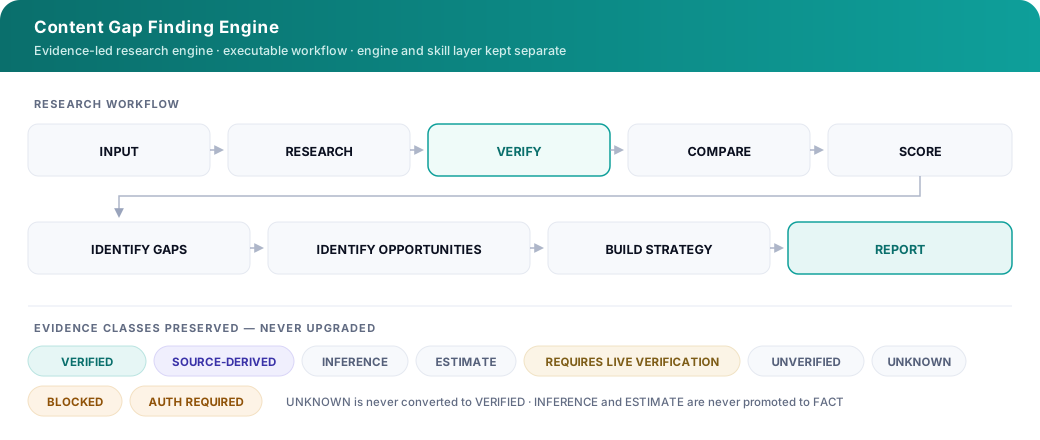
Diagram of the Content Gap Finding Engine workflow: Input, Research, Verify, Compare, Score, Identify Gaps, Identify Opportunities, Build Strategy, Report. Below it, the preserved evidence classes: Verified, Source-derived, Inference, Estimate, Requires live verification, Unverified, Unknown, Blocked and Auth required.
The research workflow, and the evidence classes the engine preserves.
Primary class
ENGINE
Family
Research
Workflow
9 steps
Output
Evidence-classified report

Problem solved

Most content research produces a confident-looking list built on unverifiable inputs. A tool reports a keyword volume, an inference is written as a fact, and a blocked source quietly becomes a plausible number. The output looks decision-ready but cannot be trusted.

Content Gap Finding Engine addresses this by making the evidence trail part of the product. Every finding carries its class, comparisons and scores are explicit, and where something could not be verified, the report says so instead of filling the gap.

Who it is for

  • Content strategists and SEO practitioners who need to justify priorities with evidence rather than assertion.
  • Founders and marketers evaluating where to publish and what to build content around.
  • Analysts who need a repeatable research process and an auditable output.
  • Teams with compliance or accuracy constraints who cannot publish claims that were never verified.

It is not intended for bulk article generation or for anyone who wants a single number without the reasoning behind it.

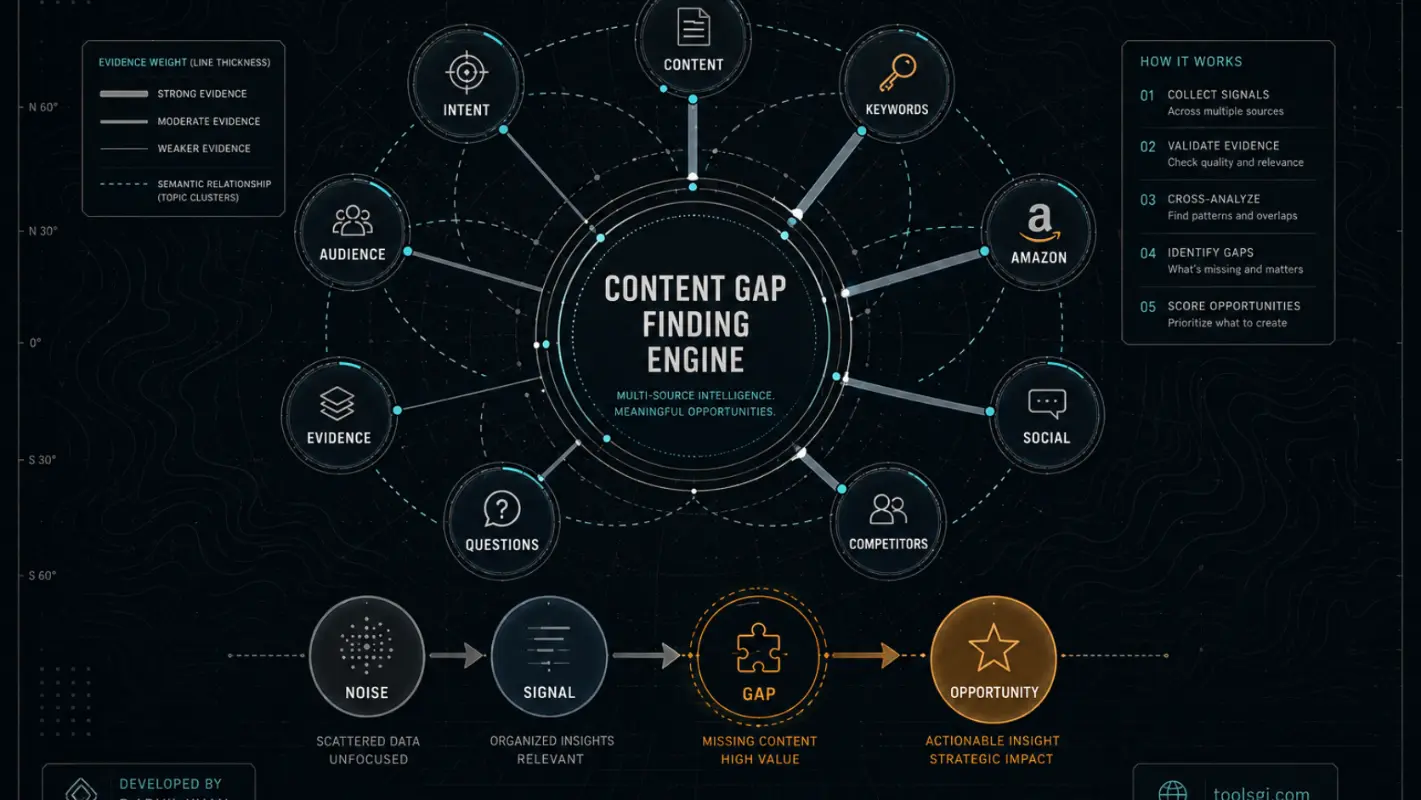
Visual overview

Content Gap Finding Engine
Turn a content or market question into an evidence-classified gap report — with every finding labelled by how well it is actually known.

Real workflow

The engine runs a nine-step research workflow, ending in a report.

  1. INPUT
  2. RESEARCH
  3. VERIFY
  4. COMPARE
  5. SCORE
  6. IDENTIFY GAPS
  7. IDENTIFY OPPORTUNITIES
  8. BUILD STRATEGY
  9. REPORT

Evidence rules

The engine preserves a fixed set of evidence classes through the whole workflow, so a reader always knows how well something is actually known.

VERIFIEDSOURCE-DERIVEDINFERENCEESTIMATEREQUIRES LIVE VERIFICATIONUNVERIFIEDUNKNOWNBLOCKEDAUTH REQUIRED
Non-negotiable

The engine never converts:

  • UNKNOWN → VERIFIED
  • INFERENCE → FACT
  • ESTIMATE → FACT
  • a blocked source → a fabricated result

A source that is blocked or behind authentication is reported as blocked or auth-required — never replaced with a plausible-looking answer.

Key features

Research integrity

  • Evidence classification end to end — every finding carries its class.
  • Explicit verification step — findings are checked before they are compared or scored.
  • No silent upgrades — unknowns and inferences stay labelled.

Analysis

  • Structured comparison — findings are compared on defined dimensions, not on impression.
  • Scoring — opportunities are scored so priorities are defensible.
  • Gap and opportunity identification — the analysis produces named gaps and opportunities, not a raw dump.
  • Strategy output — the report ends in a strategy, not a data export.

Architecture

  • Engine and skill layer separated — the engine owns research logic, orchestration, adapters, scoring, evidence, storage, reports and execution; the skill layer owns detection, routing, instruction, fallback and the stand-in workflow. The skill layer never overwrites engine code.

What’s included

The research engine

A runnable engine that owns the research logic, orchestration, adapters, scoring, evidence handling, storage, reports and execution.

The skill layer

A separate operator layer that owns detection, routing, instruction, fallback and the stand-in workflow. It never overwrites engine code.

Stand-in mode

When a full engine runtime is unavailable, the skill layer can run in a documented stand-in mode — and every artefact it produces is labelled as stand-in rather than presented as a full run.

An indexed prompt library

Each prompt defines its input, context, engine action, expected output, assumptions and evidence handling.

Setup and self-check tooling

A dedicated API credential setup guide, a built-in diagnostic command that reports pass or fail, and an automated test suite.

Sample inputs and integrity checks

Sample input data so a first run needs no preparation, plus published checksums so a delivered package can be verified.

For a breakdown of how this documentation is organised, see Documentation.

Requirements & compatibility

Input
A content or market research question, plus any seed sources or target set.
Output
An evidence-classified gap and opportunity report with a strategy.
Runtime
The engine is a command-line application. A Python runtime and an isolated environment are required for a full engine run.
Credentials
Research adapters require API credentials. A dedicated setup guide is included with the package.
Without a runtime
The skill layer can run in a documented stand-in mode, labelling every artefact it produces as stand-in rather than presenting it as a full engine run.
Delivery form
Instant customer ZIP download containing Python engine, CLI tooling, tests, and documentation.

Full package contents are summarised on Documentation.

Examples & usage

The real engine evidence below demonstrates the genuine Content Gap Finding Engine package structure, analytical workflows, and evidence discipline. In live operation, CGFE ingests research inputs, computes multi-source intent discrepancies, classifies findings under strict evidence tags (with AUTH_REQUIRED and BLOCKED preserved where sources are gated), and compiles structured opportunity reports. Below is verified documentation and architectural evidence from the release repository.

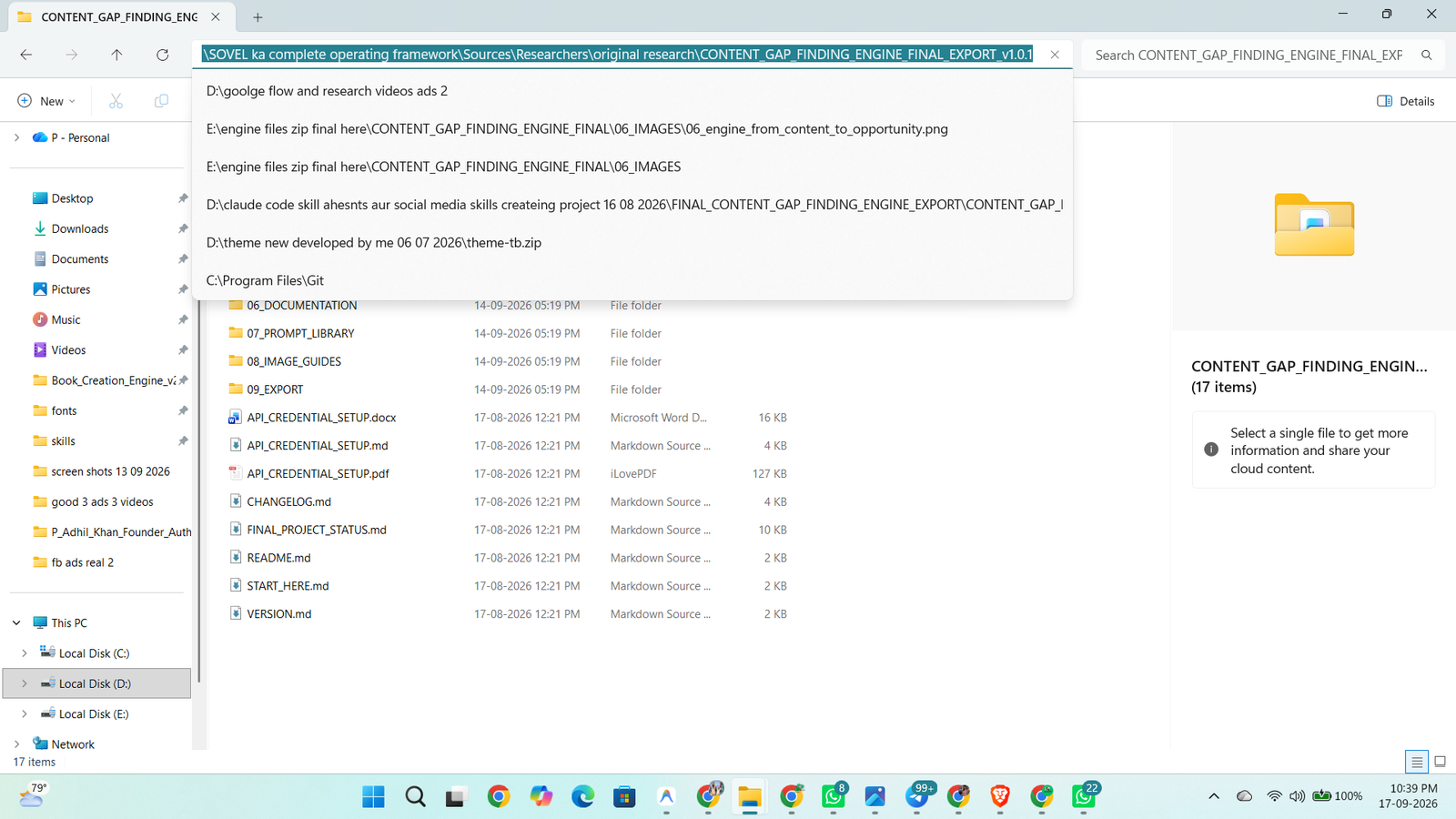
GENUINE REPOSITORY STRUCTURE
Windows Explorer showing the Content Gap Finding Engine project structure and documentation folders.

Engine Repository & Documentation Package

Windows Explorer showing the Content Gap Finding Engine project structure, documentation, and configuration folders.

Windows file system view · CONTENT_GAP_FINDING_ENGINE_FINAL_EXPORT_v1.0.1
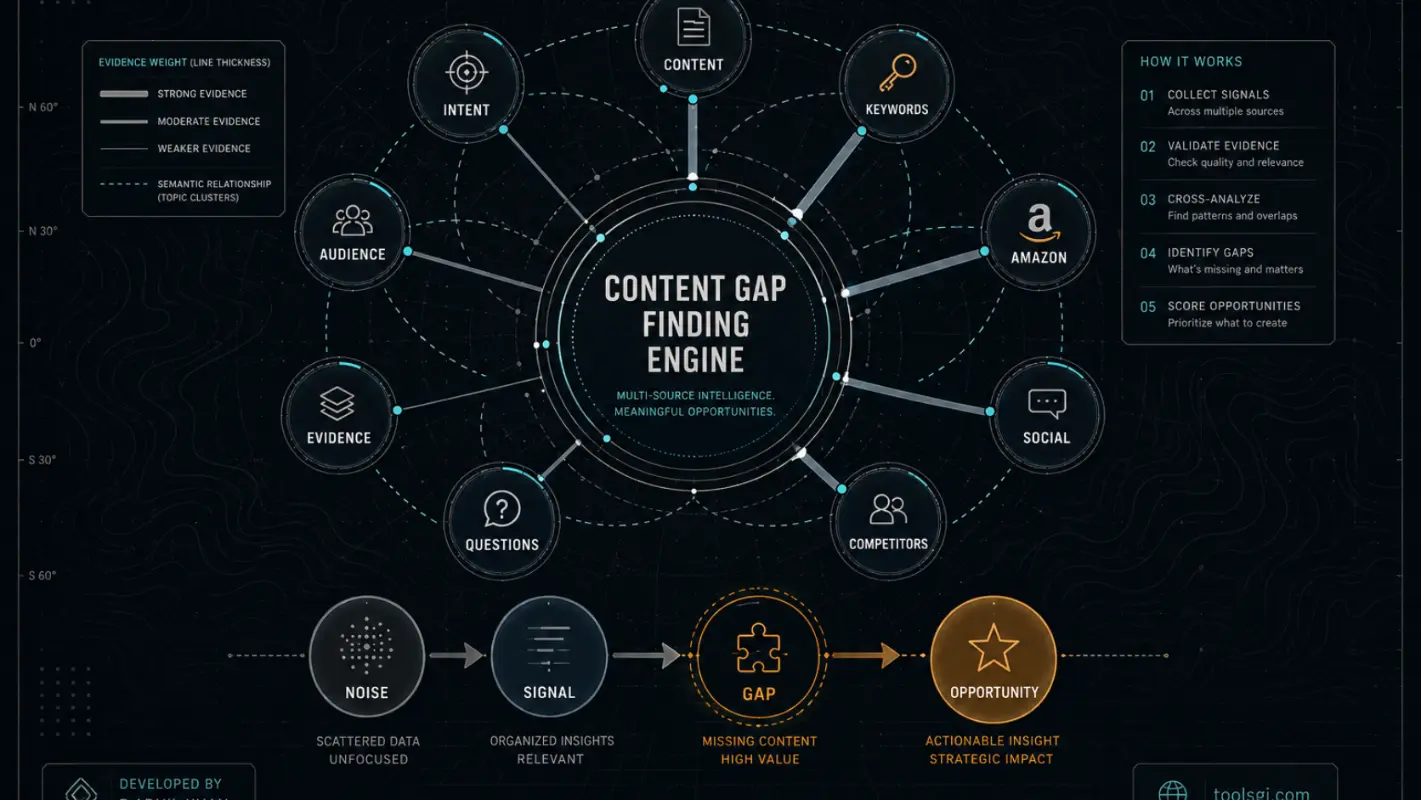
9-STAGE DISCOVERY WORKFLOW
CGFE multi-source gap analysis and market intelligence map.

Market Whitespace & Gap Intelligence Mapping

CGFE multi-source gap analysis mapping competitor topic coverage, intent discrepancies, and unaddressed search demand.

Engine output specification · 08_IMAGE_GUIDES
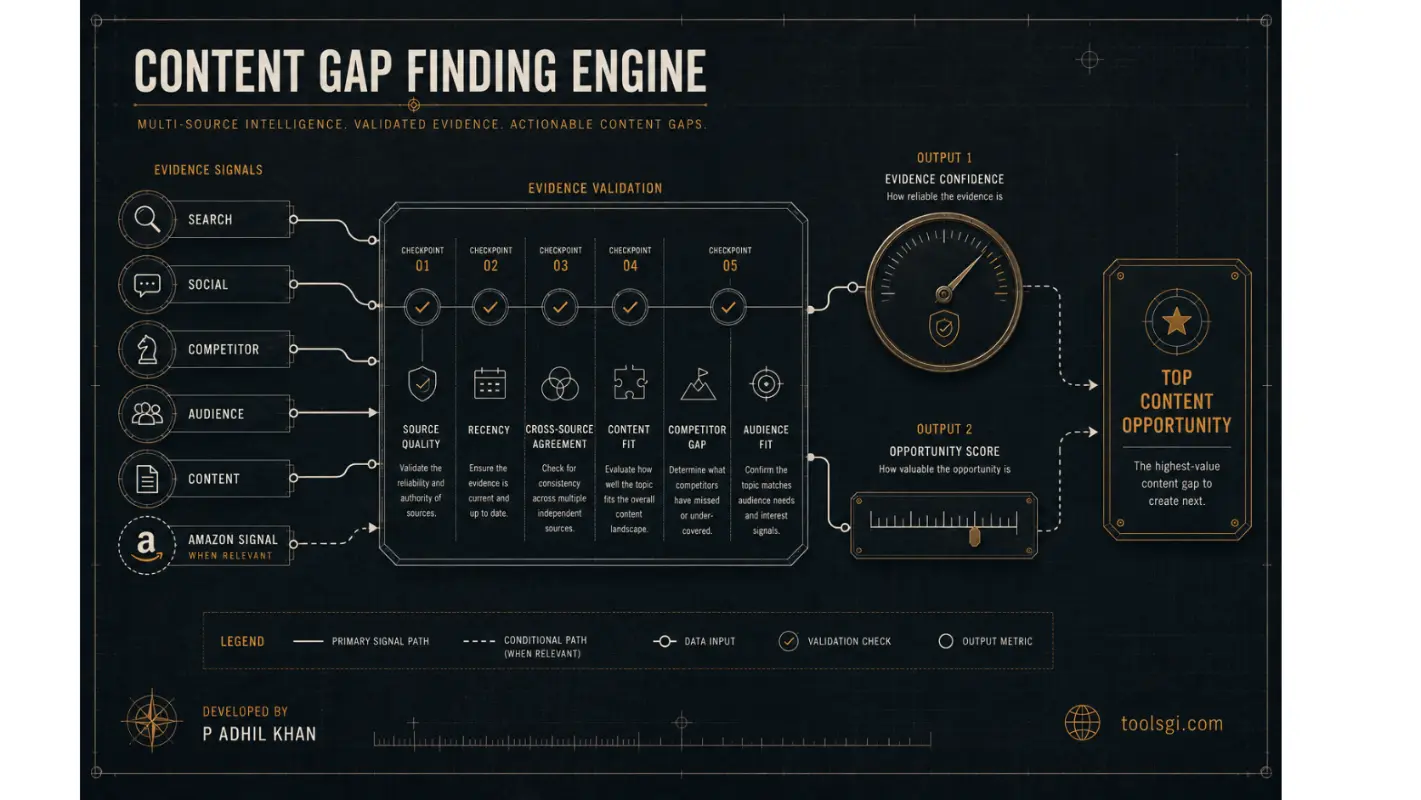
EVIDENCE CLASSIFICATION SCHEMA
CGFE evidence classification schema and validation gates.

Evidence Rules & Gate Enforcement

CGFE evidence tagging framework enforcing strict isolation between verified facts, direct quotes, benchmarks, and unverified signals.

Engine governance rulebook · 06_DOCUMENTATION

Pricing, licensing & delivery

₹2,999 One-time investment · Lifetime commercial license
VERIFIED RELEASE
  • Digital delivery: Instant customer ZIP download containing Python research engine, 79 unit tests, diagnostic CLI, and prompt library.
  • Commercial use: Deploy across personal, client, and production software projects without recurring subscription fees.
  • Governed structure: Package includes verified checksums, rulebooks, prompts, workflows, and executable checklists.
  • Support & updates: Direct access to official SOVEL documentation, changelog records, and customer support.

Naming

Content Gap Finding Engine is the canonical public name for this product across the SOVEL platform, product registry, and customer packages, reflecting its architecture as an executable, evidence-led research engine.

The product is published and distributed under this name, with the permanent canonical URL /content-gap-finding-engine/.

Canonical public name verified

Documentation

Comprehensive package documentation is included directly within the product archive. This product page serves as the public documentation and specification surface, with indexed platform guidance on Documentation.

Package documentation included

Changelog

Version history and release notes are maintained directly in the product package changelog. The current release represents the active stable build (v1.0.0+), with lifetime 1.x maintenance updates included.

Active release

Support

Customer support and technical inquiries are handled directly via support@sovel.pro. Review coverage guidelines, requirements, and triage workflows on Support & contact.

FAQ

Is this a content generator?

No. It is a research engine. It produces an evidence-classified gap and opportunity report with a strategy — not bulk articles.

What happens when a source is blocked?

The report records it as blocked or auth-required. The engine does not substitute a fabricated result.

Can it tell me a number I cannot verify?

It can record an estimate, but it will label it an estimate. An estimate is never presented as a fact.

Is it available to buy?

Yes. Content Gap Finding Engine is available for direct purchase at ₹2,999 (INR) with instant digital delivery of the Python research engine, test suites, and diagnostic tooling.

Builder

Content Gap Finding Engine is built by P. Adhil Khan.

See the rest of the platform.

The product library shows each family, what it is for, and how the documented products actually work.