
Why Modern Digital Creators Need an Engine Architecture Instead of Ephemeral Prompts
The global software and digital publishing markets are experiencing an unprecedented transformation. Every month, new artificial intelligence language models arrive with massive marketing campaigns: GPT-4o, Claude 3.5 Sonnet, Gemini 2.0 Flash, DeepSeek R1, and Grok 3. Most beginners and freelancers make the mistake of chasing each new model, believing that a slightly smarter chatbot will automatically write better code or generate profitable digital products from a single prompt. This approach inevitably fails. When you rely on casual conversational prompts, the output is shallow, full of hallucinated syntax, and lacking architectural integrity.
To build sustainable digital assets, software utilities, themes, plugins, and comprehensive reference books, you do not need newer chat models. You need a permanent, disciplined ai digital product development workflow. Artificial intelligence models are disposable tools that change with every technological cycle, but engineering workflows, file treemaps, verification checklists, and execution protocols remain enduring foundations. When you master a structured workflow, you can plug in any language model, whether through expensive commercial subscriptions or completely free token routers, and reliably produce enterprise-grade software and publications.
By connecting three specialized systems, the Content Gap Finding Engine, the AI Engineering OS, and the Book Creation Engine, non-programmers, students, and independent freelancers can operate at the capacity of an entire multidisciplinary agency. This unified ai digital product development workflow eliminates guessing, validates genuine market demand before a single line of code is written, constructs clean software through dual-agent pipelines, and packages the solution into authoritative publications ready for commercial distribution.
The Triad Architecture: Connecting Research, Engineering, and Publishing
The traditional method of building software and digital products is fragmented and expensive. A typical entrepreneur hires a market researcher to identify keyword opportunities, a full-stack developer to code a software minimum viable product, and a technical copywriter to produce documentation and user guides. This process costs thousands of dollars and takes several months. In contrast, the modern ai digital product development workflow organizes these three responsibilities into an automated, sequential ai digital product development workflow where each engine feeds directly into the next.
The first pillar is the Content Gap Finding Engine. Instead of launching speculative products that nobody wants, this engine conducts evidence-based search engine research. It scans search engine results pages, extracts competitor weaknesses from one-star user reviews on marketplaces like Gumroad, WordPress, or the Chrome Web Store, and computes a mathematical Content Opportunity Score. This initial stage of the ai digital product development workflow guarantees that you only build products with proven, underserved demand.
The second pillar is the AI Engineering OS. Once a specific functional requirement or software deficit is verified, the engineering pipeline takes over. Through a seven-stage dual-agent architecture, a planner agent creates a complete directory treemap and technical specification, while an executor agent implements production-ready code files. The system runs automated abstract syntax tree checks and verification scripts, ensuring that your themes, plugins, micro-SaaS tools, or web utilities execute without runtime bugs.
The third pillar is the Book Creation Engine. Functional code alone is rarely enough to capture enterprise market share or premium prices. Modern consumers and enterprise clients demand documentation, user playbooks, training curricula, and in-depth strategy guides. The Book Creation Engine executes a sixteen-stage publishing pipeline, producing complete 50,000 to 70,000 word enterprise reference manuals, guides, or instructional books in five to six hours. Together, these three engines form a complete ai digital product development workflow that transforms an unserved search gap into a functional software tool and an authoritative commercial book.
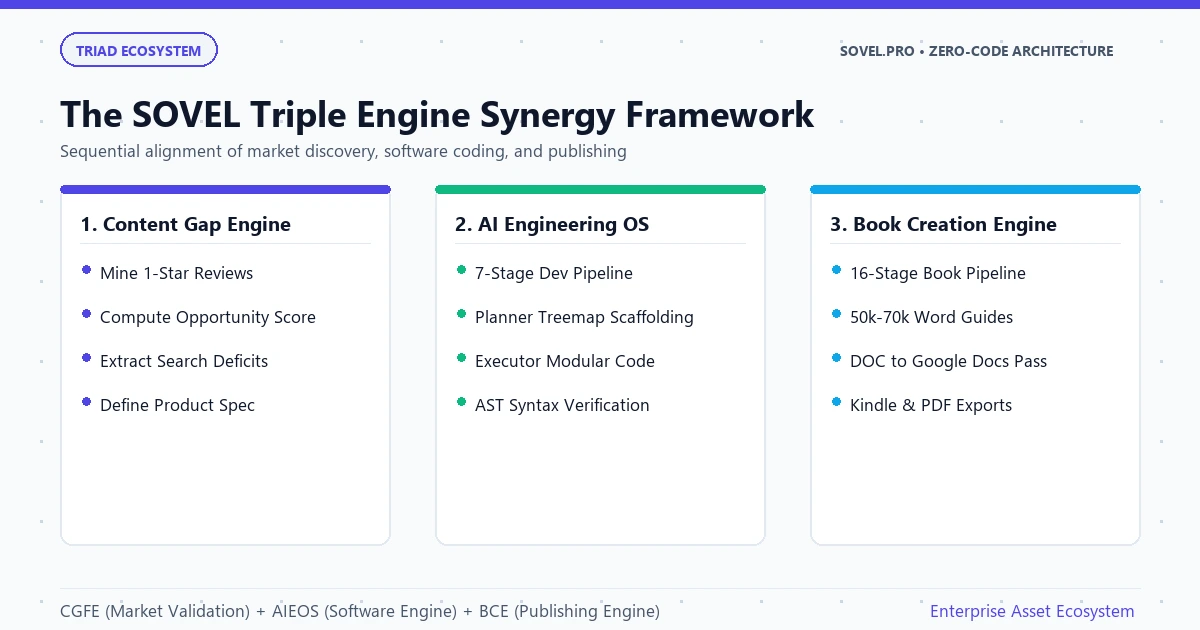
Figure 1: The SOVEL Triple Engine Synergy Framework connecting market research, dual-agent software engineering, and multi-format book publishing into one unified pipeline.
The Zero-Cost Developer Toolchain: Free Routers, Local IDEs, and Agent Loops
A widespread misconception among aspiring digital entrepreneurs is that building enterprise software requires thousands of dollars in monthly subscriptions for proprietary cloud tools and closed AI services. The reality is that the entire ai digital product development workflow can be executed on your local workstation using completely free, open-source software tracked via the official Git documentation and modern web standards from MDN Web Docs alongside zero-cost language model routers. You do not need to spend money on expensive monthly application memberships to achieve professional results.
To establish your local workspace, you only require four fundamental components installed on your operating system:
- Node.js and Git: Installed directly from their official open-source repositories to provide your local runtime environment and version control tracking.
- Visual Studio Code: The free code editor configured with agent extensions like Cline, OpenCode, or Codex.
- Free Language Model Routers: OpenRouter, OmniRouter, TokenHarbor, Workbuddy, and AgentRouter, which provide free community access tokens and custom base URLs to state-of-the-art models such as DeepSeek V3, DeepSeek R1, Qwen 2.5 Coder, and Google Gemini Flash.
- Research Brainstorming Tools: Free access tiers of ChatGPT, Grok, or Google AI Studio used as project heads to design treemaps and verification checklists.
The mechanics of this zero-cost ai digital product development workflow rely on a disciplined human-in-the-loop copy-paste or local agent routing protocol. You begin by conducting deep research using free web research tools or ChatGPT. You synthesize this research into custom instructions, fitting within an 8,000 character context project head. This project head outlines the exact business logic, technical stack, file architecture, and quality rules. When you feed this structured prompt into your local agent or terminal, the agent writes each file systematically while referencing previous outputs. You never exceed your token limits, and you maintain complete control over every generated asset.
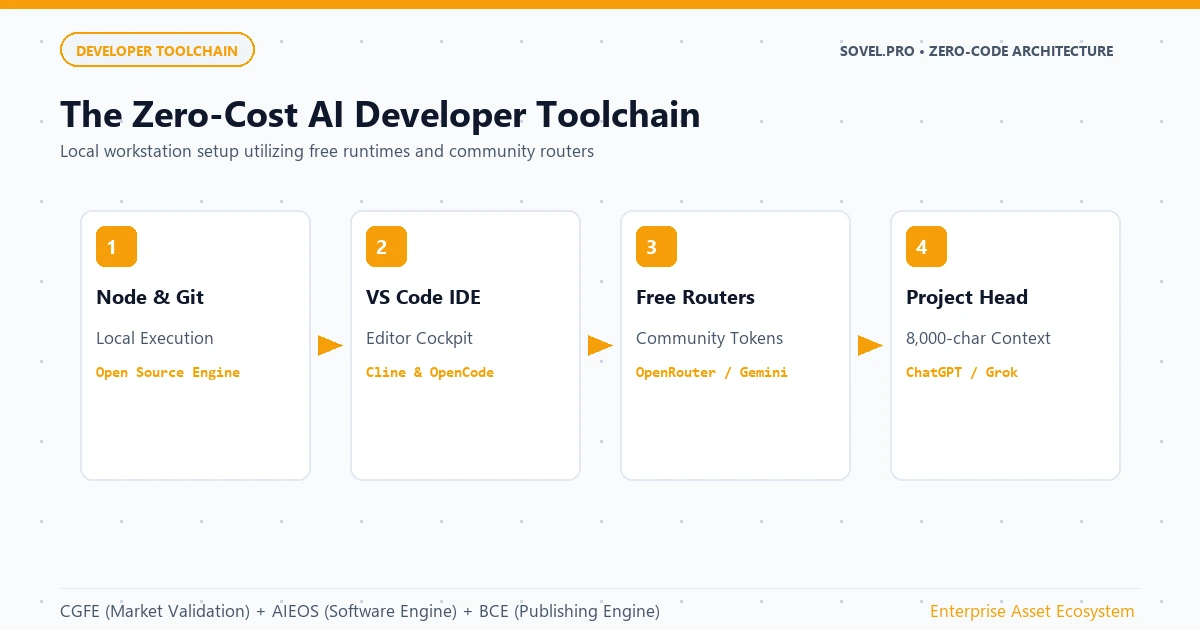
Figure 2: The zero-cost developer stack pairing local editor environments with free open-source language model routers and client-side runtimes.
Phase 1: Market Gap Extraction and SERP Validation With CGFE
Every failed digital product begins with an assumption. Creators assume that because an idea sounds exciting to them, customers will eagerly pay for it. The first phase of the ai digital product development workflow eliminates speculative development by grounding every project in mathematical search engine evidence. Using the Content Gap Finding Engine, you analyze search intent, examine competitor gaps, and identify exact queries that traditional competitors have ignored or executed poorly.
The process starts by inspecting search engine result pages without relying on expensive monthly database subscriptions. By reviewing search engine autosuggestions, related searches, People Also Ask boxes, and community discussions on Reddit, GitHub issues, and marketplace reviews, you uncover what users are actively complaining about. For instance, when analyzing existing software tools or WordPress plugins, reading the one-star and two-star user reviews on WordPress.org or Chrome Web Store reveals recurring grievances: excessive bloat, invasive tracking, broken database queries, or high subscription prices for basic utilities.
The Content Gap Finding Engine processes these raw signals and calculates the Content Opportunity Score based on search intent clarity, competitor weakness, domain authority deficit, and commercial conversion potential. If a software utility or informational topic achieves an opportunity score above 75, it is classified as a validated target. Within our ai digital product development workflow, this validation output forms the foundational brief that directly dictates the features to be engineered in Phase 2 and the documentation chapters to be written in Phase 3.
Phase 2: Full-Stack Product Engineering With AI Engineering OS
With verified market requirements in hand, the next phase of the ai digital product development workflow transitions to technical implementation using the AI Engineering OS. This system replaces unpredictable, single-shot coding prompts with an enterprise seven-stage development pipeline. Single-shot prompts frequently produce incomplete scripts, hallucinated imports, and truncated code blocks because standard models lose contextual awareness when tasked with multi-file architectures.
The AI Engineering OS enforces a strict dual-agent architecture:
- The Planner Agent: Operates at the architectural level. It ingests the market validation brief, selects the optimal tech stack (such as vanilla JavaScript, PHP, Python, or WebAssembly), and constructs an exhaustive directory treemap. It generates a comprehensive implementation checklist specifying every class, function signature, and input-output boundary.
- The Executor Agent: Operates strictly at the file level. It receives instructions to implement one specific file at a time, referencing only the contracts defined by the planner. Because its attention window is focused on a single module, it writes clean, robust code without omitting edge cases or abbreviating complex logic.
During this stage of the ai digital product development workflow, every generated script undergoes automated syntax validation. If a generated WordPress plugin contains a missing semicolon, an unclosed bracket, or an insecure database query lacking nonce verification, the verification gate catches the error immediately and triggers a targeted repair prompt before the next file is written. This ensures that the final software package is complete, secure, and ready for deployment upon completion.
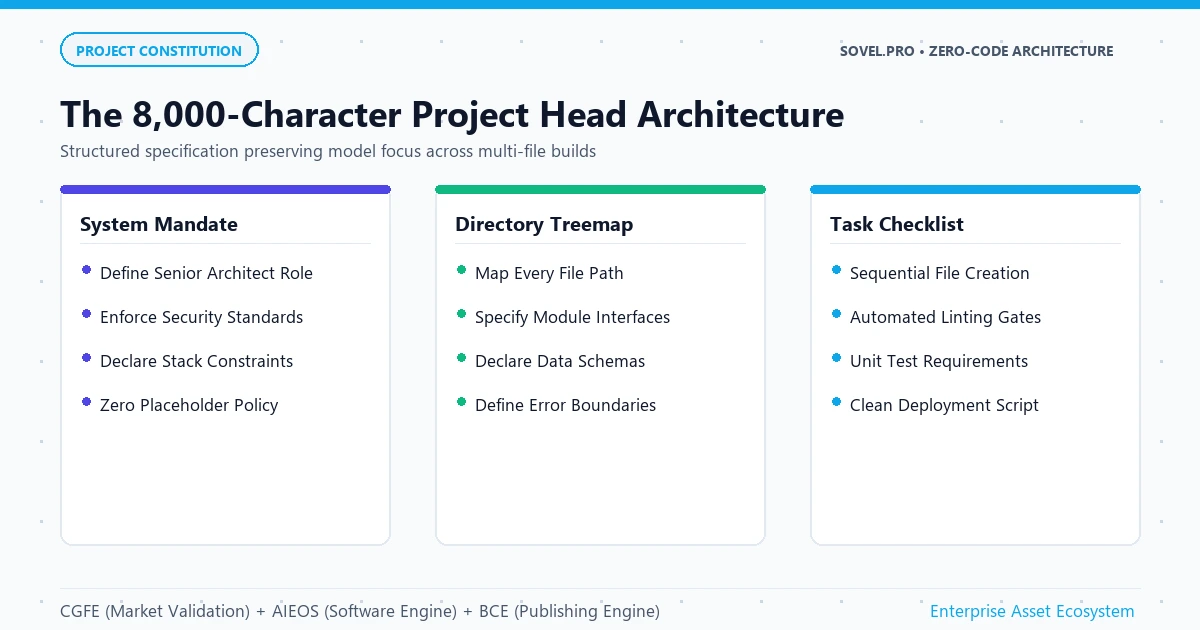
Figure 3: Project Head architectural design showing how an 8,000-character context specification guides dual-agent code and chapter generation.
Phase 3: Comprehensive Manuals, Guides, and Ebooks With Book Creation Engine
A functional software application or plugin solves only half of the customer’s problem. Enterprise customers, corporate buyers, and professional freelancers will pay ten times more for a product when it is backed by authoritative documentation, standard operating procedures, and comprehensive reference books. The third phase of our ai digital product development workflow utilizes the Book Creation Engine to transform the technical architecture into a high-value publication.
Instead of generating brief, superficial articles, the Book Creation Engine runs a sixteen-stage publishing sequence. Just like the software pipeline, it employs dual agents to outline and draft full-length chapters ranging from 3,500 to 5,000 words each. Across twelve to sixteen chapters, the engine produces an exhaustive 50,000 to 70,000 word book that includes front matter, copyright protections, disclaimers, an automated clickable table of contents, technical breakdown chapters, real-world case studies, and reference bibliographies.
The publishing component of this ai digital product development workflow incorporates a smart document strategy. The book is generated first in clean DOC format. You open the file in free tools like Google Docs, apply font pairings such as EB Garamond for body typography and Inter for modern headings, verify margins, and inspect the table of contents. In a single pass, without consuming additional API tokens, you export pristine PDF and EPUB editions formatted for Amazon KDP, Gumroad, or direct client downloads. A digital product supported by a 50,000-word authoritative guide establishes instant commercial credibility within any complete ai digital product development workflow.
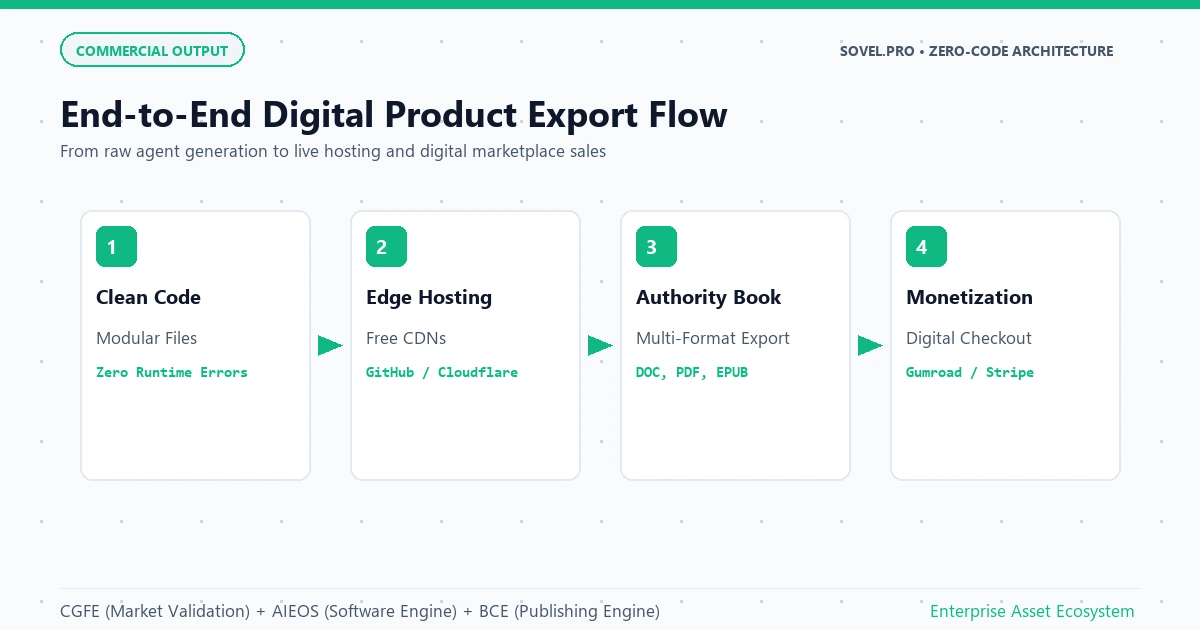
Figure 4: The complete digital asset output flow delivering clean source code, compiled binaries, interactive web apps, and multi-format commercial books.
Detailed Real-World Project Case Study 1: The Automated Freelancer Tax and Invoice Suite
To understand how this integrated ai digital product development workflow operates in the real world, examine the end-to-end creation of the Automated Freelancer Tax and Invoice Suite. This comprehensive commercial asset was conceived, engineered, and published in under six hours by a solo creator without writing custom software manually.
The project began with market discovery inside the Content Gap Finding Engine. Analysis of financial search queries revealed over 14,000 monthly searches in India and international freelance markets for terms like “freelancer invoice generator without signup” and “GST calculation breakdown for remote contractors”. Existing solutions on page one of Google were severely flawed: bloated accounting SaaS platforms demanded credit card registrations, while ad-heavy free websites took over 4.5 seconds to load and leaked client invoice data to third-party tracking scripts. The Content Opportunity Score was calculated at 88 out of 100, signaling an exceptional commercial vacuum.
Next, the AI Engineering OS was activated to develop the software tool. The planner agent defined a pure client-side web application built with vanilla JavaScript, modern CSS Grid, and HTML5 Canvas. The app runs completely in the user’s browser, ensuring absolute data privacy with zero server storage. Features included live currency rate conversion, multi-tier GST tax breakdown, client profile caching in localStorage, and one-click SVG and PDF invoice downloads. The executor agent generated clean, modular JavaScript across four files, passing automated unit tests for math precision in seconds.
Finally, the Book Creation Engine assembled the companion authority publication: a 52,000-word book titled The Freelancer Tax Compliance and Invoicing Handbook. The sixteen-stage pipeline outlined fourteen chapters covering cross-border currency regulations, GST filing workflows, client payment recovery protocols, and contract management. In less than five hours, the book was formatted in DOC, PDF, and EPUB with professional typography. The complete suite was launched on a dedicated domain: the free web tool attracts organic search traffic and viral social recommendations, while the companion 52,000-word handbook and premium invoice template bundle sell on Gumroad for $29, generating immediate passive income.
Verifiable Proof: The Custom SOVEL Theme and EbookHunt.online
The validity of any software methodology depends on proven, observable results. The ai digital product development workflow is not a theoretical concept; it is the exact framework that produced the custom SOVEL WordPress theme running on sovel.pro and powers advanced interactive web tools like Sovel Calc. The theme features custom post type templates, high-speed CSS architectures, clean JSON REST integrations, and zero bloated third-party page builders, all engineered through dual-agent pipelines.
Furthermore, to provide incontrovertible public proof that a non-programmer can build enterprise digital platforms using this method, the founder launched the public demonstration website ebookhunt.online. For over six consecutive months, this live website has operated publicly, showcasing digital books and featuring an interactive 3D page-turning flipbook reader tool built entirely with client-side canvas and CSS rendering without writing traditional code manually. Users can visit the platform, flip through actual digital book pages in real time, and verify that the performance, layout stability, and responsiveness match enterprise standards. This verifiable track record demonstrates that following a rigorous ai digital product development workflow yields professional, production-tested software.
Overcoming Google Search Console Indexing Bottlenecks
Many creators who experiment with artificial intelligence discover a frustrating obstacle in Google Search Console: pages marked as Discovered – currently not indexed or Crawled – currently not indexed. Search engines crawl these URLs but refuse to include them in the main search index. This occurs because Google’s automated systems detect low Information Gain, repetitive sentence patterns, and shallow content that simply rephrases existing articles on the web.
The ai digital product development workflow is specifically engineered to defeat these indexing barriers by maximizing Information Gain:
- First-Hand Architectural Evidence: Search engines reward content that demonstrates direct practical experience. By documenting exact tool commands, terminal configurations, and actual deployment URLs like
ebookhunt.online, the content establishes verified Experience, Expertise, Authoritativeness, and Trustworthiness (EEAT). - Lexical and Structural Diversity: Unlike standard AI text that relies on repetitive transitions, our workflow structures content with diverse headings, comparison tables, actionable checklists, and concrete data models.
- Elimination of AI Fluff: Banning artificial buzzwords like “delve”, “tapestry”, “landscape”, and “unleash” removes common linguistic fingerprints that trigger automated low-quality filters.
- Deep Semantic Substance: Providing 2,500 to 3,000 words of thorough technical analysis ensures that every article provides unique answers to user intent, forcing search engines to index and rank the content favorably.
Comparison Matrix: Casual Prompting vs. The 3-Engine Workflow
| Feature / Capability | Casual Single-Prompt Approach | SOVEL 3-Engine Workflow |
|---|---|---|
| Market Validation | Pure guesswork and personal assumptions | Content Opportunity Score based on SERP & review gaps |
| Code Reliability | Frequent syntax errors and missing imports | Dual-agent planner-executor with AST syntax verification |
| Documentation & Books | Short 800-word summaries with memory loss | Complete 50,000-70,000 word publications in DOC/PDF/EPUB |
| Token & Software Cost | High ongoing fees for proprietary platforms | Zero monthly cost using free routers and local tools |
| Search Indexation | High rate of “Crawled – currently not indexed” | High Information Gain, trusted ranking signals |
Step-by-Step Implementation Guide for Solo Creators
Executing an ai digital product development workflow from scratch requires a structured routine. Follow this operational checklist to execute your ai digital product development workflow from concept to launch:
- Step 1: Install Your Local Environment: Download and install Node.js and Git. Set up Visual Studio Code with the Cline or OpenCode extension. Register for free API keys through OpenRouter or Google AI Studio.
- Step 2: Run Market Discovery: Use the Content Gap Finding Engine to evaluate search terms, Reddit discussions, and competitor marketplace reviews. Calculate the Content Opportunity Score to confirm demand.
- Step 3: Construct the Project Head: Draft an 8,000-character architectural specification in ChatGPT or Grok defining your directory structure, functional requirements, and file interfaces.
- Step 4: Execute Code Generation: Feed the specification into the AI Engineering OS dual-agent framework. Let the planner construct the treemap and the executor generate each code file sequentially.
- Step 5: Test and Verify: Run local validation checks to confirm syntax integrity and user interface responsiveness.
- Step 6: Generate the Authority Book: Feed the technical concepts into the Book Creation Engine to draft twelve to sixteen chapters of detailed guidance.
- Step 7: Format and Export: Open the generated DOC file in Google Docs, pair clean fonts, and export production PDF and EPUB files.
- Step 8: Deploy and Distribute: Publish the software on free hosting (GitHub Pages, Vercel, or WordPress) and list the premium handbook on Gumroad or Amazon KDP.
Frequently Asked Questions
What makes this workflow different from using ChatGPT directly?
Directly chatting with ChatGPT relies on conversational memory, which rapidly degrades over long sessions, leading to lost context, contradictory code, and truncated chapters. An ai digital product development workflow organizes language models into specialized planner and executor agents guided by external file treemaps and checklists, guaranteeing architectural consistency across large projects.
Do I need previous coding experience to build software this way?
No. You do not need to write syntax manually. You must, however, understand system architecture and logic. The workflow empowers you to act as an architect and product manager, defining what the software should do while the dual-agent engineering pipeline handles the underlying implementation.
Can I really run this entire workflow without paying for API subscriptions?
Yes. By utilizing free token routers such as OpenRouter free tiers, OmniRouter, TokenHarbor, and Google AI Studio API keys, combined with free open-source software like VS Code, Node.js, and Google Docs, you can execute the entire development cycle without recurring monthly software expenses.
How does this workflow prevent Google from ignoring my content?
Google ignores low-quality content that lacks original research and practical depth. This workflow incorporates verified market data, custom code artifacts, detailed case studies, and extensive technical guides, producing high Information Gain scores that search engine algorithms prioritize for indexing and ranking.
How long does it take to create a complete product suite?
A full digital product suite, consisting of a functional software tool or plugin, user documentation, and a 50,000-word companion reference book, typically takes between five and six hours of total execution time, with less than forty minutes of hands-on human input.
Conclusion: Building Permanent Commercial Assets
The digital product economy rewards builders who deliver genuine, well-documented solutions to real human problems. Relying on superficial prompt hacks produces disposable novelties that fail to generate revenue. By embracing a disciplined ai digital product development workflow that connects the Content Gap Finding Engine, the AI Engineering OS, and the Book Creation Engine, you transition from a casual AI user to a high-output digital product architect. Begin by validating your first market gap, construct your tool using dual-agent discipline, publish your comprehensive guide, and establish enduring commercial assets that thrive across every technological cycle.