
Why One-Shot AI Prompts Produce Terrible Novels
Generic prompts result in generic output. When you ask an AI to write a whole book at once, it forgets characters, loses plot threads, and breaks tone. This is why you need specific chapter-by-chapter AI prompts for long-form narrative fiction. Chapter-by-chapter generation is the only approach that works for long-form fiction.
The Book Creation Engine uses this exact method with its dual-agent system. By breaking the story into chunks, the AI maintains context and produces coherent, engaging prose. Mastering ai prompts for writing a novel chapter by chapter is the secret to high-quality fiction.
In this guide, I will share seven expert templates. These ai prompts for writing a novel chapter by chapter will transform your drafting process. Whether you are writing a thriller, romance, or sci-fi epic, these templates guarantee consistency and quality.
Stop wasting time with one-shot requests. Learn to use these specialized novel drafting prompts and take control of your storytelling.
Template 1: The Character Bible Prompt
Before you write a single scene, you need a character bible. This is the first of our ai prompts for writing a novel chapter by chapter. The AI needs to know exactly who your characters are.
Your prompt should include the character name, age, physical traits, personality, backstory, speech patterns, and relationships. It must also define their core character arc. When you use ai prompts for writing a novel chapter by chapter, this bible acts as the anchor.
Example Prompt: “Act as an expert novelist. Create a detailed character bible for [Name]. Include their physical description, internal motivations, fatal flaw, and unique speech patterns. This will be used as a reference document for upcoming chapters.”
Store this output carefully. You will feed it back to the AI in subsequent steps. This ensures that during creative generation passes, the AI never forgets who is talking.
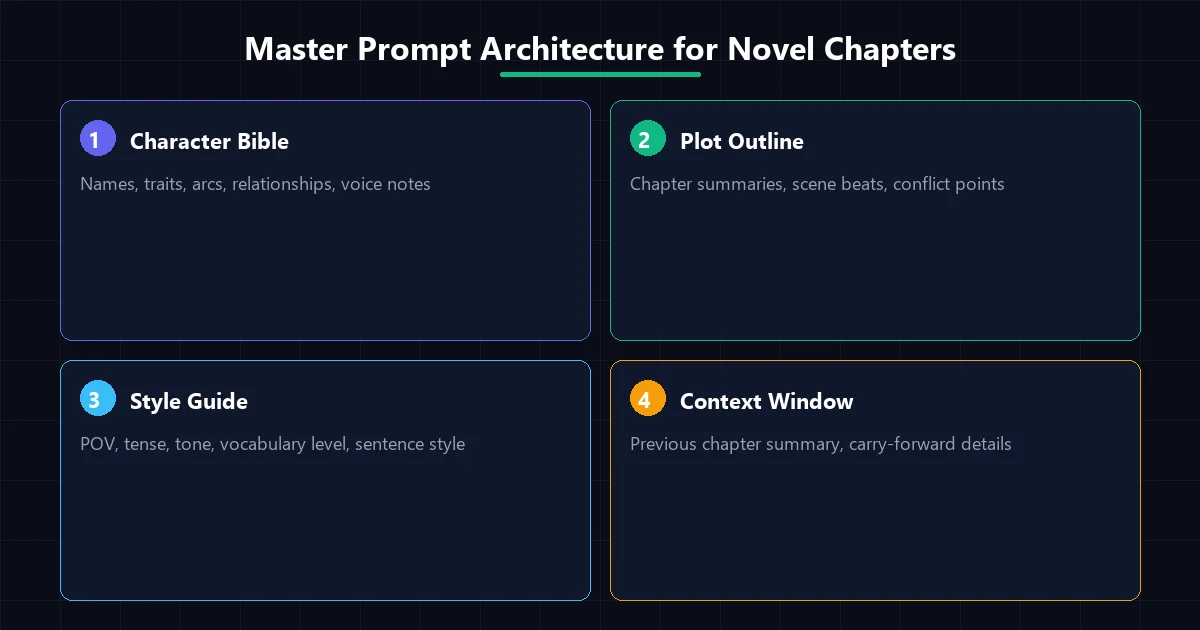
The character bible is the foundation of your novel.
Template 2: The Plot Outline Prompt
The next step in our ai prompts for writing a novel chapter by chapter is the plot outline. The structure must include a beginning hook, rising action, a midpoint shift, the climax, and the resolution. You need a chapter-by-chapter summary format.
Example Prompt: “Act as a master storyteller. Create a 15-chapter plot outline for a [Genre] novel. For each chapter, provide a 3-sentence summary covering the main event, the POV character, and the cliffhanger ending.”
This outline prevents the AI from wandering off-topic. Consistent novel generation workflows rely heavily on a rigid structure. You can refine this outline in Google Docs before moving forward.
Visit our tools section to find text editors perfect for outlining your ideas.
Template 3: The Chapter Generation Prompt
This is the most important template among the ai prompts for writing a novel chapter by chapter. You must include the chapter number, POV character, scene goal, emotional arc, word count target, and carry-forward details from the previous chapter.
Example Prompt: “Write Chapter 4 from the perspective of [Character]. The scene goal is [Goal]. The emotional arc shifts from hope to despair. The target word count is 4,000 words. Remember that in the previous chapter, [Event] happened. Maintain a gritty, suspenseful tone.”
By providing these constraints, the AI produces highly specific and relevant text. This is why ai prompts for writing a novel chapter by chapter work so well. They treat the AI as a co-writer following strict instructions.
Always review the output before generating the next chapter. This prevents errors from compounding.
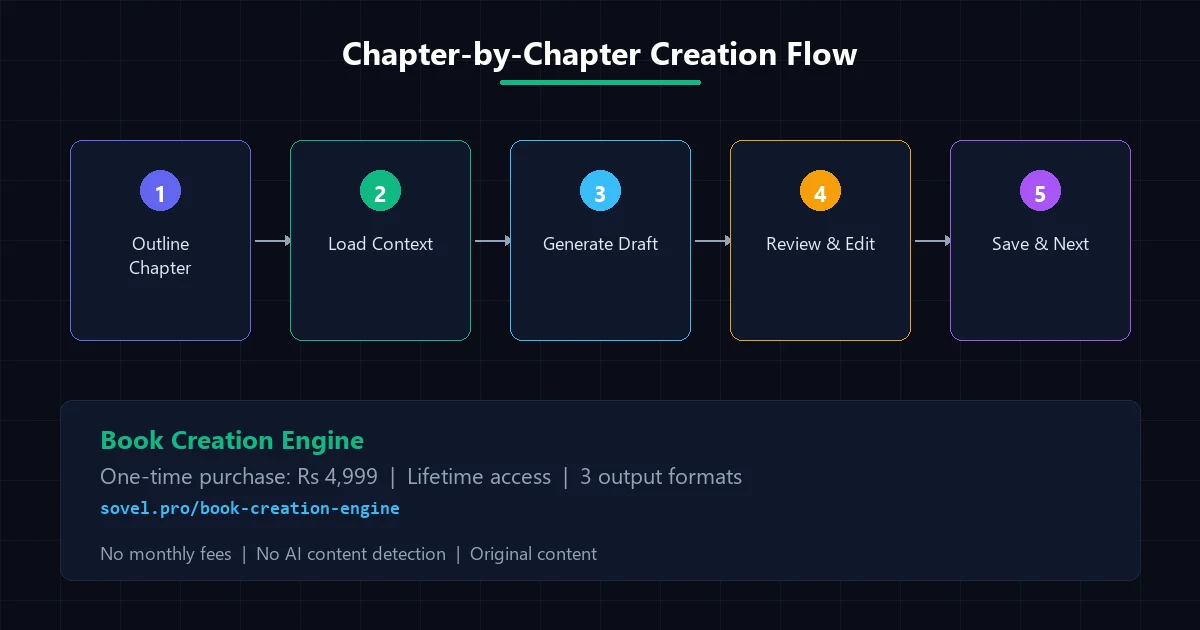
Follow a strict chapter-by-chapter creation flow for best results.
Template 4: The Dialogue Polish Prompt
AI dialogue can often sound robotic and overly formal. To fix this, use one of our specialized ai prompts for writing a novel chapter by chapter focused entirely on dialogue. You must instruct the AI to remove formal speech patterns and add subtext.
Example Prompt: “Review the following chapter text. Rewrite the dialogue to make it sound more natural and conversational. Include contractions, interruptions, and character-specific speech patterns based on the character bible. Add subtext where characters say one thing but mean another.”
This step improves your prose from amateur to professional. When drafting fiction with artificial intelligence, separating the writing phase from the dialogue polish phase yields much better results.
Before and after comparisons often show a dramatic increase in readability. This is a crucial step in the pipeline.
Template 5: The Consistency Check Prompt
As you progress, the AI might make continuity errors. This is where the consistency check comes in. It is one of the most vital ai prompts for writing a novel chapter by chapter. You need to cross-reference character details, timelines, and settings across chapters.
Example Prompt: “Analyze the provided texts for Chapters 1 through 5. Identify any continuity errors regarding character descriptions, timelines, or setting details. List the discrepancies and suggest fixes.”
By regularly running this check, you ensure a seamless reading experience. Utilizing iterative prompt chains requires diligence in maintaining the story world.
You can integrate these checks into your daily writing routine to catch errors early.
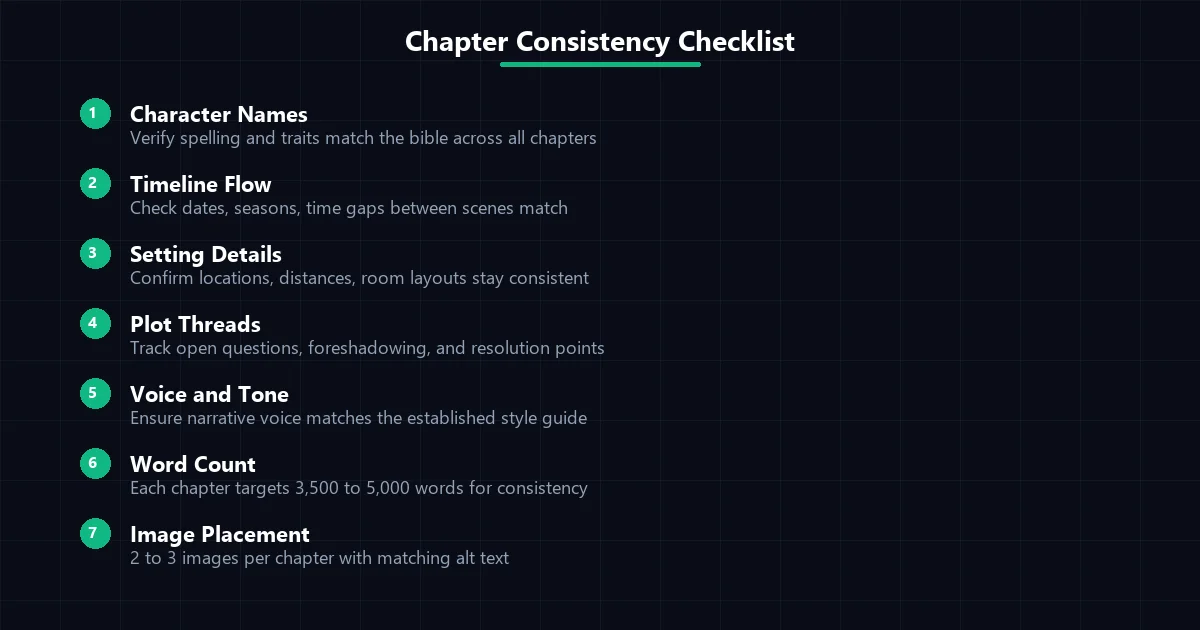
Run consistency checks frequently to avoid plot holes.
Template 6: The Pacing Analysis Prompt
Pacing keeps readers engaged. Use ai prompts for writing a novel chapter by chapter to analyze the tension curve. Check your chapter length distribution and cliffhanger placement.
Example Prompt: “Analyze the pacing of this chapter. Does the tension rise appropriately? Are there too many slow moments? Suggest areas where action should be accelerated or where descriptive pauses are needed.”
A well-paced novel is unputdownable. Incorporating pacing analysis into your ai prompts for writing a novel chapter by chapter ensures your book flows naturally.
For more advanced workflow systems, consider checking out our AI Engineering OS to automate these checks.
Template 7: The Final Revision Prompt
The last step is polishing the prose. The final revision template is essential among the ai prompts for writing a novel chapter by chapter. Instruct the AI to cut filler words, strengthen verbs, and match your unique author voice.
Example Prompt: “Revise this chapter for stylistic impact. Remove passive voice, eliminate adverbs where strong verbs can be used, and ensure the tone matches the gritty realism established in the prompt constraints.”
This polish transforms raw AI output into a compelling manuscript. By mastering these ai prompts for writing a novel chapter by chapter, you save hundreds of hours of editing time.
Your readers will not know an AI helped write the book if you do this correctly.
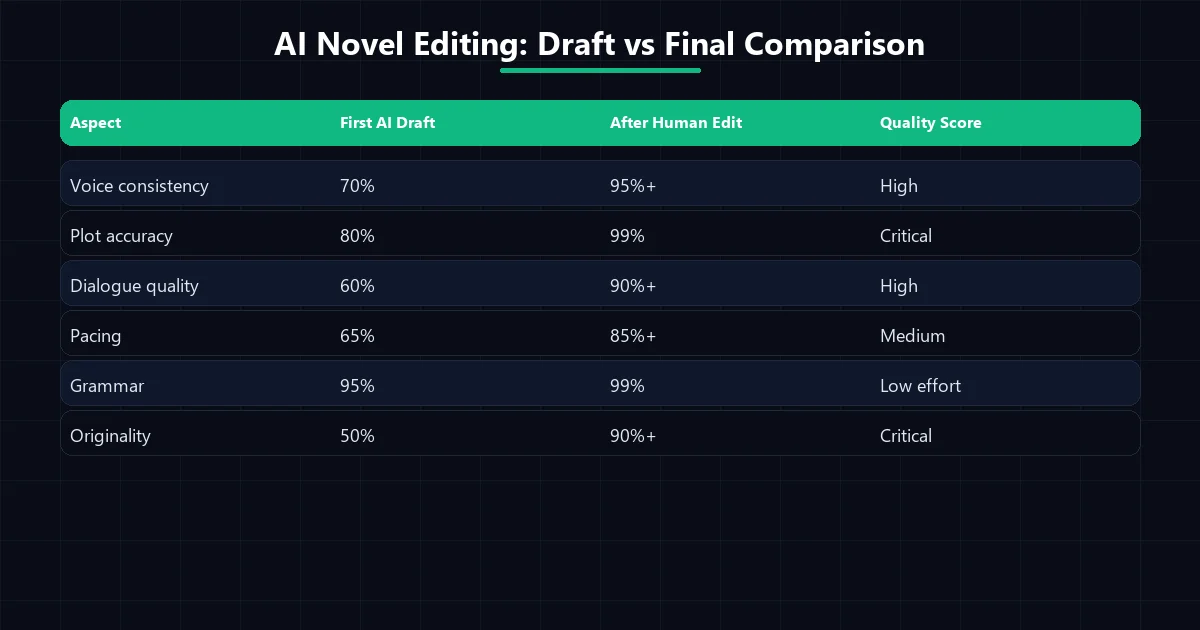
Final revisions are what make your novel shine.
How Book Creation Engine Automates This Entire Process
The 16-stage pipeline of the Book Creation Engine handles all 7 prompt types automatically. You do not need to manually copy and paste ai prompts for writing a novel chapter by chapter if you use this system.
The dual-agent system means the planner agent creates the structure while the executor agent generates the content based on these exact prompt templates. You provide the idea and the research, and the engine handles the complex prompt chain.
This allows you to focus on the creative direction rather than the technical execution. If you want to scale your publishing, utilizing these automated storytelling pipelines is the best investment you can make.
Read more on our blog to see user success stories.
Advanced Novel Structuring Techniques
To master ai prompts for writing a novel chapter by chapter, you should also consider integrating subplots. A good prompt will explicitly ask the AI to weave a secondary character arc into the main narrative. This creates depth and prevents the story from feeling one-dimensional.
You can also use structured narrative templates to experiment with different narrative voices. For instance, you can request Chapter 1 in first-person and Chapter 2 in third-person limited to see which style better fits your story.
If you are writing a sci-fi or fantasy novel, world-building becomes crucial. Use ai prompts for writing a novel chapter by chapter to specifically dictate the rules of magic or the layout of a futuristic city. This constraints the AI and prevents it from inventing illogical concepts midway through the book.
Reviewing the output after each prompt is mandatory. The true power of iterative fiction drafting lies in your ability to steer the AI based on its previous output.
Handling AI Hallucinations in Fiction
Even with the best ai prompts for writing a novel chapter by chapter, AI models can hallucinate. They might introduce a character who died three chapters ago or change the color of the protagonist’s car. This is why the verification step is critical.
Always keep a master summary document. After each chapter is generated and approved, paste a short summary into your master document. When you prepare prompts for the next section, include that master summary.
This technique provides the AI with a rolling memory. It drastically reduces hallucinations and ensures the story remains grounded. Combining this with our templates ensures a flawless narrative.
Subtext and Emotional Resonance in AI Scene Drafting
One common flaw in raw machine-generated prose is on-the-nose exposition. Characters often state their feelings explicitly rather than revealing them through physical action, silence, or subtext. When crafting effective ai prompts for writing a novel chapter by chapter, you must instruct the model to constrain explicit emotional declarations.
Instruct the engine to use objective correlatives, behavioral cues, and sensory anchors. For example, rather than writing that a protagonist feels anxious, the prompt should require the scene to describe the rhythmic tapping of fingers against a cold brass railing, the tight constriction of breathing, or the deliberate avoidance of eye contact.
This technique elevates chapter-level prose from robotic recitation to immersive fiction. By incorporating emotional constraint instructions into your fiction generation templates, every scene gains dramatic tension and psychological depth that keeps human readers turning pages.
Managing Multi-Character Dialogue Without Voice Confusion
When three or more characters interact in a single scene, standard language models frequently blur speech cadences together. Every character starts sounding like an articulate college professor. To preserve individuality across extensive manuscripts, your chapter prompts must enforce distinct linguistic profiles.
Assign specific dialogue traits in your character bible: sentence length tendencies, vocabulary preferences, regional idioms, and conversational tactics like interrupting, deflecting, or interrogating. Include these constraints directly inside your chapter execution prompt so the model maintains rigid boundaries between character voices.
The Book Creation Engine simplifies this by feeding character voice rules into every generation pass automatically. As you deploy ai prompts for writing a novel chapter by chapter, the underlying pipeline ensures that dialogue attribution remains crystal clear and authentic from chapter one to the climax.
To maximize continuity, maintain a running glossary of specific terms, historical dates, and character relationships. Updating this glossary after each chapter ensures that background lore remains coherent and credible throughout your entire story arc.
Frequently Asked Questions
Do these prompts work with any AI model?
Yes, these ai prompts for writing a novel chapter by chapter work with GPT-4, Claude, Gemini Pro, and open-source models like DeepSeek. However, models with larger context windows perform better at maintaining character bibles across long texts.
How long should an AI-generated chapter be?
Aim for 3,500 to 5,000 words per chapter. This is the optimal length for reader engagement and gives the AI enough room to develop scenes without losing focus or hallucinating details.
Can the AI remember my characters across 20 chapters?
Not automatically. That is why you must use the character bible prompt and include the carry-forward details in every chapter generation prompt. The AI only remembers what is in its immediate context window.
Is it necessary to use a dual-agent system?
While you can do it manually, a dual-agent system like the Book Creation Engine automates the feedback loop between planning and writing, drastically reducing errors and saving you hours of manual prompting.
Will my novel sound robotic?
Not if you use the Dialogue Polish and Final Revision prompts. These specific templates are designed to inject human emotion, subtext, and stylistic flair into the raw AI output.
Take Control of Your Novel Today
Using chapter-by-chapter AI prompts is a skill that takes time to master. Start with these seven templates and adjust them to fit your genre. Over time, you will develop your own unique prompting style.
If you want to skip the learning curve and automate the entire process, purchase the Book Creation Engine for just Rs 4,999. It will transform how you write fiction forever.