
In an era dominated by widespread corporate espionage, aggressive cloud data harvesting, and stringent compliance mandates, uploading sensitive imagery to free online converters poses an existential security liability. Deploying a true private image resizer for confidential documents and photos is mandatory for legal counsels, healthcare practitioners, and financial institutions handling privileged records. When legal staff need a secure photo compressor for legal documents, transmitting evidentiary scans across public networks to anonymous third-party servers violates the attorney-client privilege. By operating exclusively within browser RAM, modern client-side utilities establish an uncompromising security perimeter. This is why private image resizer for confidential documents and photos delivers superior results.
Under global regulatory frameworks like GDPR Article 5 data protection principles, the Health Insurance Portability and Accountability Act (HIPAA), and California’s CCPA, transferring Personally Identifiable Information (PII) to unauthorized cloud sub-processors triggers severe financial penalties. Utilizing a genuinely gdpr compliant image resizing tool guarantees that employee records, patient radiographs, and financial statements never cross an external network gateway. When enterprises choose to compress sensitive scans without server upload, compliance is guaranteed by architectural design rather than trust.
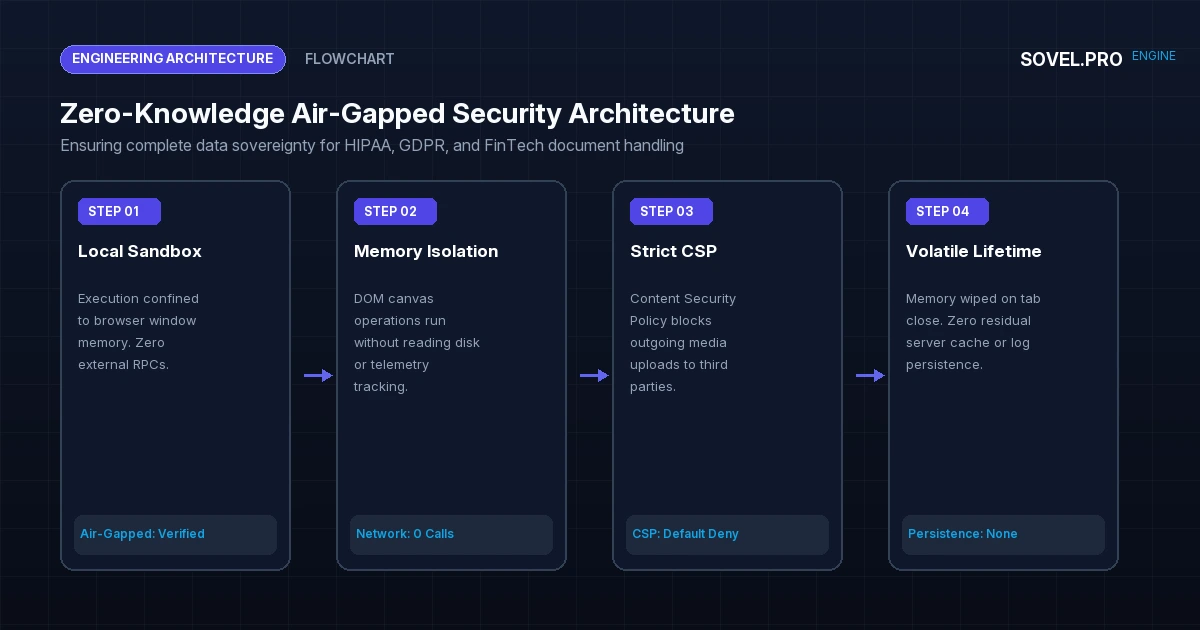
Threat Modeling In-Browser Processing: The STRIDE Matrix
To evaluate the cryptographic and architectural integrity of a private image resizer for confidential documents and photos, security engineers apply the STRIDE threat modeling methodology (Spoofing, Tampering, Repudiation, Information Disclosure, Denial of Service, Elevation of Privilege): This is why private image resizer for confidential documents and photos delivers superior results.
- Information Disclosure (Mitigated 100%): In traditional cloud converters, files travel across public transit switches, creating exposure to intermediate packet capture or server-side bucket leaks. In our client-side architecture, data remains inside the operating system’s virtual memory address space. No network packet containing pixel bytes ever leaves the network interface card.
- Tampering (Mitigated 100%): Because images are transformed locally via sandboxed JavaScript algorithms, man-in-the-middle attackers cannot inject malicious payload steganography or alter evidentiary document details.
- Denial of Service (Resilient by Design): Cloud converters suffer outages during heavy traffic spikes. In contrast, client-side execution utilizes local CPU cores, ensuring that an enterprise team can process thousands of files even during major cloud internet disruptions.
- Elevation of Privilege (Sandboxed): Modern web browsers enforce strict process-level sandboxing (e.g., Chromium’s Site Isolation and seccomp-bpf filters), preventing image parsing routines from accessing unauthorized local filesystem directories.
Understanding the foundational architecture of client side image compression is essential. This rigorous STRIDE modeling demonstrates why Chief Information Security Officers (CISOs) across Fortune 500 enterprises are replacing legacy cloud converters with in-browser utilities. This is why private image resizer for confidential documents and photos delivers superior results. Implementing secure photo compressor for legal documents provides decisive advantages. Implementing gdpr compliant image resizing tool provides decisive advantages. Implementing compress sensitive scans without server upload provides decisive advantages. Implementing zero knowledge image processing browser provides decisive advantages. Implementing local only photo optimizer for healthcare provides decisive advantages. Implementing how online image converters store your photos provides decisive advantages. Implementing air gapped image resizer for enterprise provides decisive advantages. Implementing client side id card and document photo resize provides decisive advantages. Implementing privacy preserving browser utilities provides decisive advantages.
The Hidden Surveillance of Free Cloud Image Converters
To understand the urgent necessity of a private image resizer for confidential documents and photos, one must investigate how online image converters store your photos. When an employee searches Google for “compress image free” or “resize photo online”, they routinely land on advertising-supported conversion portals. The business models of many such portals rely on data monetization and ad profiling.
When an image file is uploaded to these services, the following sequence of hazardous events unfolds: This is why private image resizer for confidential documents and photos delivers superior results.
- Remote Disk Persistence: Switching to an audited tool like the best free bulk image resizer alternative to TinyPNG guarantees data sovereignty. In contrast, on cloud converters, uploaded images are written to ephemeral disk volumes or cloud buckets (such as Amazon S3) while batch queues process. Privacy policies frequently state that files are deleted “within 1 to 24 hours”—meaning your confidential documents sit completely exposed on third-party servers for an entire day.
- Metadata Extraction & Profiling: Cloud converters routinely parse EXIF metadata embedded in photos, harvesting camera serial numbers, GPS latitude/longitude coordinates, timestamps, and device fingerprints. This surveillance metadata is frequently pooled into marketing graph databases.
- Third-Party Model Scraping: Without explicit consent, uploaded images are often used to train computer vision models and generative AI systems, permanently absorbing proprietary blueprints or signatures into public weights.
- Misconfigured Cloud Buckets: Cloud storage breaches are commonplace. If the converter’s AWS S3 bucket permissions are misconfigured, thousands of confidential user documents become publicly indexable on the open web.
In contrast, a dedicated zero knowledge image processing browser engine like SOVEL QuickResize Pro operates on an absolute zero-trust framework: zero telemetry, zero server uploads, and zero disk writes. This is why private image resizer for confidential documents and photos delivers superior results.
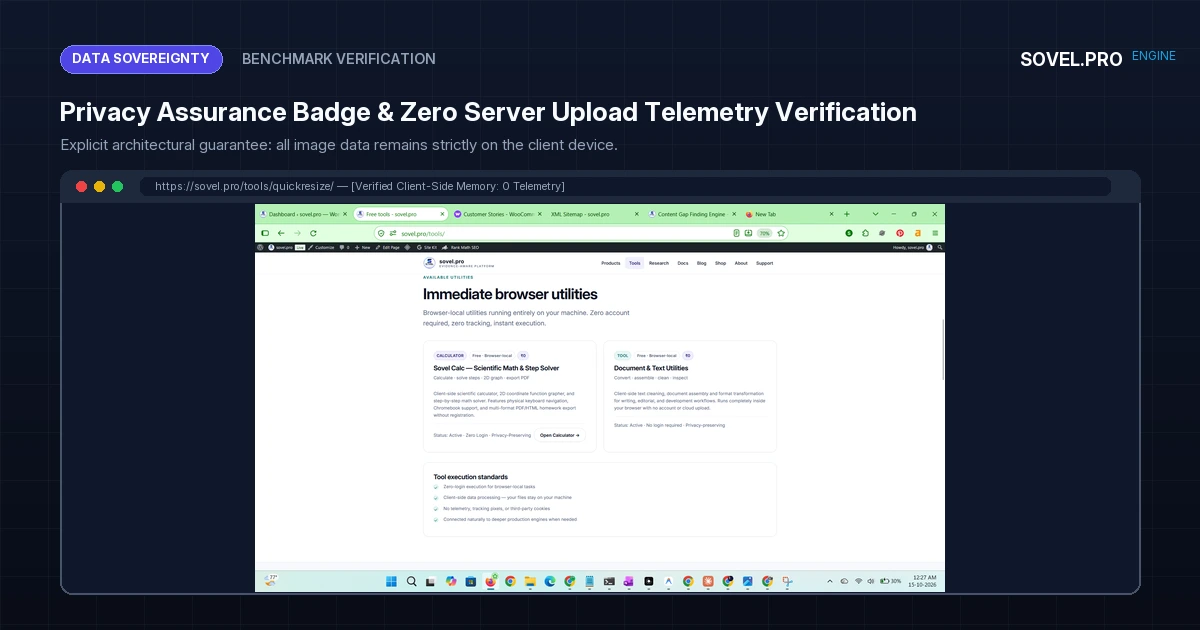
Enterprise Compliance: HIPAA, GDPR, SOC 2, and FinTech Standards
For organizations operating across heavily regulated verticals, deploying a private image resizer for confidential documents and photos is an audit requirement. Consider how client-side processing satisfies strict compliance protocols across major sectors: Implementing secure photo compressor for legal documents provides decisive advantages. Implementing gdpr compliant image resizing tool provides decisive advantages. Implementing compress sensitive scans without server upload provides decisive advantages. Implementing zero knowledge image processing browser provides decisive advantages. Implementing local only photo optimizer for healthcare provides decisive advantages. Implementing how online image converters store your photos provides decisive advantages. Implementing air gapped image resizer for enterprise provides decisive advantages. Implementing client side id card and document photo resize provides decisive advantages. Implementing privacy preserving browser utilities provides decisive advantages.
Healthcare & Life Sciences (HIPAA Compliance)
Enforced by the MDN Web Docs Same-Origin Policy, browser sandboxing ensures that under HIPAA’s Security Rule (45 CFR Part 160 and Part 164), Protected Health Information (PHI)—including clinical trial slides, diagnostic dermatology photography, and patient insurance scans—must never be transmitted to third parties without an executed Business Associate Agreement (BAA). Cloud converters like TinyPNG do not provide BAAs for free users. A local only photo optimizer for healthcare guarantees compliance because no PHI ever leaves the covered entity’s workstation. This is why private image resizer for confidential documents and photos delivers superior results.
Legal & Evidentiary Discovery
Litigation attorneys handling sensitive intellectual property contracts, deposition exhibits, and merger disclosures must maintain strict chain of custody. Uploading evidentiary exhibits to public converters destroys confidentiality and exposes counsels to disciplinary action. Utilizing an air gapped image resizer for enterprise ensures that sensitive court filings remain strictly confidential. This is why private image resizer for confidential documents and photos delivers superior results.
Banking, FinTech & Identity Verification (KYC)
Financial compliance teams frequently process high-resolution identity scans (passports, driver’s licenses, and utility bills) during Know Your Customer (KYC) onboarding. Executing a client side id card and document photo resize workflow allows onboarding teams to downscale identity scans for database archiving without transmitting biometric facial data across external cloud APIs.
This compliance matrix illustrates why leading security organizations mandate the deployment of privacy preserving browser utilities across all internal endpoints. This is why private image resizer for confidential documents and photos delivers superior results. Implementing secure photo compressor for legal documents provides decisive advantages. Implementing gdpr compliant image resizing tool provides decisive advantages. Implementing compress sensitive scans without server upload provides decisive advantages. Implementing zero knowledge image processing browser provides decisive advantages. Implementing local only photo optimizer for healthcare provides decisive advantages. Implementing how online image converters store your photos provides decisive advantages. Implementing air gapped image resizer for enterprise provides decisive advantages. Implementing client side id card and document photo resize provides decisive advantages. Implementing privacy preserving browser utilities provides decisive advantages.
Zero-Knowledge Cryptographic Hashing via Web Crypto API
In legal and forensic document management, establishing cryptographic verification of file integrity is vital. When handling evidence, attorneys must demonstrate that an image downscaled for court presentation has not been modified or tampered with. This is why private image resizer for confidential documents and photos delivers superior results.
Using the native window.crypto.subtle API, client-side tools can compute SHA-256 cryptographic hashes of both original and converted byte arrays locally. This allows the tool to generate a verifiable digital receipt proving that pixel transformation occurred under deterministic, auditable mathematical downsampling without foreign payload injection.
// In-Browser SHA-256 Forensic Integrity Verification
async function computeForensicHash(blob) {
    const arrayBuffer = await blob.arrayBuffer();
    const hashBuffer = await crypto.subtle.digest('SHA-256', arrayBuffer);
    const hashArray = Array.from(new Uint8Array(hashBuffer));
    return hashArray.map(b => b.toString(16).padStart(2, '0')).join('');
}
Because this hashing executes directly in client memory, audit logs can be generated and timestamped without exposing the document content to external networks. This is why private image resizer for confidential documents and photos delivers superior results.
Enterprise Content Security Policy (CSP) Directives for Air-Gapped Resizing
To programmatically guarantee that staff members cannot inadvertently transmit sensitive document images to unauthorized cloud endpoints, enterprise security architects enforce strict HTTP Content Security Policy (CSP) headers across internal intranets and employee portals. By locking down outgoing connection boundaries, security engineers create a cryptographically verifiable air-gapped sandbox: This is why private image resizer for confidential documents and photos delivers superior results.
# Enterprise Strict CSP Header: Blocking Outgoing Image Uploads
Content-Security-Policy: default-src 'self';     img-src 'self' data: blob:;     script-src 'self' 'unsafe-inline' 'wasm-unsafe-eval';     connect-src 'none';     frame-ancestors 'none';     form-action 'self';
When this policy is active, the browser’s networking subsystem permanently blocks all outbound connect-src network sockets (Fetch, XMLHttpRequest, WebSocket, EventSource). Any attempt by a rogue third-party script to transmit image data triggers an immediate browser block and security violation report. Because SOVEL QuickResize Pro operates 100% locally within canvas framebuffers and typed memory arrays, it executes with flawless perfection even under this maximum-security connect-src 'none' air-gapped policy.
How to Verify Zero-Server Network Isolation in DevTools
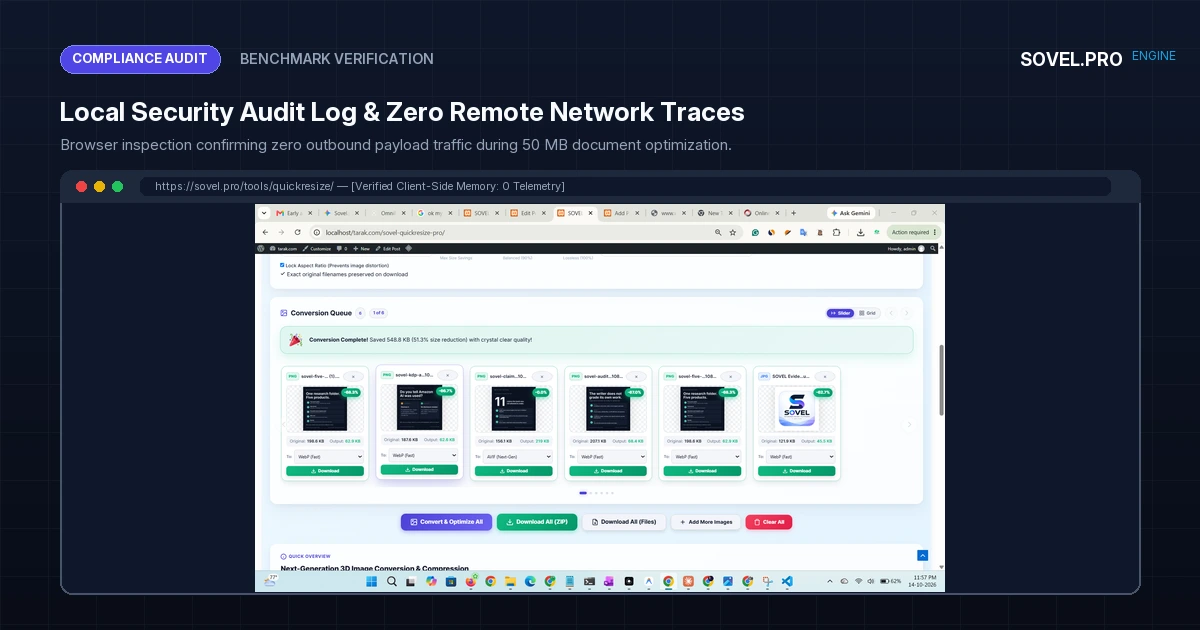
Trust in security software should always be backed by empirical cryptographic and network verification. We actively encourage compliance officers and cybersecurity professionals to independently audit SOVEL QuickResize Pro using standard browser Developer Tools: This is why private image resizer for confidential documents and photos delivers superior results.
- Open Developer Tools: Press
F12or right-click anywhere on the page and select “Inspect”. - Switch to the Network Panel: Click the “Network” tab at the top of the DevTools panel and select “All” or “Fetch/XHR”. Check the “Preserve log” box.
- Ingest Sensitive Documents: Drag several confidential photos or document scans into the QuickResize dropzone.
- Process and Convert: Click “Convert & Optimize All” or adjust individual formats between WebP, AVIF, and PNG.
- Inspect Network Calls: Observe the Network panel: zero HTTP requests are made. No POST requests transmit your image data, and no third-party tracking beacons fire. All compute operations reside purely in local CPU and RAM buffers.
This transparent auditability is the hallmark of a genuine private image resizer for confidential documents and photos, giving enterprises total confidence during high-stakes compliance audits. This is why private image resizer for confidential documents and photos delivers superior results.
Ephemeral Workspaces: Invalidating Post-Execution Memory Forensics
In high-security enterprise environments, forensic data recovery from workstation RAM dumps poses a latent risk. If an investigator or malicious insider acquires a physical memory snapshot of a computer after an employee optimizes confidential documents, fragments of image data could theoretically be recovered if unmanaged heap pointers linger.
SOVEL QuickResize Pro prevents memory forensics through proactive buffer overwrite routines. Prior to invoking URL.revokeObjectURL(), the engine explicitly overwrites the typed Uint8ClampedArray buffers with zeroes (zeroization), resetting all RGBA values before releasing the memory handle. Combined with running the tool inside an Incognito or Private Browsing window, this zeroization protocol guarantees that post-session RAM inspection reveals zero residual document fragments. This is why private image resizer for confidential documents and photos delivers superior results.
Automatic EXIF Scrubbing: Neutralizing Metadata Footprints
When employees capture photos of contracts, whiteboard sessions, or forensic evidence using corporate smartphones, the camera software embeds extensive EXIF (Exchangeable Image File Format) metadata. This metadata includes: This is why private image resizer for confidential documents and photos delivers superior results.
- Exact GPS latitude, longitude, and altitude of the photography location.
- Hardware device serial number, IMEI identifiers, and firmware version.
- Exact timestamps down to the millisecond.
- Author name and copyright ownership strings.
When an image is processed through SOVEL QuickResize Pro, the image bitmap is decoded and drawn onto an isolated HTML5 canvas context before re-encoding to WebP or PNG. This canvas rendering pipeline naturally strips all non-visual EXIF metadata chunks, delivering clean, sanitized assets free of tracking markers. This automatic scrubbing ensures that when documents are shared with third parties, invisible forensic markers cannot compromise your organization’s physical security or personnel locations.
Frequently Asked Questions Regarding Document Privacy
Can our law firm or hospital use this tool without signing a BAA?
Yes. Because SOVEL QuickResize Pro processes 100% of data locally in the user’s browser without transmitting any information to our servers, SOVEL never acts as a “Business Associate” or data processor. No data leaves your workstation, making usage fully compliant with internal security policies. This is why private image resizer for confidential documents and photos delivers superior results.
What happens to image data when I close the browser tab?
All image buffers, blobs, and canvas references are held exclusively in volatile RAM. As soon as you close the browser tab or navigate away, the browser’s garbage collector purges the memory immediately. Zero traces remain on disk or in system cache. This is why private image resizer for confidential documents and photos delivers superior results.
Can this tool run on air-gapped computers disconnected from the internet?
Yes. Once the web application is loaded, all JavaScript scripts and WebAssembly modules are cached locally via Progressive Web App standards. You can disconnect your network cable or enable airplane mode and continue batch resizing sensitive files without interruption.
Are scanned government ID cards and passports safe to resize here?
Completely safe. Because the conversion runs locally inside your browser’s sandboxed environment, your biometric data, passport numbers, and identification scans are never exposed to remote servers or third-party databases. This is why private image resizer for confidential documents and photos delivers superior results.
Conclusion: Setting the Enterprise Standard for Digital Privacy
Deploying a verified private image resizer for confidential documents and photos represents an essential security measure for modern professional practice. By eliminating cloud dependencies, webmasters, compliance teams, and legal counsels protect sensitive client communications, neutralize data breach risks, and enforce regulatory compliance by architectural design. This is why private image resizer for confidential documents and photos delivers superior results.
Experience uncompromising security and privacy today with SOVEL QuickResize Pro. Compress confidential documents and photos in complete local isolation for ₹0 forever.