
The Science of Editorial Prioritization: Beyond Search Volume Guesswork
Editorial teams and digital publishers make a fatal strategic error every single week: they select article topics based on gut feeling, raw search volume estimates, or whatever subject happens to be trending on social media. Raw monthly search volume tells you nothing about user commercial intent, competitor content quality, or your realistic probability of ranking on page one. Mastering a rigorous content opportunity score calculation replaces subjective editorial debates with an objective, auditable mathematical framework that ranks candidate topics by their true revenue potential.
An opportunity score is a normalized numerical index (from 0 to 100) that evaluates a keyword candidate across multiple performance dimensions. Instead of manually calculating formulas in sprawling spreadsheets, publishers deploy the Content Gap Finding Engine, an automated Python research system that analyzes search intent, calculates weighted opportunity scores, and triages topics into actionable editorial sprint bands.
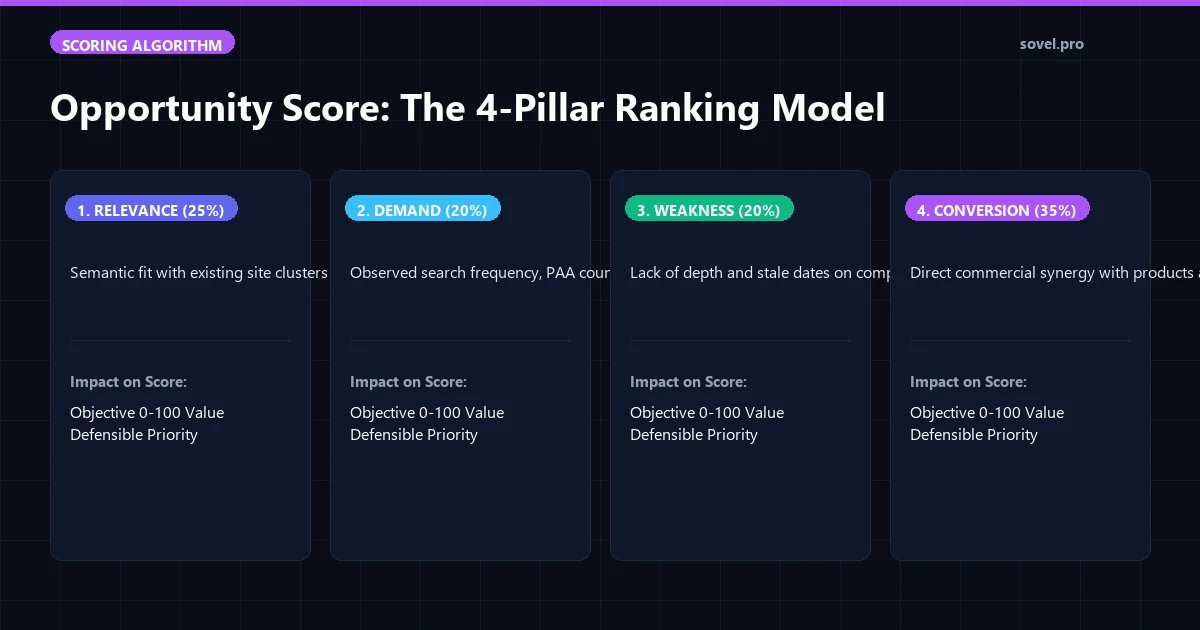
The 4-pillar model balances semantic relevance, audience demand, competitor vulnerability, and business conversion synergy.
When you implement an institutional content opportunity score calculation, every article on your editorial calendar is backed by verifiable mathematical evidence, ensuring that your team invests resources exclusively in high-return search opportunities.
Step 1: The 4-Pillar Model of Content Opportunity
A defensible content opportunity score calculation cannot rely on a single metric. A keyword with fifty thousand monthly searches is completely worthless to your business if the searchers have zero purchase intent and the top five ranking pages are entrenched government portals. An institutional scoring model balances four essential pillars:
- Topic Relevance (Weight: 25%): Evaluates semantic alignment with your existing domain authority, topical clusters, and core audience expectations. A topic that has zero connection to your software or services receives a low relevance score regardless of its popularity.
- Search Demand (Weight: 20%): Assesses observed user interest by aggregating search suggestions, People Also Ask question frequency, and search velocity trends. This composite signal avoids the inaccuracy of third-party volume scrapers.
- Competitor Weakness (Weight: 20%): Measures the vulnerability of current top-ranking pages. Outdated publishing dates, thin content, missing code samples, and poor mobile formatting increase the competitor weakness score.
- Commercial Conversion (Weight: 35%): The most heavily weighted factor. Evaluates how directly the search query connects to your digital products, software licenses, consulting services, or affiliate offers.
By weighting commercial conversion at thirty-five percent, your content opportunity score calculation prioritizes articles that drive revenue over empty vanity traffic.
Step 2: The Mathematical Formula and Normalization Process
When implementing content opportunity score calculation, to ensure consistency across thousands of candidate keywords, each of the four pillars must be normalized onto a standard 0-to-100 scale before applying the weighted calculation.
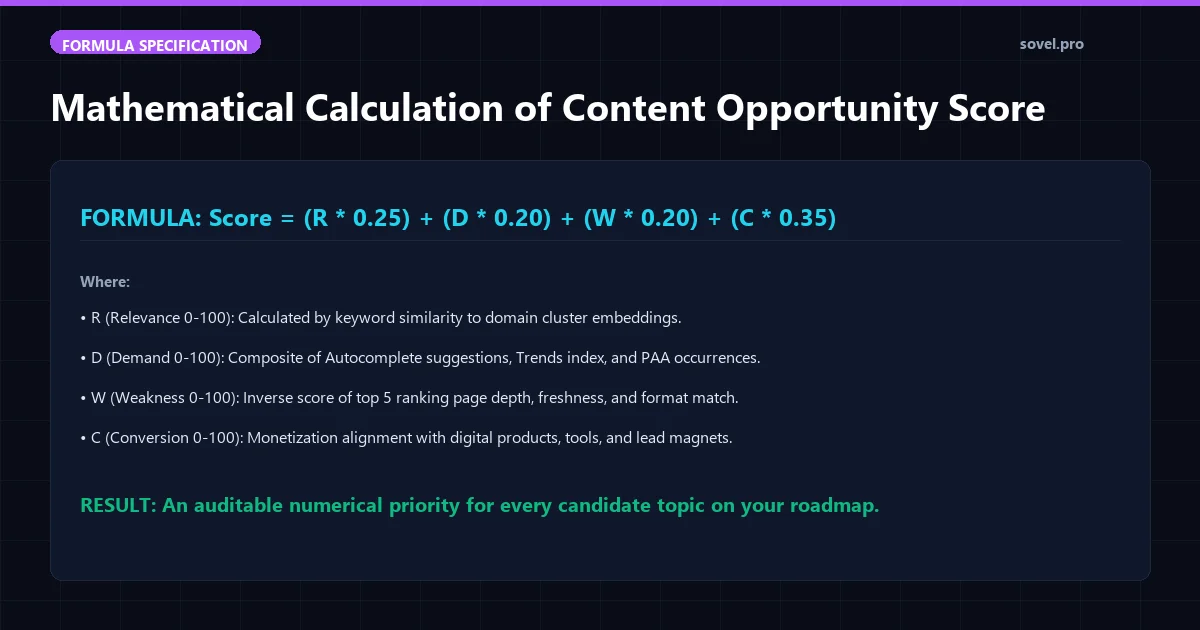
A weighted linear combination translates four distinct qualitative and quantitative signals into an objective 0-to-100 score.
The formal mathematical formula for the opportunity score is expressed as follows:
Opportunity Score = (R * 0.25) + (D * 0.20) + (W * 0.20) + (C * 0.35)

Where:
- R = Topical Relevance (0 to 100)
- D = Composite Search Demand (0 to 100)
- W = Competitor Weakness Index (0 to 100)
- C = Commercial Conversion Synergy (0 to 100)
Let us examine how this normalization works in practice during a real-world content opportunity score calculation:
| Pillar Component | Raw Input Measurement | Normalization Function | Normalized Value (0-100) | Weighted Score |
|---|---|---|---|---|
| Relevance (25%) | Direct match to local Python tools cluster | Cluster embedding cosine similarity = 0.88 | 88.0 | 22.00 |
| Demand (20%) | Appears in 8 of 10 Autocomplete adapters | 8 / 10 suggestion presence = 80% | 80.0 | 16.00 |
| Weakness (20%) | Top competitor is a 5-year-old forum post | Lack of structured tutorial = 75% weakness | 75.0 | 15.00 |
| Conversion (35%) | Direct solution provided by SOVEL-CGFE | Solves exact pain point of target buyer | 95.0 | 33.25 |
| Final Opportunity Score | Composite Evaluation | Sum of All Four Weighted Pillars | N/A | 86.25 (TARGET) |
This transparent mathematical formula ensures that every member of your editorial team understands exactly why a topic was chosen and where its value lies.
Step 3: Three Score Triage Bands for Editorial Workflow
A score is only useful if it dictates clear, immediate operational behavior. Once the content opportunity score calculation is complete, the engine automatically sorts candidate topics into three actionable triage bands:

Three strict score thresholds divide candidate topics into immediate sprints, supporting clusters, and backlog monitoring.
- The Target Band (Score >= 60): Immediate Production Queue
Topics scoring sixty or higher represent verified, high-converting market gaps. These keywords feature strong search demand, clear competitor vulnerability, and direct synergy with your digital products. Editorial teams should schedule these articles for immediate production in the upcoming weekly sprint.
- The Secondary Band (Score 40 to 59): Supporting Cluster Content
Topics in the forty to fifty-nine range are valuable supporting resources. They may have slightly lower commercial intent or face moderately stronger competition, but they are essential for building topical authority. Batch-produce these articles to provide internal linking support for your primary pillar posts.
- The Monitor Band (Score < 40): Archive and Passive Observation
Topics scoring below forty do not justify active writing resources. They represent saturated SERPs, ambiguous search intent, or zero product monetization potential. The engine stores these queries in the local SQLite backlog for passive quarterly re-evaluation.
Applying these triage thresholds during your content opportunity score calculation prevents content teams from wasting hundreds of hours drafting low-impact articles.
Step 4: The Editorial Prioritization Matrix: Balancing Potential vs Effort
While the opportunity score measures potential return, real-world editorial teams must also evaluate the production effort required to create the content. A sophisticated content opportunity score calculation pairs the opportunity score with an effort estimation matrix.

Balancing opportunity score against production effort separates rapid quick wins from foundational pillar guides.
Categorize your high-scoring opportunities into two operational quadrants:
- Quick Wins (High Score + Low Effort): Topics where an existing article on your domain can be updated with an H3 subsection, code snippet, or HTML comparison table. Production time is two to four hours, with immediate ranking improvements within days.
- Strategic Pillars (High Score + High Effort): Foundational, comprehensive technical guides requiring 2,500 words, custom architecture diagrams, and downloadable code packages. Production time is one to two days, serving as the core authority anchor for an entire topic cluster.
By balancing return potential and resource investment, your content opportunity score calculation maximizes the velocity of your organic search growth.
Step 5: Implementing Automated Opportunity Scoring in Python
When implementing content opportunity score calculation, to automate the mathematical scoring calculation across hundreds of candidate queries, the Content Gap Finding Engine executes a clean, vectorized Python algorithm directly within its SQLite processing pipeline:
def calculate_opportunity_score(relevance: float, demand: float, weakness: float, conversion: float) -> dict:
    # Ensure all inputs are clamped between 0.0 and 100.0
    r = max(0.0, min(100.0, relevance))
    d = max(0.0, min(100.0, demand))
    w = max(0.0, min(100.0, weakness))
    c = max(0.0, min(100.0, conversion))

    # Apply 4-pillar weighting formula
    final_score = (r * 0.25) + (d * 0.20) + (w * 0.20) + (c * 0.35)
    final_score = round(final_score, 2)

    # Assign editorial triage band
    if final_score >= 60.0:
        triage = "TARGET"
        action = "Schedule for immediate production sprint"
    elif final_score >= 40.0:
        triage = "SECONDARY"
        action = "Batch-produce as supporting cluster content"
    else:
        triage = "MONITOR"
        action = "Archive in SQLite backlog for future review"

    return {
        "opportunity_score": final_score,
        "triage_band": triage,
        "recommended_action": action
    }

# Example calculation run:
# result = calculate_opportunity_score(relevance=88, demand=80, weakness=75, conversion=95)
# print(result) # Output: {'opportunity_score': 86.25, 'triage_band': 'TARGET', ...}
Integrating this calculation directly into your data pipeline ensures that every keyword is evaluated objectively without cognitive bias. When you rely on automated content opportunity score calculation, you eliminate subjective editorial opinions from your content planning.
Step 6: Real-World Case Study: Triaging a 200-Keyword Roadmap
To observe the business impact of mathematical scoring, consider a software company preparing to publish articles for its newly launched developer utility. The marketing team had compiled a brainstorming spreadsheet containing two hundred potential article titles.
Left to traditional subjective debates, the team planned to write a massive, general guide to “What is Python Programming” because it had the highest theoretical search volume. However, running the entire list through the content opportunity score calculation engine produced a completely different set of priorities:
- “What is Python Programming” scored a dismal 32.4 (Monitor Band) due to near-zero conversion alignment and overwhelming competition from established universities and Wikipedia.
- “Python script for local SQLite caching” scored an impressive 84.6 (Target Band) due to high commercial synergy with their software, verified competitor gaps, and strong developer demand.
- “How to prevent database locks in multi-threaded Python” scored 78.2 (Target Band), representing an immediate quick win for an existing guide.
Step 7: Temporal Decay Penalty and Content Freshness Modeling
Search interest is never permanent. A technical query that drove thousands of visits two years ago may lose search velocity as newer programming languages, libraries, or operating system versions replace legacy software. A sophisticated content opportunity score calculation incorporates a temporal decay penalty into its evaluation model.
When the engine analyzes Google Trends velocity or checks the publish dates of competing articles, it applies an automated decay factor:
# Temporal decay adjustment
# delta_months: elapsed months since topic interest peak
decay_factor = 1.0 / (1.0 + (0.05 * delta_months))
adjusted_opportunity_score = round(raw_opportunity_score * decay_factor, 2)
If a candidate topic exhibits a steep sixty-percent drop in search suggestions over the trailing twelve months, the decay penalty lowers its score, ensuring that your team prioritizes evergreen or accelerating search queries during every content opportunity score calculation.
Step 8: Multi-Author Editorial Governance and Sprint Planning
In multi-author newsrooms and digital agencies, editorial disputes frequently arise regarding which writers should tackle which topics. Using an objective content opportunity score calculation standardizes project governance across all contributors.
| Writer Experience Tier | Assigned Triage Band | Content Archetype | Expected Editorial Velocity |
|---|---|---|---|
| Senior Technical Lead | Target Band (Score >= 75) | Comprehensive 2,500-word Pillar Guide | 1 foundational guide per week |
| Contributing Staff Writer | Target Band (Score 60-74) | Targeted Tutorial & Comparison Post | 2 focused articles per week |
| Freelance Technical Specialist | Secondary Band (Score 45-59) | Supporting Glossary & FAQ Clusters | 3 supporting cluster posts per week |
| Junior Research Assistant | Audit / Triage Queue | Running Python Engine & Brief Generation | Continuous backlog maintenance |
By attaching an empirical Opportunity Score to every Jira ticket or Notion card, team leads can justify editorial resource allocation with complete transparency during every content opportunity score calculation.
Frequently Asked Questions About Opportunity Score Calculation
Why does commercial conversion receive the highest weight in the formula?
Organic traffic that fails to convert into email subscribers, product trials, or direct software sales represents an unmonetized business cost. In a realistic content opportunity score calculation, weighting conversion at thirty-five percent guarantees that your publishing efforts support measurable business revenue.
Can the 4-pillar weights be customized for non-commercial publishers?
Yes. Non-profit organizations, educational institutions, or ad-monetized blogs can adjust the weights in the Content Gap Finding Engine configuration file. For ad-supported publishers, demand can be increased to 40 percent and conversion reduced to 15 percent.
How does the engine measure competitor weakness without third-party APIs?
The engine evaluates competitor vulnerability by parsing public search result pages, checking page publish dates, measuring text formatting density, and assessing whether competing pages provide complete answers or rely on shallow narrative fluff.
What is the minimum score required to justify writing a new article?
As a general rule, topics scoring below 40 should never be given dedicated new pages. Focus your creative energy on topics scoring 60 and above for primary guides, and topics scoring 40 to 59 for supporting cluster articles.
How does opportunity score calculation connect with the Sovel ecosystem?
Opportunity score calculation ensures that every Sovel product serves verified market demand. It dictates feature prioritization in the AI Engineering OS, selects high-earning non-fiction book topics in the Book Creation Engine, and drives the discovery pipeline in the Content Gap Finding Engine.
Conclusion: Build a Defensible, Evidence-Backed Publishing Roadmap
The era of guessing which content to write is over. By implementing an auditable, institutional content opportunity score calculation, you transform content marketing into a predictable revenue generator backed by empirical data.
Stop wasting valuable editorial hours on speculative keywords. Deploy the mathematical power of the Content Gap Finding Engine, calculate objective opportunity scores across your niche, and execute an editorial roadmap that dominates search results.
For more foundational frameworks on building sustainable search traffic, explore our comprehensive tutorials on python script for keyword research free and our complete guide on evidence based seo keyword strategy.