
Niche client research is the work you do before the website, the offer and the launch, and it is usually the work people skip. They pick a niche because a course recommended it, because a competitor looks busy, or because the label sounds impressive at a networking event. Then they spend a year finding out that the buyers are few, the contacts are hidden, or the budget was never there.
The short answer: niche client research means counting the buyers you can actually reach, reading how crowded the space is, and testing whether the people in it talk about the problem you solve. You do that with public pages, a spreadsheet and about two weeks of reading. If the count is thin or the language is cold, you change the niche before you have spent money on it.
This guide walks through five checks, the scorecard that holds them together, and the 30-day test that turns an opinion into evidence. The examples come from SOVEL CLIENT RADAR, the engine this site sells, because it makes the counting step concrete. The same thinking shapes the agency client acquisition routine and the outreach list building that follows it.
Count the buyers before you count anything else
A niche client research project starts with a number: the count of distinct companies that could plausibly buy your service, found on pages you can read today. Followers, search volume and market size estimates come later, if they come at all.
The counting method matters more than the total, and it is the first habit that separates niche client research from a hunch. The same company appears in a trade directory, a chamber list, a partner page and a conference roster, so a raw row count overstates the market. Count domains. Ten directories with the same forty businesses is a market of forty, and knowing that early saves months of misplaced confidence.
Market density is the next layer of niche client research. Density measures how many companies exist per unit of reachable contact: how many publish an email, a phone number, a named person or a contact form that a human answers. Thirty companies with four reachable contacts is a thinner market than twelve companies with nine.
That collapse is common, and it is worth expecting. A long list of studios often shrinks once duplicates are removed, and part of what remains has no contact page at all. A market worth a year of work needs reachable buyers, and the density count shows that in an afternoon.

How narrow should a niche be?
A niche is the right size when you can name thirty buyers and still have room to grow. Narrower than that and the list runs out in a week. Wider and the message has to cover too many different problems, which pushes you back toward generic work. Niche client research begins with that size question.
Niche client research finds that edge by testing labels. Start with a broad industry, then add one constraint: a city, a company size, a platform, a service model, a stage of growth. “Healthcare” is not a niche. “Dental practices with two locations and no in-house marketer” is a market you can count.
Test each label against the list. If a constraint cuts the count from two hundred to twelve, it is too tight for a first attempt. If it changes nothing, it is decoration. The useful constraint removes about half the names and leaves the ones you can serve well.
Write the final label in one sentence and put it at the top of the sheet. Every later decision in niche client research refers back to that sentence: which directories to read, which phrases belong in the sheet, and which proof to show first.
A label specific enough to be wrong is specific enough to test. That is why niche client research beats a hunch, and why the label deserves an afternoon of its own before the outreach starts.
Read saturation before you count competitors
Competitor saturation is about attention. Headcount tells you very little. A niche with two hundred agencies can still be open if most of them publish nothing specific. A niche with six agencies can be closed if all six own the same search result and the same referral network.
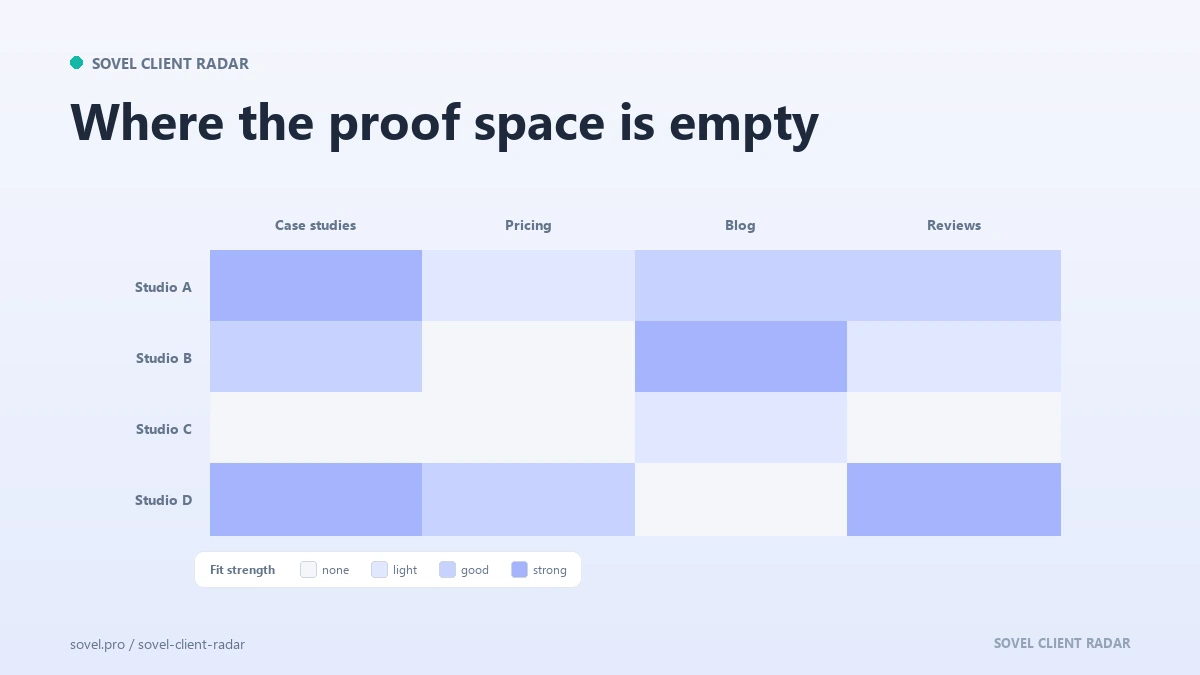
Look for proof rather than presence. Who publishes a case study for this exact service? Who has a page that answers the buyer’s question in the buyer’s words? Who shows up when you search the service plus the city? A cluster of generic homepages with the same stock photograph is a sign that nobody has done the work, which is an opening.
The harder version of competitor saturation is vendor capture. If every buyer in the niche already works with one platform, one reseller or one agency group, the market is spoken for. You can still sell, but you are selling against an incumbent relationship, and the sales cycle gets longer than the price justifies.
Check saturation before you write a single page. That order is the difference between niche client research and a folder of competitor screenshots. Two hours of reading tells you whether the niche rewards specificity or whether the buyer has stopped comparing. The answer changes your offer more than any brand exercise.
Collect the customer language before you write a word
Customer language is the phrase a buyer uses when describing the problem, and it is the most useful output of niche client research. It shapes the offer, the first email and the page title, and it cannot be guessed from a keyword tool.
The best sources are pages the buyer wrote: service pages, about pages, FAQ sections, job adverts, support documentation and review replies. A manufacturer that writes “we keep the line running” is telling you the outcome it cares about. A clinic that writes “we answer the phone after six” is telling you where the pain sits.
Harvest exact phrases. Themes are too vague to use. Copy ten exact sentences into a sheet with the URL and the date, then group them by problem. When three companies describe the same frustration in almost the same words, you have found the offer. That is the whole method, and it costs one afternoon.
Use the language carefully. Mirroring a buyer’s phrase in your own page is fine. Lifting a paragraph from their site is not, and it reads as laziness to anyone who knows both companies.
Test the budget with public evidence
Every niche has a budget, and most of it is visible before you send anything. The question is whether the money already moves toward the kind of work you sell.
Look for evidence of spend. A company hiring a marketing coordinator is budgeting for marketing. A company with a paid listing in a trade directory is spending on visibility. A company that sponsors a local event, runs a blog with an agency byline or lists a new location is showing where money goes.
A business can be large and still have no budget for you. A twenty-person firm with an in-house team of four may never buy outside help, while an eight-person firm with one overloaded generalist may buy every quarter. Budget follows the gap between what a company needs and what it can do in-house.
Write the evidence next to each name in the sheet. “Hiring a content lead, posted this month” is a budget signal. “No marketing hire, no blog, no listings” is a different signal, and it usually means the money goes somewhere else. A budget note per row is the part of niche client research that pays for itself fastest.
The US Small Business Administration guide to market research and competitive analysis is a useful sanity check on this step, because it treats demand as something you verify rather than assume.
Score the niche on one page
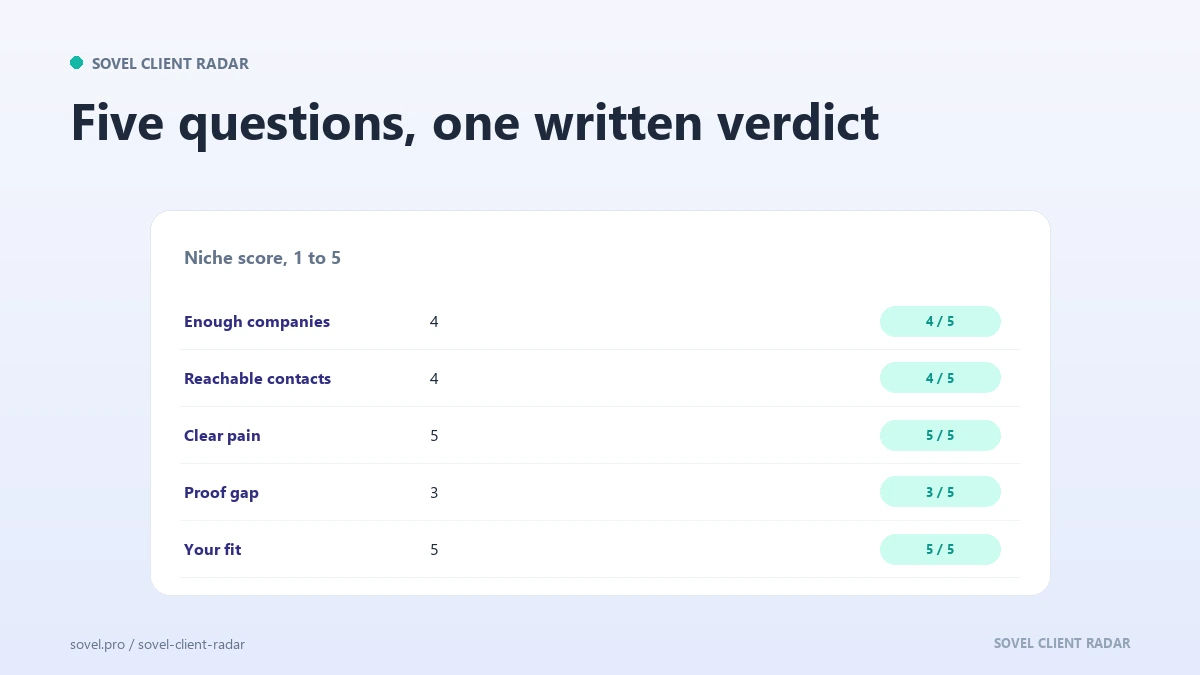
A scorecard turns five separate impressions into one decision. It also gives you a record you can revisit in six months, when the answer may have changed.
Score each row from 1 to 5, then write the verdict in words. A niche that scores well on density and fit but poorly on budget is a maybe. Keep it for a cheaper offer later.
| Check | What earns a high score | What earns a low score |
|---|---|---|
| Market density | Many distinct domains, most with a reachable contact | Few domains, contacts hidden behind forms |
| Competitor saturation | Generic competitors, little published proof | Incumbents with proof, referrals and search presence |
| Customer language | Clear, repeated phrases about the problem | Vague or silent about the work you sell |
| Budget evidence | Hiring, listings, sponsorship or recent expansion | No visible spend on marketing or ops |
| Fit | Work you already do well, at your rate | Work you would need to learn on the client’s money |
Two rules keep a niche client research scorecard honest. First, score the evidence, not the enthusiasm. Second, if a row has no evidence at all, write zero rather than guessing. A scorecard full of guesses is a mood board with numbers.
Run a 30-day test before you commit
A 30-day test is the cheapest way to find out whether a niche is real, and it is the step where niche client research turns into a decision. It does not need a website, a brand or a full offer. It needs a list, a sentence and twenty sends.
Week one, count and dedupe. Build a list of thirty distinct companies, record the source for each one, and mark which have a reachable contact. Week two, read the top fifteen and harvest the phrases. Week three, send five specific emails with one proof point each. Week four, review replies, silence and the reason behind both.

The test measures two things: whether people answer, and whether you enjoy the conversations. A niche that replies but drains you is a poor long-term choice. A niche with slow replies but good conversations is worth a second month.
Keep the test small on purpose. Twenty careful sends teach you more than two hundred automated ones, and they leave your domain and your reputation intact.
Is my niche too crowded?
The question “is my niche too crowded” usually comes from looking at the wrong layer. The crowded layer is the one everyone can see: the agency list, the directory, the search result page. The open layer is the one nobody has written for, the specific problem, the specific city, the specific handoff that keeps failing.
A niche is too crowded when buyers cannot tell the offers apart, when every competitor claims the same three things, and when price is the only remaining difference. That is a saturation problem, and it is solved by narrowing the problem you solve rather than by picking a different industry.
A niche is not too crowded when the incumbents are generalists, when their proof is thin, or when their pages ignore the language buyers use. In those cases the market looks full from a distance and has room up close.
So the honest test is whether you can describe a buyer, a problem and a proof in one sentence that nobody else in the niche is saying. The competitor count tells you less. If you can write that sentence, the count stops mattering so much.
When that sentence will not form, the niche needs another pass rather than a new niche. Go back to the sheet and reread the rows you scored low, because the missing detail is usually sitting in a page you skimmed. Niche client research is cheap to repeat and expensive to skip, and a crowded-feeling market is best judged on your own rows rather than someone else’s opinion.
How to choose a niche you can defend
How to choose a niche is a question about evidence, and the answer holds up better when it is written down. Three tests decide it: can you name thirty buyers, can you reach a third of them, and can you show one piece of proof they would recognise as relevant.
If the answer is yes to all three, commit for ninety days and stop shopping for a better niche. The switching cost is real, and a niche studied for three months beats a niche chosen twice a week.
If the answer is no, walk away on evidence rather than mood. Walk away when the list of distinct domains stays under twenty after a week of reading, when every buyer is locked into a platform relationship, when the only feedback is about price, or when the work itself is something you would not want to repeat.
Write the answer down and date it. A sentence that says why this niche fits is worth more than a positioning deck, because it can be checked against the list in three months. Niche client research produces that sentence, and the sentence makes the next decision cheaper: a new directory to read, a new constraint to test, a new piece of proof to gather.
How to choose a niche also depends on what you already have. A designer with three retail clients has a niche whether or not it is fashionable. A consultant with no clients has to build the list first and let the pattern appear. Either way, the decision rests on counting, reading and testing, which is the whole point of doing niche client research before the website goes live.
Which edition fits your research?
SOVEL CLIENT RADAR covers the counting part of niche client research. It builds a query matrix from a niche, a location and an ideal customer profile, reads public pages under the rules those pages publish, and returns a scored list with a source and a retrieval time for every claim. The price moves with seats and with the per-run lead ceiling.
- Personal / Freelancer: ₹5,999 buys one seat and 50 leads per run, enough to test one niche across a month.
- Pro / Small Business: ₹12,999 buys one seat and 200 leads per run, a deeper sweep when a niche needs a wider map.
- Agency / Enterprise: ₹39,999 buys five seats and 500 leads per run, for several niches researched in the same week.
Pay once, then run it as often as the research needs, since no edition counts runs by day or month. No feature sits behind a higher tier. The output folder carries an 84-column lead sheet, a contacts file, a signals file, a six-sheet workbook and a report you can read on a phone. The product page sets out what each edition contains and what it costs.
If you want to check how crowded a niche looks from the content side, the competitor content gap method shows where to look. That comparison is the content half of niche client research. For the next step after this one, read the agency client acquisition routine for teams, and the outreach list building rules for the list you will send from.
FAQ
How many prospects make a niche viable?
A working floor is around thirty distinct companies with a reachable contact for at least a third of them. Below that, the niche can still work for a specialist with warm referrals, but cold research will feel like scraping a dry well. Count domains rather than rows before you decide.
How do I size a market without paid tools?
Use public pages and a spreadsheet. Read trade directories, chamber lists, partner pages and conference rosters, then dedupe by domain. That gives you a count of named buyers, which is more useful for niche client research than a market size figure you cannot act on.
What if the niche is crowded?
Crowding is usually a positioning problem rather than a market problem. Narrow the problem, the city or the handoff you specialise in, then check whether the incumbents have written anything specific about it. If they have not, the space is open enough to test.
How long should niche client research take?
Two weeks of reading and one month of testing is enough to make a first decision in most niche client research projects. A scorecard can be filled in a day once the list exists. The expensive mistake is spending six months on a brand before the count is done.
Can I serve two niches at once?
You can, if the two niches share a buyer type and a proof set. Two unrelated niches double the research and halve the depth, which shows in the outreach. Start with one, run the 30-day test, and add the second only when the first produces steady conversations.
What if I cannot find any contact details?
That is a finding worth recording. A niche whose buyers publish no contact route is hard to reach without paid data or referrals. Record the gap on the scorecard, then test a nearby niche where pages list a phone number or a named person.
What is niche client research in one sentence?
Niche client research is the practice of counting reachable buyers, reading the competition and testing demand before you commit to a market. It ends with a scorecard and a short list rather than a brand deck. The test is whether you can name thirty buyers and reach a third of them.
Does a small niche mean a small business?
No. A niche of forty companies can support a specialist who charges well, because the buyer list is finite and the proof compounds. The number to watch is reachable buyers, and that number decides how much of your week the research deserves.