
Agency client acquisition usually fails in the same place: the list. A team with strong delivery and weak research pitches companies that were never going to buy, then blames the market when replies are thin. The fix is unglamorous. Decide what you want to sell, find the companies that match that shape, and keep one shared record of why each name sits there.
The short version: agency client acquisition is a research routine that turns public business pages into a shortlist of companies matching the retainer you want to run, then gives one named person the job of moving each name forward. It works when the list is shared, the fit test is written down, and case study matching happens before the first email instead of after the call.
The six steps below suit a team of two to fifteen people. Each step has an owner, an output and a time cost, because a new business pipeline that depends on heroics collapses in the first busy month. The examples use SOVEL CLIENT RADAR, the engine this site sells, so the list mechanics stay concrete rather than abstract. A studio of one can run the same loop with the freelance client prospecting guide.
Put the retainer before the research
Agency client acquisition starts with a written retainer brief. The target list comes after it. The brief is one page: the service you want to repeat, the hours per month, the budget band, the industry, the person who signs, and the three conditions that make a company a poor fit. Every later step is a test against that page.
Retainer fit is a plain test. A company has good retainer fit when the work you would do for it looks like the work you already do well, at a size that pays, with a person who can approve it. A retainer built on a one-off project usually ends in month three, when the project is finished and nobody knows what comes next.
A vague brief poisons every step after it. “We want ambitious brands” produces a list of ambitious brands with no budget. “Shopify stores with a marketing hire, no in-house designer, and a catalogue one person can read in an afternoon” produces a list you can check in ten minutes per company.
The brief also gives the team a way to decline work without an argument. When a partner forwards an inbound lead that fails three lines of the page, the answer is already written down, and the conversation takes a minute instead of an afternoon.

Map the market you can actually reach
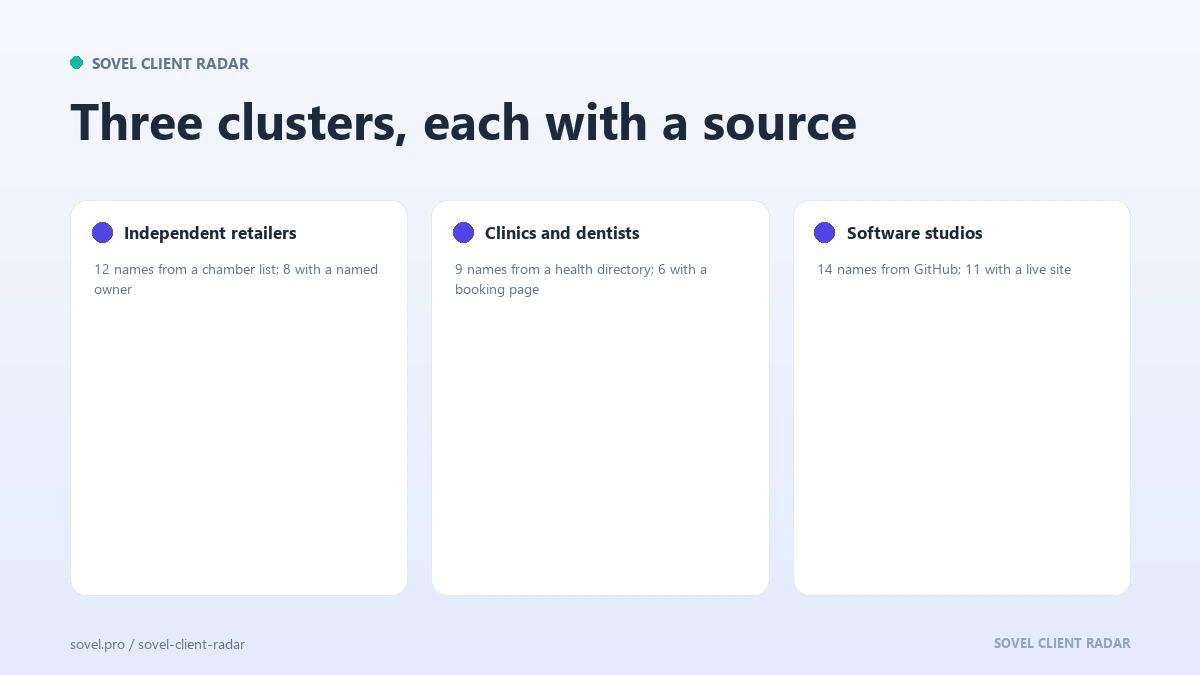
A market map is the second task in any honest agency client acquisition plan. Pick three categories where your best work already sits, then name the companies in each one by reading pages that list them: trade directories, partner pages, conference exhibitors, local business indexes and the client pages of tools you use.
The point of the map is coverage. Judgement comes later, when you score. You want forty or fifty named companies before you score anything, because a shortlist drawn from eight names is a guess with extra steps. Agency client acquisition research improves when the pool is wider than the team’s memory.
This is where many teams discover that their market is smaller than they assumed. If the map produces twelve companies across three categories, that is useful information. It tells you the niche is thin, or the categories were too narrow, or the reading was confined to one directory.
SOVEL CLIENT RADAR handles this part by reading the pages you name. You pass a directory or a member list with the seed-pages option, and the engine follows profile pages on that host, then takes external links as candidate businesses. Each candidate keeps the URL of the page that mentioned it, so the market map carries a source line rather than a name you half remember. That one change removes most of the copying from agency client acquisition.
Build one shared list
The shared list is where most agency client acquisition breaks down. One person keeps a spreadsheet, another keeps notes in an inbox, a third remembers a conversation in the corridor, and the team meets on Monday with three versions of the truth.
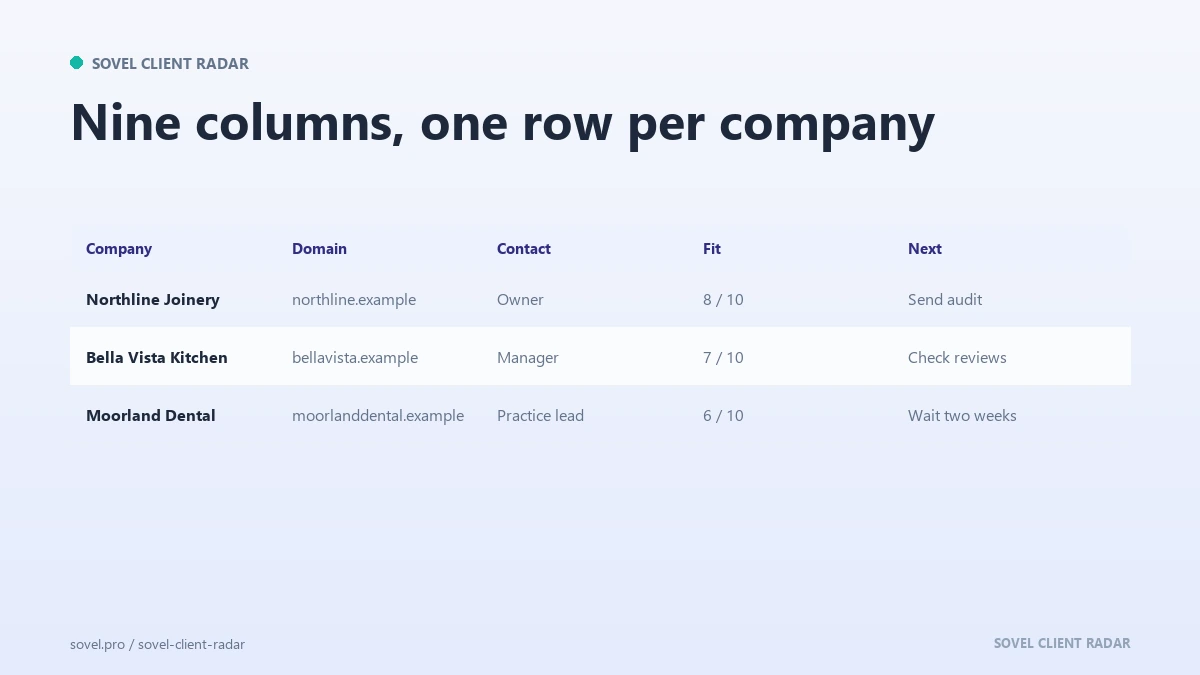
One table fixes it. Every row needs a company name, a domain, the source URL where you found it, the date you read that source, a fit note in one sentence, the best contact route, an owner, a stage, and the next action with a date. Domain is the key. Two rows with the same domain are one company. That rule alone clears most of the mess that makes agency client acquisition feel harder than it is.
This is also the cheapest place to protect the agency’s reputation. A suppression flag on the row means nobody emails a company that asked to be left alone, and nobody re-approaches a prospect a colleague already closed. The engine ships a suppress command for exactly this, and it accepts a domain, a URL or an email address.
A new business pipeline built on one shared table survives staff changes. When the person who did the research leaves, the reasoning stays with the rows, and the next owner can see why a company was added or dropped.
Put fit ahead of size
Qualification is the step that keeps agency client acquisition honest. The largest company on the list is rarely the best prospect. The best prospect is the one whose problem matches your proof, whose budget matches your floor, and whose decision maker you can name.
Run five questions against every row. Does the company sell to a customer we understand? Is there a page, a hire or a launch that points to work we do? Can we name the person who would approve the spend? Is the budget band plausible for a company that size? Would we still want this client in twelve months?
Retainer fit answers the last question, and it is the one teams skip. A company with a big logo and a small problem consumes the same account hours as a company with a modest logo and a real problem. The second one renews, and the first one calls a review meeting in week six.
Write the disqualifier next to each row you drop. “No marketing hire”, “in-house team of nine”, “franchise locked into a central agency contract”. A written disqualifier stops the same name returning next quarter as somebody’s fresh idea.
Match the case study before you write
Case study matching changes the reply rate more than any subject line. You choose the piece of proof that matches the prospect’s situation, then you write the first line from that match, which is why the order matters.
The common mistake is sending the flagship case study to everyone. A retailer does not care about your software migration, and a product team does not care about your shop redesign, even when both projects were excellent. Matching means reading the prospect’s site and choosing the project that looks like their next year.
Keep a small index of proof: five projects, each with one sentence about the problem, one about what changed, and one about the kind of company it suited. When a new name enters the list, the owner picks the matching project and pastes the index line into the row. That is the whole method, and it takes about two minutes.
If no project matches, say so and pitch the closest one with a caveat. A team that admits the gap sounds more credible than one that claims every project applies to every buyer, and a caveat costs nothing while it keeps the trust that agency client acquisition depends on.
Give every name one owner
Agency client acquisition stalls when ownership is shared, because shared ownership means nobody’s job. One name per row, one person accountable for the next action, and a date that shows on the board.
The six steps map cleanly onto a small team. The table below is the version I would pin above a desk, because it answers the question every founder asks in week two: who is supposed to do this.
| Step | Owner | Output |
|---|---|---|
| Write the retainer brief | Founder or delivery lead | One page with service, hours, budget band and disqualifiers |
| Map the market | Researcher | Forty to fifty named companies across three categories |
| Build the shared list | Researcher | One table with source URLs, an owner and a next action |
| Qualify on fit | Account lead | A shortlist with a written reason for each name |
| Match the case study | Whoever ran the closest project | One proof link and one sentence per prospect |
| Run the weekly hour | New business owner | Five first emails, five follow-ups, every next action logged |
The table does more for agency client acquisition than any training session, because it turns a vague ambition into six jobs with names attached and a visible output for each one. Agency client acquisition works better as six small jobs than as one large intention.
Keep the weekly new business hour
The weekly hour is the heartbeat of agency client acquisition. One hour, same slot, same room or call, with the list open. A quarterly offsite does not replace it, and neither does a burst of activity after a quiet month.
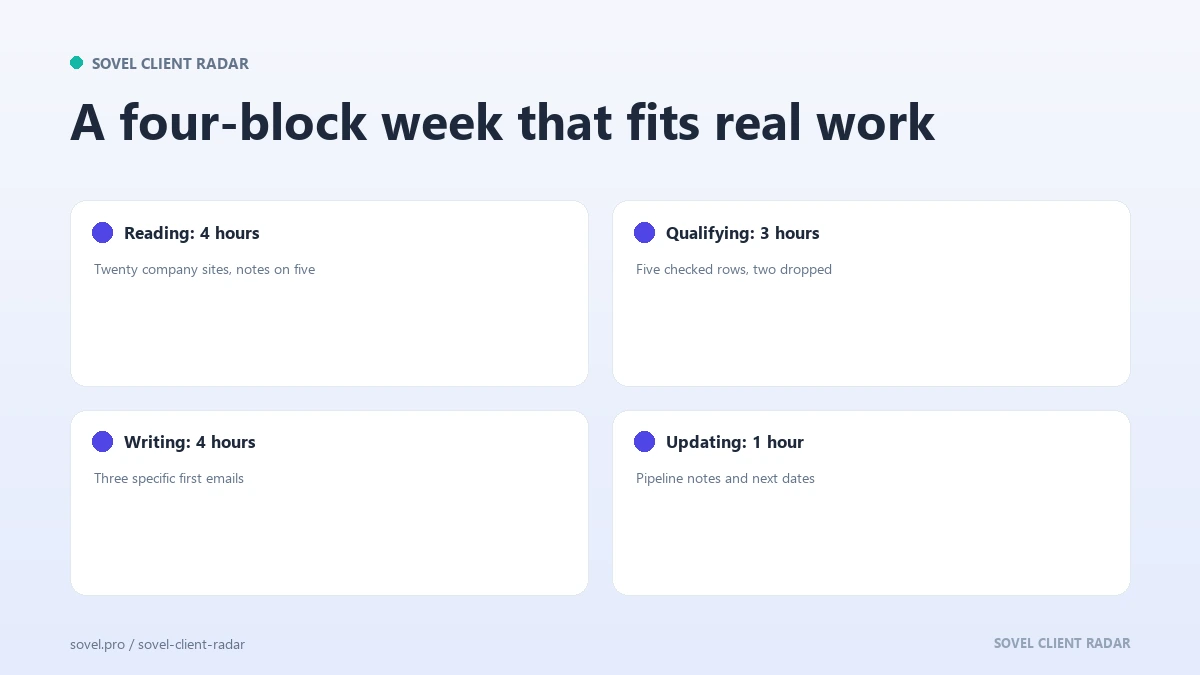
The hour has a fixed shape. Ten minutes reading new rows. Twenty minutes qualifying and matching proof. Twenty minutes writing first lines and follow-ups. Ten minutes updating stages and dates. Anything that does not fit goes to next week, where it will take ten minutes instead of derailing the session. That shape is what makes agency client acquisition repeatable.
This is also the honest answer to how to win agency clients without a full-time sales hire. You do not need a pipeline meeting every morning. You need a small, repeated block that nobody cancels, plus a record of what happened inside it. How to win agency clients is mostly a question of consistency, and consistency is easier to protect when it costs one hour a week.
An agency prospecting plan that asks for ten hours a week will be abandoned in month two. An agency prospecting plan built around one protected hour will still be running in month twelve, and twelve months of steady research beats two heroic weeks every time.
Two numbers belong on the wall: new names added and first emails sent. Both are inputs the team controls, and they predict the rest without pretending to.
How does capacity planning shape the list?
Capacity planning is the step that stops agency client acquisition from creating work the team cannot deliver. A retainer sold in a strong month becomes a delivery problem in a busy one, and a client who arrives that way rarely stays for a second year.
Count the hours first. A team of three with a hundred and twenty billable hours a week has a ceiling, and a new retainer of twenty hours a month uses a real share of it. Write that ceiling beside the retainer brief, so the fit test includes a delivery question: if this company said yes on Friday, who would do the work in week three?
The list changes once capacity enters the picture. Senior-heavy retainers suit a small number of deep relationships, so the shared list can stay short. Productised retainers suit volume, so the market map needs more names and the qualifying step gets faster. Agency client acquisition that ignores this mismatch produces a pipeline full of work the team will resent.
Review capacity monthly, not quarterly. When two retainers land in the same month, pause the outreach hour, protect delivery, and restart when the hours free up. A paused week costs less than a missed deadline, and the list keeps its place on the board.
Agency client acquisition is a delivery promise made before the work exists. Capacity planning is how that promise stays true.
Where does AI fit without lowering the standard?
AI can shorten the reading part of agency client acquisition, and it can also fill a list with plausible nonsense. The difference is whether a person checks the output against the source page.
The optional AI layer in SOVEL CLIENT RADAR works this way. You add your own provider key, the engine asks for one second opinion per lead, and every quoted phrase the model returns is checked against the page it came from. A quote that is not really there gets deleted, and the run notes count how many were dropped. That is a small design decision with a large effect on trust.
Teams that write their own prompts need the same discipline. Ask for a summary of a page you have open, then check the summary against the page. Ask for a first line, then confirm the detail exists in the source. A risk framework such as the NIST AI Risk Management Framework helps here because it treats human review as part of the system rather than an optional extra.
Matching a project to a prospect is a good place to use a model and a poor place to trust one. A model can compare two descriptions quickly. It cannot know whether the client would agree with the comparison, so a person signs off before the line goes out.
Which edition fits your team?
SOVEL CLIENT RADAR does the reading part of agency client acquisition. It builds a query matrix from your niche, reads public pages under the rules they publish, records a source and a retrieval time for every contact, and writes a report folder the whole team can open. Pick an edition by team size and by how deep a single run needs to go.
- Personal / Freelancer at ₹5,999: one seat, up to 50 leads per run. A one-person studio working a single niche.
- Pro / Small Business at ₹12,999: one seat, up to 200 leads per run. A small team that wants a deeper list from the same research hour.
- Agency / Enterprise at ₹39,999: five seats, up to 500 leads per run. A team researching several client niches at once.
Nothing in the licence limits how often you run it, and every feature is present in all three. Exports cover CSV, XLSX, JSON, JSONL, Markdown, HTML, DOCX and PDF, so the account lead and the delivery lead can read one run in the format each of them prefers. The product page lists what every edition contains, including the optional AI layer and the report set.
If your new business work is mostly white-label delivery for other agencies, the white-label AI development workflow covers that arrangement. Two more reads pair with this one: the freelance client prospecting routine for solo operators, and the niche client research method for choosing the categories on your market map.
FAQ
How is agency client acquisition different from lead generation?
Lead generation usually means collecting names and contact details at volume. Agency client acquisition starts from a retainer brief and works backwards, so every name carries a reason, a proof match and an owner. The output is a shortlist a partner can defend in a meeting.
How many prospects should a small agency work each month?
Twenty to thirty qualified names is a realistic month for a team running one protected hour a week, with five first emails going out weekly. The number matters less than the ratio: every name should have a source, a fit note and a matched case study. Agency client acquisition gets easier when the shortlist is small enough to read.
Who should own research inside the agency?
One person owns the shared list, and it does not have to be a founder. A junior researcher with a clear brief and a weekly hour produces better rows than a partner who fits it around delivery. The owner keeps the table clean, the source URLs current and the next actions dated.
How do we avoid bad fits when the pipeline is thin?
Keep the disqualifiers visible and treat them as a feature of the brief. When cash flow is tight, the temptation is to relax the fit test, and that decision usually costs more than the empty week. A thin pipeline is a research problem, so add a category to the market map rather than lowering the bar.
Can we use AI in agency client acquisition?
Yes, with a checking step. Use a model to summarise a page, compare two project descriptions or draft a first line, then confirm every fact against the page it came from. The engine’s optional AI layer deletes quotes that do not appear on the page and reports the count.
How do we measure whether the work is paying off?
Count inputs before outcomes: names added, names qualified, first emails sent and follow-ups logged. Those four numbers show whether the routine is running. Replies and signed retainers follow, but a quiet month tells you little while the input numbers are still moving.
What if we only serve one industry?
A single-industry agency needs a deeper map rather than a wider one. Read five directories instead of one, follow partner pages inside the industry, and track the companies that raised money, opened a location or hired a marketing lead. Case study matching is easier in one industry, because the proof is closer to the prospect’s daily work.