
Freelance client prospecting is the part of the job nobody bills for, which is exactly why it gets skipped until the work dries up. Then it becomes urgent, the list is cold, and the first email reads like a request for rescue.
The fix is small and dull. Five habits, run in a fixed weekly block: collect ten names, check them against your portfolio fit, hold a rate floor, follow up on a schedule, and ask for one referral after every project.
Most advice about how to get freelance clients starts with a platform and a profile. This guide starts with a calendar slot, because freelance client prospecting only works when it has a place to happen.
Why does freelance client prospecting fail in the first month?
Most freelancers treat freelance client prospecting as a campaign. They send thirty emails in a burst, get two replies, and stop. The burst feels productive and leaves nothing behind, because a list built in a panic has no dates and no follow up.
Freelance client prospecting works when it is a routine that survives a busy week. That means a block in the calendar, a fixed number of names, and a stopping point. The routine should still run in the week a project goes sideways, which is why it has to fit into 90 minutes.
There is an emotional reason too. Prospecting asks you to be rejected by strangers, and the easiest way to avoid that is to be too busy. A short, scheduled block lowers the cost of starting, and a lower cost means you keep doing it.
Freelance client prospecting also competes with paid work for the same hours, and paid work always wins the argument. That is why the block has to be defended like a deadline, and why a smaller block that happens beats a bigger one that keeps moving. Ten minutes of collecting names is worth more than a perfect plan for a day you never find.
Rates belong inside freelance client prospecting, not in a separate finance folder. The number you will not go below decides which names you pursue and which you decline, so it shapes the list from the first minute.
Habit 1: keep a fixed pipeline block
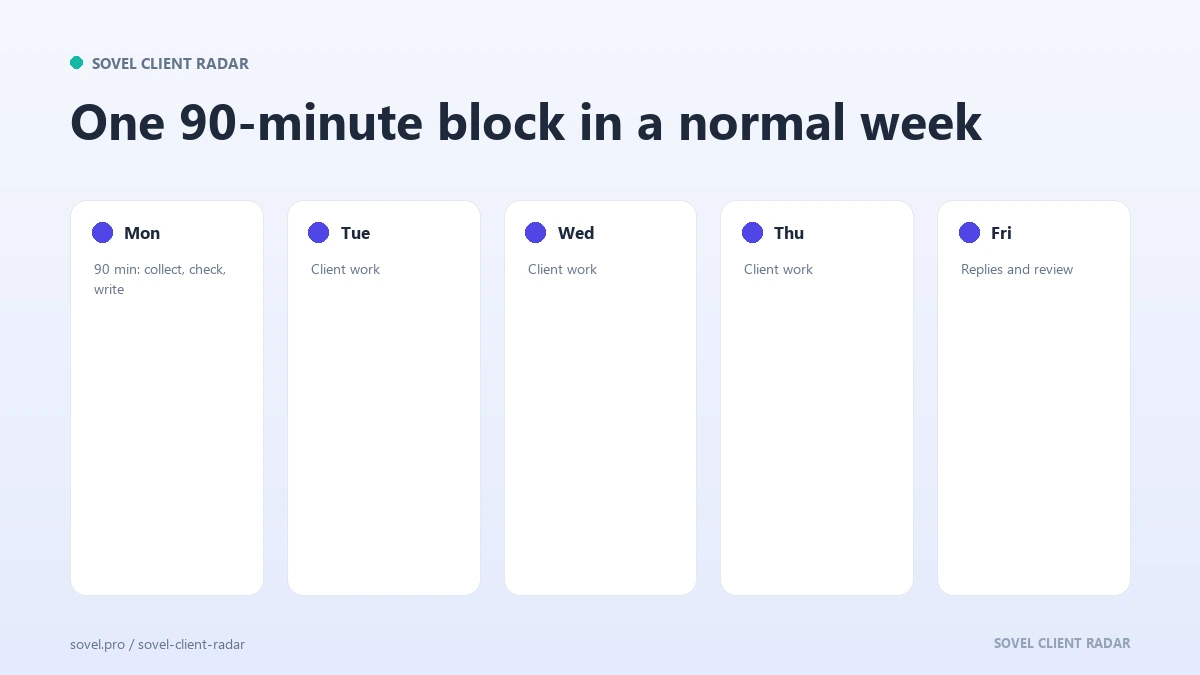
Pick 90 minutes, the same day and hour every week, and call it the pipeline block. Treat it like a client meeting. Freelance client prospecting only becomes reliable when it owns a slot that other work cannot take.
The block has three parts. Twenty minutes to collect names, forty to check them, thirty to write and send. Anything longer than 90 minutes gets postponed, and anything shorter produces a list too thin to matter. Freelance client prospecting rewards the fixed block more than the long session.
Turn off notifications and close the client inbox. A block interrupted by a delivery question becomes a delivery hour, and freelance client prospecting slips another week.
Keep one file per block: the date, the names, the source for each, and the messages sent. That file is your freelance pipeline, and it is more useful than any dashboard because you can read it in a minute.
Habit 2: collect ten names a week
Ten names is the right number for freelance client prospecting. It is small enough to finish, large enough to produce two or three replies, and honest about the hours a solo worker has.
Where the names come from matters less than the recording. A trade directory, a supplier page, a conference list, a former client’s partner page, a job advert that names a company. Pick one source per week and work it properly, because freelance client prospecting rewards depth in one place more than a scatter across five.
Record four things per name: the company, the website, the person you would write to, and the page where you found them. That is the minimum for a file that can be picked up next month without guesswork.
A source that lists companies with a website and a named person is worth more than a file of 500 addresses. One good directory page can carry a month of freelance client prospecting on its own, because every row arrives with a page you can cite and a business that chose to be listed.
Then filter. Six of the ten usually survive a two minute check: the site loads, the business still exists, the person is still listed. Four get a message. Three maybes get a date. A list of ten produces four emails, not ten, and that ratio is normal in freelance client prospecting.
Keep the source page open in a tab until the four messages are sent. The first line often needs one more look at the page, and a closed tab turns that look into a fresh search.
Habit 3: check portfolio fit before you write
Portfolio fit is the question of whether you can show work that resembles the job you are about to pitch. It is the fastest filter in freelance client prospecting, and it saves hours of writing to the wrong buyer.
Three tests, each a yes or no. Can you show two pieces of work that look like this project. Would you take the job if it paid your rate. Does the buyer seem to value the work, or are they shopping for the cheapest quote. Two yes answers are enough to start writing, and that is the standard freelance client prospecting needs.
The first test is about proof, and it is the one freelancers skip. A landscape photographer pitching a software company can still win on a different angle, and the email has to do more work. A specialist whose portfolio matches the brief gets a reply from a shorter message.
The second test is about appetite. A job you would resent at your own rate will not improve at a lower one. Portfolio fit includes the version of the work you want to be doing in a year, and freelance client prospecting is easier when the answer is specific.
Fit also decides how you write the first line. When the work matches, name the closest project and say why it is close. When it does not, you have to earn attention with an observation about the buyer. That is slower, and it is worth doing only when the reason is strong.

Habit 4: hold a rate floor
A rate floor is the number below which you decline, written down before the conversation starts. Without one, every quote is a negotiation with your own anxiety, and the pipeline fills with work that pays less than it costs to deliver.
Set it from arithmetic. Take the income you need each month, divide by the billable days you can actually sell, and add your costs. A freelancer who needs 100,000 a month and can bill 12 days has a floor near 8,300 a day before tax. The number is yours, and it belongs in the file.
Then decide what happens below it. Some work is worth doing at a lower price for a portfolio piece, a case study or a foot in a new sector. That is a decision, and it should carry a reason in the row rather than a shrug. The IRS self-employed tax center is a public starting point for the cost side of solo work if you have never set a number before.
The floor does more than protect income. It shortens the list. Names that cannot reach the floor come off early, which means freelance client prospecting spends its hours on buyers who can say yes.
Review the floor every quarter. Costs move, demand moves, and a number set two years ago is a guess about a market that has changed. A freelancer who has not raised a rate in three years is usually quoting against a floor built for a different life.
A floor also gives you a sentence for the awkward moment. When a buyer asks for a discount, the answer is a smaller scope at the same rate, which keeps the number intact and the conversation polite. That sentence is easier to say when the number is written down.
Habit 5: run a follow up ladder
Most replies arrive after the first message, and almost none arrive after a single send. A follow up ladder is the schedule that keeps a quiet prospect in view without turning into pestering.
Three touches, spaced out, each with a reason to exist. Day zero, the first message with the observation. Day four, a short note that adds one useful thing, such as the screenshot or the page you mentioned. Day eleven, a closing note that says you will stop here. Then stop.
The second touch is where most freelancers give up, and it is also the one that produces replies. The first email often arrives on a bad day and the second arrives on a good one. Build the ladder into the file so freelance client prospecting runs without relying on memory.
The third touch should make stopping easy for both sides. “I will leave it here, and the offer stands if the timing changes” costs nothing and keeps the door open. A follow up ladder that ends politely is worth more than one that ends with a fourth attempt.
Track the ladder per name, not per week. A file with dates beside each touch tells you who is due today, and a list without dates is a list you will avoid.

When do you ask for a referral?
One question after a finished project does more than a week of cold email. “Is there another business in your trade that keeps running into the same snag?” is specific, easy to answer and easy to decline.
Ask while the work is fresh. A client who has just seen the result remembers what it fixed. A client you ask six months later has to reconstruct the value, and most will not bother.
Keep the ask small. A request for “anyone who needs help” produces nothing. A request for one company in the same sector, at a similar size, produces a name or a polite no, and both are useful.
Referrals feed the front of the pipeline. A warm name that arrives with a sentence of context needs less research and gets a faster reply, which is why the referral ask sits inside freelance client prospecting rather than beside it.
Ask once, then leave it. A client who is asked twice starts to feel like a lead source, and the relationship cools. Freelance client prospecting works on trust, and trust is easier to keep when a request is small and clearly finished.
What does the monthly review count?
Once a month, read the file and count four things: names collected, messages sent, replies, and calls booked. That count is the only honest measure of whether freelance client prospecting is working.
Then look at the sources. If one produced three replies and another produced none, do more of the first and drop the second. Sources change, so the review is not a one time decision. A freelance pipeline reviewed monthly tells you which row to cut, and cutting is how the file stays short.
Check the rate floor too. If every conversation stalls at price, the list is wrong or the pitch is. If nobody mentions price, you may be quoting below the market. How to get freelance clients is answered by the reply count, not by the number of names in the file.
If you sell content or search work, the keyword research to published article pipeline is a useful model for this review. Fixed inputs, fixed steps, a finished file you can inspect at the end. Freelance client prospecting deserves the same design, and a monthly review is the inspection.

What should you stop doing?
Stop refreshing job boards. They reward speed and punish judgment, and every hour there is an hour not spent on a named company with a reason to talk to you.
Stop offering free work as a way in. A paid small job tests the same thing and pays for the time. Unpaid tests select for freelancers with spare capacity, which is rarely the ones with the best portfolio.
Stop discounting to win. A discount teaches the client what your work is worth and makes the next project harder. If the price is wrong for the buyer, the buyer is wrong for the price.
Stop prospecting only when worried. Freelance client prospecting done in a panic produces a list of whoever answered, and whoever answered is rarely the client you wanted.
Stop measuring freelance client prospecting by hours spent. An afternoon of reading that produces two specific emails beats a week of scrolling that produces none, so count messages and replies instead of time.
Stop writing long introductions about yourself. The first line should be about the buyer’s page, and the rest can follow in a sentence or two.
What does the week look like?
| Day | Task | Output | Minutes |
|---|---|---|---|
| Monday | Collect ten names from one source | Ten rows with a source page | 20 |
| Monday | Check each name for fit | Six kept, four dropped with a reason | 40 |
| Monday | Write and send four messages | Four sends, each with a specific first line | 30 |
| Thursday | Follow up on last week’s sends | Four short notes | 15 |
| Friday | Referral ask after delivered work | One question, one conversation | 10 |
| Month end | Review counts and sources | One page with four numbers | 30 |
Ninety minutes plus a fifteen minute follow up is the whole routine. Freelance client prospecting does not need more hours, and it does not survive a plan that asks for them.
The table is also a useful test of your own week. If two rows slipped three weeks running, the block is not protected, and the fix is in the calendar rather than in your motivation.
Two short blocks hold the routine better than one long one. The second handles the follow ups and the referral asks, and it stops the Monday session from becoming the whole habit.
Where does the engine fit a weekly routine?
SOVEL CLIENT RADAR takes over the collecting. It visits the sites a business publishes, notes what it found with a page address and a date, and hands you a report you can sort. Run the same topic next week and it returns only names it has not given you before, which is what makes a weekly ten possible without repeating yourself.
The checking, the fit test and the rate decision stay yours. The engine will not tell you whether a brief excites you, and it should not pretend to. How to get freelance clients still comes down to reading three pages and writing one honest sentence.
Three lifetime editions exist, and one fits a solo freelancer. The entry tier, Personal, asks ₹5,999 and returns up to 50 leads a run on one seat. Pro asks ₹12,999 for a single seat and up to 200 leads a run. Agency asks ₹39,999 for five seats and up to 500 leads a run. All three include the full feature set and the optional AI layer, with no daily or monthly run limit, and the SOVEL Client Radar listing sets out what each one covers.
FAQ
How many prospects should I contact each week?
Four messages from ten collected names is a realistic week for one person. That pace produces roughly sixteen conversations a month and leaves room for delivery. Freelance client prospecting is a consistency question before it is a volume question.
Do I need a niche to get steady work?
No, and a niche helps. A narrower set of buyers makes the fit test easier to judge and the first line easier to write. If you serve three sectors, pick the one with the shortest sales cycle for the block and keep the others warm elsewhere.
How do I avoid job boards without losing work?
Replace the board with three named sources you check weekly: one directory your buyers join, one list of companies that hired recently, one set of past clients and their partners. Named companies beat listings because you can check them before writing.
How long before the routine produces work?
The first replies usually arrive within a month, and a signed project often takes longer, because a freelance pipeline has a delay between contact and decision. Judge the routine on replies and calls in month one, not on signed work.
What if I am too busy to prospect?
Keep the block and reduce the number. Four names and two messages still keep the work coming, and a smaller block survives a heavy month. Stop completely and you will restart in a panic.
How do I track a freelance pipeline without a CRM?
One spreadsheet with columns for the company, the source page, the contact, the fit verdict, the date of the last touch and the next date. Sort by the next date each morning. That is enough until two people share the file.
Can I use the engine if I work alone?
Yes. The Personal licence covers one seat and 50 leads per run, which is more than a solo week produces. The agency client acquisition guide is the next read if you grow into a small team, and the client discovery workflow covers the handoff when that happens.