
Client discovery workflow design decides whether a list becomes a conversation or a folder nobody opens. Everyone has an opinion about where to find names. Almost nobody describes what happens between a list and a sent email, which is where the work either compounds or collapses.
The short answer: a client discovery workflow has seven steps. Write the brief, run the search, read the report in order, build a shortlist, write a research record, send the first email, then work a dated follow-up ladder. Each step has one output you can check before the next step starts.
This guide walks through the seven steps from lead list to email, with the exact fields to record, the stop rule that keeps a follow-up from becoming a nuisance, and the handoff that lets somebody else pick up the work. SOVEL CLIENT RADAR is the tool used throughout, because a process described without a tool tends to stay a description.
What has to be true before the first step?
Three things. You know what you sell, who buys it and what makes a company a bad fit. Without those three, the client discovery workflow produces a list of businesses that look plausible and buy nothing.
The intake brief is where those three answers live. It is one page, it takes twenty minutes, and it is the difference between a run that returns 40 useful companies and a run that returns 200 random ones.
A client discovery workflow without a brief is a search with a grander name.
A brief also protects you from your own mood. On a good day you might add twenty names you like. On a bad day you might delete the whole list. The brief says what counts before you see the results, which is the only way to judge them.
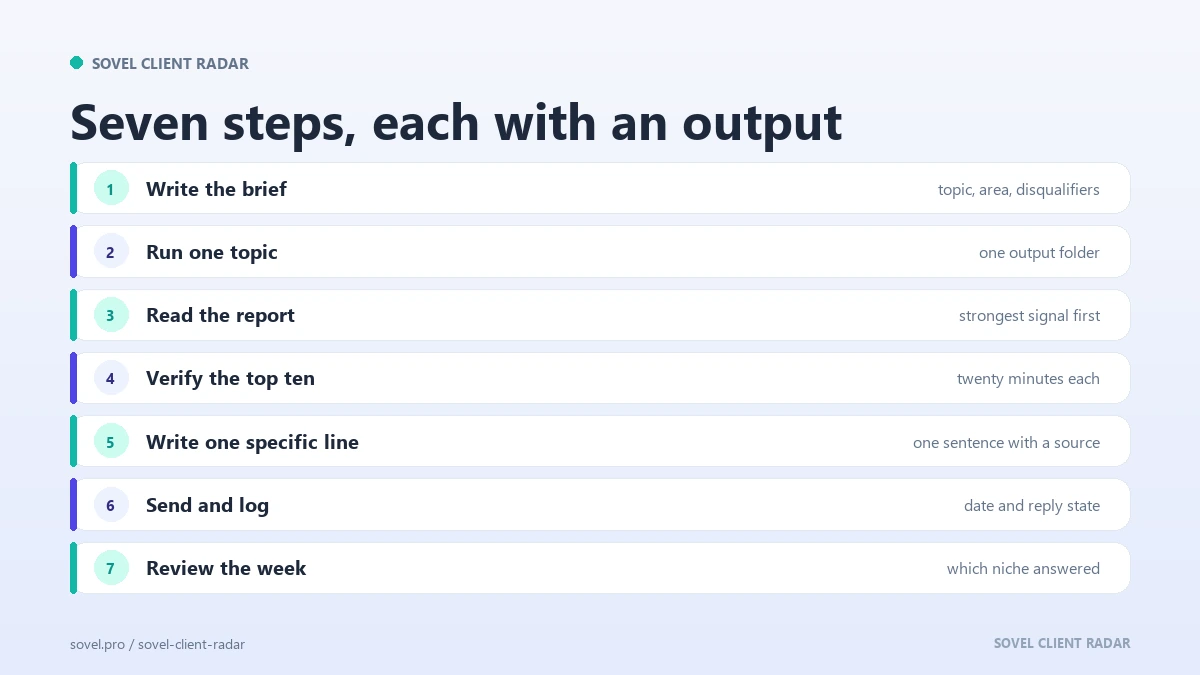
Why does a client discovery workflow need a fixed order?
Because the steps depend on each other, and skipping one moves the failure later. A shortlist built before the report is read is a list of names you already liked. An email written before the record is built is a compliment with a link in it.
A fixed order also makes the client discovery workflow teachable. A new colleague can follow seven steps and produce something usable in week one, because each step leaves an output that can be checked before the next one starts.
The order is not sacred. Reorder it for your market and keep the dependencies intact: the brief before the run, the read before the shortlist, the record before the email, the ladder before the send.
Step 1: write the intake brief
The intake brief has five fields: the service you sell, the niche, the location, the disqualifiers and the outcome the buyer wants. Add a sixth if you work with a team, which is who owns the list this week.
Keep the niche narrow enough to describe in one sentence. A niche stated as agencies, consultancies and professional services is three niches, and the queries will be vague for all of them. A niche stated as Shopify agencies with two to ten staff in the UK is a market you can search.
Disqualifiers matter as much as the target. A competitor, a company you already contacted, a client you parted badly from, a business too large to answer: each one goes in the brief so the run can exclude it and nobody has to remember it later.
Write the brief in a file you keep. A brief that lives in a chat message disappears on Friday, and next week’s client discovery workflow starts from a guess. The file is also the first thing to reread when a run returns something you did not expect.
Step 2: run the first search
Step 2 of the client discovery workflow answers one question: does this niche produce reachable businesses at all? The engine builds a query matrix from the brief, adds autocomplete phrases that describe buyers, and reads candidate sites under their own rules.
Before the run, use the dry run. It prints the queries and the sources without fetching a page, which is the cheapest way to catch a brief that names a service rather than a buyer. If the queries read like job titles, fix the brief.
The run writes a folder rather than a screen. Inside it you get a lead spreadsheet running to 84 columns, separate files for contacts and signals, a workbook with six sheets, JSON records, an HTML report, Markdown and a set of verification notes. The notes name every source that was blocked and every check that ran out of time.
The engine also follows links from pages it already read, because a link is how a machine finds the next page. Google’s guidance on making links crawlable explains the same principle for websites.
That folder is the raw material for the rest of the client discovery workflow. Read the notes before the list, because a run that was blocked on three sources is a different result from a run that read everything. When you send part of it onward, the guide to lead list export formats covers which file suits which reader.
Step 3: read the report in order
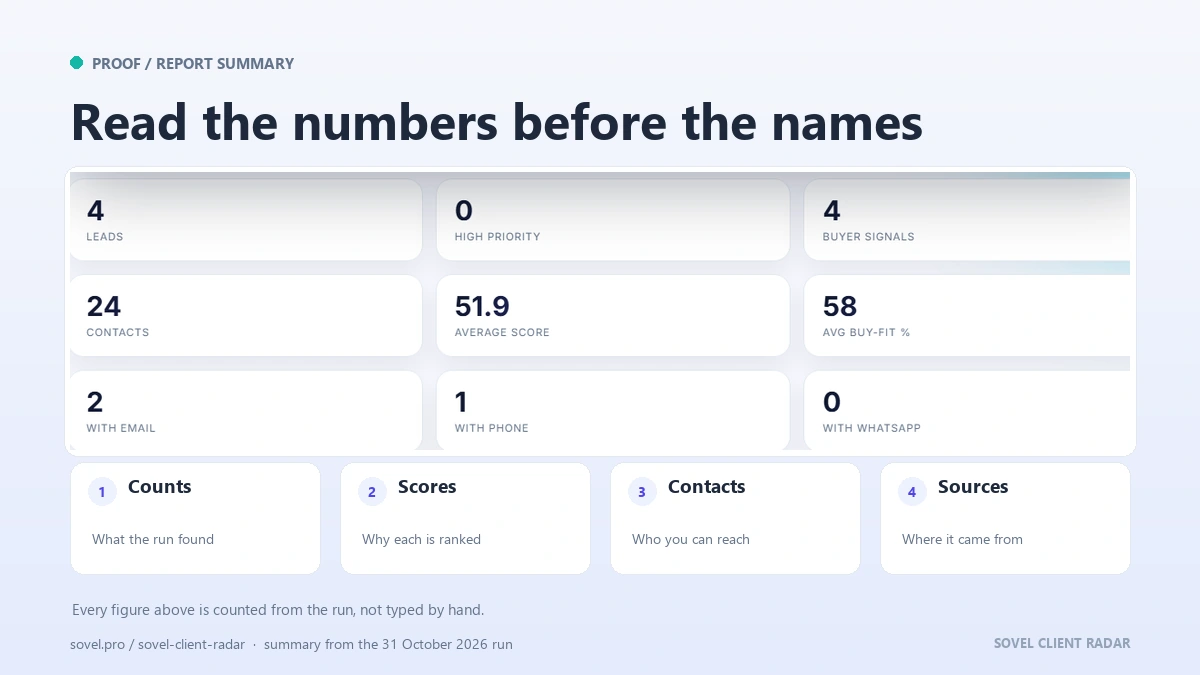
Read the report in a fixed order and this stage of the client discovery workflow takes twenty minutes. Read by scrolling and it takes an hour and produces nothing you can act on.
Start with the strongest signal. The why-now block names the dated reason this company might buy: a vacancy posted on its own careers page, a blog that went quiet, a page that changed since the last run, a homepage that loads slowly.
Then read the contact route. Which address is ranked first, and why. A named inbox with a domain match beats a role address, and both beat a form that nobody answers.
Then read the score breakdown. Fit, pain, reachability and timing are separate numbers, and a company with a high total and a low timing score is a name for next quarter.
Step 4: build the shortlist
The shortlist is five companies, not fifty. Five is enough to research properly, enough to send five emails, and small enough that you notice when one of them is wrong. A client discovery workflow that produces fifty names has produced a reading list.
Cut in this order. Remove anything with no contact route you can use. Remove anything that fails a disqualifier in the brief. Remove anything whose strongest signal is older than a quarter. What remains is usually five to twelve names, which is the right size for a decision.
Then rank the shortlist by the reason to write, not by the score. A company with a modest fit score and a hiring page updated this week is a better first email than a company with a higher score and a blog that stopped in 2022.
Keep the cut list. The names you removed are a record of your judgement, and they are the first place to look when next month’s run returns nothing new. That recycling is how a weekly client discovery process stays cheap.
Step 5: write the research record
The research record is the memory of the client discovery workflow, so fill one card per shortlisted company before you write a single word of the email. Company, domain, sector, size estimate, the signal with its date, the contact route with its source, and one sentence about why this company and not its competitor.
The sentence is the hard part. It has to be specific enough that the company could recognise itself, and short enough that it fits in an email. A blog that stopped in March is specific. A great company in the design space is not.
Record where each fact came from. The page where the fact appeared, plus the date you read it, next to the claim, so a colleague can check the work without asking you. This is the discipline that makes the later handover possible.
A card that takes fifteen minutes saves the hour you would spend rewriting a bad email.
Step 6: send the first email
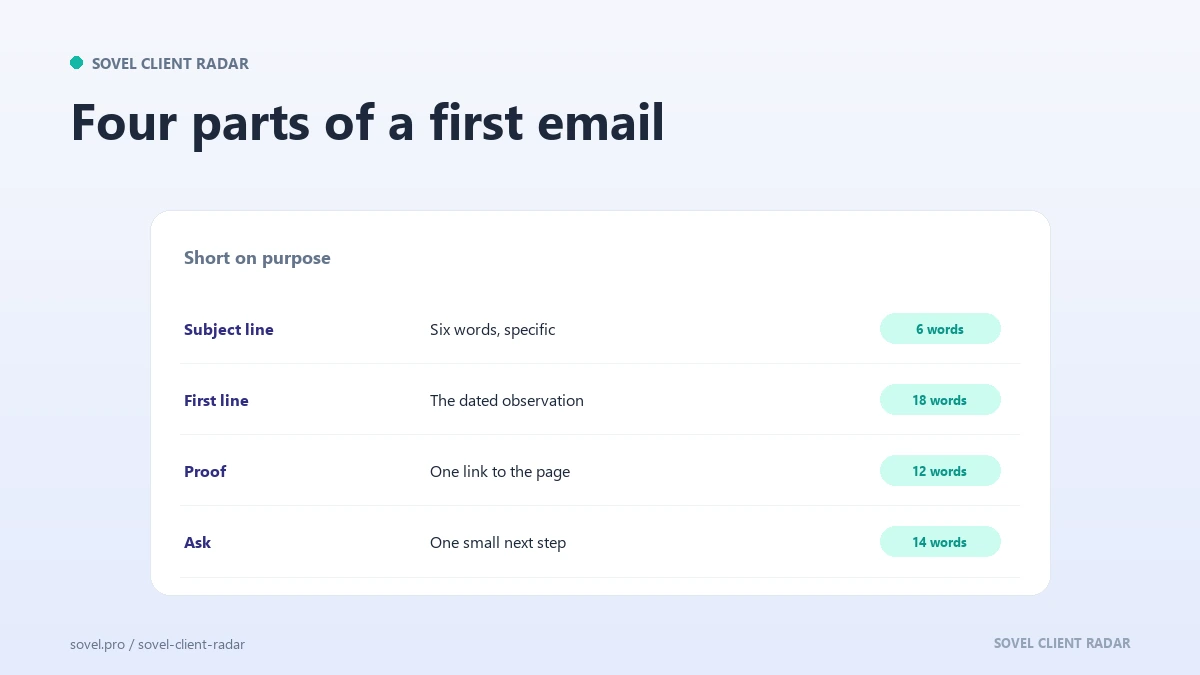
The sixth step of the client discovery workflow is the first email, and it has four parts in about 120 words. A line about them, drawn from the record. A line about the work you do, in the buyer’s language. One concrete outcome you have delivered, described without inflation. A closing question that is easy to answer.
The subject line is a fact, not a hook. A subject that mentions the thing you noticed gets opened by the person who owns that thing. A subject that says quick question gets deleted by everyone.
Write the email as though the recipient will read it on a phone, standing up. Short paragraphs, no attachments on the first contact, no calendar link until somebody answers.
The stretch from lead list to email is where most of the risk sits, and it is also where a good record earns its keep.
Send from a domain you own, with a signature that names a person. The first email is the step in this client discovery workflow with the highest chance of doing damage, and it deserves the most care.
Step 7: work the follow-up ladder
The last step of the client discovery workflow is a ladder of dated next actions, decided before the first send. Day three, a short nudge with one new piece of information. Day eight, a different angle, such as a second signal from the same site. Day fifteen, a close that gives the person an easy exit.
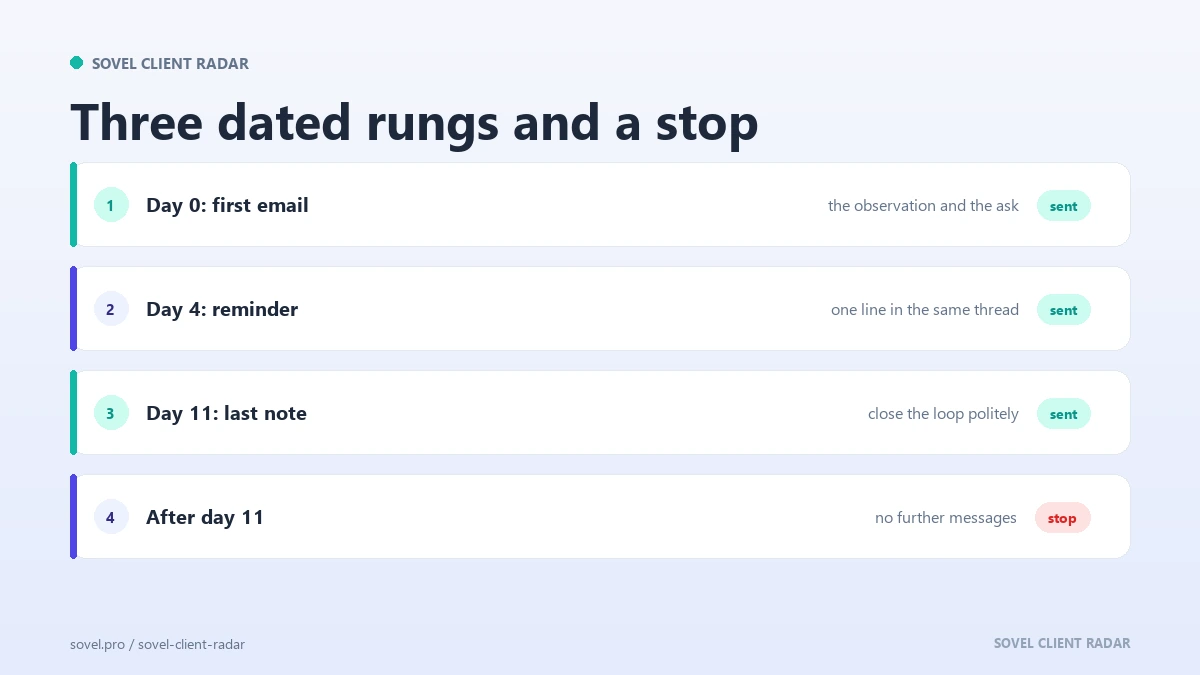
Each rung adds something. A follow-up that only says checking in wastes the reader’s time and your credibility. A follow-up that adds a fact gives the person a reason to reply.
Decide the ladder when you write the email, not after the silence. A ladder chosen in advance is a plan, and one chosen after a week of no reply reads like a reaction.
The ladder ends. That is the point of the three touch rule: three genuine attempts, then stop and record the outcome. The rule protects the prospect from a fourth email and protects you from spending a month on a company that will never answer.
What does a bad client discovery workflow look like?
It looks busy. A list of two hundred names, a spreadsheet with no source column, an inbox of templates sent to whoever had an address, and a Friday afternoon spent wondering why nobody replied.
The failure is usually a missing step. No brief, so the run searches for a job title. No report read, so the shortlist is alphabetical. No record, so the email could have been written to anybody. No ladder, so the second follow-up never happens and the first one is forgotten.
A bad client discovery workflow also hides its own evidence. Ask where a name came from and the answer is a memory. Ask why the company was considered a fit and the answer is a feeling. Both answers collapse the first time a client asks for proof.
The repair is cheap. Add the brief, read the notes, write five cards, date three touches. None of that requires a new subscription.
How does the three touch rule work in practice?
In this client discovery workflow, three touches means three messages with new information in each one, over about two weeks. A first email, a nudge with a fact, and a close. Nothing else.
The rule exists because persistence and pestering look identical from the inside. From the outside they are easy to tell apart: one adds information, the other adds pressure.
The engine writes a version of this rule into the approach plan for every lead, so the sequence is decided before you are emotionally invested. That matters on the day a good prospect ignores you, which is the day a fourth and fifth email starts to feel reasonable.
What happens at the pipeline handoff?
The pipeline handoff is the moment the client discovery workflow stops being research and becomes somebody’s work. It needs three things: the shortlist, the record, and a named owner.
Hand over the folder, not a link to a screen. The recipient needs the report, the contacts file, the verification notes and the research cards, because a screen disappears when the subscription does and a folder does not.
Say what you did not check. A handoff that hides a blocked source is a handoff that fails on the first question from the person who receives it.
A good pipeline handoff takes ten minutes and saves a week of rework. The person who receives it should be able to send the first email without asking you anything.
What does the weekly review look like?
The client discovery workflow ends each week with twenty minutes on Friday. Count what went out, what came back and what was blocked. Then decide one change for next week.
Four numbers are enough: names read, emails sent, replies received, and meetings booked. Any other metric is decoration at this stage.
Change one variable at a time. A new niche, a new signal, a new opening line. Change three and you learn nothing about which one mattered.
Write the four numbers on the same page as the brief, so a week later the comparison is the review. A strong week followed by a weak one usually means the list changed, not the market. Look at the source and the signal before you rewrite anything.
The cadence is the same discipline as a content pipeline from keyword research to published article: a fixed input, a fixed process and a fixed output, repeated until the numbers tell you something.
How do the seven steps compare?
| Step | Output | Typical time | Owner |
|---|---|---|---|
| 1 Intake brief | One page brief | 20 minutes | You |
| 2 First run | Run folder | Machine time | Engine |
| 3 Report read | Five to twelve names | 20 minutes | You |
| 4 Shortlist | Five companies | 20 minutes | You |
| 5 Research record | Five cards | 15 minutes each | You |
| 6 First email | Five drafts | 40 minutes | You |
| 7 Follow-up ladder | Dated next actions | 10 minutes | You |
The totals matter less than the shape. One person can run this client discovery workflow in about four hours a week, and the machine does the reading that used to fill a day.
Which edition fits the work?
Every edition runs the full client discovery workflow. The difference is the size of the list one run can produce and the number of machines that can run it.
Start with Personal if one person runs the brief: ₹5,999, one machine, 50 leads a run. Move to Pro when the list needs to be deeper: ₹12,999, one machine, 200 leads a run, with the AI layer. Agency suits a team splitting several niches: ₹39,999, five machines, 500 leads a run.
Runs are not limited by day or month, and the licence is paid once.
Everything each edition includes is listed on the SOVEL Client Radar product page. If you want the underlying method rather than the routine, the client discovery engine guide explains where the data comes from.
FAQ
How long does a client discovery workflow take?
About four hours a week for one person, which is the honest answer for the whole client discovery process. The brief and the report read take twenty minutes each, the shortlist another twenty, and five research cards about seventy-five minutes. The run itself is machine time.
How many leads should one run produce?
Fifty is a useful ceiling for a solo worker, because five emails a week come from a shortlist of five, and a shortlist of five comes from twenty or thirty readable names. A larger cap helps a team, not a habit.
What if the run finds nothing?
Read the verification notes first. A blocked source, a niche phrase that describes a job title, or a location that is too small will each produce an empty list with a reason. Fix the brief before you change the tool.
Can I run this without a CRM?
No, and a folder plus a spreadsheet will carry the first month. Add a CRM when two people need the same list at once, or when a follow-up date gets missed twice.
How do I personalise an email without spending an hour?
Use one fact from the research record and say why it matters. A single correct detail beats three paragraphs of research. The record is built for exactly this, which is why it comes before the writing.
When should I stop following up?
After the third touch, which lands around day fifteen. Record the outcome and set a date three months out if the signal was real. When a new signal appears, that is a new sequence.
Can I run the workflow for a client?
Yes. Hand over the folder and the notes, and agree who owns the follow-up before the first email goes out. A pipeline handoff without a named owner is how a good list ends up unused.
Does the client discovery workflow change for a team?
The steps stay the same and the ownership changes. One person writes the brief, another reads the report, and a third sends. The written record is what keeps three people from repeating the same work.