
Agent budgets do not usually explode. They leak, quietly, through places nobody put a meter: a tool list resent ten thousand times a month, a doom loop that ran unattended overnight, a memory layer that injects paragraphs when a summary would do. Understanding AI agent token cost is mostly learning to see those leaks, because the price of the work itself is rarely the problem. The good news is that the leaks are structural, and structure can be fixed once.
This article does the arithmetic in public, because AI agent token cost conversations tend to run on adjectives when they need numbers. It walks through the anatomy of a token bill, sizes the seven leaks that account for most waste, shows what a doom loop actually costs in currency rather than in vibes, and ends with the fixes ranked by how much they save per hour of effort. All the math uses round numbers you can swap for your own rates, because rates change and the structure of the waste does not.

The anatomy of an AI agent token cost bill
Direct answer: AI agent token cost is driven by the total number of tokens processed per request multiplied by the number of requests, and in agentic workloads the per-request total is dominated by repeated context, not by new work. Every step of an agent session re-sends the conversation, the system prompt and the tool announcements, so the cost of a session grows super-linearly with its length. The levers that matter are requests per task, tokens per request, and waste per request.
A concrete shape helps, and it is the first exercise in managing AI agent token cost: Say a coding agent averages 30,000 tokens per request when you add up the re-sent conversation, the standing instructions and the tool list. A modest session of 60 requests therefore processes 1.8 million tokens, and a team running twenty such sessions a week processes 36 million tokens monthly before a single deliberate purchase. Now look at the same team’s invoice and ask what fraction of those tokens did useful work. That question is the entry point to AI agent token cost discipline, and the seven leaks below are its answer. In most stacks, the honest answer is well under half, and the rest is the seven leaks below.
Leak 1: the doom loop, the most expensive bug you are not tracking
An unattended doom loop is the largest single leak in most agent budgets. The mechanics are covered in the Hacker News and in our doom loop article, so here only the money matters. A loop that runs twenty minutes at 30,000 tokens per request, with a request every few seconds, burns on the order of several hundred thousand tokens producing nothing. Run that twice a week across a team and the monthly waste crosses a million tokens, which at typical frontier-model rates is a meaningful line item spent on the same failed fix, repeatedly.
The second-order cost is worse than the first, and it is why AI agent token cost audits always trace quality complaints back to repetition events. After the loop breaks, the polluted context remains, and the rest of the session tends to need more turns to reach the same quality. The loop bills you twice: once while it runs, and once in the quality tax it leaves behind. Teams that add loop interception usually report it as the fastest payback in their whole reliability budget, because the fix costs nothing to run and the waste was recurring. It is the first recommendation in any serious AI agent token cost review.
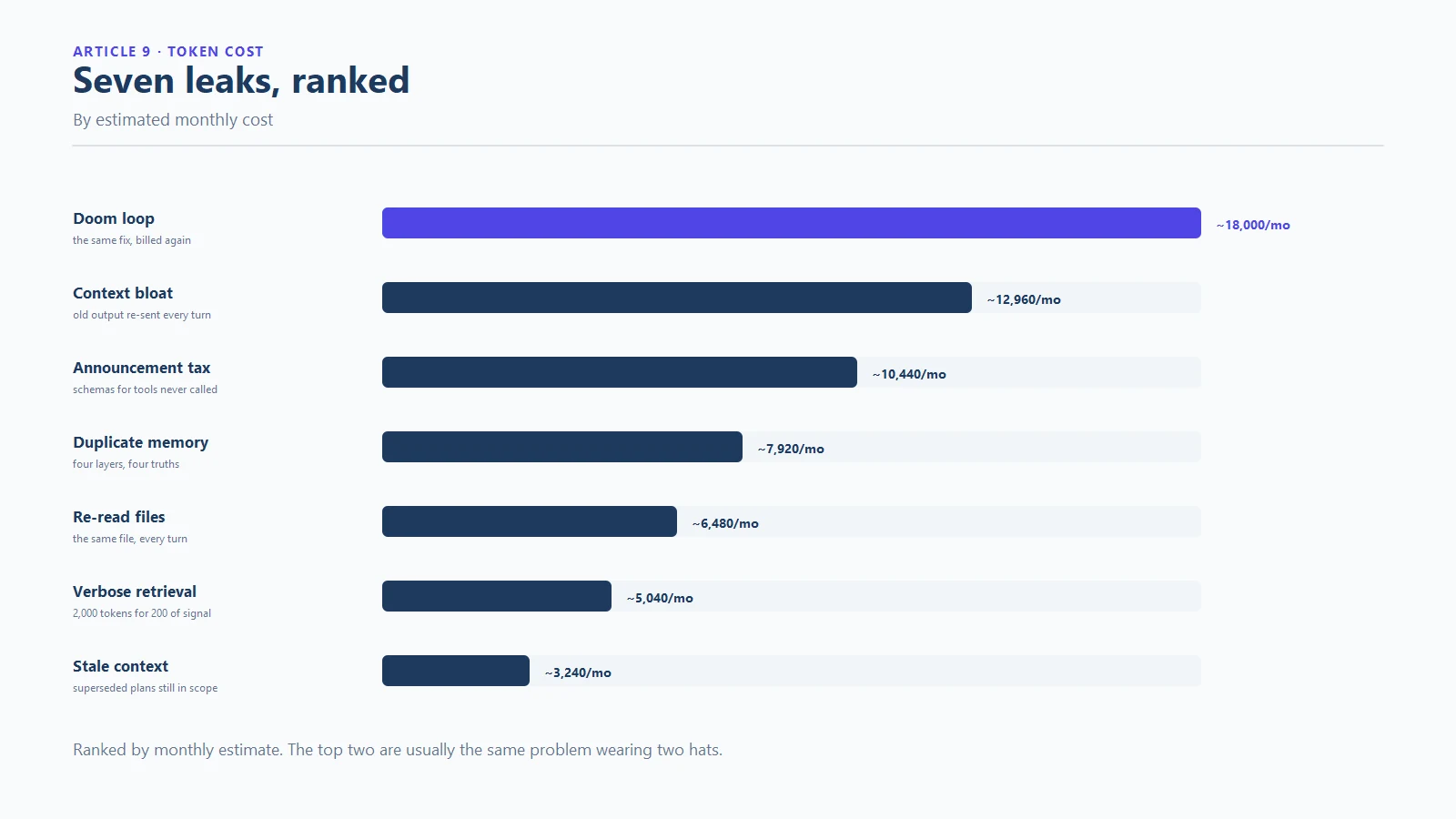
| Leak | Typical monthly waste (20-session team) | Fix effort |
|---|---|---|
| Doom loops unattended | 1,000,000+ tokens | Low, once tooling is in place |
| Tool announcements re-sent | 2,000,000+ tokens | Medium, choose lazy-loading servers |
| Context bloat in long sessions | 1,500,000+ tokens | Medium, summarise and trim |
| Redundant memory layers | 500,000+ tokens | Low, delete duplicates |
| Retry storms on rate limits | 300,000+ tokens | Low, back off properly |
| Verbose outputs nobody reads | 400,000+ tokens | Low, cap output lengths |
| Rerunning solved work | 600,000+ tokens | Medium, add memory |
The numbers in the table are illustrative round figures for a mid-sized team, not measurements of any particular stack, and they are deliberately conservative. The point is the ranking: repetition-related waste dominates, and most of it is mechanical to stop.

Leak 2: the announcement tax, billed monthly
The second leak is the standing cost of connected tools. Every MCP server announces its tools with names, descriptions and schemas, and the client re-sends those announcements on every request. Five servers announcing 6,000 tokens combined, across 200 requests a day, re-sends twelve million announcement tokens a month. None of those tokens wrote a line of code; they introduced capabilities, over and over, to a model that already knew.
The fix is architectural rather than behavioural: prefer servers with lazy schema injection, which hold their definitions back until a tool is actually needed. In AI agent token cost terms, this converts a fixed monthly tax into a usage-based cost, which is almost always the better shape. The MCP memory server article sizes this leak in detail, including the design target of cutting context bloat by 65 to 80 percent that one local-first engine publishes. The short version for budget purposes: the announcement tax is often the largest fully-fixed cost in the stack, and it responds completely to tooling choices.

Leak 3: context bloat in long sessions
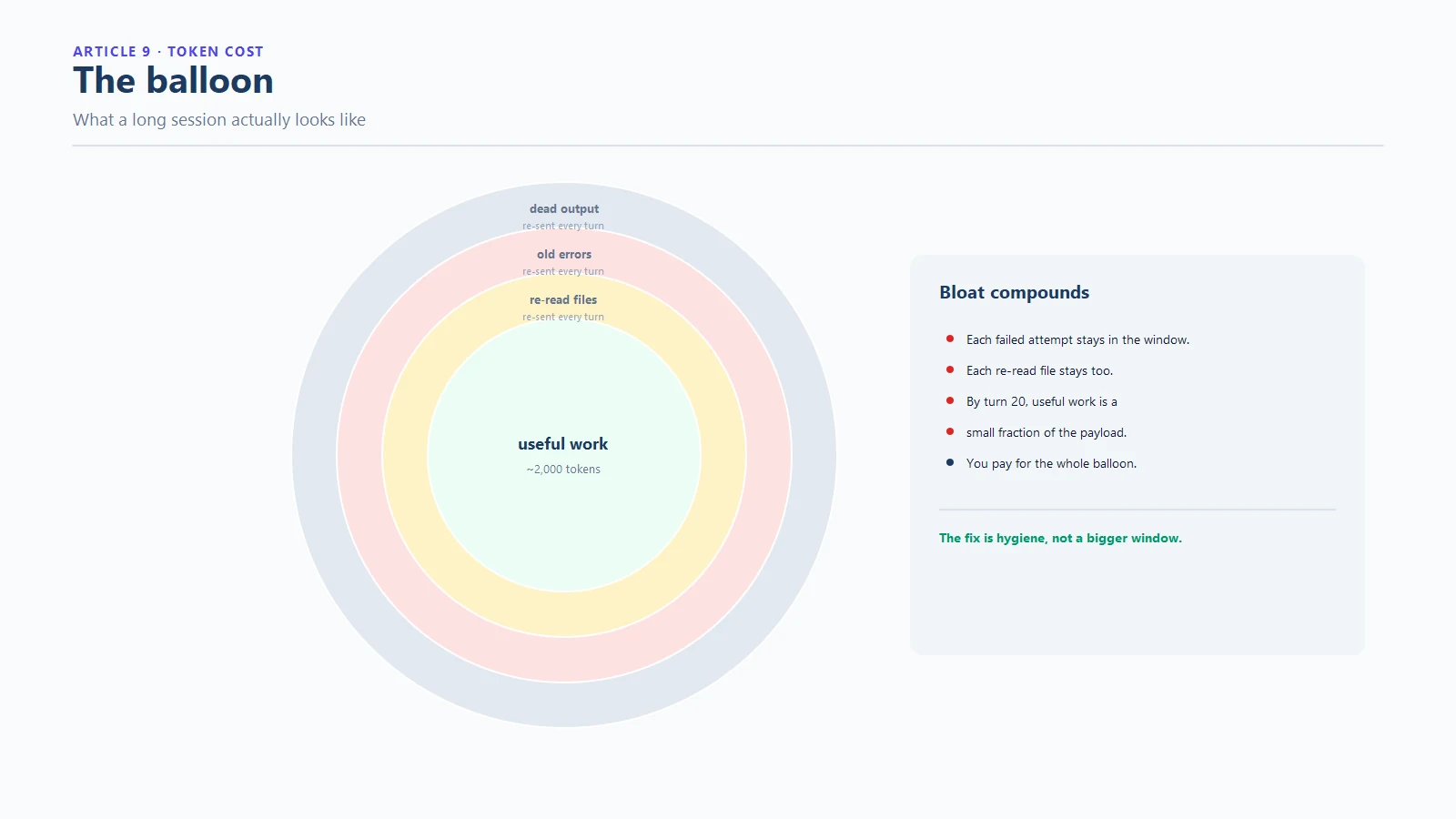
Long sessions accumulate, and context bloat is the leak that makes AI agent token cost grow with tenure rather than with output. Old tool output, dead-end explorations and error text from solved problems all stay in the window, and every remaining turn pays to carry them. A session that should cost 1.8 million tokens routinely costs three or four million by the end, with the difference being material nobody needed. Trimming and summarising are the manual defences, and a memory layer with dense summaries is the automatic one: a 200-token handover note replacing tens of thousands of tokens of transcript is the single best ratio in the whole cost discipline.
Leak 4: redundant memory layers
Teams that experimented their way into memory often run two or three layers at once: a hosted service, a local notes file, a memory MCP server, each injecting its own view into context. The injections overlap, the contradictions confuse the model into extra turns, and the standing costs stack. One memory layer, one write path, one summary per turn is cleaner architecture, and it is a monthly saving you can measure by deleting things.
Leak 5: retry storms against rate limits
When an external API answers HTTP 429, meaning too many requests, a naive agent retries immediately, gets rejected again, and burns tokens arguing with a rate limiter. Well-behaved networking solved this decades ago with backoff, the practice of waiting progressively longer between retries, and the same discipline belongs in agent loops. In AI agent token cost terms, a retry storm is a doom loop against an API, with the same cure: count the strikes, then stop. Rate limiting with proper backoff converts this leak from a recurring tax into a rounding error, and it is the reason the reliability engine in this series implements TCP-style congestion control for agent tool calls.
Leak 6 and 7: verbose outputs and rerunning solved work
The last two leaks are mirror images, and together they close the audit: AI agent token cost is bounded below by the work, and everything above that line is one of these seven. Verbose outputs, long tool responses and chatty summaries that nobody reads, cost tokens on the way in and then again on every subsequent re-send. Rerunning solved work, re-deriving facts the last session already established, is the absence of memory priced per turn. Both respond to the same principle: the cheapest token is the one you never send, and the second cheapest is the one you send only once.
The fixes, ranked by payback
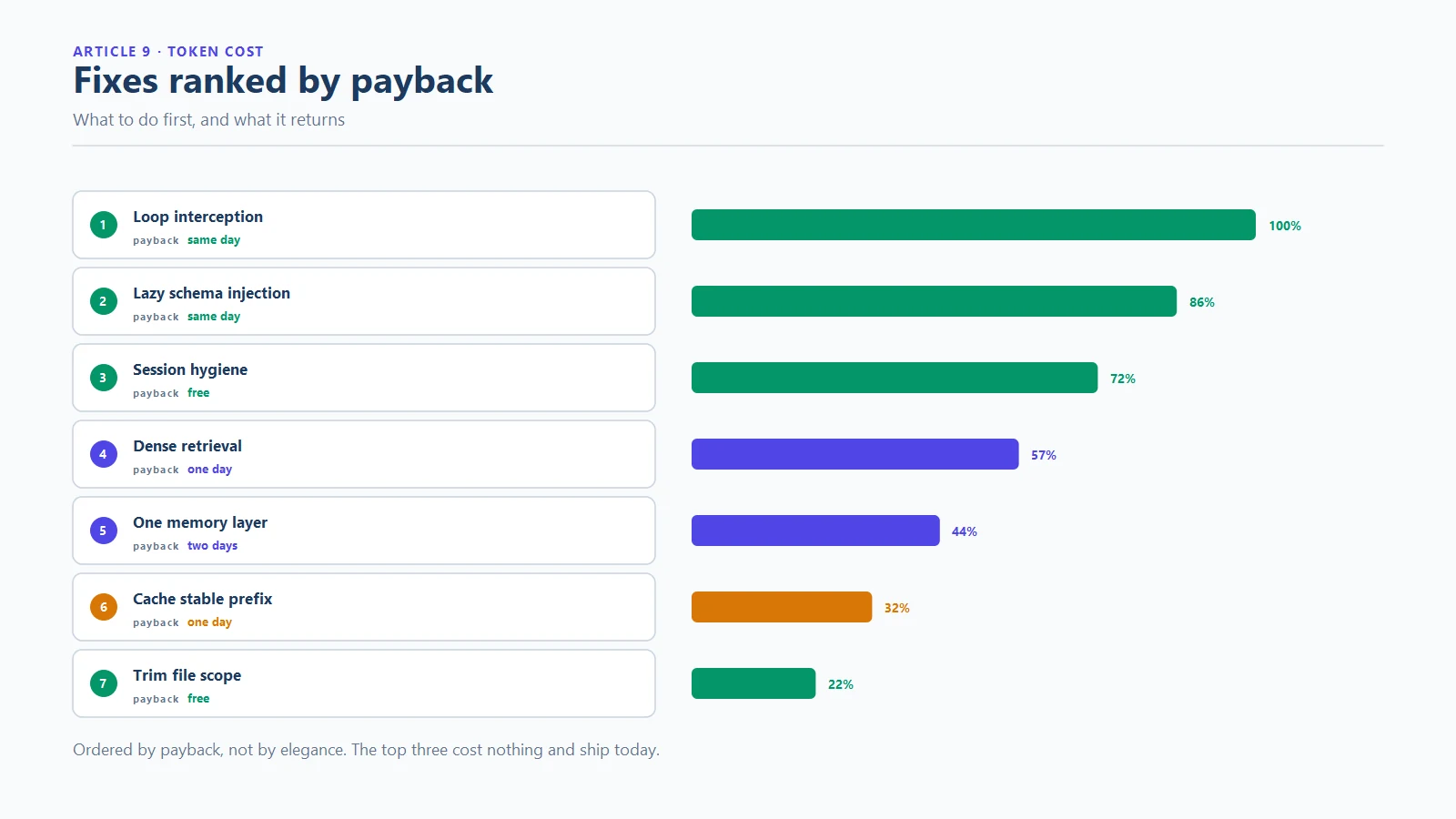
Every leak has a fix, and the fixes sort cleanly by how fast they pay back. AI agent token cost management is not one big decision; it is seven small ones, ranked here:
- Loop interception. Two-strike detection on repeated failures. Highest payback because the waste is recurring and the fix is passive once installed.
- Lazy tool schemas. Choose servers that inject definitions only at use. Largest single standing-cost reduction available.
- Dense memory summaries. Replace transcript re-reads with 200-token handovers. Pays in both cost and quality.
- One memory layer. Delete the duplicates. The cheapest fix in the list, priced in deletion.
- Backoff on rate limits. Stop arguing with rate limiters. Pure behavioural change if your harness lacks support.
- Output caps. Bound tool responses and summaries. A config change in most stacks.
- Session hygiene. End sessions at task boundaries instead of letting them sprawl. Free, and it compounds with every other fix.
Notice what is absent from the list: switching models. Cheaper models reduce the rate per token, which helps, but the leaks above are volume problems, and volume multiplies whatever rate you pay. Fix the structure first; negotiate the rate second. That ordering is the whole strategy of cost management in one sentence.
Frequently asked questions
What drives AI agent token cost the most?
Repeated context, not new work. Every request re-sends the conversation, system prompt and tool announcements, so cost grows super-linearly with session length. The biggest leaks are doom loops, announcement overhead and context bloat, all of which are volume problems rather than rate problems.
How much does a doom loop cost in tokens?
An unattended twenty-minute loop at typical agentic request sizes burns on the order of hundreds of thousands of tokens, all producing nothing. Multiplied across a team and a month, it is regularly the largest single waste item, and the second-order quality tax on the rest of the session often exceeds the direct burn.
Do tool announcements really cost that much?
They cost more than people estimate, because they are re-sent on every request. A five-server stack announcing 6,000 tokens across 200 daily requests re-sends roughly twelve million announcement tokens a month. Lazy schema injection cuts this dramatically, which is why it is the highest-payback tooling choice available.
Can I reduce AI agent token cost without changing models?
Yes, and it is the recommended order. Loop interception, lazy schemas, dense memory summaries, single memory layers, backoff and output caps all reduce volume, and volume multiplies whatever rate you pay. Model choice is a rate negotiation; the leaks are volume engineering.
How do I measure where my tokens actually go?
Start with request counts and average tokens per request from your provider’s usage dashboard, then estimate the standing components: tool announcements from your server configs, system prompt size, and average session length. Most teams can size their top two leaks in an afternoon with a spreadsheet and one transcript sample.
Does local-first tooling change token cost?
It changes the structure in your favour. A local engine with lazy schema injection, dense memory summaries and loop interception attacks the three largest leaks mechanically, and it adds no per-seat subscription to the bill. The engine in this series publishes a design target of 65 to 80 percent context-bloat reduction for exactly this reason.
Spend on work, not on waste
AI agent token cost is not a fact of life; it is a design outcome. The teams with sane bills did not find cheaper models, they found their leaks: the loops they no longer watch, the announcements they no longer resend, the transcripts they no longer re-read. Fix the structure, then negotiate the rate, and the same budget that bought frustration buys output. The engine built around these fixes is documented on the SOVEL Net-Routed Agentic OS product page, and the loop mechanics behind leak one are in the doom loop guide.