
Your agent hits an error at 11 pm. It proposes a fix. The fix fails with the same message. It proposes the fix again, with one word changed. You watch this happen four more times, and somewhere around the sixth attempt you realise you are paying for every one of them. That cycle has a name in developer communities: an AI coding agent doom loop. Once you have seen one, you never forget the feeling of watching your token meter tick upward while the agent argues with the same error.
The AI coding agent doom loop is not a rare glitch. It is the default behaviour of an agent that has no memory of its own failures and no exit condition built into its harness. The model is doing exactly what it was optimised to do, which is produce a plausible next step. The problem is that a plausible next step after a failed fix is, very often, the same failed fix with different punctuation.
This article does three things. It defines the AI coding agent doom loop precisely, so you can recognise one in your own transcripts. It walks through five manual fixes that work today in any tool, along with the point where each one stops helping. And it explains the structured approach, where loop protection is handled by tooling instead of by your own attention. By the end you should be able to pick a fix that matches how often you hit loops, rather than reaching for the first one you find.

What is an AI coding agent doom loop?
Direct answer: it is a repeating cycle in which an agent attempts to fix a failure, the attempt fails, and the agent retries the same or a slightly varied attempt instead of changing strategy. The loop continues until a human interrupts it, a token or rate limit cuts it off, or the agent accidentally wanders out of the pattern. The defining feature is repetition without strategic change.
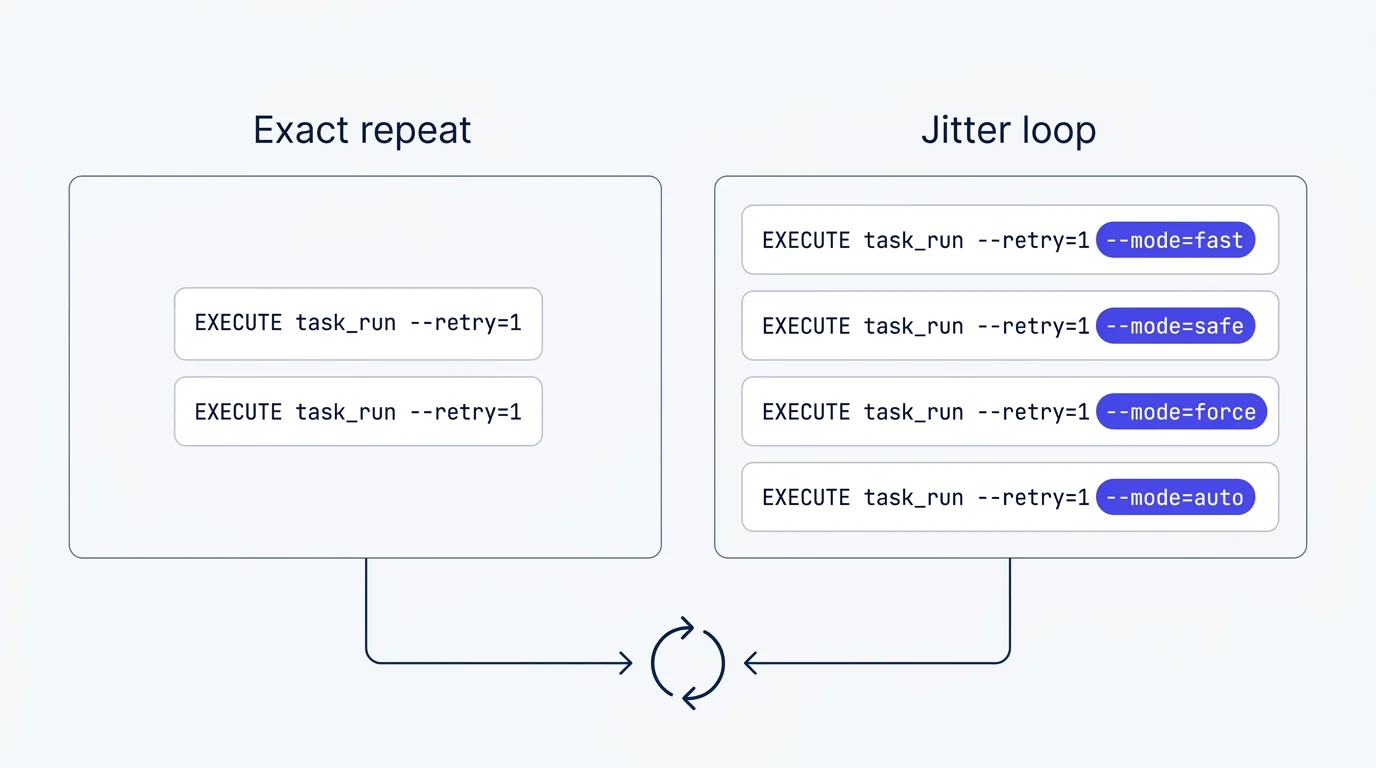
Two sub-patterns show up in real transcripts. The first is the exact repeat: the agent issues the same tool call with the same arguments and gets the same error. The second is the jitter loop, where each attempt differs by a tiny amount, a renamed variable here, a reordered flag there, while the underlying mistake stays untouched. Jitter is harder to spot because the text looks different each time. It is the same loop wearing different clothes.
Both patterns share one root cause. The agent has no persistent memory of its own attempts within the failing task, and its context window, the slice of conversation the model can attend to at one moment, fills up with error output. As the window fills, the most recent failures dominate what the model sees, which nudges it toward the same neighbourhood of fixes it just tried. The loop feeds itself.
Why the AI coding agent doom loop happens: four causes
Four forces combine to produce the cycle. Each one is ordinary on its own; together they are why the loop sustains itself without outside help.
1. Retry is the trained instinct
Models are trained on enormous amounts of text in which persistence is a virtue. When a fix fails, the statistically natural continuation is another fix. Nothing in a default agent setup penalises repeating yourself, so the model does what looks reasonable: it tries again. Every doom loop starts here, with a behaviour that would be admirable in a person.
2. Context pollution
Every failed attempt writes error text into the conversation. After five failures, the model’s attention is saturated with failure output, including the exact strings it needs to reproduce the failure. This is context pollution, and it actively pushes the agent toward repeating the mistake it is trying to escape. It is also why a doom loop gets harder to break the longer it runs.
3. No memory of prior attempts
Most agent setups keep no structured record of what was already tried. The transcript contains the attempts, but nothing summarises them into a state the model can reason over. Without that summary, attempt number seven starts from roughly the same position as attempt number three, which is the mechanical heart of the problem.
4. No exit condition
A well-built control system has a defined stopping rule. Default agent harnesses usually do not. There is no counter that says three failed fixes on the same target means stop and escalate. The AI coding agent doom loop ends only when something outside the loop intervenes, and that something is usually you.

What an AI coding agent doom loop actually costs
The visible cost of an AI coding agent doom loop is time. The invisible cost is tokens, and it is worth doing the arithmetic once so the number stops being abstract. Say a coding agent session costs roughly 40,000 tokens per minute of agentic work when you count the full conversation that gets resent with every step. A doom loop that runs for twenty minutes before you notice it can burn on the order of 800,000 tokens, and a large share of those tokens purchased the same failed attempt several times over. At typical API pricing, that is real money spent producing nothing.
The second cost is subtler. Every minute the agent spends inside the loop, it writes more failure text into its own context. Even when the loop breaks, the agent continues from a polluted state, and quality in the rest of the session tends to suffer. Developers on Hacker News describe this regularly: the session where the loop happened is rarely the session that ships clean code afterwards. The loop wastes tokens while it runs, and it degrades everything downstream of it.
Five manual fixes that work, and where each one stops
These five fixes are what most developers use against an AI coding agent doom loop today. Each one works. Each one also has a hard edge, and knowing the edge matters more than knowing the fix.
Fix 1: Watch the transcript and interrupt early
The simplest answer to an AI coding agent doom loop is attention. Read the agent’s output, and when you see the same failure twice, interrupt and restate the problem in different terms. This works, and experienced agent users do it reflexively. Where it stops working: it scales with your attention. The loop you catch is the one that happens while you are watching. Overnight runs and long refactors, which are exactly the jobs agents are best at, have no watcher.
Fix 2: Cap retries in the prompt or config
Most agent tools let you add instructions like “if the same command fails twice, stop and report.” This converts your attention into a written rule, which is progress against the AI coding agent doom loop. Where it stops working: instructions are advisory. The model can comply, miscount, or decide this failure is somehow different from the last one. A written cap reduces the AI coding agent doom loop frequency; it does not eliminate it, because nothing enforces the count.
Fix 3: Reset the session
When you catch a doom loop in progress, ending the session and starting fresh clears the polluted context. This genuinely helps, and it is the right move mid-loop. Where it stops working: a reset also throws away the useful state. The agent forgets the failed attempts, which is what you wanted, and the project decisions, which you did not. You are treating the symptom by deleting the patient’s short-term memory.
Fix 4: Keep a failure notes file
Some teams have the agent append each failed attempt to a notes file, then instruct it to read that file before proposing a fix. This gives the model a structured view of what has been tried, which starves the AI coding agent doom loop of its main fuel, amnesia. Where it stops working: the file grows, the agent reads it inconsistently, and maintaining the discipline across every project is on you. It is a good habit that depends on human consistency to survive.
Fix 5: Narrow the task
A doom loop thrives on vague goals, because a vague goal gives the model no clear signal that its approach has failed. Splitting work into small, verifiable steps, each with a definition of done, removes the space in which loops grow. Where it stops working: task design is skilled labour. It helps a lot, and it does not scale to zero, because somebody has to do the decomposition for every task, forever.
None of these five are wrong. They are the tools available when nothing in the harness is watching for repetition. The honest summary is that all five depend on human attention or human discipline, and the failure modes they fight are precisely the ones that appear when attention lapses. That gap is what the loop exploits.

Manual fixes versus structured loop protection
| Manual fixes (1 to 5) | Structured loop protection | |
|---|---|---|
| Detection | Your eyes on the transcript | Automatic, checks every tool call |
| Response time | As fast as you notice | Within two strikes, by design |
| Jitter loops | Easy to miss, text looks new each time | Pattern comparison catches varied repeats |
| Works unattended | No, needs a watcher | Yes, runs the same at 3 am |
| Memory of attempts | Depends on your notes file habit | Recorded in the project database |
| Exit condition | Whatever you wrote in the prompt | Hard-coded interrupt plus fallback path |
| Cost | Your time and consistency | One-time tool licence |
The structured fix: loop protection as a tool feature
The alternative to vigilance is machinery. If the four causes of the AI coding agent doom loop are mechanical, the fix can be mechanical too. This is the design position behind the loop protection in SOVEL Net-Routed Agentic OS, a local-first reliability engine that watches agent behaviour from outside the conversation. Three mechanisms do the work.
First, repetition detection with a two-strike limit. The engine compares each tool call against recent ones. An exact repeat, or a jittered variation of one, is flagged. On the second strike the loop breaker interrupts the cycle before a third attempt can run. Two is a deliberate choice: one failure is noise, two is a pattern, and waiting for five only spends tokens you do not need to spend.
Second, a fallback path instead of a dead end. Interrupting a loop without an alternative just moves the failure somewhere else. The engine pre-computes an alternative approach, borrowing the idea of a feasible successor from routing protocols, so when the loop breaker fires, the agent has somewhere concrete to go rather than a lecture about trying harder.
Third, memory of attempts. Every guarded command and its outcome lands in a local SQLite database, the open embedded database format documented at sqlite.org. The next attempt starts from a recorded history of what failed, not from a clean slate that invites repeating it. With all three mechanisms running, the AI coding agent doom loop loses the three things it needs to survive: amnesia, an open-ended retry budget and an empty exit.

What this looks like in practice
The engine runs as a Node.js command-line tool called sovel-brain, and it connects to Claude Desktop, Cursor, Cline or any client that speaks the Model Context Protocol. Here is what a guarded session changes about the problem:
sovel-brain guard -- npm test
The command executes under supervision. If the agent circles back to the same failing test twice, the breaker interrupts, the fallback path activates, and the event is written to the project’s memory file. You find out about the AI coding agent doom loop after it ended, from a report you can export, instead of discovering it twenty minutes later by reading the transcript yourself.
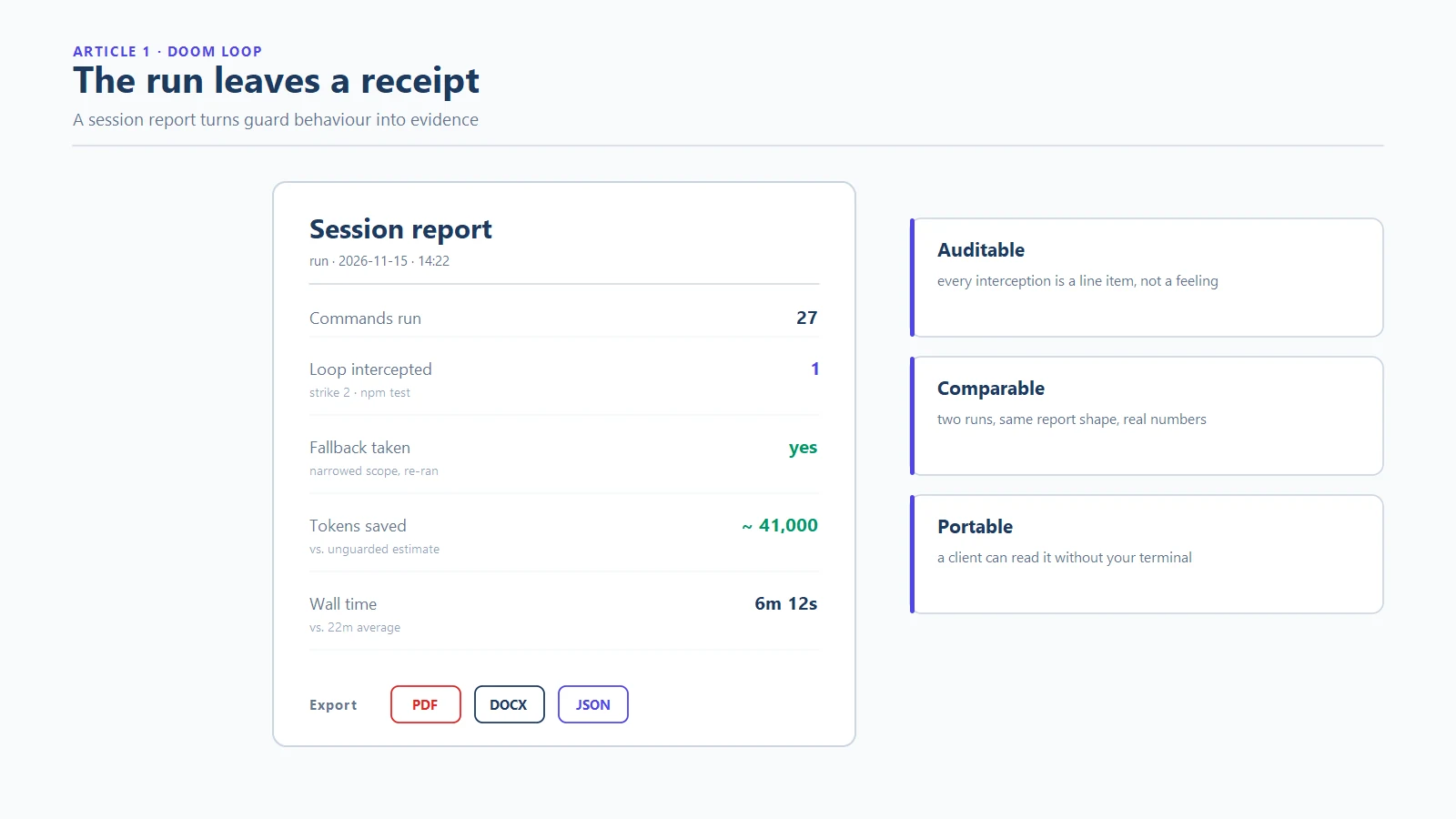
A candid note on scope. Structured protection changes the economics of the problem, not the physics of it. Agents will still make mistakes, and the first failure of anything still costs what it costs. What changes is that the second identical failure becomes the last one, and the session you leave running overnight comes back with a report instead of a bill.
If you are weighing agent tooling more broadly, our AI coding agent comparison covers how the major options differ, and zero-search-volume keywords explains why topics like this one, which forums discuss constantly and keyword tools barely register, are worth writing about. The full engine behind this approach is documented on the SOVEL Net-Routed Agentic OS product page.
Frequently asked questions
What causes an AI coding agent doom loop?
Four things combine: the model’s trained instinct to retry, context pollution from accumulated error output, no structured memory of prior attempts, and no enforced exit condition in the agent harness. Remove any one and the AI coding agent doom loop weakens; remove all four and it cannot form.
How do I stop my AI agent from repeating the same failed fix?
For a loop happening now, interrupt the session and restate the problem with a constraint the previous attempts ignored. For prevention, add a written retry cap to your agent config, keep a failure notes file for the agent to read, and consider tooling that watches for repetition automatically, such as the loop protection in SOVEL Net-Routed Agentic OS. That combination covers both the AI coding agent doom loop you can see and the ones that run while you are away from the desk.
Does a bigger context window prevent doom loops?
No. A larger window delays context pollution but does not change the retry instinct or add an exit condition. In practice a bigger window can make loops more expensive, because each repeated attempt carries more context tokens with it.
What is a jitter loop?
A jitter loop is a doom loop in disguise: each attempt differs slightly from the last, a renamed variable or a reordered flag, while the underlying mistake stays the same. It evades simple duplicate detection because the text is never identical, which makes the jitter-driven AI coding agent doom loop the dangerous variety, and it is why pattern-based detection compares the structure of attempts rather than their exact text.
How much do doom loops cost in tokens?
It depends on session size, but a twenty-minute unnoticed loop can burn on the order of hundreds of thousands of tokens, since the full conversation is resent with every step. The larger cost is downstream: the polluted context that remains after the loop tends to lower the quality of the rest of the session.
Can prompt engineering alone fix the problem?
Prompt instructions reduce the frequency of loops and are worth writing. They are advisory by nature, with nothing enforcing the count, so they work best as one layer on top of mechanical protection rather than as the whole answer.
The loop ends when something outside it intervenes
Every AI coding agent doom loop ends the same way: something outside the loop steps in. Today that something is usually you, reading a transcript at an hour you would rather be asleep. The five manual fixes in this article make you better at that job. Structured loop protection exists so the job does not have to be yours at all, which is the difference between managing the loop and forgetting about it.
Next in this series: context versus memory, the conceptual distinction that explains why bigger windows keep disappointing people. If you want the full picture of the engine that implements everything above, start at the product page.