
Zero search volume keywords are phrases that a tool reports as having no measurable monthly demand. The number is a measurement gap rather than a statement about people, and the difference between those two readings decides whether you write a useful page or waste a week.
Most published advice says to target them because they are easy to rank for. That advice is half right and it produces a lot of pages nobody reads. This guide sets out a four-condition test that separates real demand from a phrase a tool simply cannot count, four trap cases that look identical to opportunity, and where a zero-volume page belongs in a cluster.
What does zero actually mean?
It means the phrase fell below the tool’s reporting floor for the period you selected. It does not mean nobody searched it.
Every keyword tool has a floor, and that floor is the first thing to understand about zero search volume keywords. Below that floor the estimate becomes too unreliable to publish, so the tool shows zero, a dash, or a blank cell. A phrase with forty monthly searches and a phrase with zero monthly searches can both display as zero, because the tool cannot separate them at that resolution. Anyone working with zero search volume keywords meets this problem on the first day.
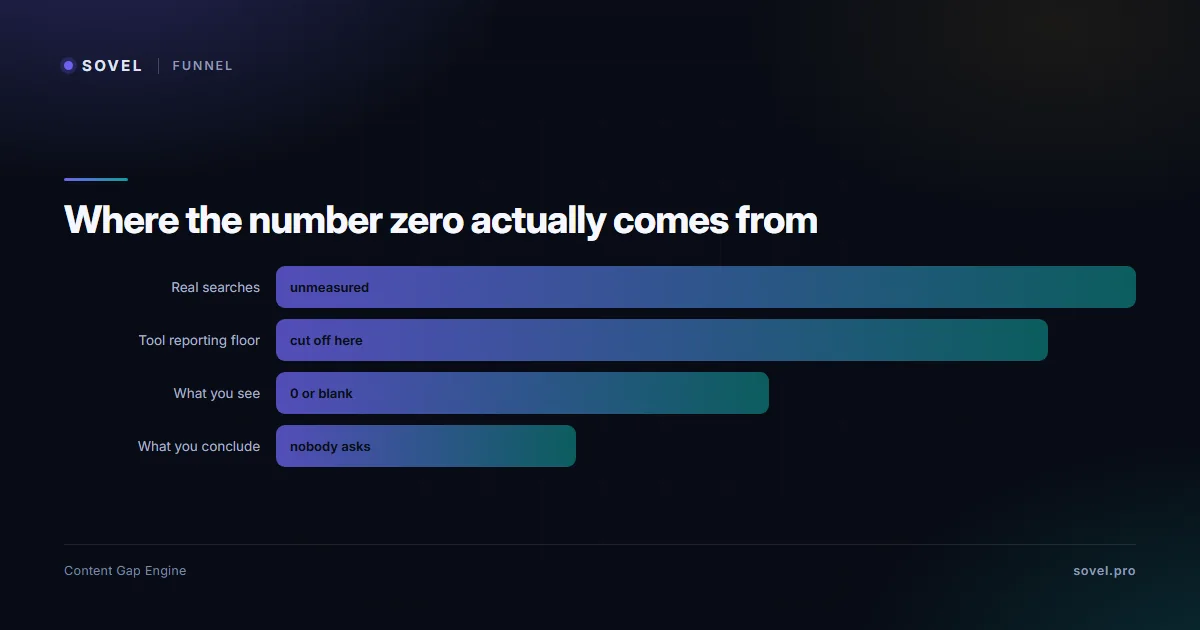
That single fact explains most of the confusion around the number. The number is an absence of measurement, dressed up as a value.
There is a second layer that makes zero search volume keywords harder to read than they look. Tools model volume from clickstream and panel data, then round. A phrase that only exists in small communities can be invisible to a panel that samples a million users. The phrase is real, the panel is thin, and the report says zero.
Why the standard advice fails
The common argument about zero search volume keywords runs like this: zero-volume phrases are easy to rank for, they convert well, and they add up. All three claims can be true. None of them are true by default.
The failure mode with zero search volume keywords is volume of pages rather than quality of pages. A team reads that these phrases are easy, produces two hundred thin pages, and waits. Nothing happens, because a page with no demand has no impressions, no internal links worth passing, and no learning attached. Six months later the site has two hundred pages that nobody visits and a crawl budget that is being spent on them.
The second failure with zero search volume keywords is measurement. A page with zero impressions teaches you nothing. You cannot tell whether the topic is wrong, the title is wrong, or the demand does not exist. The real cost is the loss of feedback rather than the writing time.
So the useful question about zero search volume keywords is which ones carry evidence of demand that the tool cannot see.
The four-condition test
A phrase passes this test for zero search volume keywords when all four conditions hold. Three out of four is a monitor, not a write.
| Condition | What it proves | How to check |
|---|---|---|
| Two independent sources | The phrase exists outside one tool | Autocomplete, forum titles, question boxes |
| A complete question | Someone would say it aloud | Read it as a sentence, not a fragment |
| One ranking page with engagement | Demand exists at some scale | Search it, look for a page that clearly serves it |
| One step from a known-volume phrase | It inherits a parent’s demand | Find the head term it modifies |
Condition one does most of the work in any zero search volume keywords decision. A phrase that appears in Google autocomplete and in a Reddit title is confirmed twice by sources that do not share a data pipeline. Two separate data pipelines agreeing is stronger evidence than any single volume estimate, and it costs nothing to gather.
Condition two filters the fragments that dominate most zero search volume keywords lists. “Content gap audit template free” is a fragment assembled by a tool. “How do I audit content I already published” is a sentence a person would say. Fragments rarely become pages that read well, because the phrase has no verb and no reader inside it.
Condition three is the one people skip when they build a list from a tool export. Search the phrase yourself. If a page ranks and clearly serves the query, demand exists at some scale. If the results are all irrelevant, the phrase is probably an artefact of how you assembled it.
Condition four is about inheritance. A zero-volume phrase that sits one modifier away from a phrase with real volume borrows its parent’s audience. “Content gap audit for a fifty post blog” inherits from “content gap audit”. A phrase with no parent inherits nothing.

The four trap cases
Some phrases pass a casual glance and fail the test, and these four patterns cover most of the failures in zero search volume keywords work. Four patterns account for most of the waste.
| Trap | Why it looks good | Why it fails |
|---|---|---|
| Typo only | Real search volume exists | You inherit the misspelling, not the demand |
| Brand you do not own | Clear intent, clear demand | The click belongs to the brand |
| Season | Strong for three weeks | The page goes quiet for forty-nine |
| Two intents glued | Looks like one phrase | Serves two readers, satisfies neither |
The typo trap is subtle, and it catches a surprising share of zero search volume keywords. A misspelling can have genuine volume, and a page targeting it can rank. What it cannot do is build authority, because the page is about a spelling error rather than a topic. It also reads badly to anyone who notices.
The glued-intent trap is the most common in practice. “Free content gap tool for agencies” contains a price constraint and an audience constraint. A page optimised for both serves a solo freelancer badly and an agency badly. Split it into two pages, or pick one.
The season trap deserves a specific note when you plan zero search volume keywords for 2026. Annual phrases like “best tools 2026” carry real volume for about ten weeks and then decay. They are not zero-volume phrases, but they behave like them for most of the year, and the maintenance cost is real.
How to place a zero-volume page
A zero-volume page works as a supporting page inside a cluster, which is the placement rule that decides whether the page pays off. It fails as a standalone bet.
The structure that works has three parts. A hub page targets the head term with real volume. Supporting pages target the specific phrases, each one answering a narrow question completely. Internal links run from the hub to each supporting page and back, so the cluster passes authority in both directions.
That structure solves the feedback problem. Even if a supporting page gets no direct search traffic, it earns its place by making the hub more complete and by catching long-tail queries the hub cannot answer. You can measure it through the hub rather than in isolation.
The structure that fails is the orphan. Two hundred zero-volume pages with no hub, no internal links and no shared topic produce two hundred dead ends. This is the pattern behind most abandoned content experiments, and it is entirely avoidable.
There is a placement rule worth remembering. If a phrase cannot be linked from an existing page with a natural anchor, it probably does not belong on the site yet. The link test is a cheap proxy for topical fit.
Building a validation table
Fifteen minutes with a table saves a week of writing, and the table is the only durable output of zero search volume keywords research. Four columns are enough.
| Phrase | Sources | Complete question | Verdict |
|---|---|---|---|
| budget ai writing stack | 2 | yes | write |
| ai writing stack for 3 | 1 | no | skip |
| free ai writing stack | 3 | yes | write |
| ai writing stack 2027 | 1 | no | monitor |
The verdict column has three values, and three is the right number. Write, monitor, skip. A monitor row gets re-checked in ninety days, which is cheap. A skip row is documented so nobody re-proposes it in six months.
Keep the table. Zero search volume keywords get re-proposed constantly because they look like fresh ideas each time. A recorded skip is the only defence against the same meeting happening four times a year.

Where the phrase came from matters
Two phrases can both show zero and mean entirely different things. The origin tells you which.
A phrase assembled by a tool, by stacking modifiers onto a head term, usually has no origin. Nobody typed it. It exists because the tool generated a permutation. These are the phrases that produce dead pages, and they are easy to spot because they read like a spreadsheet cell rather than a sentence.
A phrase found in a forum title, a question box or an autocomplete tail has an origin. Someone typed it while trying to solve something. The volume may be below the floor, and the intent is real.
Sort your candidate list by origin before you sort it by anything else. Origin is a better predictor of whether a page will be read than any volume estimate, and it takes one column in a sheet.
The difference between a phrase and a page
A phrase is a string. A page is an answer to a question somebody is holding. The gap between the two is where most of the wasted effort sits.
A phrase becomes a page when three things are true. Somebody would type it while trying to solve something. The answer needs more than a sentence. And the answer is not already sitting on a page you own.
Those three conditions are harder to meet than they look. Plenty of phrases pass the first and fail the second, because the answer is one line. Plenty pass the first two and fail the third, because a section already exists three clicks away.
The practical test is to write the answer before you write the page. If the answer fits in a paragraph, it belongs inside an existing article. If it needs a table, a sequence and a caveat, it is a page. That decision takes ten minutes and saves the four hours you would have spent on a page that should have been a section.
This is also why the same phrase can be a page on one site and a section on another. It depends entirely on what already exists, which is why copying a competitor’s structure rarely transfers and why a template applied across two sites produces different results.
Why AI systems find these phrases even when tools do not
A retrieval system matches on meaning rather than on a reported number. A precise phrase with a clear answer can be lifted into an AI response even when a keyword tool shows nothing, because the two systems measure different things.
That is the practical argument for large language model optimization on narrow topics. LLMO rewards entity clarity and a direct answer, and a precise question-shaped phrase already provides both. The phrase does the targeting work that volume data would otherwise do.
It is also the reason a page built from zero search volume keywords should answer one question completely rather than gesture at several. A system looking for a clean chunk takes the complete answer and skips the vague one, which is a different selection rule from the one a ranking algorithm applies.
What the engine does differently
The engine refuses to estimate volume for zero search volume keywords. A keyword with no verified volume stays UNKNOWN, and that label travels with the keyword into the brief.
That sounds like a limitation. In practice it is the most useful design decision in the tool, because it prevents the exact failure this article is about. A research file full of estimated numbers looks authoritative and produces confident decisions on invented data. A research file with an honest UNKNOWN forces the next question, which is what evidence would settle it.
The engine also separates evidence classes. A phrase confirmed by two public sources is labelled differently from a phrase seen once, and a blocked source is reported as blocked rather than as zero. When Reddit returned HTTP 403 in a live run on 7 November 2026, the report said so. That distinction matters for zero search volume keywords specifically, because a blocked source and an absent phrase look identical if you are not careful.
The scoring model handles the rest, and it is where zero search volume keywords get a fair hearing. The score is built from nine weighted components, and two of them, relevance and intent fit, do not depend on volume at all. A phrase nobody measures can still score well when it sits close to your subject and matches what the reader is trying to do, which is exactly the case where writing it makes sense.
The evidence classes and the UNKNOWN handling are documented on the Content Gap Finding Engine page, and the report formats are described at SOVEL Gap Brain.

A short decision rule
When a phrase has no volume, no origin and no ranking page, skip it. When it has two of the three, monitor it. When it has all three, write it as a section first and promote it to a page only if the section earns attention.
That rule is deliberately conservative. It costs a few opportunities and it prevents the pattern that kills content programmes, which is a hundred pages nobody reads and a team that no longer trusts its own research.
A 2026 example
A practical case makes the test for zero search volume keywords concrete. Suppose you run a site about content research and you find the phrase “content gap audit for a fifty post blog”. A tool reports zero.
Check the four conditions. Autocomplete returns a version of it when you type “content gap audit for”. A forum thread uses almost the same sentence. Searching the phrase returns two pages that address it loosely. And it sits one modifier from “content gap audit”, which has real volume.
Four out of four. The phrase passes, and it becomes a section inside the existing audit guide rather than a standalone page, because condition three showed the existing pages already half-answer it. That is the correct outcome: a passing phrase does not automatically become a new URL.
Now take “content gap audit 2027”. Zero volume, no autocomplete presence, no forum language, and no page ranking. It fails three conditions. It goes in the monitor column with a note to re-check in a year, and nobody writes it.
Two phrases, two decisions, fifteen minutes, and that is the entire workflow for zero search volume keywords. That is the whole method, and it scales to fifty phrases in an afternoon.
If you want the sources that make condition one easy, the Google autocomplete guide and the Reddit language guide cover the two cheapest options. For how a validated phrase gets scored and prioritised, see content opportunity score calculation.
FAQ
Do zero search volume keywords actually get traffic?
Some do, and most do not. A phrase below a tool’s reporting floor can still receive a small, steady flow of visits, and that flow is often enough to justify a supporting page. It is rarely enough to justify a standalone site section.
Why does one tool show zero and another show forty?
Because the tools use different panels, different rounding and different floors. Neither number is a measurement of people. Treat any single figure below a hundred as an order of magnitude rather than a value.
Is it worth targeting zero search volume keywords in 2026?
Yes, when they pass the four-condition test and sit inside a cluster with a hub page. The mistake is treating them as a cheap alternative to competitive keywords rather than as supporting material.
How many zero-volume pages should a cluster have?
Enough to cover the questions the hub cannot answer, and no more. A practical range is three to eight supporting pages per hub. Past that, the cluster starts to look like a list of fragments.
Can zero search volume keywords rank in AI search?
They can be retrieved, because AI systems match on meaning rather than on reported volume. A precise phrase with a clear answer is more likely to be lifted into an answer than a broad phrase with a vague one, which is a genuine argument in their favour.
What is the biggest mistake with zero search volume keywords?
Building them as standalone pages with no internal links. A page with no demand and no links has no impressions, which means no feedback, which means you never learn whether the decision was right.
Does the engine estimate volume for these phrases?
No. Volume stays UNKNOWN when it cannot be verified, and the label travels with the keyword. That is deliberate, because an invented number is worse than a missing one when you are deciding what to write.
Where can I read Google’s position on thin pages?
Google’s guidance on creating helpful, people-first content and its ranking systems guide both describe what separates a useful page from a page that exists to fill a slot. A zero-volume page that helps a reader is fine. A hundred of them that do not are the problem.