
Query fan-out is what happens when an AI search system takes one question and runs several narrower searches before it answers. The page that wins is the one whose sections map cleanly onto the sub-queries the system generated. Length is not the deciding factor.
That single shift explains a pattern a lot of writers have noticed: pages that rank well on Google sometimes get absorbed by an AI answer without being cited. The content was useful. The structure gave the retrieval system nothing clean to lift.
This guide covers the three shapes fan-out takes, the five structural moves that help a page survive it, and how to find the sub-queries for a topic without buying a tool.
What is query fan-out?
It is the expansion step inside a retrieval system. A user asks one thing. The system rewrites that into a set of related searches, runs them, and synthesises the results into a single answer.
Google documents its AI features and how they interact with web content in its AI features guidance, and the general shape of retrieval is described in the How Search Works overview. Neither publishes the exact expansion logic, which is why practical work on query fan-out focuses on structure rather than on reverse-engineering a formula.
The important consequence of query fan-out is structural. If one prompt becomes eight searches, then eight different passages from eight different pages can end up in the answer. Your page competes at the passage level as well as the page level.
That is a genuine change in how to write. A page built as one long argument has one passage worth retrieving. A page built as ten self-contained answers has ten.
The three shapes fan-out takes
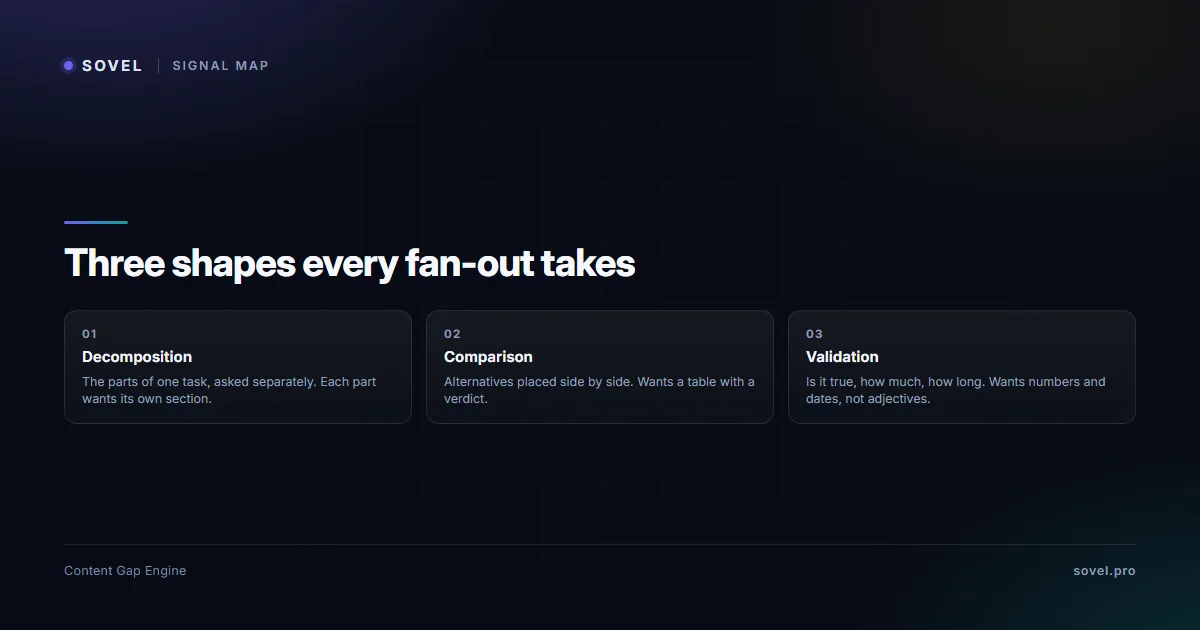
Most expansions fall into three patterns. Recognising them tells you what kind of section to write.
| Shape | What the system is doing | What it needs from you |
|---|---|---|
| Decomposition | Breaking one task into its parts | One section per part, in order |
| Comparison | Placing alternatives side by side | A table with a clear verdict |
| Validation | Checking a claim, a number or a timeline | Specific figures, dates and sources |
Decomposition is the most common shape in query fan-out. A question about how to do something becomes questions about prerequisites, steps, tools and failure modes. Each of those is a separate search, and each one wants a separate passage.
Comparison appears whenever a query implies a choice. The system searches for both options, then for the comparison itself. A page that names both options in a heading and compares them in a table gives it three clean passages instead of one muddy paragraph.
Validation appears whenever a query contains a claim that could be checked. How much, how long, is it legal, does it still work. These searches reward specificity, and they punish adjectives. “Significantly faster” is not retrievable. “Cuts the process from four hours to forty minutes” is.
Why long articles lose under fan-out
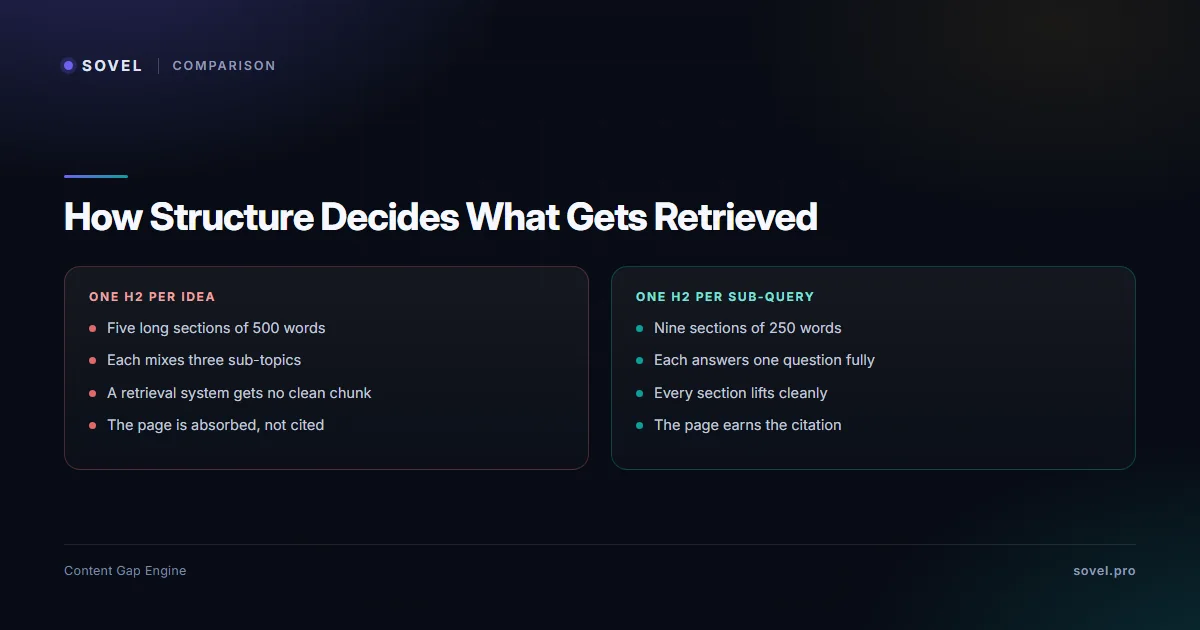
A 3,000-word article with five headings of 600 words each looks thorough. Under fan-out it is often weaker than a 2,000-word article with ten headings of 200 words.
The reason is chunking, and it is the mechanism behind every query fan-out effect. Retrieval systems split pages into passages before comparing them against a query. A 600-word section that covers three sub-topics produces a passage that is partly about each and fully about none. When the system compares it against a specific sub-query, it loses to a passage that is entirely about that one thing.
There is a second effect that makes the structure harder to game. Long undifferentiated sections are harder to attribute. If a system can absorb an idea from a page without needing to cite the specific passage, it often does. Distinct, self-contained sections with a clear claim in the first sentence are easier to cite and harder to swallow.
This is the practical meaning for writers. Structure is the interface between your page and the retrieval step.
The five structural moves
Five changes do most of the work in query fan-out planning. None of them require new tools.
One section per sub-query. List the sub-queries before drafting, then give each one a heading. If two sub-queries genuinely belong together, merge them into one heading that names both, rather than writing one heading and covering the second in passing.
Answer in the first fifty words. Every section opens with a direct answer, then expands. The first two sentences are the passage most likely to be lifted, so they have to stand alone and be correct without context.
A table for every comparison. Comparisons are where prose fails hardest. Two products, two approaches, two costs: put them in rows and columns, then add one sentence of verdict underneath. Tables are easier to parse and easier to quote.
Name the entities. Products, standards, organisations, dates. A section that says “the leading search engine” is less retrievable than one that says “Google”. Entity naming is also how a system confirms what the page is about.
Add a shortcut section. A short block near the end titled something like “if you only need one thing” that states the single most useful takeaway. This catches the reader, and the retrieval system, that wants the conclusion without the argument.

How do you find the sub-queries without a paid tool?
You already have four free sources for query fan-out planning, and they map onto the three shapes.
| Source | What to type | What it returns |
|---|---|---|
| Autocomplete | question word plus seed | Beginner phrasing, decomposition |
| People Also Ask | open each box once | Second level questions, validation |
| Related searches | scroll to the page foot | Adjacent intent, comparison |
| Your own support inbox | past questions | Real objections, validation |
The method is to collect forty to sixty candidate sub-queries, then deduplicate by the question they are really asking. Most lists collapse by half at that step, because “how long does it take”, “how many hours” and “can I do it in a day” are one sub-query with three phrasings.
Then sort the survivors into the three shapes. Decomposition sub-queries become process sections. Comparison sub-queries become tables. Validation sub-queries become a numbers section with sources.
That sort is the whole of query fan-out planning. It takes about an hour for a topic you already know, and it produces an outline that is structurally different from what a keyword tool would suggest.
The People Also Ask guide covers the expansion loop in detail, and the Google autocomplete guide covers the prefix work that surfaces the question phrasing.
What not to do
Three patterns look like query fan-out optimisation and are not.
Turning every sub-query into a heading with a one-line answer. That produces a table of contents rather than a page. If a heading has forty words under it, it should have been a bullet inside a larger section.
Repeating the query in every heading. “Query fan-out for beginners”, “query fan-out examples”, “query fan-out tools” is keyword stuffing wearing a structural costume. Headings should answer, not repeat.
Writing for the system instead of the reader. A page that reads like a database dump gets retrieved rarely, because retrieval systems increasingly weight whether a passage is actually useful. The structural moves above help a reader first and a retrieval system second, which is the right order.
There is a fourth pattern worth naming. Adding a FAQ block of twenty questions to a page that already answers them in the body. That duplicates content, splits the page’s focus, and gives the system two competing passages for the same question. Five to nine FAQ entries that cover genuinely different angles is the useful version.
Where the engine fits
The engine produces the raw material for query fan-out planning in one pass. It collects questions, keywords and competitor coverage, then groups them into gap types and opportunities.
In a live run on 7 November 2026, the engine scored 52 keywords and produced 54 gap records for a single topic, with 15 opportunities. The questions arrived tagged by intent, which is what makes the three-shape sort fast. Instead of reading sixty phrases and guessing, you read a list that already separates question-shaped demand from comparison-shaped demand.
Two outputs matter here.
- Gap types. The engine separates content gaps, question gaps, evidence gaps, trust gaps and AEO gaps. An evidence gap is a validation sub-query that nobody has answered with a number, and those are the highest-value sections to write.
- Coverage verdicts. Each topic is checked against your sitemap and returned as NEW, REFRESH, EXPAND, MERGE, REDIRECT or DO NOT CREATE. That stops you restructuring a page that should be merged into another one.
The gap types and the coverage verdicts are described on the Content Gap Finding Engine page, with the report side at SOVEL Gap Brain.
The wider context sits in generative engine optimization content gaps, which covers how retrieval changes the definition of a content gap. For the answer-level mechanics, see answer engine optimization for business websites and LLM content optimization.
Where fan-out does not apply
Not every query benefits from this structure, and treating every page the same produces a site of over-sectioned fragments.
Three cases where fan-out is the wrong frame. A navigational query wants one destination, and splitting the answer across nine sections helps nobody. A transactional query wants a price and a button, and structure is secondary to clarity. A single-fact query wants one sentence, and a nine-section page around it is padding.
The signal sits in the result set, and it is the first thing to check before applying query fan-out to a page. If the top results are short pages that answer in two paragraphs, the query is not fanning out into eight sub-questions. Match the depth the query already rewards rather than the depth your template prefers.
Query fan-out rewards pages that answer several real questions. Where there is only one question, it rewards brevity instead.

Two details that decide whether the structure holds
The first is heading length. A heading that runs to fifteen words stops being a label and becomes a sentence, and a sentence heading is harder to scan and harder to match. Keep headings under about eight words and let the answer underneath carry the detail.
The second is the first sentence of each section. It should answer the heading without referring to anything above it. If it opens with “this” or “that”, the reader arriving from a search result has nothing to attach the pronoun to, and the passage stops working on its own.
Both details are easy to fix and easy to miss. A page can have perfect section coverage and still fail the chunk test because every section starts with a pronoun pointing at the section above.
Read the finished page from the middle. Start at any heading and read down for two paragraphs. If you can follow it, the structure works. If you need to scroll up, the section needs a subject in its first line.
Measuring whether it worked
You cannot measure query fan-out performance directly without tooling, and even with tooling the signal is noisy. Three proxies are honest.
Check whether your sections appear as standalone answers. Paste a heading into an AI assistant with no other context and see whether the answer it gives matches your section. If the assistant cannot answer from the heading alone, the section is not self-contained.
Watch which pages get cited, not how often. A page that gets cited for one specific sub-query is working. A page that gets absorbed silently is not, and the fix is usually structural rather than topical.
Track impressions for question-shaped queries. If your page starts appearing for the sub-queries you wrote sections for, the structure is doing its job. That is visible in Search Console without any new tool.
None of these prove causation. All of them tell you whether the page is legible to a system that reads in passages, which is the only thing you control. Run all three once a quarter and compare the results over time, because a single reading is noise and a trend is a signal.
Why the same structure helps human readers
Query fan-out gets discussed as a machine-facing technique. The structure it rewards is also the structure readers already prefer.
A reader arriving from a search result has one question. A page with nine named sections lets that reader find the answer in one scroll instead of reading an argument that builds toward it. The answer-first opening in each section does the same job for a skimmer that it does for a retrieval system.
The failure modes line up as well. A page with five 600-word sections is hard to skim and hard to retrieve. A page with fifteen one-line headings is hard to read and hard to retrieve. The useful range sits between those two, and it is roughly the same range for both audiences.
That alignment is worth trusting. Techniques that only serve machines tend to decay as the machines change. Techniques that serve a reader first tend to keep working, because the underlying behaviour, which is a person looking for one answer, does not change.
Treat query fan-out as a reason to structure clearly rather than as a separate discipline. The writing improves either way.
A worked outline
Take a topic and apply the query fan-out structure. Suppose the topic is choosing a static site generator.
The decomposition sub-queries are prerequisites, build steps, deployment and maintenance. The comparison sub-queries are two generators head to head, and hosted versus self-managed. The validation sub-queries are build time, cost at scale, and whether an existing site can migrate.
That produces nine sections. Each one gets a heading that names its sub-query, an answer in the first fifty words, and a table where a comparison exists. The shortcut section at the end says which generator to pick for a five-page site and which for a five-thousand-page one.
Nine sections, roughly 2,300 words, and every section can be lifted alone once query fan-out is applied. That is what query fan-out rewards, and it is also a better page for a human reader who arrived with one specific question.
If you want the next layer, SGE optimization strategy covers how the answer surface itself behaves once a passage is selected.
FAQ
Is query fan-out a confirmed Google mechanism?
Google has described AI search systems that expand a query into multiple searches before answering, and its AI features documentation describes how content appears in those surfaces. The exact expansion logic is not published, so treat any specific claim about the number of sub-queries as an estimate.
Does query fan-out mean I should write shorter articles?
No. It means each section should be shorter and more self-contained. A 2,500-word page with ten tight sections performs better than a 2,500-word page with four sprawling ones.
How many headings should a page have?
Roughly one per sub-query, which usually lands between seven and twelve for a substantial topic. Fewer than five suggests the page is covering one narrow question. More than fifteen suggests the headings are fragments.
Does schema markup help with query fan-out?
It helps a system understand structure and entity relationships, and it does not guarantee retrieval. Article and FAQ markup are the two that matter most for a page like this, and both should describe content that is visibly on the page.
Can I optimise for query fan-out without a paid tool?
Yes. Autocomplete, question boxes, related searches and your own support inbox supply the sub-queries. The work is in the sort and the writing, and neither needs software.
Why does my page get used in AI answers without a citation?
Because the passage was useful and not distinctive enough to attribute. The fix is structural: name the entity, state a specific claim, cite a primary source. A passage that could only have come from your page is easier to credit.
How often should I revisit the structure?
When the underlying questions change, which is usually every six to twelve months for a topic that moves. A quick re-run of the sub-query collection is enough. Rewriting the whole page is rarely necessary.