
People also ask keyword research is the practice of reading the question boxes on a search result as a graph rather than a list. Every question you open generates more questions underneath it, and the second level is where the useful phrasing usually sits.
Most guides tell you to copy the box into a document. That produces a page with twenty-two headings and no readers. This guide covers the expansion loop, the six question shapes and the section each one earns, and the ledger that keeps your answers from colliding with pages you already published.
What is people also ask keyword research actually reading?
It reads a generated set of related questions for one query. Google builds that set from queries real people asked next, then shows a handful at a time. Opening one question loads more questions beneath it.
The practical consequence: the box is a traversal, not a snapshot. Two people opening the same query can see different questions depending on what they expand, their region, and their device. That is why screenshots of the box go stale in weeks and why copying one capture into a content plan produces a thin brief.
The honest way to run people also ask keyword research is to record the path, not just the endpoint. Write down the seed query, which question you opened, and what appeared underneath. A question that appears at depth two from three different parents is a genuinely central question. A question that appears once, under one parent, might be an artefact of your own search history.
Google’s own documentation on FAQ structured data is worth reading alongside this, because it explains what the FAQ format is actually for. It is a way to mark up question and answer pairs that already exist on the page, and it does nothing for ranking on its own.
Why the box changes when you open it
Opening a question triggers a fresh set of related questions. This single behaviour is what separates people also ask keyword research from keyword tool research.
A keyword tool returns a static list with numbers attached. The question box returns a moving list with no numbers at all. If you treat the first capture as complete, you will miss most of the graph, and you will write a page that answers the surface question while ignoring the three follow-ups a reader actually has.
There is a second reason people also ask keyword research rewards patience. Questions decay. A question that dominated in 2024 can disappear once the market learns the answer, and a new question takes its place. This is why a question captured eighteen months ago is worth re-checking before you build an article around it.
The third reason is personalisation. Search history and location both shape what you see. A question about pricing in one country may never appear in another. For a single-market site this is fine. For a site selling into several markets, capture separately per market and compare.
Device adds another layer. The mobile result page shows fewer questions at a time, so a mobile capture returns a narrower slice of the same graph. If most of your readers arrive on a phone, do the capture on a phone. The questions are generated for the surface the reader is actually using, and a desktop-only capture quietly biases the outline toward desktop readers.
The depth-2 expansion loop
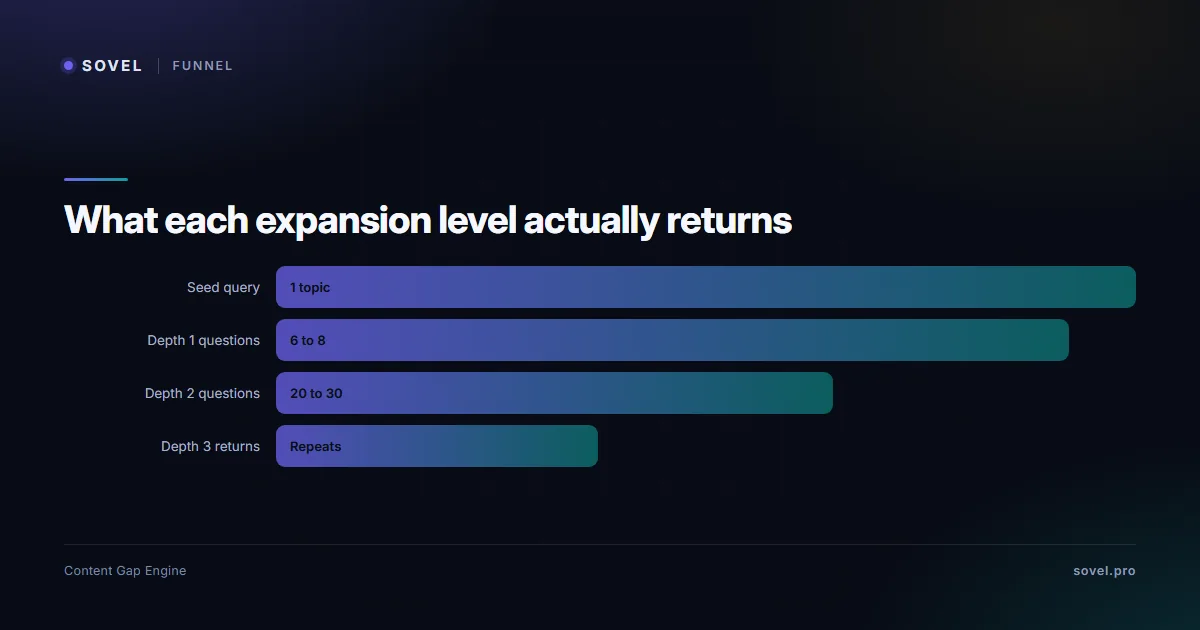
Two levels is enough for people also ask keyword research. Three levels mostly repeats what you already have, and the returns fall off sharply.
The loop:
- Search the seed query. Record every question visible at depth one, with the date.
- Open each question once. Record every new question that appears underneath, tagged with its parent.
- Repeat for the questions that appear under two or more parents. Those are the central ones.
- Stop. Depth three returns duplicates and near-duplicates, and the time is better spent writing.
On a typical people also ask keyword research seed you get six to eight questions at depth one and twenty to thirty at depth two. That is a usable pool for one article, and often for two.
The tagging matters more than the count. A question with three parents is a hub question and deserves its own H2. A question with one parent is a supporting detail and belongs inside someone else’s section. Running people also ask keyword research without parent tags produces a flat list, and a flat list is what turns into a twenty-two heading page.
Six question shapes and the section each one earns
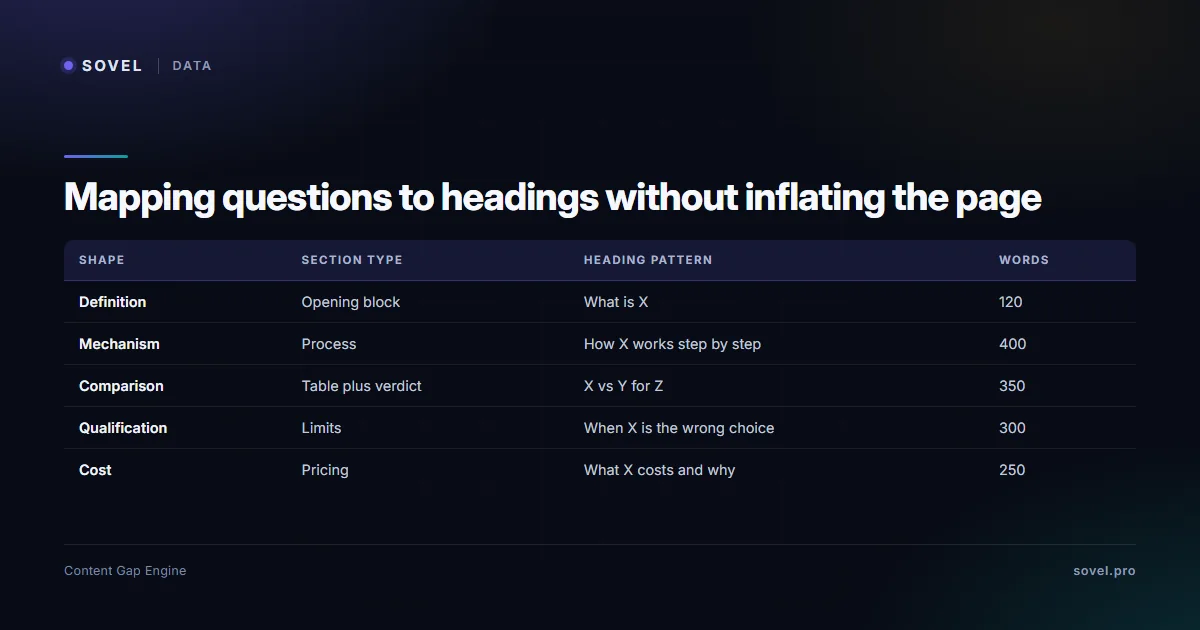
Every question in the box falls into one of six shapes. The shape tells you what kind of section to write, which is more useful than the question itself.
| Shape | Typical phrasing | What the reader needs | Section it becomes |
|---|---|---|---|
| Definition | what is, what does mean | A plain explanation | Opening block |
| Mechanism | how does, how do you | Ordered steps | Process section |
| Qualification | is it, can it, does it | A yes or no with conditions | Limits section |
| Comparison | vs, better than, or | A verdict | Table section |
| Cost | how much, is it free | Numbers and tiers | Pricing detail |
| Troubleshooting | not working, why does | Cause and fix | Failure section |
This table is the core of people also ask keyword research done well. You stop asking “which question should I answer” and start asking “which section is missing from my outline”. Six shapes, six section types, and most articles only have three of them.
Heading patterns are where people also ask keyword research turns into structure. A definition shape wants a short noun phrase. A mechanism shape wants a verb. A comparison shape wants both names in the heading so a reader scanning the page can find the comparison without reading the paragraph above it.
The qualification shape is the one writers skip. Questions like “is it worth it” or “can I do this without a tool” carry the reader’s real objection, and an article that never addresses the objection reads as promotional even when it is accurate.

The mistake that turns a good page into a table of contents
The most common failure in people also ask keyword research is one H2 per question.
Twenty-two questions become twenty-two headings. Each heading gets forty words because there is nothing more to say about a single question in isolation. The reader scrolls, sees a wall of short sections, and leaves. The page has twenty-two chances to be cited and no section strong enough to be worth citing.
The fix inside people also ask keyword research is grouping by shared intent. Three questions about pricing become one pricing section that answers all three in order. Four questions about setup become one setup section with a numbered list. You end up with seven headings covering twenty-two questions, and each heading has enough room to say something complete.
| One H2 per question | One H2 per shared intent |
|---|---|
| 22 headings on a 2,400 word page | 7 headings on a 2,400 word page |
| Each section answers 40 words | Each section answers fully |
| Reader scrolls, never reads | Reader finishes the page |
| No section is citable alone | Every section stands alone |
There is a mechanical test for whether the grouping worked. Read one heading and its section with no other context. If it makes complete sense on its own, the chunk is clean. If it needs the section above it, the grouping cut in the wrong place.

Build a question ledger before you build an outline
A ledger is where people also ask keyword research stops being a reading exercise and becomes a plan. It takes fifteen minutes and it prevents the two failures that hurt most: answering a question you already answered, and answering it differently on two pages.
| Field | Why it matters |
|---|---|
| Question, verbatim | Paraphrasing loses the phrasing people actually search |
| Depth and parent | Tells you whether it is a hub question or a detail |
| Capture date | Questions decay, so age changes the decision |
| Shape | Maps to a section type without re-thinking |
| Already answered on your site | The cannibalisation flag |
The last column is the one people skip. Before you write, run a site search for the question’s core phrase. People also ask keyword research output is only useful once it clears that check. If a page already answers it, the job is to improve that page rather than to publish a second one. Two thin pages competing for the same question rank worse than one strong page, every time.
A ledger also makes people also ask keyword research reusable. Six months later, the same table tells you which questions have disappeared, which have appeared, and which sections of your article need a refresh. Without it, you start from zero every time and you cannot tell what changed.
What the question box cannot tell you
It cannot tell you volume, difficulty, or whether the question sits close to a purchase. It has no numbers at all, and any tool that claims to attach volume to a PAA question is modelling rather than measuring.
It also cannot tell you whether the question is worth a whole section. A question can be common and shallow, and the shape tells you the section type while saying nothing about how much space it deserves. “What is content gap analysis” gets asked constantly and needs one paragraph, not eight hundred words. The shape tells you the section type, not the section size.
The third limit of people also ask keyword research is stability. Because the box is generated and personalised, your capture is one sample. Treat a single appearance as a hypothesis and a repeated appearance across parents and dates as a finding.
The engine handles this the same way. Reader questions come back with an evidence class attached, and a question seen once is labelled differently from a question confirmed across sources. That distinction is what stops a research document from turning into a wish list.
Generative engine optimization is the other reason this block matters. An AI answer engine lifts question and answer pairs almost verbatim, and a page with clean pairs is easier to attribute than a page where the same point sits inside three paragraphs of narrative. The box supplies the questions in the form the system expects.
One more thing the box cannot do: it cannot tell you which question your competitor already answers well. Two pages answering the same question with the same depth is a wasted page. Before you write, read the top three results for the question itself and note what each one covers. The gap is usually in the part nobody wrote, which is often the qualification shape, because objections are uncomfortable to write about and easy to skip.
Where the engine fits into the loop
Manual expansion of people also ask keyword research works for one seed. It becomes slow at five seeds, because each seed needs its own traversal and its own ledger.
The SOVEL Content Gap Finding Engine runs question research alongside keyword research in one pass. It pulls questions from search results, merges them with autocomplete phrasing and Quora threads, then labels each one. In a live run on 7 November 2026, a single topic returned 52 scored keywords, 54 gap records and 15 opportunities, with Quora available and Reddit blocked at HTTP 403. The blocked source is reported as blocked rather than silently dropped.
Two outputs change how the ledger gets built.
- Questions grouped by gap type. The engine separates question gaps from content gaps, evidence gaps and trust gaps, so you can see whether the missing piece is an answer or a proof.
- Coverage verdicts. Each question is checked against your sitemap and returns one of six verdicts, from NEW through MERGE and REDIRECT. The verdict fills the ledger’s last column automatically.
You can see the full method on the Content Gap Finding Engine page, and the conversational layer at SOVEL Gap Brain if you want to ask follow-up questions about a specific run.
The engine does not replace people also ask keyword research. It removes the collection work and leaves the editorial judgement, which is the part that decides whether the page is any good.
The pairing that works best is this method plus search intent mapping. Questions tell you what to cover. Intent tells you what page type to build. Get the second one wrong and a well-researched question page still lands on the wrong query.
What to do when the box returns nothing useful
Some seeds produce a box full of questions that have nothing to do with the topic. That usually means the seed is ambiguous. A word with two meanings pulls questions from both, and the box mixes them without warning.
The fix inside people also ask keyword research is to narrow the seed rather than abandon it. Add the qualifier that names your reader, then search again. A broad term returns broad questions. A term with an audience attached returns the questions that audience actually asks, which is the whole reason the exercise is worth doing.
There is a second case worth naming. A very specific seed can return an empty box, and an empty box is not evidence of no demand. It often means the phrase is too narrow for the system to have related questions attached yet. Check the parent term before concluding anything.
Record both cases in the ledger with a note. Six months later the empty box may be full, and the note tells you whether the topic changed or your search did. A record of a failed capture is still a record, and it costs one line. Keep it even when the answer is obvious, because the obvious answer is the one you will forget first.
A worked example
Take the seed “content gap analysis”. Depth one returns questions about definition, tools, process and free options. Depth two under the process question returns questions about doing it without a tool, doing it for a client, and doing it for an existing site.
Group by shape and the outline writes itself: a definition block, a process section, a free-options section, a client-work section, an existing-site section, and a limits section. Six sections, roughly eighteen questions covered, and no heading exists just to host one question.
That is what people also ask keyword research produces when it is run properly. Not a list of questions. A section map with evidence behind each section.
If you want the upstream method for finding the seed itself, the Google autocomplete guide covers prefix expansion. For the question of whether a low-volume question deserves a page at all, see the zero search volume test. And if two of your pages already answer the same question, the cannibalisation check explains how to merge them.
FAQ
Is people also ask keyword research still useful in 2026?
Yes, and people also ask keyword research is more useful than it was, because AI answer engines and search generative results both lift question and answer pairs directly. The box itself is unstable, so the value comes from the shape of the questions rather than from a saved screenshot.
How many questions should people also ask keyword research collect?
Twenty to thirty at depth two is a workable pool for one long article. Fewer than ten usually means the seed is too narrow. More than forty usually means you are collecting near-duplicates.
Why do I see different questions from someone in another country?
The box is generated and personalised by location, language and search history, which is why people also ask keyword research needs a clean context. Capture per market if you publish for several, and note the capture location in your ledger so the data stays interpretable.
Should every question become a heading?
No. One heading per question produces a page of forty-word sections that nobody finishes. Group three to five questions that share an intent under one heading, and answer them in order.
Can I put these questions into an FAQ schema block?
You can mark up question and answer pairs that already exist visibly on the page, following Google’s FAQPage guidance and the schema.org FAQPage definition. Marking up questions that are not visible on the page breaks the guidelines.
How often should I re-run the research?
Every six to nine months for a page that matters, and people also ask keyword research is the cheapest way to spot what changed. Questions decay, and a section built on a question nobody asks anymore takes up space that a current question could use.
Does the engine replace the ledger?
It fills the ledger faster and adds the coverage verdict, so the manual columns shrink to the verbatim question and the date. The judgement about grouping still sits with you, because people also ask keyword research ends in an editorial decision rather than a lookup.