
Search intent mapping is the step that decides what kind of page to build before anyone writes a sentence. Get it right and an ordinary draft ranks. Get it wrong and a well-researched 3,000-word guide loses to a 700-word page with a table.
The reason is simple. Intent is a property of the result set rather than a property of the words in the query. Two phrases that look identical can want two different page types, and the search results tell you which.
This guide covers the six intents worth naming, the six steps that turn a query into a page type, and the two cases that break most mappings: a split result set and a query that changes intent as a market matures.
Why intent lives in the result set
Start any search intent mapping session by typing the query and looking at what ranks. If eight of the top ten results are guides, the query wants a guide. If six are product listing pages, it wants a commercial page. The ranking itself is the evidence.
That is the whole discipline behind search intent mapping, and it is why the exercise takes thirty seconds rather than an hour. You are not guessing what the searcher wants. You are reading what the search engine has already concluded, using the results as a sample of behaviour.
Google’s ranking systems guide describes how systems assess whether content matches what someone is looking for, and the useful phrase there is “what someone is looking for” rather than “the words they typed”. The distinction is the reason this step exists.
There is a practical test at the centre of search intent mapping, and it takes thirty seconds. Search the query in a clean window, ignore the ads, and write down the format of each of the top ten results. Guides, listicles, product pages, forums, videos, official documentation. The majority format is the answer.
If the majority is unclear, that is information too, and search intent mapping should record it rather than force a choice. A split result set means the query carries more than one intent, which is a different problem with a different solution.
The six intents worth naming
Four intents get taught everywhere. Two more get skipped, and the skipped ones cause most of the bad briefs.
| Intent | What the reader is doing | Page type |
|---|---|---|
| Informational | Understanding a concept | Guide or explainer |
| Commercial | Choosing between options | Comparison with a verdict |
| Transactional | Buying or signing up | Product or pricing page |
| Navigational | Looking for one specific site | Nothing, do not compete |
| Validation | Checking a claim before acting | Evidence page with sources |
| Troubleshooting | Something is broken | Cause and fix, in order |
Validation is the first skipped intent. Someone searching “is X legal” or “does X still work in 2026” is checking a claim before they spend money or reputation. A page that answers with a clear statement and a primary source wins that query. A page that answers with “it depends” loses it.
Troubleshooting is the second. Someone searching “X not working after update” wants a cause and a fix, in that order. A page that opens with three paragraphs of background loses to a page that opens with the cause.
Naming six intents instead of four is the part of search intent mapping that changes the brief. A validation query wants a short page with citations. A troubleshooting query wants a sequence. Neither wants a 3,000-word guide, and both get one when the brief only knows about informational and commercial.

How to read a result set properly
Reading a result set is a skill, and most people do it too fast. Five habits make the reading reliable.
Use a clean window. Personalisation and history push results toward what you already read, which biases the sample. A private window with no history gives you something closer to a neutral reading.
Ignore the ads and the shopping block. They are intent signals, and they are paid placements rather than evidence of what ranks.
Record the format, not the topic. “A guide” and “a listicle” are different answers even when both cover the same subject. The format is what the search engine believes the reader wants.
Look for forum and video results. Their presence usually means the query rewards personal experience, and a page with no first-hand detail will struggle against them. Google’s Search Quality Rater Guidelines are worth reading once at this point, because they define how a page is judged against the intent behind a query, which is the same judgement the ranking reflects.
Check the dates. A result set full of 2023 pages on a fast-moving topic suggests weak competition rather than settled intent, and that changes the opportunity.
Run those five checks and the reading takes about four minutes per query. That is the honest cost of search intent mapping, and it is still the cheapest step in the whole process.
The six steps
The sequence matters in search intent mapping. Doing step four before step two is how briefs end up with the wrong format.
Step one: read the result set. Top ten, format of each, majority wins. Note any video or forum results, because those indicate the query rewards experience rather than explanation.
Step two: name the intent. One of the six, not a blend. If you cannot pick one, the query is mixed and needs step five.
Step three: choose the page type. Guide, comparison, product page, evidence page or fix guide. Write it down. This is the decision the rest of the brief depends on.
Step four: set the section order. Each intent has a natural order. Informational wants definition, mechanism, limits. Commercial wants criteria, table, verdict. Troubleshooting wants symptom, cause, fix.
Step five: check for mixed intent. If the result set splits, decide whether one page can serve both halves or whether this needs two pages with explicit internal linking.
Step six: check your own site. Search your sitemap for the query and its close variants. If a page already targets it, the job is a refresh rather than a new page.
Step six is where search intent mapping saves the most money, and it is the step most often skipped. Two pages competing for one intent is the most common self-inflicted ranking problem, and it is entirely avoidable with one search of your own site.
The decision table
The table below is the working output of search intent mapping. Fill it in before drafting, not after.
| Intent | Page type | Section order | Close with |
|---|---|---|---|
| Informational | Guide | Definition, mechanism, limits | Next step |
| Commercial | Comparison | Criteria, table, verdict | One recommendation |
| Validation | Evidence page | Claim, source, caveat | A citable statement |
| Troubleshooting | Fix guide | Symptom, cause, fix | How to prevent it |
| Transactional | Product page | Outcome, proof, price, objections | Purchase |
| Navigational | None | Not applicable | Not applicable |
The “close with” column is the one people forget. A comparison that ends without a recommendation frustrates the reader who came to choose. A validation page that ends without a citable statement gives the reader nothing to quote. The ending is part of the intent.

Mixed intent, and what to do about it
A split result set is common, and it needs to be handled deliberately.
The typical split in search intent mapping is between a guide and a listicle. Four results explain the topic, four list ten options, two are product pages. The query serves a reader who wants to understand and a reader who wants to choose.
Two options exist once search intent mapping has confirmed a split. One page with two clear halves, where the first half explains and the second half compares. Or two pages, one for each intent, linked to each other.
The one-page option works when the explanation is short, under about 600 words, and the comparison is the real destination. The two-page option works when each half needs depth, because a page that tries to do both fully ends up doing neither.
What does not work is averaging. A page that explains a little and compares a little serves neither reader, and it usually ranks for neither query. The split in the result set is a warning against compromise.

Intent drift
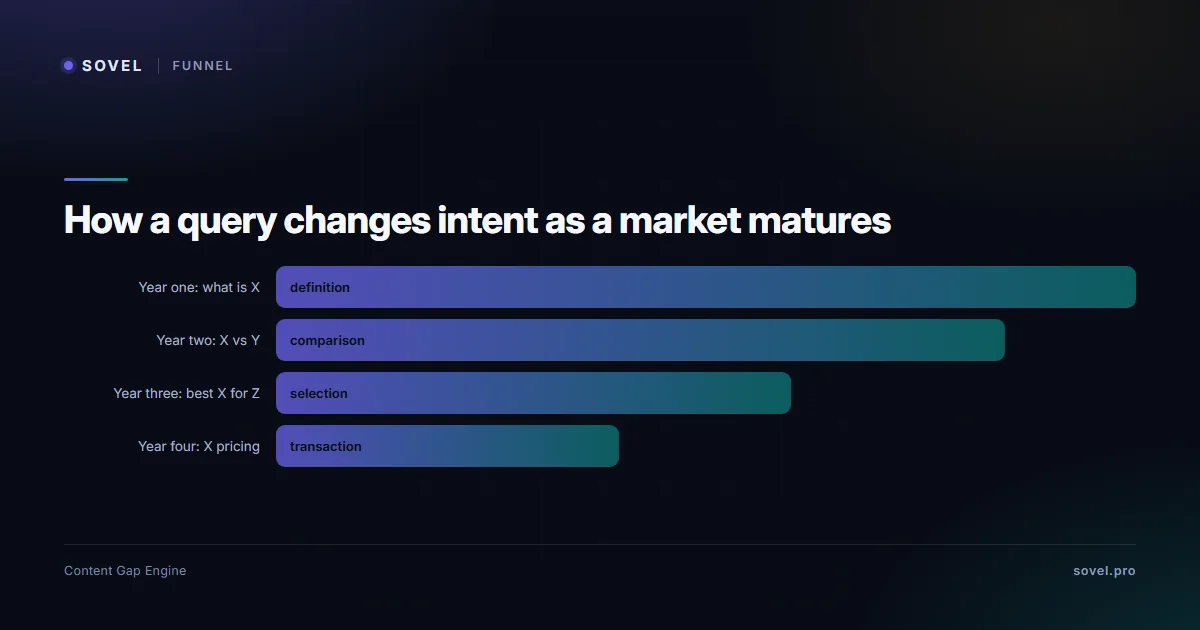
Queries change intent as a market matures, which is why search intent mapping is a recurring task. This is the part of search intent mapping that has to be re-run rather than run once.
In the first year of a category, most queries are informational, because nobody knows what the thing is. In the second year, comparison queries grow as buyers appear. By the third year, the volume sits in selection and pricing queries, because the market has learned the vocabulary.
A page built for the first-year intent keeps ranking for a while and then slowly stops, not because it got worse but because the query moved. The symptoms are familiar: impressions hold, clicks fall, average position drifts down, and the page looks fine when you read it.
The fix is to re-run the mapping on your highest-traffic pages once a year. Search the query, look at the current top ten, and compare the format mix with what you built. If the mix has shifted from guides to comparisons, the page needs a comparison section rather than a rewrite.
Re-mapping a page you already published
Most search intent mapping work happens on existing pages, not new ones. The process is shorter.
Search the query your page targets. Compare the current top ten with what your page is. If your page is a guide and eight of the top ten are comparisons, the page is mis-shaped rather than out of date.
Three responses are possible. Add the missing format as a section and keep the page. Split the page into two and link them. Or leave it and accept a narrower target, which is sometimes correct for a page that earns its traffic from long-tail variants.
The wrong response is a rewrite that changes the topic. If the intent moved from explanation to comparison, the page needs a comparison section. It does not need to become a different article, and replacing it loses whatever authority it accumulated.
Record the decision in the page’s notes. Search intent mapping produces a series of small decisions, and a record of them is what stops the same debate recurring every quarter.
Where the engine fits
The engine infers intent from the observed mix rather than from the words, which is the same method described above, run across more sources and repeated per keyword.
In a live run on 7 November 2026, the engine reported an intent mix per topic that included long-tail, question, commercial, transactional and platform-native signals, then scored each keyword against that mix. The output separates keywords that fit the page’s intent from keywords that would pull it in a different direction.
Two outputs help with search intent mapping directly.
- Intent fit as a scoring component. A keyword that matches the intended page type scores higher than one that does not, which surfaces the mismatch before you write.
- Cannibalisation verdicts. Each keyword returns one of six verdicts against your sitemap, from NEW through MERGE and REDIRECT. The verdict is step six, automated.
Intent inference and the cannibalisation verdicts are covered on the Content Gap Finding Engine page, and the conversational view is at SOVEL Gap Brain.
The neighbouring skill is question research. The People Also Ask guide covers which questions to answer, and this page covers what shape the answer should take. For the brief itself, see the SEO content brief generator.
The two-minute version for a busy week
Not every page needs the full six steps. When a week is short, three questions cover most of the decision.
What format dominates the top ten? That answers the page type without any interpretation. If eight results are guides, build a guide.
What does the reader do next? That answers the closing section. A comparison ends with a pick. A guide ends with a next step. An evidence page ends with a citable line.
Does a page already exist on the site? That answers whether this is a new page or a refresh, and it is the question that prevents most duplication.
Three questions, two minutes, and the brief has a shape. The full process adds precision on mixed results and drift, and it is worth running on anything that carries revenue. For a supporting page, the short version is usually enough, and it is better than a thorough process applied three weeks late to a query nobody was waiting on.
What changes when the answer appears above the results
Search generative results change the value of getting intent right. When an AI summary answers the query before anyone clicks, a page built for the wrong intent gets skipped rather than outranked.
The practical effect is that the page type decision matters more than the word count. A comparison page that answers which one in a table survives being summarised, because the table is the answer. A guide that builds toward a conclusion loses the reader to the summary above it.
That is the argument for treating AI search as a second reader of the same structure. The mapping does not change. The cost of getting it wrong does, and it compounds every time the summary surface expands.
When the mapping is genuinely ambiguous
Some queries resist a clean answer in search intent mapping, and forcing one in search intent mapping produces a worse page than admitting the uncertainty.
Three signs of genuine ambiguity. The result set is evenly split across three formats. The top results are all low quality, which suggests the engine has not settled on an intent either. Or the query is new enough that no format has established itself.
In those cases, the useful move is to build the page that serves the clearest reader and accept a narrower target. A page that clearly serves one intent ranks for that intent. A page that hedges across three ranks for none.
There is also a commercial dimension. A query with ambiguous intent often has low commercial value, because nobody has worked out how to monetise it yet. That is a reason to expect a slower result and to measure it against the right benchmark.
The cannibalisation check matters more in ambiguous search intent mapping cases, because ambiguity invites a second page that competes with the first. Run it before you commit.
Intent and internal links
The mapping also decides how pages link to each other, and the link pattern is what makes a cluster readable to both readers and search engines.
A guide should link to the comparison that follows it, because the reader who finishes understanding will want to choose. A comparison should link back to the guide, because the reader who is not ready to choose needs the explanation first. A troubleshooting page should link to both, because the reader who fixed the symptom often wants to prevent it.
That pattern only works if search intent mapping assigned each page one intent. Pages with blended intents produce blended links, and blended links tell a reader nothing about what to expect after the click.
Anchor text is the other half. A link labelled “read more” carries no intent. A link labelled “compare the two approaches” tells the reader exactly what the next page does. Search intent mapping gives you the vocabulary for those anchors, which is a small benefit that compounds across a hundred pages.
FAQ
Is search intent mapping different from keyword research?
Yes. Keyword research tells you what people search. Search intent mapping tells you what kind of page should answer it. A keyword list without an intent decision produces briefs with the right topic and the wrong format.
How many results do I need to check?
Ten is enough for a clear majority. If the top ten are split, check twenty and see whether a pattern emerges further down. If it does not, the query is genuinely mixed.
Can one page serve two intents?
Sometimes. It works when one half is short and the other is the destination, and it fails when both halves need depth. In the second case, build two pages and link them explicitly.
How often should I re-run search intent mapping?
Once a year for pages that carry traffic, and whenever a page’s clicks fall while impressions hold. That pattern usually means the query moved rather than the page decayed.
Does search intent mapping apply to AI search?
It applies more, because AI systems answer the question the reader is actually asking. A page built for the wrong intent gets skipped in favour of one that matches, regardless of length or domain authority.
What is the most common mapping mistake?
Building a long guide for a query that wants a short answer with a table. It happens because the brief names a topic and never names a page type, so the writer defaults to the most thorough format available.
How do I know if my page already targets the query?
Search your own site for the query and its close variants before you brief anything. If a page exists and ranks on page two or three, the job is usually a refresh with a clearer format rather than a new page.