
The Foundation: Why Subjective Opinions Destroy Editorial Efficiency
Most content teams choose what to write based on personal intuition, brainstorm sessions, or executive opinion. A founder thinks a topic sounds interesting, a marketer reads a trending post on social media, and an article is commissioned without any verifiable proof that searchers actually want the information. An evidence based seo keyword strategy replaces this subjective guessing with a rigorous, source-backed framework where every topic must earn its place on the publishing roadmap.
In traditional publishing environments, editorial teams produce dozens of articles that generate zero organic search impressions because no one verified search intent or internal overlap before writing. To establish a reliable, repeatable publishing workflow, modern content operations rely on the Content Gap Finding Engine, a local Python research system that validates queries, checks internal competition, and assigns transparent confidence scores to every opportunity.
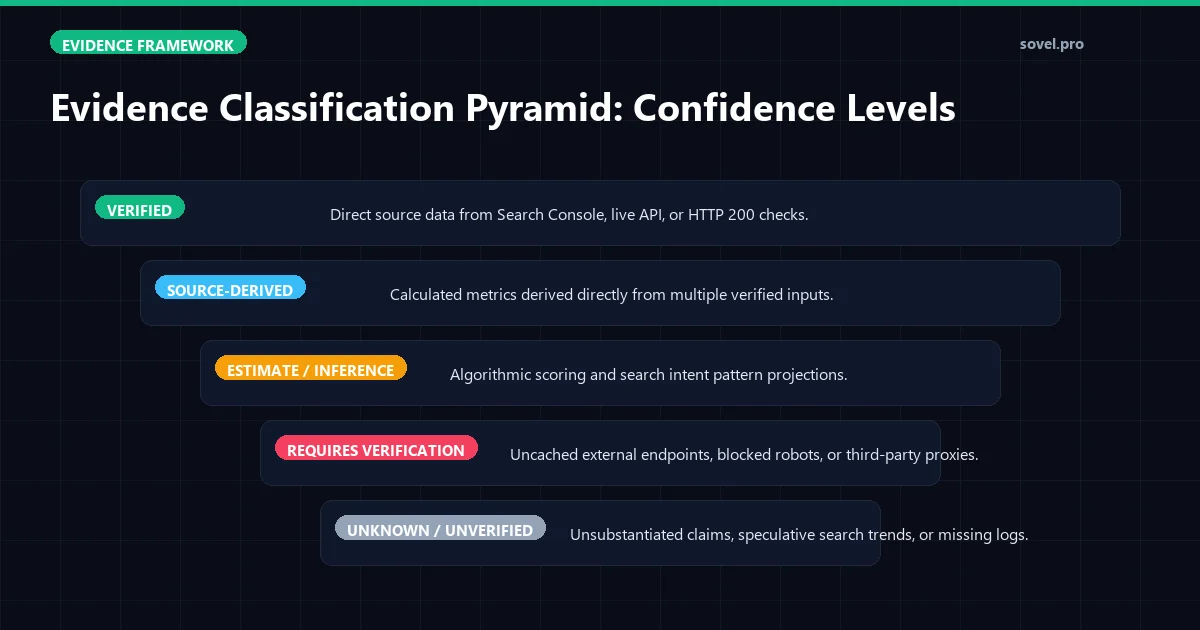
The evidence classification pyramid ranks search signals by factual certainty to prevent speculation.
An evidence based seo keyword strategy treats keyword research like an engineering problem. Instead of asking “What should we write about this week?”, the system asks “What specific problems are users actively trying to solve, what evidence confirms that demand, and does our site have the structural authority to win that search query?” Applying this standard eliminates wasted effort and builds an organic search footprint that compounds reliably over time.
The Evidence Classification Pyramid: Categorizing Search Certainty
When conducting evidence based seo keyword strategy, the core vulnerability of modern SEO is that commercial tools present estimated metrics as definitive facts. A dashboard might report that a keyword has 1,200 monthly searches and a difficulty score of 34, yet both numbers are proprietary algorithmic projections that may bear little resemblance to reality. An evidence based seo keyword strategy categorizes all incoming search data into distinct evidence tiers:
- Tier 1: Verified Direct Data. First-party query logs from your own Google Search Console, live server access logs, and direct user support tickets. This represents observable truth about what people are searching for on your domain.
- Tier 2: Source-Derived Signals. Google Autocomplete suggestions, People Also Ask questions, and Google Trends velocity scores. These signals reflect live search engine behavior directly from primary endpoints.
- Tier 3: Marketplace and Community Evidence. Amazon customer reviews, Reddit discussion threads, and Quora questions. These confirm genuine user pain points and conversational intent outside traditional search boxes.
- Tier 4: Algorithmic Inferences and Estimates. Third-party volume estimates, difficulty ratings, and competitor keyword projections. These metrics are treated as speculative indicators that require validation before investment.
- Tier 5: Unverified and Blocked Data. Cached web scrapes, failed network endpoints, and unsubstantiated opinion. This data is strictly segregated so it never contaminates editorial decisions.
By enforcing this pyramid, an search research method guarantees that your editorial investments are anchored in observable search behavior rather than third-party estimations.
Rule 1: Never Treat An Unverified Signal as Proven Demand
When conducting evidence based seo keyword strategy, the first rule of an evidence based seo keyword strategy is absolute honesty regarding data provenance. When an agency or software dashboard claims that a topic has immense commercial potential, an evidence-led practitioner immediately asks: What is the primary data source? Was it observed in live autocomplete queries? Did real users ask this question in a community?
When you confuse an unverified estimate with proven search demand, you risk spending thousands of dollars drafting content for non-existent audiences. Every keyword brief must carry an explicit evidence label that states exactly how the demand was verified.
Rule 2: Keep Opportunity Score and Evidence Confidence on Separate Axes
A classic failure mode in content strategy is collapsing commercial appeal and data certainty into a single arbitrary number. A keyword might have extraordinary commercial intent (such as “enterprise software migration pricing”), yet your evidence that searchers actually want that information might be very low. Conversely, a trivial query might have verified demand but minimal commercial value.
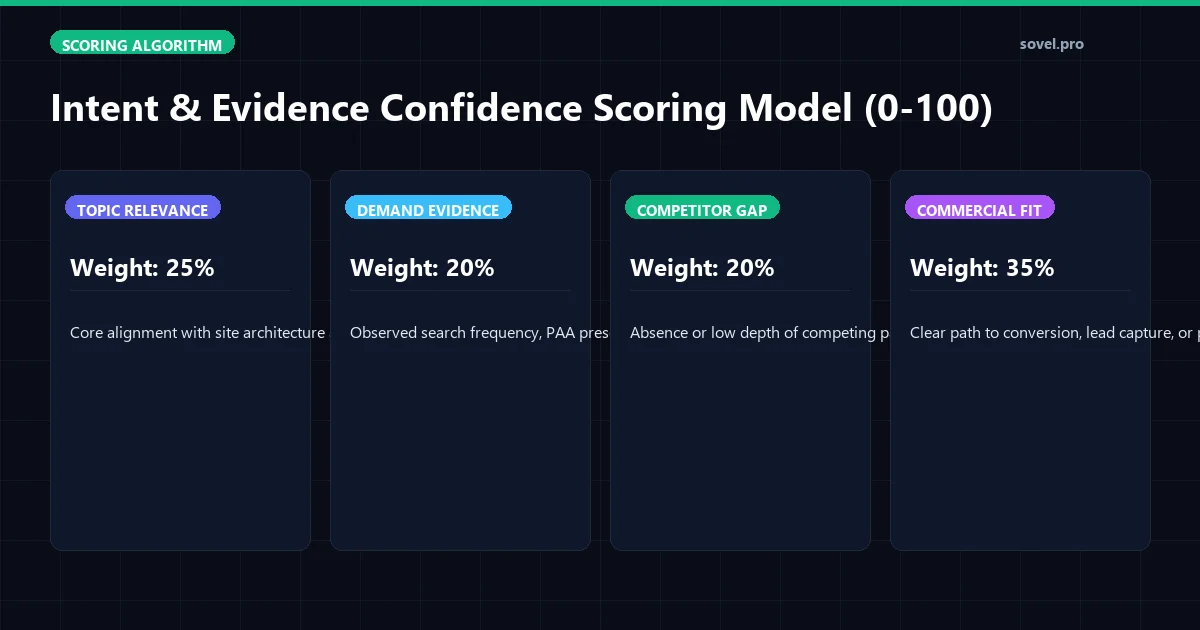
Separating opportunity potential from evidence confidence allows teams to make calculated, low-risk investments.
In an evidence based seo keyword strategy, opportunity potential and evidence confidence are tracked as two independent metrics:
- Opportunity Score (0 to 100): Evaluates topic relevance, audience alignment, search intent strength, competitor weakness, and conversion fit.
- Evidence Confidence (Verified to Unknown): Documents the reliability of the underlying data source, from direct Search Console logs to algorithmic estimates.
This separation allows decision-makers to choose between high-probability immediate targets (high score, verified confidence) and speculative high-upside investigations without confusing the two.
Rule 3: Enforce an Internal Cannibalization Check Before Every Draft
Publishing a great article is counterproductive if that article competes directly against an existing page on your own domain. Search engines prioritize websites that maintain clear, canonical topical authority. When two of your pages target identical search intent, search crawlers alternate between them, diluting backlinks, splitting click-through rates, and driving rankings down for both URLs.
Before any keyword is approved for production in an evidence based seo keyword strategy, it must pass a mandatory internal cannibalization audit. The Content Gap Finding Engine automates this check by cross-referencing candidate queries against your site architecture, returning one of seven definitive verdicts:
- New Content: Zero internal competition. Proceed to production.
- Refresh Existing: A ranking page already exists but needs updated data or depth.
- Merge URLs: Two existing pages are competing. Consolidate them into one authoritative pillar.
- Retarget Page: An existing article is ranking for secondary queries that should be formalized.
- Canonicalize: Similar utility pages should reference a single primary canonical URL.
- Drop Topic: Topic duplicates existing core landing pages with zero differentiation potential.
Conducting this check guarantees that every newly published article expands your total search footprint rather than cannibalizing existing traffic.
Rule 4: Match Content Format Directly to Explicit Search Intent
Search engines rank formats that satisfy user needs most efficiently. If a searcher types “pemdas rules chart”, they want an immediate visual reference table, not a 3,000-word essay detailing the history of arithmetic notation. Writing the wrong format is one of the most common reasons well-written content fails to rank.
An evidence based seo keyword strategy maps keyword intent directly to structural content archetypes:
| Search Intent Type | User Query Example | Optimal Content Architecture |
|---|---|---|
| Informational / Direct Answer | what counts as a content gap | Direct definition in paragraph one, 5-point checklist |
| Diagnostic / Problem-Solving | how to spot keyword cannibalization | Step-by-step diagnostic workflow, decision table |
| Comparative / Commercial | local research engine vs seo saas | Feature-by-feature matrix, pricing table, verdict summary |
| Technical / Implementation | python local research pipeline cli | Prerequisites checklist, executable commands, error handling |
Aligning the structural layout of your article with observed search intent ensures that both human readers and search crawlers immediately recognize your page as the optimal answer.
Rule 5: Quantify Competitor Weakness Using Objective Quality Gates
An evidence based seo keyword strategy never assumes that top-ranking competitors are invincible. By evaluating competing pages against objective quality gates, you can identify clear weaknesses in search results. A competitor ranking at position one with an outdated, unreferenced article from 2021 is far more vulnerable than a competitor with an interactive calculator and original research.
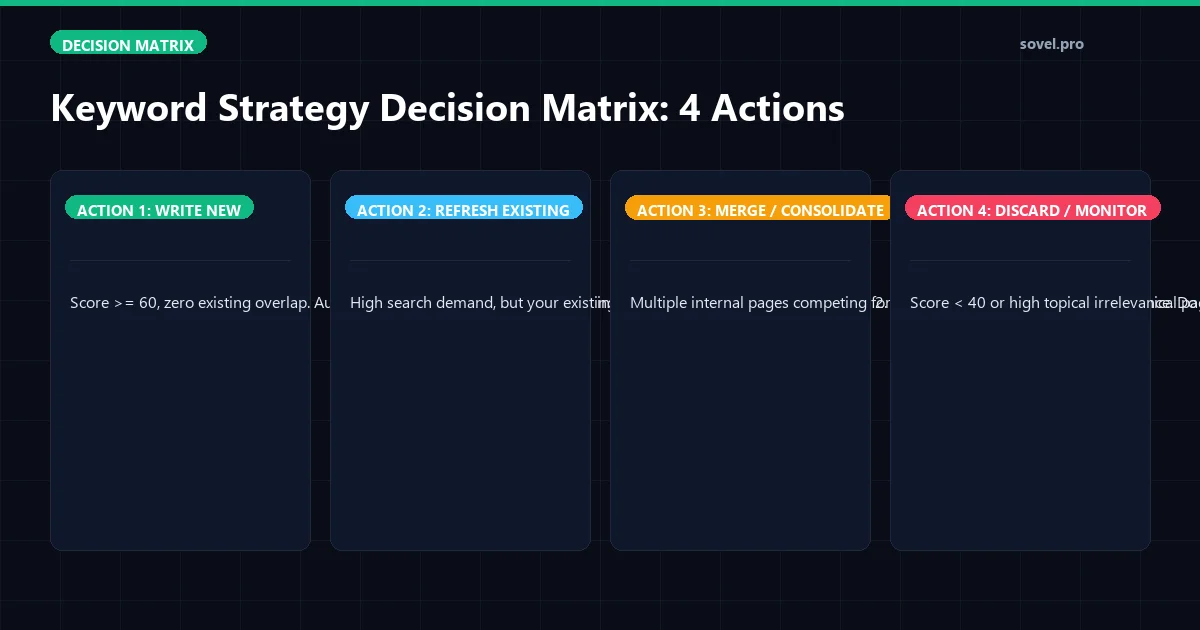
The keyword strategy decision matrix translates research findings into clear, prioritized publishing actions.
When you evaluate competitor weaknesses objectively, you learn to identify topics where your domain can realistically capture organic market share without requiring months of outreach or thousands of backlinks.
Rule 6: Maintain Data Provenance from Seed Query to Final Brief
In traditional marketing teams, the reasoning behind keyword decisions is forgotten within weeks of publication. An editor approves a topic, a freelance writer drafts an article, and six months later nobody remembers why the piece was written or what specific search intent it was intended to serve.
An evidence based seo keyword strategy requires full data provenance. Every content brief produced by the Content Gap Finding Engine stores the initial seed query, the source adapters that detected it, the competitor URLs analyzed, the opportunity score formula, and the date the signals were verified. This transparent record ensures that your content library remains defensible, auditable, and easy to update over time.
Rule 7: Build Evergreen Content Roadmaps Immune to Algorithm Volatility
Search engines regularly release core algorithm updates designed to penalize low-effort content, programmatic link spam, and superficial AI-generated text. Sites that rely on speculative keyword hacks frequently suffer catastrophic traffic drops during these updates. By contrast, an evidence based seo keyword strategy produces robust, evergreen assets that gain search authority over time.
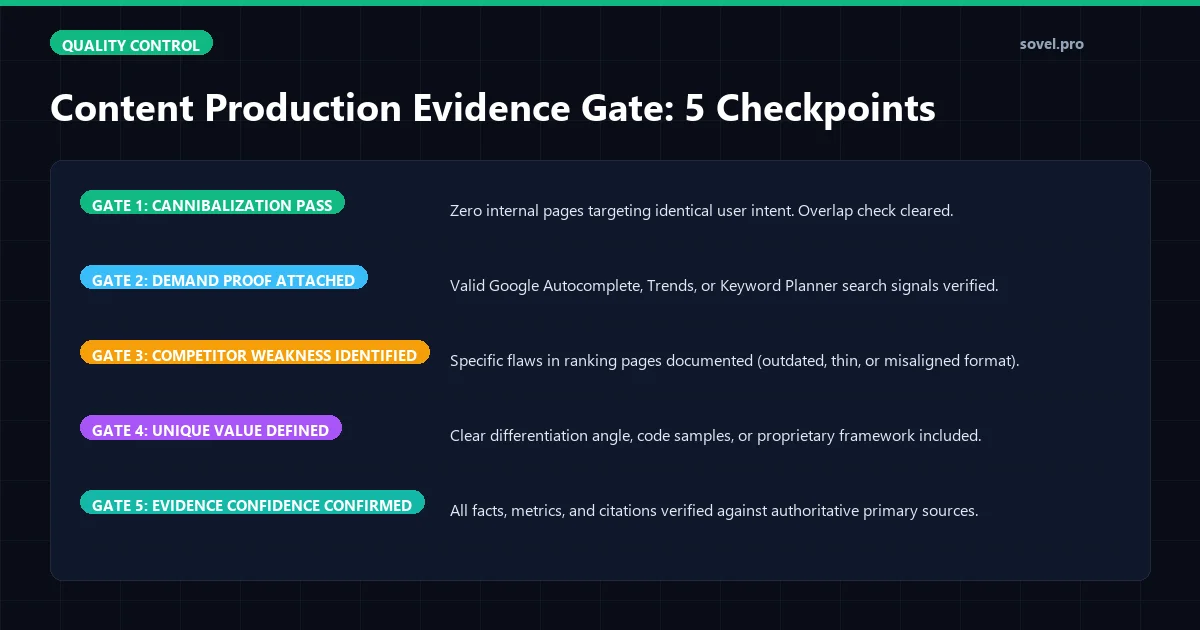
Five strict quality checkpoints verify every topic before production resources are committed.
When every article in your catalog addresses verified user demand, provides original utility, avoids internal competition, and respects content guidelines documented by Google Search Central, algorithmic updates consistently reward your domain with higher visibility and improved rankings.
How the Content Gap Finding Engine Enforces Evidence Discipline
Executing an evidence-based strategy by hand across hundreds of candidate topics requires immense operational discipline. The Content Gap Finding Engine automates this entire methodology into an offline, local Python pipeline.
Operating entirely on your local machine with standard library modules, the engine runs 79 diagnostic unit tests, coordinates ten search adapters, and exports defensible Markdown and PDF reports. It calculates weighted opportunity scores, checks existing sitemaps for cannibalization, and outputs complete writer-ready briefs with full provenance attached.
For independent publishers, SEO professionals, and software founders, the Content Gap Finding Engine provides an enterprise-grade research engine for a single one-time payment of Rs 2,999, completely eliminating recurring software subscriptions.
The Mathematical Formula Behind Opportunity Scoring
A core pillar of an evidence based seo keyword strategy is removing guesswork through objective scoring algorithms. Rather than having writers argue subjectively over which article to write next, the Content Gap Finding Engine evaluates every candidate keyword using a weighted multi-factor formula that yields an Opportunity Score between 0 and 100.
The mathematical weighting model balances four critical dimensions:
- Topic Relevance (Weight: 25%): Evaluates semantic alignment with your core domain architecture, existing topical authority clusters, and audience profile.
- Search Demand Evidence (Weight: 20%): Calculated from observed search frequency, Google Autocomplete modifier depth, and People Also Ask question velocity.
- Competitor Weakness (Weight: 20%): Assesses the lack of comprehensive answers, outdated publish dates, and format mismatch in the current top five organic search results.
- Conversion and Commercial Fit (Weight: 35%): Measures direct synergy with your digital products, software tools, or affiliate monetization paths.
By applying this transparent formula, an evidence based seo keyword strategy guarantees that every score represents a balanced evaluation of market demand, competitive opportunity, and commercial value.
Executing the Automated 79-Test Diagnostic Suite
To ensure that research signals remain completely accurate and uncorrupted, an evidence based seo keyword strategy must rely on verified technical infrastructure. The Content Gap Finding Engine includes a comprehensive test suite of 79 automated unit tests that verify every adapter, evidence classifier, and scoring calculation before you conduct research.
Publishers run this verification command directly in their terminal:
cd 01_ENGINE
python -W ignore -m unittest discover -s tests -v
When all 79 tests pass with an OK verdict, you have cryptographic assurance that your local adapters are parsing Google Autocomplete, Trends, and community signals accurately. This rigorous technical foundation is what elevates an evidence based seo keyword strategy above subjective keyword brainstorming.
Frequently Asked Questions About Evidence-Based SEO Strategy
What makes an evidence-based keyword strategy different from traditional SEO?
Traditional SEO relies heavily on third-party volume estimates, subjective brainstorming, and black-box difficulty scores. An evidence based seo keyword strategy uses observable primary search data, verifies source provenance, separates potential from confidence, and enforces mandatory internal cannibalization checks before writing.
How does evidence confidence affect my publishing schedule?
Topics with verified demand and high opportunity scores form your immediate core publishing queue. Topics with promising commercial intent but estimated evidence confidence are slated for secondary investigation or quick proof-of-concept tests rather than heavy upfront investment.
Can I apply this strategy if my website is brand new?
Yes. Brand-new websites benefit most from an evidence based seo keyword strategy because they cannot afford to waste time or capital publishing articles that fail to rank. By targeting verified long-tail search gaps with low competitor depth, new sites build initial topical authority rapidly.
How does this strategy connect with software and book publishing?
Evidence-based discovery applies across all digital assets. For software creators, it informs feature specifications and documentation in the AI Engineering OS. For authors, it identifies unfilled market niches and reader pain points inside the Book Creation Engine.
How do I know when an existing article needs to be refreshed?
When an internal overlap check reveals that an existing URL is already ranking on page two or three for your target keyword, refreshing that page with updated evidence and deeper explanations is faster and more effective than publishing a competing new article.
Conclusion: Transforming Editorial Guesswork Into Predictable Organic Growth
Organic search success is not a mystery, nor is it dependent on expensive monthly software subscriptions. By establishing an evidence based seo keyword strategy, you ground every editorial decision in verifiable search demand, objective competitor analysis, and disciplined internal architecture.
Whether you manage an editorial team or publish content independently, the principles of evidence classification, opportunity scoring, and cannibalization prevention protect your publishing investments and drive lasting organic traffic.
To implement this framework on your own site, deploy the Content Gap Finding Engine today. Deepen your strategic understanding by reading our companion articles on content gap analysis, keyword research without paid tools, and executing a professional cannibalization check before every editorial sprint.