
Token depletion resume protocol architecture is an indispensable engineering mechanism for anyone executing long-form generative workloads with artificial intelligence models. When generating thousands of lines of code or drafting a 50,000-word book, network timeouts, API rate limits, model token context exhaustion, and transient terminal crashes are not rare anomalies; they are guaranteed operational occurrences. Without a deterministic token depletion resume protocol, an unexpected disconnection midway through Chapter 11 wipes out active memory, corrupts output files, and forces operators to manually reconstruct lost paragraphs.
To build production-grade publications and digital applications, engineers must implement persistent state boundaries. The token depletion resume protocol decouples the ephemeral inference session from the persistent project ledger. By recording every completed subsection, word count delta, and character reference in an immutable local database, this protocol ensures that when an interruption occurs, the author or agent can resume execution instantly from the exact token boundary where execution paused.
The Mechanics of Context Exhaustion in Long Generations
To understand why a token depletion resume protocol is necessary, one must examine how large language models handle memory buffers during extended generation tasks. Most language models process tokens through an attention mechanism with strict input and output limits:
1. Hard Context Ceilings
Every language model possesses a maximum context window (such as 128,000 or 200,000 tokens). While this appears vast, token consumption accelerates non-linearly when processing source dossiers, style guides, character registries, and previous chapter drafts simultaneously. When an external call exceeds the token window, the API returns a context overflow error and immediately terminates generation. A token depletion resume protocol catches this condition, truncates extraneous conversational history, and restores drafting using only necessary state artifacts.
2. Provider Rate Limits and Mid-Stream Dropped Packets
Commercial API endpoints enforce strict tokens-per-minute (TPM) and requests-per-minute (RPM) constraints. During rapid multi-agent drafting passes, high generation velocity frequently triggers HTTP 429 (Too Many Requests) errors. In traditional scripts, an unhandled rate limit crash causes the script to abort, leaving half-written files with syntax errors. A token depletion resume protocol traps rate-limit exceptions, applies exponential backoff, and resumes drafting from the exact sentence where the stream ceased.
3. State Drift Caused by Naive Restarts
When creators lack an automated token depletion resume protocol, their default response to an error is re-running the entire prompt from the beginning. This naive retry strategy is disastrous: it consumes expensive API tokens needlessly, introduces fresh inconsistencies, and overwrites carefully reviewed sections with newly generated variations. An engineered token depletion resume protocol strictly forbids starting over, enforcing forward-only progression.
The Architectural Pillars of the Protocol
An industrial token depletion resume protocol relies on four core technical pillars operating on the local workstation:
Pillar 1: Local SQLite State Ledger
Instead of relying on fragile JSON files or memory caches, the token depletion resume protocol records project state inside a local SQLite database utilizing Write-Ahead Logging (WAL) in accordance with SQLite WAL Documentation. SQLite provides atomic transactions (ACID compliance), ensuring that even a sudden power loss cannot corrupt the project database.
The ledger schema tracks:
* project_id: Unique project identifier
* chapter_index: Current active chapter (1 to 15)
* subsection_index: Current active subsection (for example, 4.2)
* target_word_floor: Mandatory minimum words required
* accumulated_words: Validated word count produced so far
* last_paragraph_hash: SHA-256 hash of the final approved paragraph
* session_status: DRAFTING, INTERRUPTED, AUDITED, or LOCKED
Pillar 2: Atomic Checkpoint Commits
The token depletion resume protocol commits progress to disk after every approved paragraph. When the execution agent generates a block of prose, the text is evaluated by an inline AST and regex validator. If the paragraph complies with tone rules and contains no prohibited claims, the text is appended to the chapter file and the SQLite ledger updates atomically. If the system crashes five seconds later, the exact state remains preserved.
Pillar 3: Context-Slicing Resume Controller
When restarting after an interruption, the token depletion resume protocol does not pass the entire book into the model prompt. Instead, it reads the SQLite database, extracts the last approved paragraph, and constructs a precise resumption prompt:
This surgical context slicing minimizes token overhead and guarantees that the drafting model picks up the narrative thread without awkward transitions or repeated ideas.
Pillar 4: Idempotent Regeneration Safeguards
The token depletion resume protocol guarantees idempotency (an operation that produces the same result no matter how many times it is executed). If a subsection generation is interrupted halfway, the protocol detects the incomplete trailing sentence, trims it back to the last valid punctuation mark, and resumes from that verified milestone.
Integrating the Protocol with Cline, OpenCode, and VS Code Workspaces
Deploying the token depletion resume protocol within modern developer environments like Visual Studio Code provides unmatched development velocity. When operating autonomous extensions like Cline or OpenCode, the developer does not need to manually babysit generation streams:
- Workspace Boundary Enforcement: The protocol operates as a local background daemon. It monitors file write events inside the
/chapters/folder. Every time the autonomous agent appends 500 words to an active chapter, the daemon computes cryptographic hashes and logs checkpoints into the SQLite ledger. - Autonomous Tool Hooks: When an API error occurs, the extension catches the socket termination event and invokes the protocol resume routine. The resume script queries the local SQLite database, formats the surgical resumption context, and provides it directly back to the autonomous agent.
- Decoupled LLM Providers: The token depletion resume protocol works agnostically across multiple provider endpoints. If an OpenRouter rate limit exhausts your allowance on one model family, the protocol allows you to switch provider credentials instantly and resume drafting using an alternative model without losing a single paragraph of previously generated prose.
This local IDE setup ensures that large book production runs or multi-file software projects proceed smoothly even during extended overnight generation sprints.
Real-Time Terminal Monitoring: Catching HTTP 429 and Stream Anomalies
During high-speed multi-agent production runs, network conditions between your local workstation and remote inference servers are rarely static. The token depletion resume protocol incorporates active stream inspection to detect connection anomalies before files become corrupted:
* HTTP 429 Backoff Logic: When an external inference server returns a rate-limit error, the protocol pauses execution, calculates an exponential backoff interval (such as 4 seconds, 8 seconds, or 16 seconds), and re-attempts connection without human intervention.
* Truncated JSON Recovery: If an API stream terminates abruptly midway through an output token sequence, standard JSON parsers crash with unhandled exception errors. The protocol intercepts incomplete streaming buffers, strips malformed trailing bytes, and re-establishes socket communication.
* Word Floor Synchronization: The protocol continuously compares accumulated words against the chapter minimum threshold. If a network interruption occurs when a chapter is at 2,800 words of a 3,300-word budget, the resume controller calculates the exact remaining delta (500 words) and configures the resumption prompt accordingly.
This active stream monitoring ensures that transient server hiccups never escalate into project-halting errors.
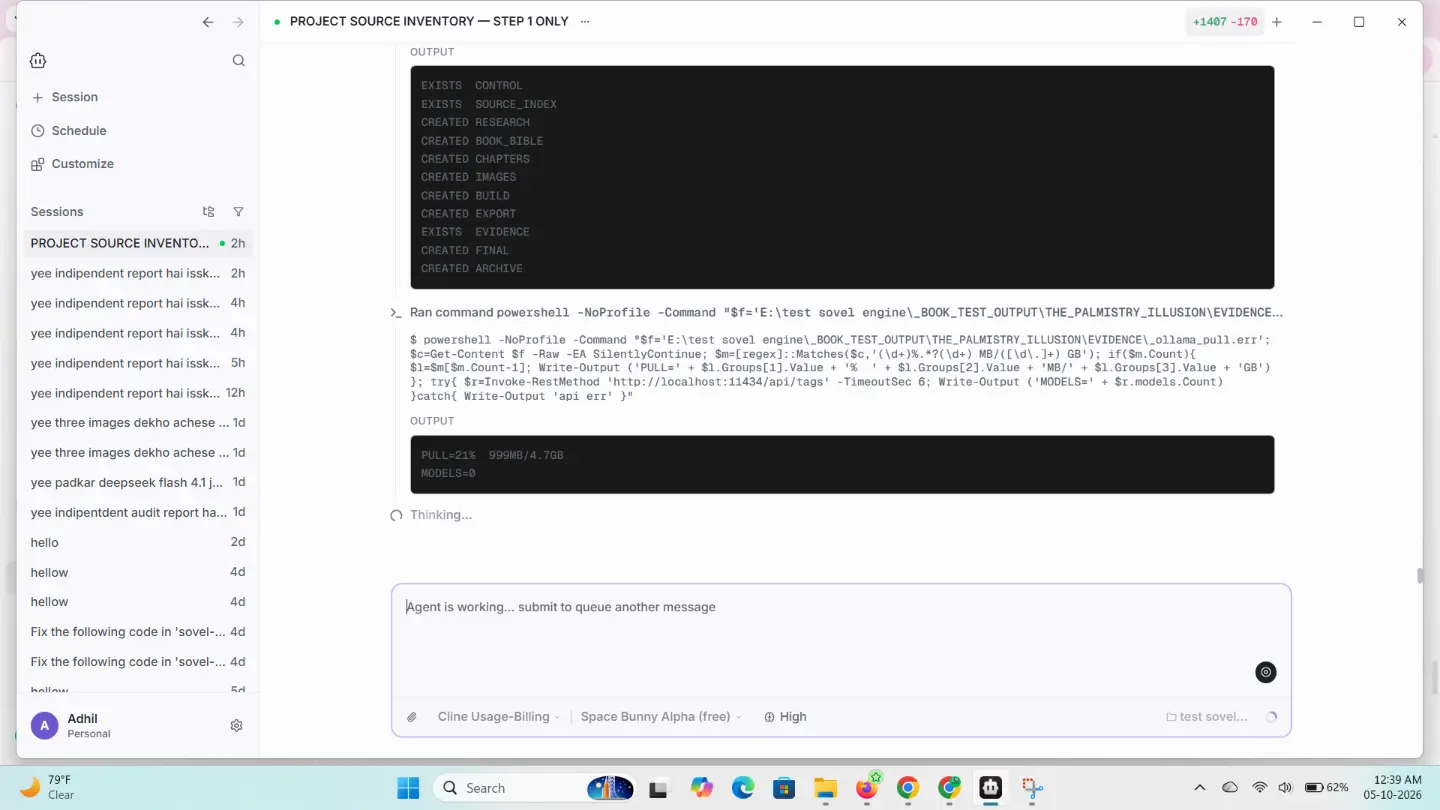
Real Benchmark: Surviving Stage 12 Interruption in The Palmistry Illusion
The necessity and reliability of the token depletion resume protocol were demonstrated during the live benchmark production of *The Palmistry Illusion* by P. Adhil Khan. The goal was authoring 50,321 core words across 15 chapters in under 8 hours.
During Stage 12 of the production sprint, an external API connection timed out while drafting Chapter 11 (which analyzed cognitive confirmation bias in fortune-telling forecasts). Over 2,400 words had been drafted in that sprint.
In an unengineered workflow, this failure would have caused severe data loss:
- The terminal process would have crashed.
- The partial text in memory would have vanished.
- The author would have been forced to re-prompt Chapter 11 from scratch, creating narrative divergence.
Because the token depletion resume protocol was active, the failure was completely non-destructive:
* The protocol detected the socket disconnection instantly.
* The SQLite ledger logged session_status = INTERRUPTED at Chapter 11, Subsection 11.3.
* The resume controller triggered an automated re-connect with exponential backoff.
* Drafting resumed 8 seconds later from the exact paragraph boundary.
* Chapter 11 finished with 3,420 core words, passing its Stage 14 floor gate with zero human intervention.
This real-world test proves that an engineered token depletion resume protocol is mandatory for anyone deploying autonomous agents for serious production tasks.

Comparing Transient Memory Queues vs Persistent SQLite Ledgers
Many initial attempts at building an automated drafting pipeline fail because developers rely on in-memory message queues or flat JSON configuration files. When handling hundreds of API requests across multi-hour drafting sessions, in-memory structures present critical operational vulnerabilities:
- Process Isolation Vulnerabilities: If an autonomous agent script running in Node.js or Python encounters an uncaught memory allocation error or unhandled promise rejection, the process terminates immediately. Everything stored in variables, memory dictionaries, or active streams is lost permanently. A SQLite ledger operating with Write-Ahead Logging writes every transaction directly to operating system pages on disk, isolating your project state from process lifecycle crashes.
- Concurrent Write Lock Contention: Flat JSON files do not support transactional locking. If two agent tasks attempt to update chapter word counts simultaneously, file write operations collide, truncating the JSON file and corrupting the entire project index. A local SQLite database manages concurrency automatically through file locks and serialized commits, allowing multiple background workers to record progress without write contention.
- Query Performance at Scale: Scanning a 50,000-word manuscript stored inside a massive JSON document requires parsing megabytes of serialized strings on every loop. A normalized SQLite ledger retrieves specific chapter hashes, sentence boundaries, and word count deltas in under 2 milliseconds through indexed B-tree lookups.
Automated Rollback and AST Verification on Resumed Slices
A reliable token depletion resume protocol does not merely resume generation; it validates the integrity of the previous slice before continuing. When a network connection drops mid-token, the trailing string often contains incomplete Markdown syntax, broken code blocks, or dangling punctuation marks.
The protocol executes a three-step sanitization routine prior to dispatching the next prompt:
* Trailing Syntax Pruning: The protocol inspects the final 500 characters of the interrupted text. If an open backtick block, unclosed quotation mark, or uncompleted parenthesis is identified, the parser prunes the text back to the last clean sentence boundary ending with a terminal period.
* Abstract Syntax Tree (AST) Inspection: The pruned subsection is passed through a Markdown AST parser. This ensures that heading hierarchies, list structures, and citation formats comply strictly with publication requirements before the chapter ledger marks the segment as verified.
* Boundary Context Injection: Once the preceding slice is validated, the protocol computes its cryptographic hash and injects the verified ending directly into the resumption envelope. The drafting agent receives unambiguous instructions describing exactly where previous text ended and where new generation must commence.
Implementing the Protocol: A Complete Python Reference
To implement a token depletion resume protocol in your local development environment, you can deploy this lightweight, production-ready Python checkpoint manager:
When incorporated into your drafting loop, this protocol ensures that every token generated contributes permanently toward your project completion.
Commercial Licensing: Three Production Editions
The SOVEL Omni-Agent Engine includes the token depletion resume protocol out of the box across three commercial licensing editions on sovel.pro:
* Personal Edition (Solo Creator License): Rs 4,999 one-time payment. Ideal for individual writers publishing on Amazon KDP. Includes full 16-stage pipeline access and automated checkpointing for 1 local workstation.
* Pro Developer Edition (Commercial License): Rs 8,999 one-time payment. Built for software engineers and digital creators building SaaS tools, plugins, and full-length books. Includes AST validation, SQLite WAL recovery, and support for 2 workstations.
* Agency Suite (Commercial Client License): Rs 19,999 one-time payment. Designed for marketing studios delivering complete publishing packages. Includes 5 workstation licenses, white-label client kits, and 20 master prompt contracts.
You can also test the photorealistic 3D reading experience using the SOVEL RealFlip interactive book viewer.
Frequently Asked Questions
What is the primary purpose of a token depletion resume protocol?
The token depletion resume protocol saves exact generation progress to a local SQLite database after every paragraph. If an API rate limit, network timeout, or system crash interrupts drafting, the system resumes execution from the exact point of stoppage without losing data or starting over.
Does the protocol require an internet connection to maintain state?
No. State management is completely local. The SQLite database runs on your own hard drive, ensuring that state persistence works even if you lose external internet connectivity.
How does the token depletion resume protocol prevent repetitive text after a restart?
The protocol sends the model the exact hash and text of the final approved sentence along with an explicit instruction to continue drafting forward. It never feeds entire completed chapters back into the context window, eliminating duplicate prose.
Can the protocol handle long books with more than 50,000 words?
Yes. Because state is partitioned into discrete chapter and subsection records, the protocol scales to multi-volume series or massive technical manuals without degrading performance.
Is SQLite fast enough to handle frequent checkpoint commits during fast streaming?
Yes. By utilizing Write-Ahead Logging (WAL mode), SQLite executes atomic commits in single-digit milliseconds, allowing real-time state tracking without slowing down token throughput.
How does this protocol help agencies delivering client publications?
It eliminates costly failed generation runs. Agency operators can execute long drafting sprints overnight with complete confidence that rate limits or transient errors will resolve automatically without manual intervention.
Where can I acquire the token depletion resume protocol?
The protocol is built directly into the SOVEL Omni-Agent Engine available on sovel.pro, giving authors and developers enterprise-grade state recovery for all digital publishing projects.