
prompt contract architecture for ai development represents the essential engineering methodology that transforms erratic natural language prompting into reliable, deterministic software and publishing pipelines. In conventional conversational artificial intelligence workflows, developers issue informal text instructions and hope the underlying model produces valid code or coherent prose. Across large projects involving multiple files or full-length manuscripts, this informal approach breaks down rapidly: models introduce unexpected formatting variations, hallucinate unapproved library dependencies, and omit critical business logic. A prompt contract architecture for ai development replaces conversational ambiguity with explicit, enforceable data contracts that govern model inputs, execution boundaries, and output syntax.
By adopting a disciplined prompt contract architecture for ai development, engineering teams condense the traditional 70-hour trial-and-error development cycle into a structured 8-hour production sprint while ensuring that every generated artifact adheres strictly to production specifications.
Why Conversational Prompting Fails in Production
To understand why prompt contract architecture for ai development is indispensable, consider how large language models interpret unconstrained instructions. Generative models operate through probabilistic token sampling. When prompted with conversational instructions such as “Write a clean user registration module,” the model must guess dozens of unstated architectural parameters:
- Underspecified Schema Boundaries: The model might format output as raw Python, wrapped Markdown, or partial pseudocode. Without an explicit contract, automated downstream parsers crash upon receiving unexpected string wrappers.
- Implicit Dependency Injection: Generative agents routinely invent external library requirements or rely on deprecated API calls that fail during runtime compilation.
- Context Hallucination: In multi-stage workflows, models lose track of previously declared variables, modifying function signatures or altering database schemas without warning.
A prompt contract architecture for ai development solves these problems by treating artificial intelligence models like remote microservices. Just as modern distributed systems require formal REST or gRPC contracts to communicate safely across boundaries, generative systems require rigorous prompt contracts to constrain model behavior.
This core methodology powers the SOVEL Omni-Agent Engine, where models are prohibited from improvising project structure and are constrained to operate within immutable architectural contracts.
The Five Structural Pillars of a Prompt Contract
A production-grade prompt contract architecture for ai development is built upon five foundational pillars that isolate, constrain, and validate generative workflows:
1. Explicit Role and Authority Scoping
The prompt contract establishes the exact operational role of the agent, defining whether it functions as a drafting worker, an AST syntax checker, or an editorial auditor. Crucially, the contract defines what the model is *prohibited* from doing, preventing a drafting agent from modifying project architecture or altering database schemas.
2. Immutable Context Ingestion Boundaries
Instead of passing uncontrolled conversational histories that consume tokens and cause attention degradation, the prompt contract architecture for ai development defines an exact input envelope. Only documents explicitly mapped to the active task (such as a specific database schema or chapter research dossier) are injected into the context window.
3. Machine-Verifiable Output Schemas
The contract mandates strict output formatting using industry standards such as JSON Schema Specifications or CommonMark Markdown Specifications. Natural language commentary (such as “Certainly, here is your code:”) is banned at the contract level, requiring pure structured data or clean Markdown prose.
4. Deterministic Pre-Execution and Post-Execution Assertions
Every prompt contract includes automated validation scripts that evaluate generated artifacts before committing changes to disk. If an output violates an abstract syntax tree rule or fails a word count floor, the contract rejects the output and triggers automated remediation.
5. Cryptographic State Ledgering
Every successful transaction executed under a prompt contract is hashed and recorded in a local SQLite database, establishing a tamper-proof audit trail of project progression.
Implementing Prompt Contracts: The Anatomy of a Specification
To see prompt contract architecture for ai development in action, examine the structural anatomy of an industrial prompt contract used for software module generation:
When an autonomous agent receives instructions encapsulated inside this prompt contract architecture for ai development, ambiguity is eliminated. The model cannot produce conversational pleasantries, cannot introduce dangerous hashing functions, and cannot invent database column names because every parameter is explicitly locked.
The Closed-Loop Communication Cycle: Human, Director, and Worker
A major advancement enabled by prompt contract architecture for ai development is the decoupling of strategic direction from tactical execution. In standard chat sessions, a human developer attempts to manage both simultaneously, leading to cognitive fatigue.
An engineered prompt contract architecture for ai development deploys a three-tier communication hierarchy:
- The Human Creator (Executive Authority): Defines the high-level project vision, reviews audit scores, and holds ultimate commercial approval rights.
- The Custom Instruction Director Agent (Contract Architect): Ingests project requirements, formulates formal prompt contracts, configures boundary constraints, and verifies incoming artifacts.
- The Autonomous Execution Worker (Tactical Compiler): Operates within a local developer environment (such as Cline, OpenCode, Claude Code, Cursor, or Antigravity) to execute bounded contracts without improvising architecture.
When the worker finishes an execution pass, the director agent validates the artifact against the prompt contract. If an error is detected, the director issues a surgical correction prompt. Once verified, the director issues the contract for the subsequent task, allowing the human creator to oversee complex builds with complete peace of mind.

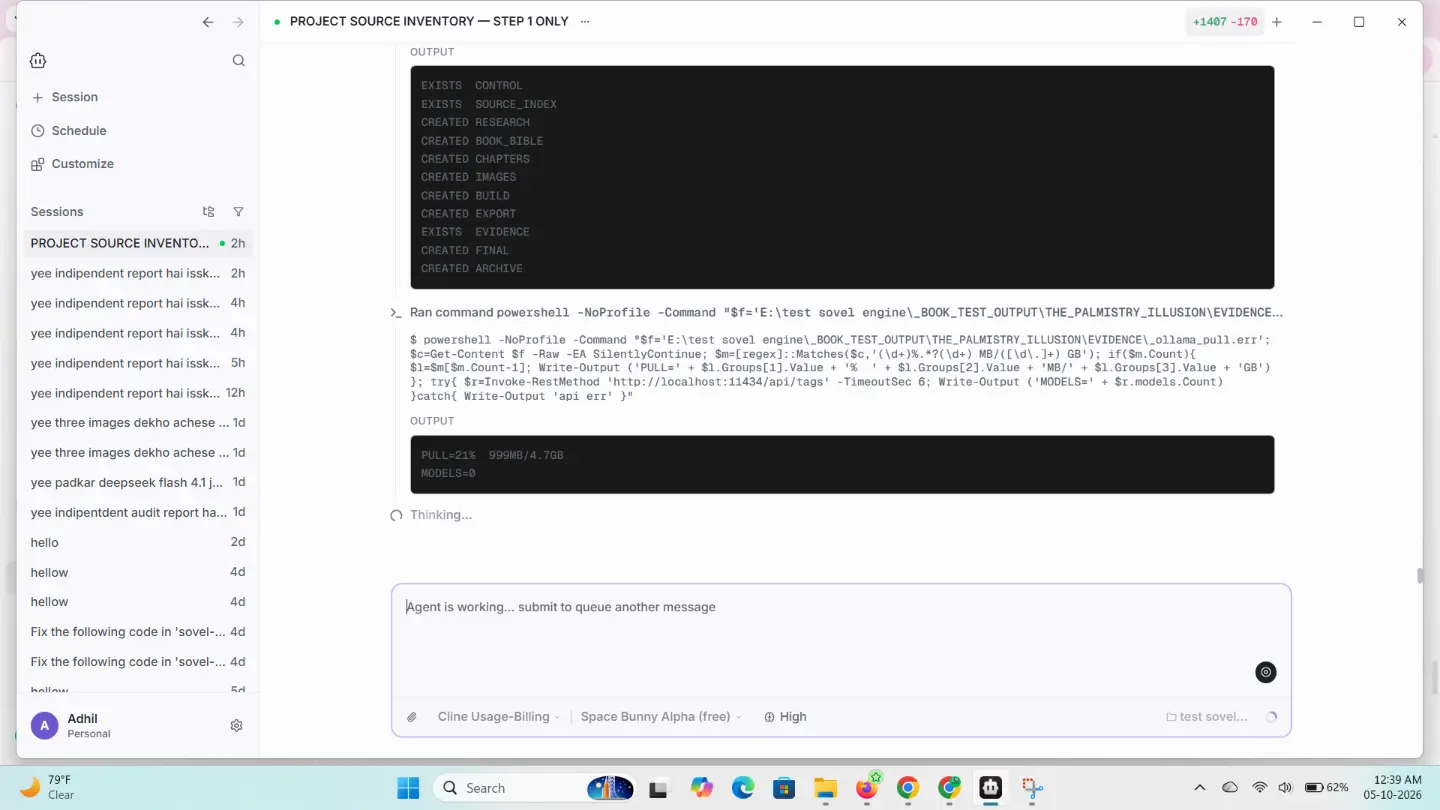
Real Benchmark: Executing 20 Prompt Contracts in The Palmistry Illusion
The immense power of prompt contract architecture for ai development was demonstrated during the controlled publication of *The Palmistry Illusion: What History, Biology, Psychology, and Evidence Reveal About the Lines on Your Hand*, authored by P. Adhil Khan.
To author a dense, 50,321-word academic critique across 15 chapters without a single factual error or broken reference, the project was governed by 20 sequential master prompt contracts (spanning Stages 00 through 18):
* Stage 01 Contract (Source Ingestion): Bound 32 primary research studies into immutable markdown evidence files.
* Stage 04 Contract (Structural Lock): Froze the 15-chapter table of contents, prohibiting models from altering titles or rearranging chapters.
* Stages 07 through 13 Contracts (Governed Drafting): Issued 15 discrete chapter drafting contracts, each specifying an exact mathematical word floor (such as 3,200 words) and locking specific empirical citations.
* Stage 17 Contract (Independent Audit): Subjected the compiled manuscript to an independent third-party audit model, verifying word counts, EPUBCheck compliance, and citation integrity.
Governed by this prompt contract architecture for ai development, the 50,321-word core manuscript was drafted and validated in 3 hours, with 2 additional hours dedicated to image testing and figure binding, completing the 133-page publication in 5 hours. The independent audit granted the release package a rating of PASS WITH NON-BLOCKING ISSUES and an engineering score of 9.5 out of 10.
Automated Verification: AST Parsers and Schema Validators
A prompt contract is only as effective as the automated validation tools that enforce it. In a modern prompt contract architecture for ai development, verification scripts execute in milliseconds on the local workstation before generated code is executed or written to disk:
* AST Parsing for Code: Verifies syntax trees in Python, JavaScript, or PHP, catching broken brackets, syntax errors, and undeclared variables instantly.
* JSON Schema Evaluation: Validates structured API responses against formal schema contracts, ensuring required fields and data types match specifications.
* Lexical and Word Budget Scans: Inspects generated prose to verify that paragraph lengths, subsection word floors, and vocabulary diversity meet contractual thresholds.
* Security and Injection Linters: Scans source code for unescaped user inputs, raw SQL strings, and insecure authentication routines.
Automating these validations ensures that your prompt contract architecture for ai development catches defects immediately at the boundary rather than allowing errors to compound across downstream tasks.
Comparing Loose Conversational Prompting vs Formal Prompt Contracts
To understand why development teams achieve 10x higher reliability with formal contracts, examine how each approach handles critical engineering constraints:
| Governance Dimension | Conversational Prompting | Prompt Contract Architecture |
|---|---|---|
| Input Scoping | Uncontrolled chat context with accumulating history | Surgical input envelopes containing only task-specific files |
| Output Syntax | Probabilistic text with conversational preamble | Strict JSON or Markdown with AST syntax enforcement |
| Word Budget Control | Vague suggestions routinely ignored by models | Mathematical floor gates that reject short drafts automatically |
| Dependency Handling | Hallucinated external packages and deprecated functions | Whitelisted dependencies locked to exact library versions |
| Failure Recovery | Manual prompt retries causing narrative drift | Deterministic state recovery with exact sentence continuation |
| Audit Verification | Subjective human scanning prone to fatigue | Independent multi-model audits with scored pass criteria |
The Lifecycle of a Production Prompt Contract
Operating a prompt contract architecture for ai development involves a disciplined four-stage lifecycle for every project task:
- Contract Formulation: The custom instruction director agent ingests project specifications and compiles the contract schema. It binds input files, establishes word counts or syntax standards, and defines explicit claim prohibitions.
- Worker Execution: The execution worker processes the contract inside a local editor workspace. It generates code or prose strictly bounded by the declared parameters.
- Automated Assertion Testing: Local validation scripts inspect the generated output against the contract specification. If an AST syntax error or word floor deficit occurs, the contract fails immediately and generates an automated remediation directive.
- Cryptographic State Commit: Once the output satisfies all assertions, the contract engine computes a SHA-256 hash of the verified artifact and records the completed milestone into the local SQLite state database.
This deterministic four-stage lifecycle guarantees that every completed step represents an immutable, production-ready milestone.
Production Python Reference: The Contract Enforcement Engine
To deploy a prompt contract architecture for ai development within your local environment, you can use this production-ready Python contract validator:
Integrating this validator into your developer scripts ensures that your prompt contract architecture for ai development intercepts non-compliant generations immediately before they can contaminate your repository.
Integrating Contracts into VS Code and Local Toolchains
In practice, deploying a prompt contract architecture for ai development does not require complex cloud infrastructure. Developers configure local agent extensions (such as Cline, OpenCode, or Claude Code) to read contract files stored directly inside the repository:
- Directory Structure: Store contracts in a dedicated
/contracts/folder with clear versioned names (such ascontract-01-auth.jsonorcontract-08-chapter08.json). - Environment Variable Injection: Bind API endpoints and model parameters using local environment files, keeping external credentials secure.
- Terminal Feedback Integration: When a contract fails, output the validation report directly into the agent terminal. The execution worker reads the error log, applies the required correction, and re-submits the artifact automatically.
This local workflow turns your code editor into an automated manufacturing facility where software modules and book chapters are assembled with mathematical precision.
Commercial Licensing: Three Production Editions
The SOVEL Omni-Agent Engine includes 20 pre-configured master prompt contracts across three commercial licensing editions available on sovel.pro:
* Personal Edition (Solo Creator License): Rs 4,999 one-time payment. Designed for individual non-fiction authors and researchers self-publishing on Amazon KDP. Includes full 16-stage pipeline access, structural lock contracts, and word floor gates for 1 local workstation.
* Pro Developer Edition (Commercial License): Rs 8,999 one-time payment. Built for software engineers and digital creators building SaaS tools, custom plugins, and full-length books. Includes AST validation contracts, Token Depletion Resume Protocol, code generators, and dual-workstation support.
* Agency Suite (Commercial Client License): Rs 19,999 one-time payment. Built for digital agencies and publishing consulting studios delivering end-to-end client applications and books. Includes 5 workstation licenses, white-label client kits, Statement of Work templates, and 20 master prompt contracts.
You can also evaluate our photorealistic 3D interactive reading interface using SOVEL RealFlip to see how contract-governed books display on modern websites.
Frequently Asked Questions
What is the main benefit of a prompt contract architecture for ai development?
A prompt contract architecture for ai development eliminates model hallucination and syntax errors by enforcing strict schema contracts, input boundaries, and automated validation tests around artificial intelligence models.
How does a prompt contract differ from standard prompt engineering?
Standard prompt engineering relies on descriptive advice in conversational text. A prompt contract operates as a formal software interface with machine-verifiable constraints, input-output schemas, and automated validation scripts.
Can prompt contracts be used for both code generation and book writing?
Yes. In code development, prompt contracts enforce AST syntax rules and security linters. In book authoring, prompt contracts enforce mathematical word count floors, claim prohibition registers, and primary citation locks.
What tools are needed to execute prompt contracts locally?
You can execute prompt contracts using local development environments such as VS Code paired with extensions like Cline or OpenCode, supported by Python validation scripts and SQLite state databases.
How does a prompt contract prevent security vulnerabilities in code?
By banning dangerous functions (such as raw database concatenation) and mandating parameterized queries and permission checks directly inside the contractual constraints.
How do prompt contracts speed up development from 70 hours to 8 hours?
By eliminating manual debugging and failed generation runs. When models operate within strict contracts, every generated file works on the first attempt, compressing development time dramatically.
Where can I acquire pre-built prompt contracts for commercial projects?
The SOVEL Omni-Agent Engine available on sovel.pro includes 20 production-tested master prompt contracts ready for immediate deployment. Every contract comes with complete JSON schemas, input boundary definitions, and automated Python validation suites to help teams build books, plugins, and software utilities without code failures.