
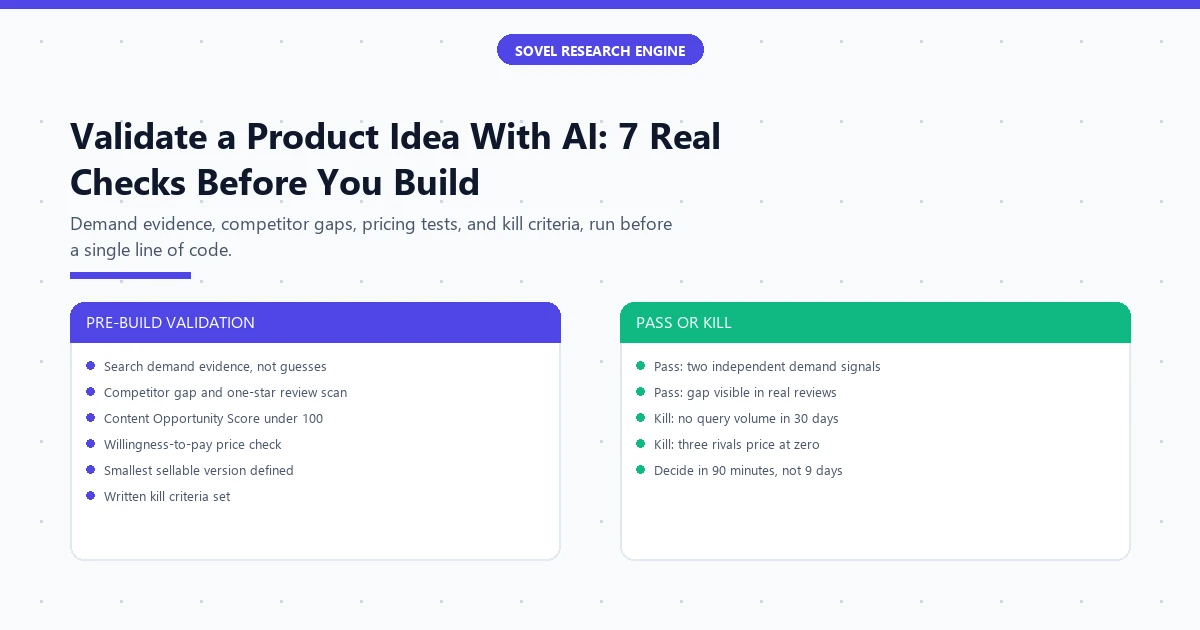
Validate a product idea with AI before you spend a month building it, and you skip the most common failure in no-code software: a finished tool nobody asked for. Most first-time builders pick an idea they like, build it fast with modern coding agents, launch it to silence, and then wonder whether their marketing failed. The marketing did not fail. The idea never had buyers. The short answer: to validate a product idea with AI, collect search demand evidence, scan competitor gaps and one-star reviews, compute a demand score, test price willingness, and write kill criteria first, all inside one 90-minute run. Ideas that pass at least five of the seven checks below deserve your build week. Ideas that fail three or more should be shelved, and the scorecard tells you exactly why.
Why do most AI-built products fail before launch?
Building got cheap, so choosing got expensive. Three years ago a simple web tool cost weeks of developer time, which forced a slow decision. Today a coding agent scaffolds the same tool in an afternoon, so builders skip the decision entirely and start typing prompts. Speed feels like progress, but it only hurries you toward a launch nobody attends.
The pattern repeats in every indie forum. A builder ships a neat habit tracker, a PDF utility, or a niche calculator, posts it twice, gets eleven visitors, and concludes that distribution is the problem. Distribution is rarely the problem at that stage. The tool answers a question nobody typed into Google, or it answers one that three free rivals already answer. To validate a product idea with AI means checking this before the build, with evidence you can point at, not with a feeling you hope is right.
A practical test: open an incognito window and search the exact problem your tool solves. If the first page holds established tools with thousands of reviews, you need a visible gap to survive there. If the first page holds forum threads asking for a solution, that is demand waiting for supply. Read how a complete digital product ships in 8 hours only after this check passes, because fast building multiplies whatever the idea was worth, good or bad. Builders who start from a market gap instead of a hunch begin with buyers already half-convinced.
How do you validate a product idea with AI in 7 checks?
Run these checks in order, and give each one a pass or fail on a single page. The order matters because each check is cheaper than the next: search data costs minutes, review reading costs a lunch break, and building costs a week. Most ideas die at check two or three, which is the whole point. A fast no is worth more than a slow maybe.
Check 1: search demand. Collect 10 to 20 queries a buyer would type, then look up their monthly volume with the free Google Keyword Planner account or a free Python keyword script. To validate a product idea with AI tools, you still need at least one query cluster with steady volume. Zero volume in 30 days of data is a fail, no matter how clever the idea sounds.
Check 2: competitor gaps. List the top five rivals from page one and write down what each one charges, what platforms it covers, and what its reviews complain about. A content gap analysis works for products too: the same discipline that finds missing article topics finds missing features. If all five rivals are free, mature, and loved, the gap you need probably is not there.
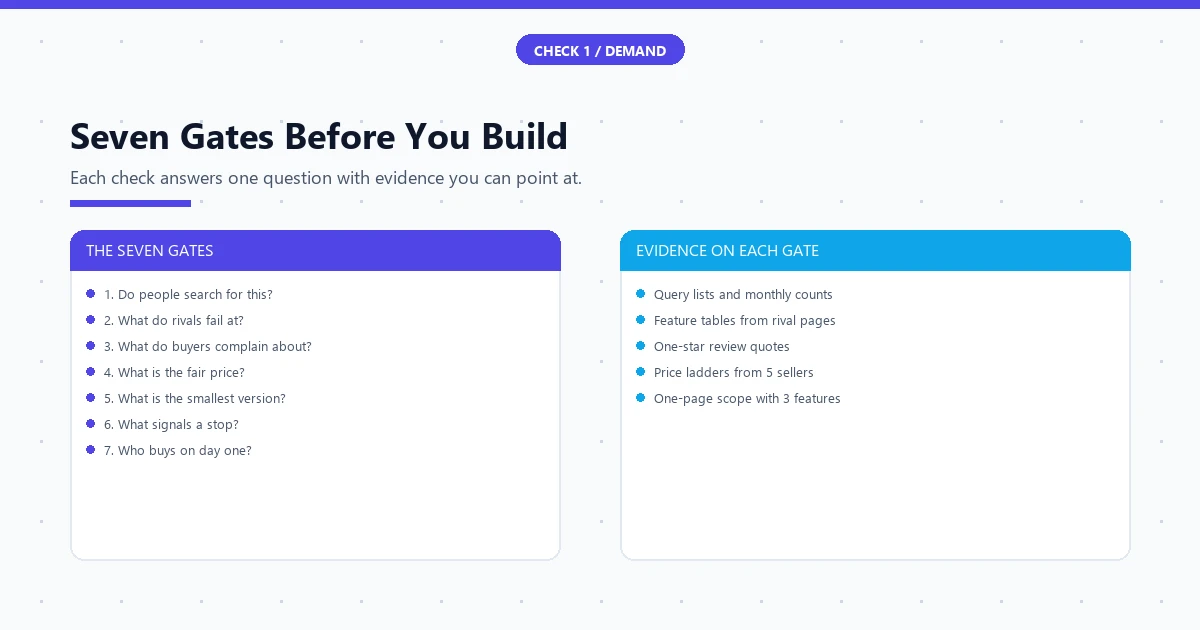
Check 3: review mining. Read twenty one-star reviews across the rival tools. Complaints that repeat three or more times are your feature list and your marketing copy in one. Buyers literally dictate what they would pay for.
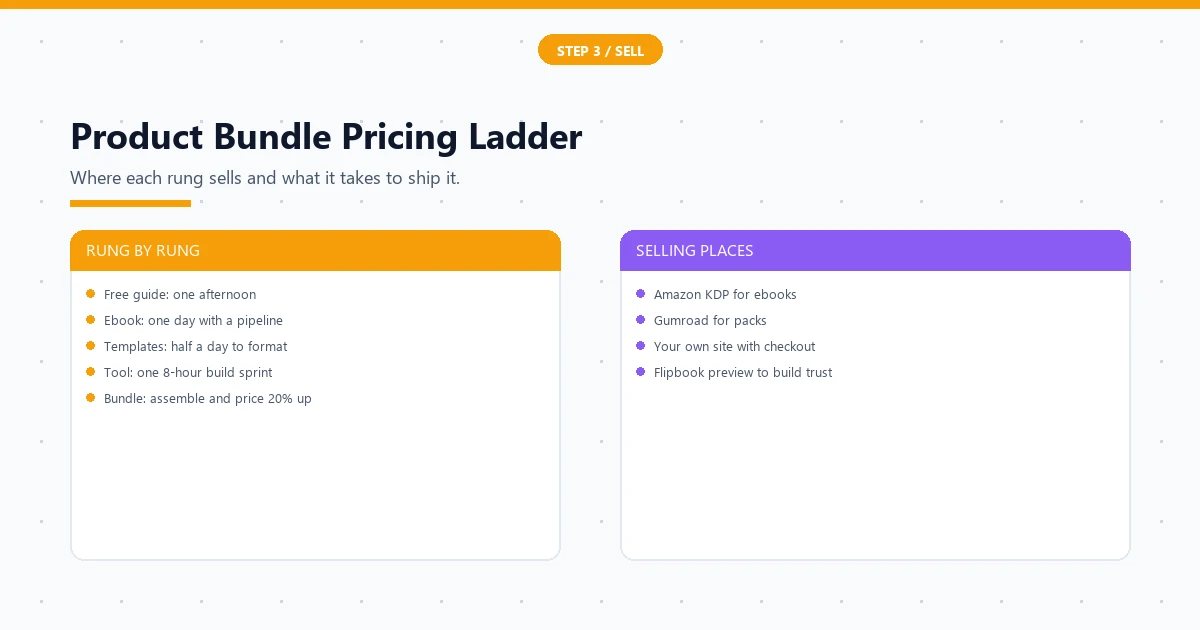
Check 4: price ladder. Write down what five sellers charge for adjacent solutions, from free to premium. If nobody charges anything in your lane, buyers may expect free, and you must plan a different way to earn.
Check 5: smallest sellable version. Shrink the idea until it fits one page: three features, one buyer, one promise. If you cannot describe a version worth paying for in three bullet points, the idea is still a project, not a product. To validate a product idea with AI, ask the model to cut features, not add them; the cut list is usually more valuable than the build list.
Check 6: kill criteria. Write two sentences that would stop the project: for example, fewer than 50 monthly searches across the cluster, or two rivals shipping your headline feature free. Builders skip this and pay later with sunk-cost months. Write it now while you are still honest.
Check 7: day-one buyers. Name ten real people or communities who would try version one this week. A subreddit, a Discord, a client list, a classroom. If you cannot name ten, distribution is not a later problem; it is a now problem, and the idea fails this gate.
What does real demand evidence look like?
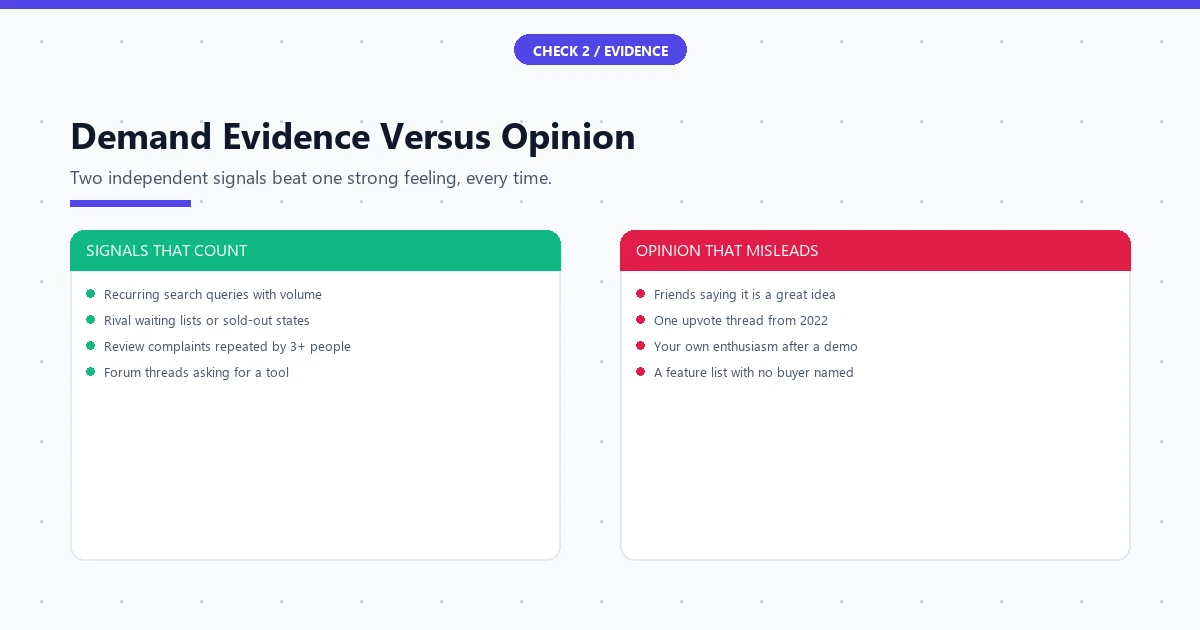
Demand evidence has two independent sources. One source is search: recurring queries with measurable volume over several months, ideally rising, from a keyword tool rather than from memory. The second source is wallets or their proxies: rivals charging money, waiting lists, template sales, freelance gigs requesting the same outcome. Either signal alone can mislead; search volume with zero paid rivals may mean the need is real but nobody pays to solve it, and paid rivals with no search volume may mean sales happen through channels you cannot reach. Pass this check only when both signals nod.
Opinion wears clever disguises. A friend saying “great idea” is politeness, not data. A viral demo video proves the demo is fun, not that the tool is needed weekly. Your own excitement after a late-night build session is the least reliable signal in the room. To validate a product idea with AI honestly, treat every encouraging anecdote as a hypothesis and demand the two signals above before spending the week. The scorecard image at the top of this article exists so you can hold each idea to the same bar; print it, fill one per idea, and compare three ideas side by side before choosing.
How do you score an idea before writing any code?
Use a simple 0 to 100 scale across four pillars, each worth 25 points: demand, gap, monetization, and reach. Demand scores search volume and trend. Gap scores how visibly rivals fail, using the review complaints from check three. Monetization scores the price ladder from check four. Reach scores your named day-one buyers from check seven. Add them up. Builders who use a formal opportunity scoring model for content will recognize the shape; the same four-pillar math adapts cleanly from articles to products, with buyers replacing readers as the unit of value.
Set thresholds in advance. Above 70 means build the smallest version immediately. Between 45 and 70 means pivot the positioning or shrink the scope and re-score. Below 45 means shelve it. The threshold is the point: without written numbers, every idea feels like a 65. Record the losing scores too. A drawer of scored, rejected ideas becomes your private dataset, and patterns across ten scorecards teach more than any single success. Six months later you will spot that your winners all had one-star review gaps and your losers all had polite-friend approval.
How long does validation take, and what tools do you need?
Ninety minutes end to end, using tools that cost nothing. Keyword Planner needs only a free Google Ads account with no spend; the Python script route needs Python installed and ten minutes of patience. Review mining needs the marketplace pages themselves plus a spreadsheet. Pricing data comes from five seller pages you open by hand, because five prices fit in your head better than fifty. To validate a product idea with AI, the model does the summarizing and pattern-finding while you do the judging; the division matters, because an AI asked “is this a good idea” will agree with you, while the same model asked “list every complaint in these reviews” performs genuinely useful work.
A common failure: spending the 90 minutes researching the wrong question. “Is there an audience for productivity tools” is unanswerable and useless. “Do at least 500 people a month search for an offline invoice generator, and do the top three rivals hold ratings under 3.5 stars” is answerable before lunch. Frame every check as a number with a threshold, and the session ends with a verdict instead of a mood. For a second authoritative opinion, see Google’s guide to creating helpful content, which rewards exactly this evidence-first approach when you validate a product idea with AI for search-driven buyers.
What should you do after an idea passes?
Build the smallest version that charges money. Not the free beta with a waitlist, but a one-page tool with a price, because payment is the only validation that counts twice. The build itself now benefits from the validation file: the review complaints become the feature list, the price ladder becomes the pricing page, and the day-one buyer list becomes the launch announcement. This handoff is where validation pays for itself a second time. For the build method, follow the 8-hour staged build process, and keep the scorecard open beside the editor; every scope argument during the build gets settled by the evidence, not by enthusiasm.
If the idea fails, shelve it with the scorecard attached and a revisit date six months out. Markets move, rivals get acquired, pricing changes, and a failed check today can pass next year. The file costs nothing to keep and saves you from re-researching from zero. Either way, you spent ninety minutes, not ninety days, and that ratio is the real product. Learning to validate a product idea with AI quickly turns a builder who ships four hopeful tools a year into one who ships one proven tool, and the proven one outsells the four combined.
How do free tools fit into AI validation?
Three free sources carry the whole run. Google’s Keyword Planner, reachable with a free Ads account, shows search volume ranges for any query cluster; Google’s own help page explains how to read those ranges without spending a rupee (Keyword Planner basics from Google Ads Help). Google Trends adds the direction: a steady five-year line beats a spike from last month. And a plain spreadsheet holds the scorecard, because the scoring is judgment, not software. To validate a product idea with AI using paid SEO suites is fine when you own them, but none of the seven checks requires one; the evidence lives in public pages and free planners.
The AI layer sits on top, summarizing rather than deciding. Feed it the review texts and ask for complaint clusters with counts. Feed it the five rival feature pages and ask for a comparison table with prices. Ask it to draft the one-page scope from your three bullets, then cut the scope yourself. Teams that already run gap analysis on their own content will find this familiar: the machine gathers, the human judges, and the scorecard records. For builders who prefer a scripted route to the same numbers, a free Python script for keyword research automates the query collection behind check one.
How do you read the scorecard when checks disagree?
Mixed results are normal, and the pillars tell you what kind. High demand with a low gap score means buyers exist but rivals serve them; the play is a narrower slice or a missing feature, not a head-on clone. High gap with low demand means nobody serves a need nobody searches for; the play is education-first content or a pivot to the adjacent query that does have volume. To validate a product idea with AI in these cases, ask the model to restate the idea three ways, each aimed at the strongest pillar, then re-score all three. The rewrite often reveals that the second phrasing was the real product all along.
Low monetization with strong everything else means the audience expects free; the answer is a free tool with a paid upgrade path or a different buyer for the same tool. Low reach with strong everything else means a good product with no door in; the answer is a partnership, a marketplace listing, or a narrower community where ten buyers wait by name. Never average a disagreement away. When you validate a product idea with AI and the pillars split two against two, the split itself is the finding: it names the exact risk the smallest version must retire first. Build the version that tests the weakest pillar, not the strongest, because confirming strength teaches nothing while retiring risk decides everything.
Frequently asked questions
Can you validate a product idea with AI for free?
Yes. Keyword Planner, review pages, and free model tiers cover the whole run; the only cost is ninety focused minutes. To validate a product idea with AI at zero spend, use the free Keyword Planner account for volume, read rival reviews by hand, and use any free chatbot for summarizing and pattern extraction. Solo builders who validate a product idea with AI on a free stack should still keep the same seven checks, because free tools change the cost, not the questions.
How many ideas should you validate before picking one?
Three at minimum, scored on the same scorecard. A single idea has no comparison point, so every threshold feels arbitrary; three scorecards make the winner obvious and the rejections specific. Founders who validate a product idea with AI in batches of three finish the week with one build candidate and two documented rejections, a better yield than a month spent polishing one untested hunch.
What if search volume is zero but forums ask for it?
That is a pivot signal, not a pass. Forums prove the problem exists but search proves buyers look for a tool; sell to the forum directly with a different channel plan, or narrow the idea until a searchable query appears. One honest exception: enterprise tools sold through sales calls, where search never reflects demand (but then you must name the ten buyers from check seven before you validate a product idea with AI any further).
Do one-star reviews really predict what to build?
Repeated complaints predict it better than any other free source. One complaint is noise, three is a pattern, and ten is a product specification written by buyers who already tried paying for alternatives. When you validate a product idea with AI, turn the top five complaints into the smallest version’s feature list, and the marketing page practically writes itself from buyer language.
What if two ideas pass the scorecard?
Build the one with the clearer day-one buyer list. Equal scores mean equal evidence, so distribution breaks the tie: ten named buyers beat a bigger market you cannot reach. Park the runner-up with its scorecard; second ideas often win six months later when the first product’s audience asks for them.
Should solo builders validate differently than teams?
The checks stay the same but the thresholds move. A solo builder should demand a score above 75 and a smallest version under two weeks, because one person absorbs every delay personally. Teams can accept 60-plus with a four-week scope, since parallel work absorbs surprises.
When should you re-validate a shelved idea?
When one failed check flips: a rival shuts down, a new query cluster appears, or a community starts asking. Re-run only the changed checks against the saved scorecard; a full re-run wastes the file’s value. Most revivals need twenty minutes, not ninety.
How do you validate a product idea with AI when you have no audience?
Borrow other people’s audiences: post the problem, not the product, in three communities and count concrete replies. To validate a product idea with AI from a standing start, mine those threads for exact buyer language, feed it back into your query list, and re-score. No audience only removes the shortcut; the seven checks work the same with strangers as with subscribers.
One last habit separates builders who validate a product idea with AI once from those who do it for every launch: the shared scorecard folder. Keep every completed sheet in one place, revisit the folder monthly, and let the pattern across ten sheets teach what no single verdict can. To validate a product idea with AI repeatedly is to build judgment on purpose, and judgment compounds faster than code.
Conclusion: ninety minutes that save ninety days
Validation is not pessimism; it is the cheapest form of building. To validate a product idea with AI is to let evidence vote before enthusiasm spends the budget, and the seven checks above make that vote countable. Print the scorecard, run three ideas through it this week, and build only the winner’s smallest version. Your future self, ninety days from now, will thank the afternoon you spent deciding instead of hoping. Teams that validate a product idea with AI as a standing habit rarely argue about what to build next, because the drawer of verdicts answers before the meeting starts.