
The Inherent Failure of Single-Prompt Artificial Intelligence
The artificial intelligence revolution has democratized text and code generation, but it has also created a widespread illusion of simplicity. Most developers, freelancers, and creators interact with language models through a single chat window, attempting to generate complex software applications, multi-chapter books, or full-stack web platforms using single conversational prompts. This approach inevitably fails when tasks scale beyond trivial scripts. Models hallucinate non-existent libraries, forget previously defined variables, overwrite critical configuration settings, and truncate vital logic. To achieve enterprise reliability, you must implement a dual agent architecture for ai workflows.
The human brain separates strategic planning from tactical execution. An architect does not lay bricks while drawing blueprints, and an author does not format book spines while outlining character arcs. Single prompts force a language model to perform both cognitive operations simultaneously within a single attention mechanism, causing severe context degradation. Implementing a dual agent architecture for ai workflows decouples architectural planning from modular execution, providing the structural rigor needed to build complex software, WordPress plugins, and commercial publications.
By connecting the Content Gap Finding Engine, the AI Engineering OS, and the Book Creation Engine, creators can harness a standardized dual agent architecture for ai workflows that guarantees system stability across both software engineering and long-form book creation. This comprehensive technical guide analyzes the mechanics of dual-agent coordination, detailing how separating planner and executor roles unlocks flawless execution for non-programmers.
Cognitive Separation: The Planner vs. The Executor
The foundation of a dual agent architecture for ai workflows is strict role specialization. Rather than treating a language model as a generalist assistant, the system assigns distinct cognitive boundaries to two specialized agents:
The first entity is the Planner Agent. The planner operates exclusively at the architectural level. It does not write production code or full prose paragraphs. Instead, its sole responsibility is defining the structural skeleton of the project:
- Directory Treemaps and File Scaffolding: Mapping out every folder, module, stylesheet, and template file required by the application.
- Interface Contracts and Function Signatures: Declaring explicit inputs, outputs, data schemas, and error boundaries between modules.
- The Master Implementation Checklist: Constructing an immutable sequence of tasks that dictates the exact order of execution.
- Context Compression (Project Head): Condensing broader market research and project constraints into an 8,000-character master instruction head.
The second entity is the Executor Agent. The executor operates strictly within the boundaries established by the planner. It receives instructions to implement one specific file or one specific chapter at a time. Because its attention window is focused entirely on a single deliverable, it writes comprehensive, error-free implementations without cutting corners, leaving placeholder comments, or suffering from memory loss. This cognitive separation is the engine that drives a successful dual agent architecture for ai workflows.
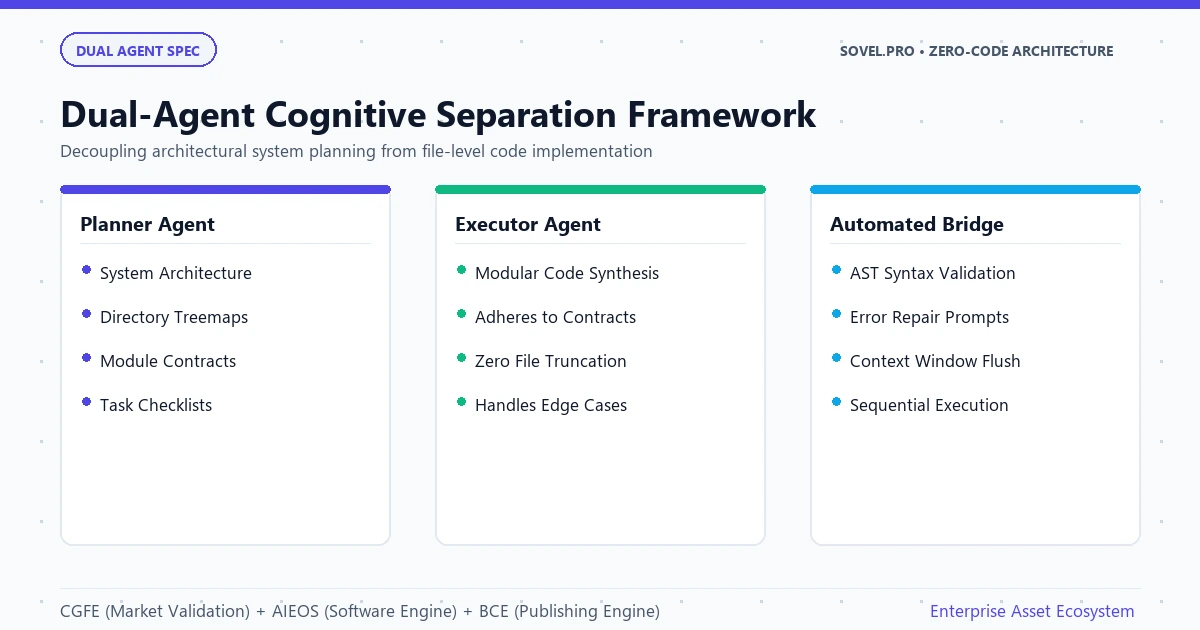
Figure 1: Cognitive separation framework showing how decoupling architectural planning from file-level execution eliminates context degradation.
Context Window Hygiene and the 8,000-Character Threshold
A major technical vulnerability in modern artificial intelligence systems is context bloat. As a conversation thread grows, language models begin suffering from attention diffusion, where instructions provided at the beginning of the prompt are forgotten or contradicted by later outputs. Deploying a dual agent architecture for ai workflows solves this problem through strict context window hygiene.
In our architecture, the communication between agents is governed by an 8,000-character context limit known as the Project Head. Instead of accumulating endless chat history, the planner compresses the entire system architecture into an 8,000-character master brief. When the executor agent begins working on a new file or chapter, it receives only:
- The 8,000-character Project Head containing the global system contracts.
- The specific task checklist item assigned for that execution cycle.
- The immediate dependencies or input interfaces created by the preceding task.
By clearing previous conversation memory and refreshing the context window for every file, the executor agent always operates at peak cognitive capacity. Understanding how to manage this context boundary is fundamental when designing a dual agent architecture for ai workflows that scales smoothly across massive codebases and 70,000-word books.
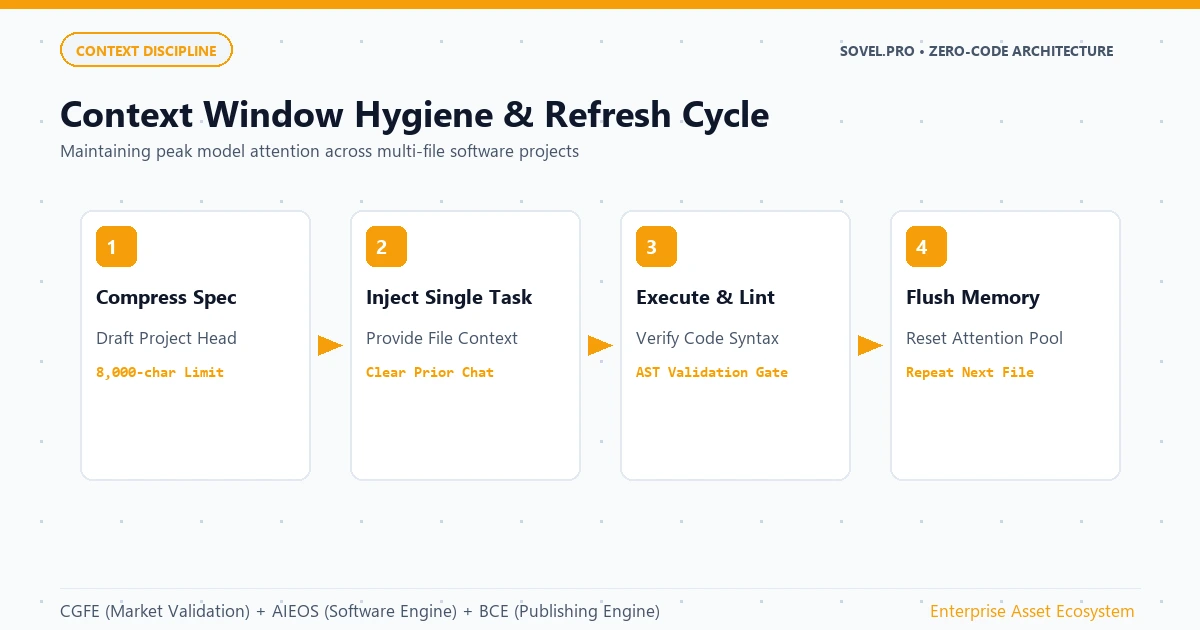
Figure 2: Context window hygiene workflow showing periodic memory flushes and targeted context injection across multi-stage execution cycles.
Dual-Agent Application in Software Engineering (AI Engineering OS)
When applied to software development, a dual agent architecture for ai workflows transforms unreliable code snippets into production-grade applications. Inside the AI Engineering OS, this process follows a seven-stage engineering pipeline:
Stage One begins with the planner agent analyzing user requirements and constructing the complete file tree. In Stage Two, the planner defines the interface contracts for every module following the MDN Web Docs JavaScript Modules specification. In Stages Three through Five, the executor agent implements the files sequentially. After each file is written, an automated verification gate runs local syntax parsers (such as Abstract Syntax Tree (AST) checks for JavaScript or PHP linter validation). If a syntax error or missing variable is detected, the verification gate halts the pipeline and generates a targeted repair prompt for the executor agent before proceeding to the next file.
This automated feedback loop ensures that errors are caught and corrected immediately at the file level, rather than cascading through the entire application. Using a dual agent architecture for ai workflows in software development guarantees that your plugins, micro-SaaS utilities, or web tools execute flawlessly upon deployment.
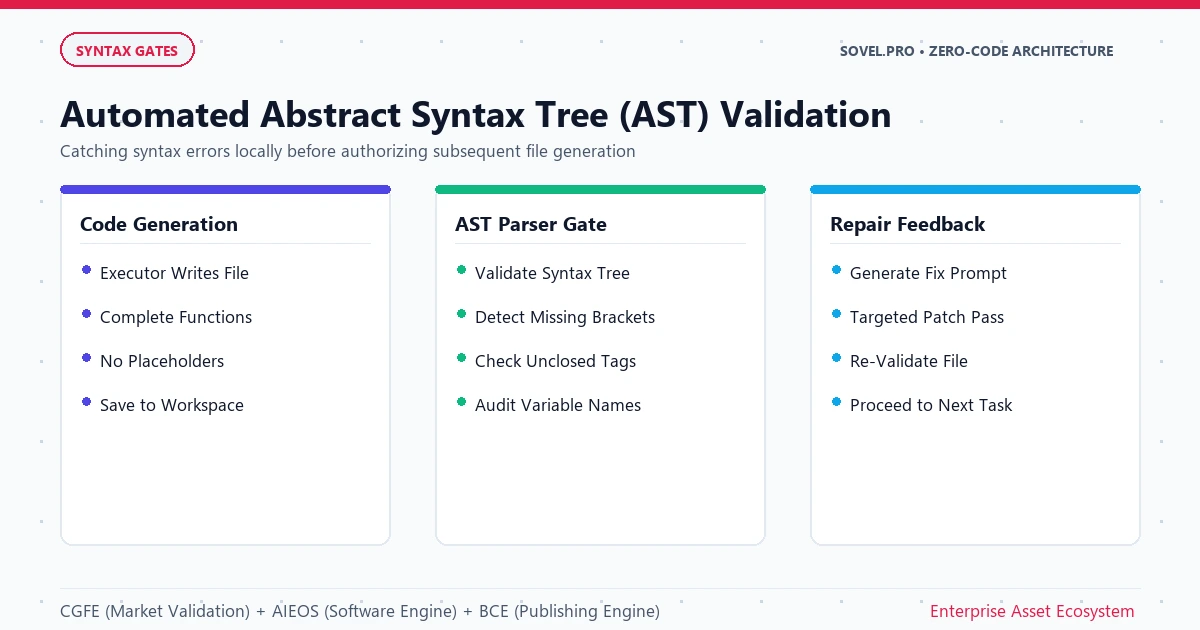
Figure 3: Automated syntax verification gate parsing generated code through AST validation before authorizing the next execution cycle.
Detailed Real-World Project Case Study 7: Automated DuPont Financial Statement Analyzer
To see how a dual agent architecture for ai workflows operates in complex technical domains, examine the development of the Automated DuPont Financial Statement Analyzer and Valuation Suite. Conceived, engineered, and published in under six hours, this commercial tool demonstrates the unmatched precision of dual-agent coordination.
The opportunity was identified through the Content Gap Finding Engine. Search data revealed over 15,000 monthly queries from accounting students, CFA candidates, and small business financial controllers for “DuPont analysis calculator with steps” and “automated DCF sensitivity model”. Existing spreadsheet templates were notoriously fragile, prone to formula breakage, and lacked dynamic visual reporting. Commercial corporate finance software cost over $500 per annual license. The Content Opportunity Score reached 91 out of 100.
The creator deployed the AI Engineering OS using a dual agent architecture for ai workflows. The planner agent defined a Python and FastAPI backend paired with a clean, responsive client-side interface. It mapped out complex financial formulas: return on equity decomposition, operating margin efficiency, asset turnover ratios, and multi-variable DCF valuation models. The executor agent generated clean, modular functions for each financial ratio, integrated KaTeX rendering for dynamic LaTeX formula display, and coded client-side PDF financial report exports. Automated test suites validated numerical accuracy against verified benchmark balance sheets in milliseconds.
Next, the creator used the Book Creation Engine to draft a 54,000-word companion textbook: Foundations of Corporate Financial Statement Analysis and Business Valuation. The book detailed balance sheet mechanics, capital budgeting, and working capital optimization across fourteen structured chapters. The software tool and companion textbook were bundled together and launched on Gumroad for ₹3,499 ($39). Within 60 days, the package generated 165 sales, netting over $6,400 in direct revenue. This success underscores the extraordinary capability of a dual agent architecture for ai workflows when applied to technical, high-value problem spaces.
Dual-Agent Application in Book Publishing (Book Creation Engine)
The identical architectural principles that govern software development apply directly to publishing. When authors attempt to write an entire book using a single prompt, artificial intelligence models generate shallow, repetitive summaries that lack narrative depth and lose character continuity. The Book Creation Engine solves this by applying a dual agent architecture for ai workflows across a sixteen-stage publication pipeline.
The publishing workflow operates with mechanical precision:
- The Literary Planner Agent: Constructs the master book bible, chapter treemaps, character profiles, topic outlines, and emotional pacing curves. It establishes target word counts (3,500 to 5,000 words per chapter) and cross-reference checklists.
- The Literary Executor Agent: Drafts each chapter sequentially. It receives the master outline, the character bible, and a carry-forward summary of previous scenes. It focuses entirely on rich, immersive prose, avoiding generic transitions and repetitive sentence structures.
- The Verification Pass: After drafting, the agent runs consistency checks, verifying that technical concepts or narrative threads remain coherent from chapter one to chapter sixteen.
This disciplined dual-agent process produces exhaustive 50,000 to 70,000 word books in five to six hours. The output is structured in clean DOC format, ready for styling in Google Docs and instant export to PDF and EPUB. Deploying a dual agent architecture for ai workflows ensures that your publications match traditional publishing standards in depth, tone, and authority.
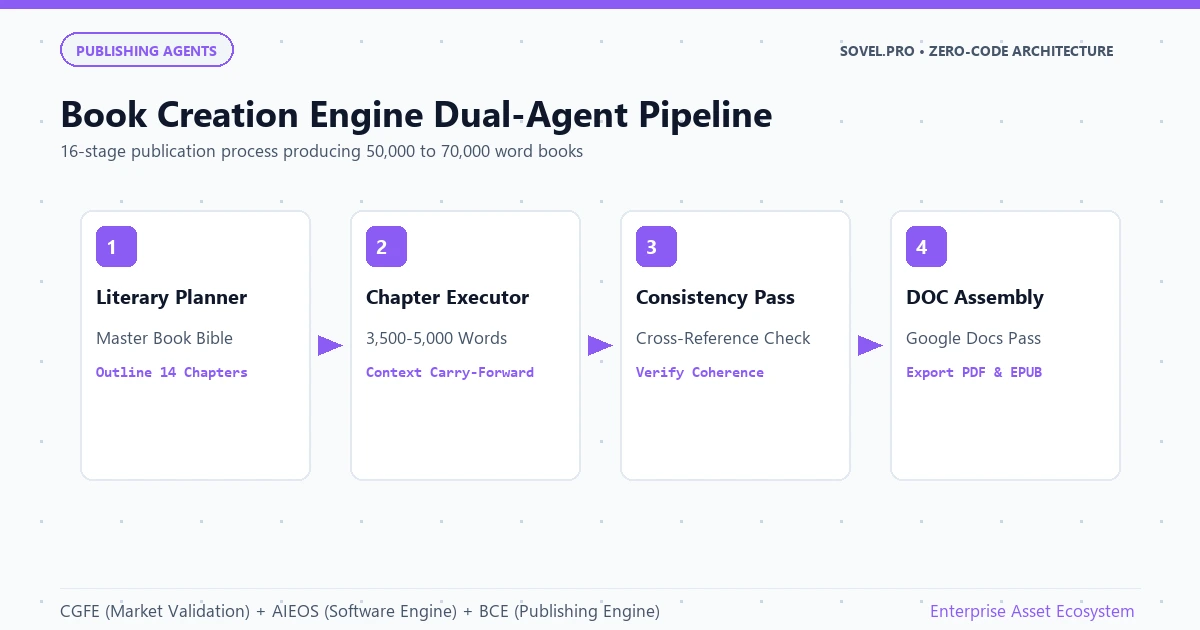
Figure 4: The Book Creation Engine dual-agent pipeline coordinating high-level book bibles with chapter-by-chapter drafting and consistency verification.
Master Prompt Templates: The Dual-Agent Instruction Contract
To successfully implement a dual agent architecture for ai workflows, you must understand the exact prompt contracts that govern communication between the human architect, the planner agent, and the executor agent. Vagueness destroys precision. Our system utilizes strict, standardized prompt templates that eliminate ambiguity.
Here is the exact Planner Agent Master Prompt used within our dual agent architecture for ai workflows:
# ROLE: Lead System Architect & Planner Agent
You are operating within a strict dual-agent software pipeline.
Your task is to analyze the following user requirement and produce ONLY the architectural specification.

## SYSTEM CONSTRAINTS:
1. Tech Stack: Node.js, Express, SQLite, Vanilla CSS/JS.
2. Architecture: PSR-4 or clean modular ES6 separation.
3. No code implementation allowed in this phase.

## REQUIRED OUTPUT:
1. Complete Directory Treemap (every folder and file path).
2. Interface Contracts: Function names, input arguments, return schemas for each module.
3. Immutable Task Checklist: Sequential list of files to be implemented by the Executor Agent.
4. Error Boundary Rules: Expected exceptions and validation protocols.

Deliver the specification strictly in markdown format without introductory fluff.
Once the planner delivers the architectural specification, the human architect activates the Executor Agent using the following file-level execution prompt:
# ROLE: Precision Code Executor Agent
You are implementing Task Item #4 from the Master Architectural Checklist: `src/controllers/finance.js`.

## CONTEXT HEAD:
[Insert 8,000-character Project Head containing directory treemap and interface contracts]

## YOUR TASK:
Write the complete, production-ready code for `src/controllers/finance.js`.
- Adhere strictly to the function signatures defined in the Project Head.
- Implement comprehensive input sanitization and error handling.
- Do NOT use placeholder comments, abbreviations, or simulated logic.
- Output ONLY the complete file code.
This strict prompt discipline guarantees that the executor agent never deviates from the master plan. By maintaining these standardized templates, your dual agent architecture for ai workflows operates with predictable, repeatable enterprise accuracy.
Real-World Verification: The SOVEL Theme and EbookHunt.online
The effectiveness of this architecture is proven by real, public software platforms in continuous operation. The custom SOVEL WordPress theme that drives sovel.pro and interactive web tools like Sovel Calc was engineered from the ground up using a dual agent architecture for ai workflows. By separating structural design from template implementation, the platform achieves instant load speeds, responsive layouts, and zero bloat.
Furthermore, the founder built and deployed ebookhunt.online as an open, verifiable demonstration site. Live for over six consecutive months, the site demonstrates that a non-programmer can construct complex, interactive digital publishing platforms using dual-agent prompt engineering. The platform showcases a digital book library and features a client-side interactive 3D page-turning flipbook reader tool built entirely with canvas rendering without paid software licenses. This living case study proves that mastering a dual agent architecture for ai workflows yields enterprise-grade software that operates reliably in real-world environments.
Architecture Comparison: Single-Prompt Chat vs. Dual-Agent Pipelines
| System Capability | Single Conversational Prompt | Dual-Agent Architecture Pipeline |
|---|---|---|
| Context Retention | Rapid memory degradation and contradictions | Refreshed context per file with 8,000-char Project Head |
| Error Detection | Errors accumulate until project crashes | Automated AST syntax gates catch errors immediately |
| Code Modularity | Monolithic, unstructured scripts | Modular, multi-file directory treemaps |
| Output Depth (Books) | Truncated 800-word chapter summaries | Full 3,500-5,000 word chapters, 70,000-word books |
| Model Independence | Tied to specific proprietary chat interfaces | Works with any open or free model router |
Step-by-Step Blueprint: Implementing Dual-Agent Pipelines
Follow this exact operational roadmap to deploy a dual agent architecture for ai workflows in your next software or publishing project:
- Step 1: Formulate the System Specification: Use research assistants to analyze your project goals and draft an 8,000-character master Project Head defining all functional constraints.
- Step 2: Initialize the Planner Agent: Direct the planner agent to construct the complete directory treemap, module contracts, and sequential task checklist.
- Step 3: Establish the Executor Workspace: Open Visual Studio Code and connect your autonomous agent extensions (Cline or OpenCode) to a free model router.
- Step 4: Execute File Implementation Sequentially: Instruct the executor agent to implement the first task checklist item, adhering strictly to the interface contracts.
- Step 5: Run Automated Syntax Verification: Execute local linting and syntax checks to ensure zero errors before proceeding to subsequent files.
- Step 6: Refresh Context Windows: Flush temporary conversation memory between major modules while retaining the master Project Head to maintain peak model attention.
- Step 7: Conduct System Integration Testing: Test the compiled application locally in a browser or sandbox to verify end-to-end functionality.
- Step 8: Deploy and Package: Package your completed software or book for distribution across commercial marketplaces.
Frequently Asked Questions
Why can a single prompt not handle both planning and execution?
Language models have finite attention capacity within a single inference pass. Forcing a model to invent high-level system architecture while simultaneously writing granular syntax causes attention diffusion, leading to missed edge cases, hallucinated variables, and truncated outputs.
Do I need multiple paid accounts to run a dual agent architecture for ai workflows?
No. You can run both planner and executor agents using free community model routers like OpenRouter, OmniRouter, and Google AI Studio. The architectural separation is a prompt engineering discipline, not a paid infrastructure requirement.
How does the dual-agent model prevent code hallucination?
The planner agent predefines all class names, function signatures, and file paths in the Project Head. The executor agent is strictly forbidden from inventing new interfaces, ensuring all code aligns perfectly with the system blueprint.
Can you apply a dual agent architecture for ai workflows to creative writing and books?
Yes. The Book Creation Engine applies this exact framework to fiction and non-fiction publishing, where the planner maintains character bibles and plot arcs, while the executor writes vivid, immersive scenes without continuity errors.
What is the ideal character limit for the Project Head?
We recommend maintaining the Project Head between 6,000 and 8,000 characters. This provides enough depth to define comprehensive system rules without consuming excessive context window capacity.
Conclusion: The Future of Autonomous Development
The era of treating artificial intelligence as a simple chat novelty has ended. To build enterprise-grade software, robust plugins, and definitive reference books, creators must embrace engineering rigor. Implementing a dual agent architecture for ai workflows provides the structural integrity, context discipline, and automated verification needed to turn ideas into production-ready digital assets. Embrace the dual-agent framework today, elevate your development standards, and build software and publications that stand the test of time.