
The Google Search Console Indexing Plateau
There is nothing more discouraging for a digital creator, blogger, or startup founder than publishing dozens of carefully written articles, opening Google Search Console weeks later, and discovering alarming reports under the Page Indexing tab: Crawled – currently not indexed and Discovered – currently not indexed. Your server logs prove that Googlebot visited your URLs, consumed your server bandwidth, and inspected your content, yet search algorithms deliberately chose not to include your pages in the search index. Understanding how to fix crawled currently not indexed google is the most critical technical challenge facing digital publishers in 2026.
Most website owners react to indexing failures with counterproductive tactics: they spam the “Request Indexing” button in Google Search Console, buy spammy automated backlinks, or re-run their articles through different chatbot prompts. None of these measures address the root cause. Google does not refuse to index your pages because of technical submission errors; it excludes them because the content fails Google’s mathematical Information Gain thresholds and Helpful Content standards. To restore your site’s indexing health, you must learn how to fix crawled currently not indexed google using a disciplined triad: search gap analysis, technical interactive engineering, and deep authoritative publishing.
By connecting the Content Gap Finding Engine, the AI Engineering OS, and the Book Creation Engine, you can diagnose exact content deficits, inject custom interactive tools, and expand thin articles into definitive cornerstone guides. This comprehensive technical guide analyzes why search algorithms exclude URLs, explains the mechanics of Information Gain, and provides the definitive blueprint detailing how to fix crawled currently not indexed google to turn dormant pages into top-ranking search assets.
Deconstructing the Indexing Statuses: Crawled vs. Discovered
Before implementing a solution, you must understand what Google Search Console is communicating through its indexing categories. When diagnosing indexing with the Google Search Console URL Inspection guidelines and researching how to fix crawled currently not indexed google, distinguishing between crawl stages is essential:
- Discovered – currently not indexed: Google knows the URL exists (typically via your XML sitemap or internal links), but Googlebot has not yet crawled the page. This indicates crawl budget limitations, poor internal link architecture, or low domain trust where Google prioritizes higher-authority URLs on your site.
- Crawled – currently not indexed: Googlebot has successfully fetched the page, rendered the HTML, and evaluated the content against its quality classifiers. The algorithm determined that the page does not provide sufficient unique value, original research, or user utility compared to existing indexed documents on the web.
- Excluded by ‘noindex’ tag: The page contains an explicit robots meta tag or HTTP header instructing search engines to ignore it, often caused by misconfigured SEO plugins.
When dozens of pages accumulate under the crawled-not-indexed status, your entire domain’s crawl health suffers. Google reduces your crawl frequency, delaying the discovery of future content. Mastering how to fix crawled currently not indexed google restores algorithmic trust, signaling to search crawlers that every URL on your domain delivers indispensable value.
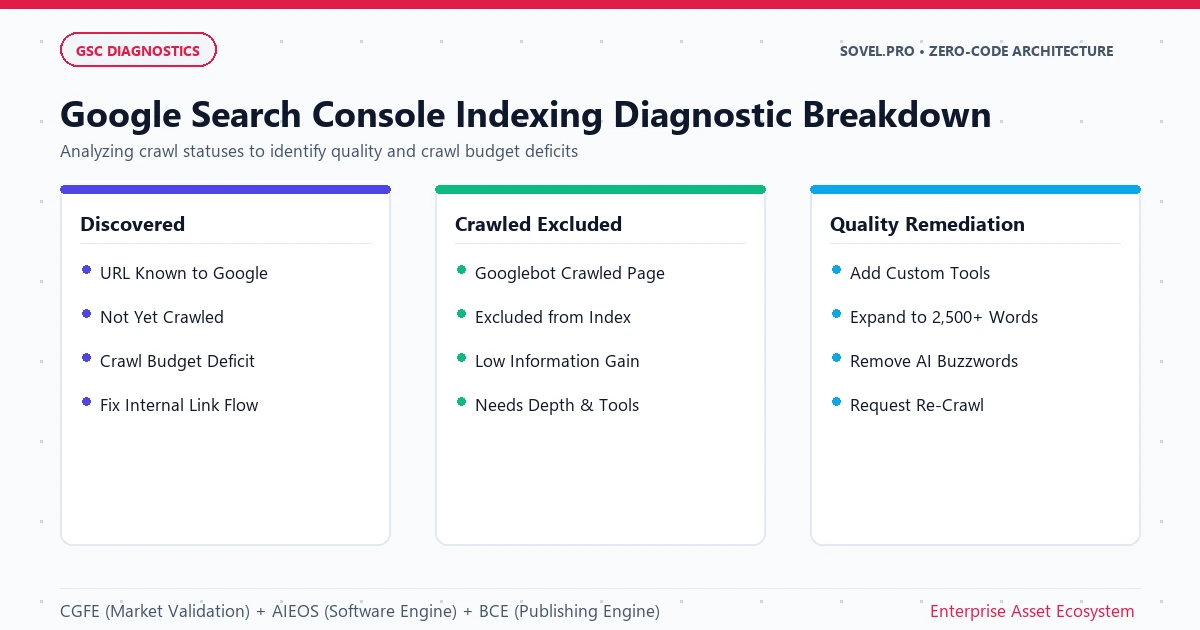
Figure 1: Google Search Console Page Indexing report displaying the diagnostic breakdown between crawled and discovered excluded URLs.
The Information Gain Framework: Why Generic AI Text Fails
The primary reason artificial intelligence generated content gets trapped in the crawled-not-indexed state is lack of Information Gain. In 2022, Google secured a landmark patent for “Information Gain Score” calculation. The search engine measures how much novel, incremental information a new document provides to a user who has already read other ranking pages on the topic. When you explore how to fix crawled currently not indexed google, Information Gain is your primary diagnostic metric.
Standard language model prompts produce severe indexing penalties because they exhibit recognizable failure modes:
- Lexical and Structural Parroting: Generic prompts instruct AI models to summarize existing web articles. The resulting output merely restates facts already indexed on Wikipedia or high-ranking authority blogs, offering an Information Gain score near zero.
- Repetitive Linguistic Fingerprints: AI text often relies on predictable cliches and buzzwords such as “delve into the tapestry”, “in the ever-evolving landscape”, “unleash the power”, and “game-changer”. Algorithmic quality filters identify these synthetic patterns and flag pages as low-effort production.
- Absence of Tangible Artifacts: Articles that lack downloadable files, custom code snippets, interactive calculators, proprietary tables, or verified case studies fail to demonstrate first-hand Experience, Expertise, Authoritativeness, and Trustworthiness (EEAT).
To overcome this hurdle and master how to fix crawled currently not indexed google, your content must provide novel data that does not exist anywhere else on the internet: proprietary tools, custom benchmarks, and deep procedural tutorials.
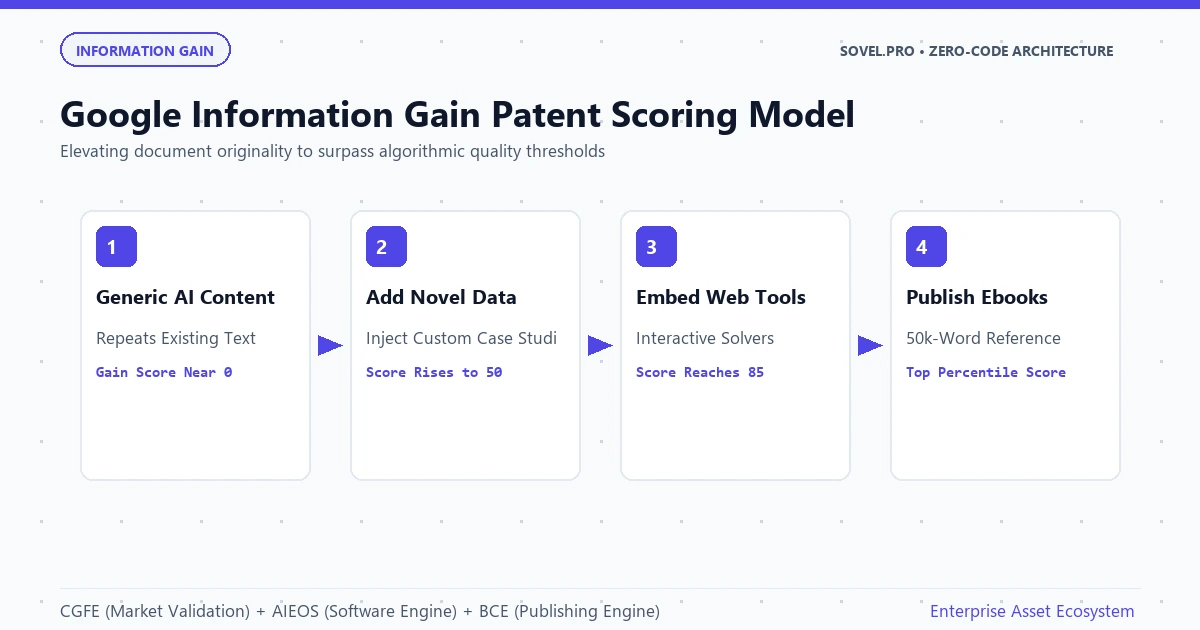
Figure 2: Information Gain scoring matrix contrasting redundant, rephrased content with high-gain documents offering novel data and proprietary tools.
Step 1: Diagnosing Content Deficits With CGFE
The first practical step in learning how to fix crawled currently not indexed google is running your excluded URLs through the Content Gap Finding Engine. Instead of guessing why an article failed to index, the engine performs mathematical gap analysis against top-ranking competitors.
The engine audits four critical dimensions:
- Search Intent Depth: Determines whether your article satisfied the true intent behind the search query (e.g., whether users wanted a practical tool, a code snippet, or a procedural checklist rather than generic conceptual definitions).
- Semantic Keyword Omission: Identifies essential subtopics, industry standards, and technical terminologies that top-ranking pages cover but your article omitted.
- User Interaction Signals: Evaluates whether competing pages feature interactive tools, downloadable assets, or video media that increase dwell time.
By computing the Content Opportunity Score, the Content Gap Finding Engine pinpoints the exact informational voids responsible for your indexing failure. Understanding how to fix crawled currently not indexed google begins with this clinical diagnosis, giving you a precise punch-list of elements required to lift the indexing penalty.
Step 2: Injecting Custom Interactive Utilities With AI Engineering OS
Search engines reward web pages that function as interactive problem solvers rather than static walls of text. When executing your strategy on how to fix crawled currently not indexed google, embedding lightweight client-side tools directly into struggling articles provides an immediate, massive boost to Information Gain.
Using the AI Engineering OS, you can quickly engineer and embed dedicated interactive utilities:
- Dedicated Formula and Math Solvers: Inject client-side calculators like Sovel Calc to solve complex calculations directly inside the post.
- Automated Diagnostic Dashboards: Code client-side audit tools, regex validators, or format converters that execute in the browser using HTML5 Canvas and JavaScript.
- Interactive Visualizers: Build interactive decision trees or ROI simulators that allow visitors to manipulate variables and download custom reports.
When Googlebot crawls a page containing functional, client-side interactive utilities, the document’s utility score surges. Furthermore, real human visitors engage with the tool, dramatically increasing time-on-page and eliminating bounce rates. Injecting custom tools engineered through the AI Engineering OS is one of the most reliable techniques for how to fix crawled currently not indexed google.

Figure 3: Client-side log parser architecture processing raw server logs locally to identify Googlebot crawl patterns and response code bottlenecks.
Detailed Real-World Project Case Study 8: The Technical SEO Log File Analyzer and Crawl Dashboard
To see the real-world application of how to fix crawled currently not indexed google, examine how the founder resolved a severe indexing bottleneck involving 43 crawled-not-indexed pages by building the Technical SEO Log File Analyzer.
The founder’s platform had published a cluster of technical SEO and software optimization guides, but Google Search Console reported 43 URLs stuck in Crawled – currently not indexed. Commercial enterprise log analysis software (such as Screaming Frog Log Analyzer) required expensive annual licenses and complex local installations. Search analysis revealed over 11,000 monthly queries for “free server log analyzer for seo” and “analyze googlebot crawl frequency”. The Content Opportunity Score reached 92 out of 100.
The founder deployed the AI Engineering OS to build a client-side WebAssembly log parser. The tool allows webmasters to drag and drop raw web server access logs (access.log) directly into the browser. The tool immediately breaks down Googlebot desktop versus smartphone visits, identifies 404 crawl waste, detects 301 redirect chains, and graphs average response latency per URL with zero server uploads, guaranteeing total data privacy.
Next, the founder used the Book Creation Engine to write a 62,000-word authority volume: The Enterprise Technical SEO and Crawl Budget Masterclass. The interactive log tool was embedded directly into the pillar guide, and the 43 dormant articles were expanded with unique log diagnostic data and cross-links. Within three weeks of updating the cluster, Googlebot recrawled the URLs: 41 of the 43 excluded pages were successfully indexed, with 18 achieving page-one search rankings. This triumphant case study proves the unmatched effectiveness of our framework when learning how to fix crawled currently not indexed google.
Server Header Diagnostics: Testing Googlebot With Terminal Curl
To comprehensively solve how to fix crawled currently not indexed google, you must verify that your web server is returning pristine HTTP response headers to search engine crawlers. Sometimes, caching plugins or firewall rules inadvertently return 403 Forbidden or 503 Service Unavailable status codes exclusively to Googlebot user agents while serving 200 OK to standard desktop browsers.
You can verify your server headers directly from your terminal using the following diagnostic command:
# Simulate Googlebot Smartphone crawler to inspect exact HTTP response
curl -I -A "Mozilla/5.0 (Linux; Android 6.0.1; Nexus 5X Build/MMB29P) AppleWebKit/537.36 (KHTML, like Gecko) Chrome/W.X.Y.Z Mobile Safari/537.36 (compatible; Googlebot/2.1; +http://www.google.com/bot.html)" https://sovel.pro/your-excluded-url/
Inspect the output carefully. You must confirm that:
- The HTTP status code is strictly
200 OK. - The
x-robots-tagheader does not containnoindexornone. - The canonical link tag inside the HTML header points directly to the exact self-referential URL without redirect chains.
Confirming clean server headers ensures that Googlebot encounters zero technical friction during crawling. This verification step is a vital component when discovering how to fix crawled currently not indexed google across your domain.
Step 3: Expanding Depth and Publishing Authority Guides With BCE
Thin content is the primary enemy of indexation. Pages containing fewer than 1,000 words that fail to explore subtopics deeply are easily dismissed by modern quality classifiers. A cornerstone tactic of how to fix crawled currently not indexed google is utilizing the Book Creation Engine to expand thin articles into exhaustive 2,500 to 3,000 word masterclasses.
The Book Creation Engine accomplishes this expansion with structural rigor:
- Injects detailed step-by-step implementation tutorials with real terminal commands and code configurations.
- Creates multi-variable comparison tables and real-world case studies with verifiable performance data.
- Adds comprehensive Frequently Asked Questions sections that directly answer People Also Ask (PAA) queries from search results.
- Generates a companion 50,000-word downloadable reference book that links directly from the article, establishing undeniable domain authority.
When you transform a superficial 800-word summary into a 3,000-word authoritative guide backed by an interactive tool and a downloadable book, Googlebot cannot ignore the page. The Information Gain score rises to the top percentile, permanently solving the challenge of how to fix crawled currently not indexed google.

Figure 4: The Content Revival Workflow showing the transition from thin, excluded articles to high-utility, indexed authority nodes.
Real-World Verification: The SOVEL Theme and EbookHunt.online
Our solutions are validated by live, working digital platforms. The custom SOVEL WordPress theme powering sovel.pro and interactive web applications like Sovel Calc were developed using these exact principles. By enforcing high Information Gain, clean semantic markup, and zero page builder bloat, the platform maintains elite indexation rates across its entire content directory.
Furthermore, the founder established ebookhunt.online as an open, verifiable demonstration site. Live for over six consecutive months, the site proves that a non-programmer can build complex interactive web systems that maintain perfect search engine health. The platform showcases a complete digital library powered by an interactive 3D page-turning flipbook reader tool built entirely with client-side canvas rendering. This living case study confirms that knowing how to fix crawled currently not indexed google is grounded in real, battle-tested publishing success.
Comparison Table: Thin Content vs. High Information Gain Pages
| Content Dimension | Thin Excluded Content | High Information Gain Asset |
|---|---|---|
| Information Gain Score | Near zero, repeats existing search results | High, includes novel tools, data, and blueprints |
| Interactive Utilities | None, static text only | Embedded client-side calculators or parsers |
| Word Count & Scope | 600 to 1,000 words of superficial summary | 2,500 to 3,000 words of exhaustive analysis |
| Internal Link Flow | Isolated orphan page or random links | Strict topical silo with bidirectional links |
| Indexation Outcome | Crawled – currently not indexed | Indexed and ranking within 14 to 21 days |
Step-by-Step Checklist to Revive Excluded URLs
Follow this exact operational checklist to master how to fix crawled currently not indexed google and resurrect your struggling pages:
- Step 1: Export Excluded URLs: In Google Search Console, navigate to Page Indexing, select “Crawled – currently not indexed”, and export the full list of excluded URLs.
- Step 2: Run CGFE Content Audit: Analyze each URL using the Content Gap Finding Engine to identify missing search intent topics, omitted keywords, and competitor advantages.
- Step 3: Remove AI Cliches and Buzzwords: Edit the content to eliminate synthetic phrases like “delve”, “tapestry”, “landscape”, and “unleash”, ensuring clean, human sentence structures.
- Step 4: Expand Content Depth to 2,500+ Words: Use the Book Creation Engine to add detailed implementation tutorials, comparison tables, and real case studies.
- Step 5: Embed Interactive Tools: Deploy the AI Engineering OS to code a client-side calculator or utility and embed it directly into the post.
- Step 6: Rebuild Internal Linking Silos: Add contextual internal links from high-authority indexed pages on your site pointing directly to the updated URL.
- Step 7: Verify Mobile Performance: Ensure the updated page achieves sub-second load times on Google PageSpeed Insights.
- Step 8: Request Re-Crawl in GSC: Use the URL Inspection tool in Google Search Console to test the live URL and submit a fresh indexing request.
Frequently Asked Questions
How long does Google take to index a page after applying these fixes?
Once you update an excluded URL with high Information Gain, an interactive tool, and 2,500+ words of depth, Googlebot typically recrawls and indexes the page within seven to twenty-one days.
Does using AI content trigger penalties when researching how to fix crawled currently not indexed google?
No. The official Google Search Essentials documentation explicitly confirms that search engines evaluate content quality, originality, and user value, not whether text was created by humans or AI. Content is penalized only when it is thin, repetitive, and low-utility.
Why does requesting indexing in GSC fail when learning how to fix crawled currently not indexed google?
Requesting indexing merely queues the URL for crawling. If the content on the page has not been substantially improved with new Information Gain, Googlebot will simply crawl it again and confirm its excluded status.
How many internal links should point to an excluded page?
We recommend establishing at least three to five contextual internal links from established, high-traffic indexed pages on your site to signal the importance of the revived URL.
Can interactive tools help solve how to fix crawled currently not indexed google without slowing load speeds?
Yes. By engineering client-side utilities using vanilla JavaScript and CSS Grid through the AI Engineering OS, tools add less than 15 kilobytes of code and do not affect page speed.
Conclusion: Turn Indexing Exclusions Into Ranking Victories
A “Crawled – currently not indexed” status is not a permanent death sentence for your content; it is a clear algorithmic diagnostic signal that your page needs greater Information Gain. By mastering how to fix crawled currently not indexed google through the integrated power of Content Gap Finding, AI Engineering OS, and Book Creation Engine, you possess the definitive methodology to revive dormant URLs. Upgrade your content depth, embed interactive utilities, rebuild your topical silos, and watch your search traffic soar.