
The Myth of Expensive AI Software Subscriptions
The tech industry frequently markets artificial intelligence as an expensive luxury reserved for well-funded startups and enterprise corporations. Major software companies advertise monthly coding subscriptions ranging from twenty to fifty dollars per seat, while proprietary API platforms require ongoing credit card charges that quickly accumulate. For students, freelancers, and independent builders with modest budgets, these recurring fees can feel like an insurmountable barrier. Fortunately, the reality of modern software development is completely different. Anyone with passion and dedication can leverage free ai coding tools for non programmers to build robust, production-grade applications without spending a single dollar on software subscriptions.
For creators seeking independence, the open-source community and competitive artificial intelligence landscape have created a massive ecosystem of free ai coding tools for non programmers of high-performance tools, community token routers, and lightweight runtime environments. When combined with a disciplined engineering pipeline, these zero-cost resources rival proprietary platforms in quality, speed, and security. However, beginners often fail because they wander aimlessly between random free chatbots, copy-pasting disconnected code snippets that break upon execution. To achieve commercial success, you must organize free ai coding tools for non programmers into an integrated system: market gap analysis, dual-agent implementation, and comprehensive publication.
By integrating the Content Gap Finding Engine, the AI Engineering OS, and the Book Creation Engine, non-technical creators can harness free ai coding tools for non programmers to construct enterprise software, custom WordPress plugins, browser extensions, and comprehensive books. This definitive guide breaks down the exact zero-cost toolchain, showing how to assemble your workstation, connect free token routers, and build high-value digital products without paying a single cent in monthly software fees.
The Complete Zero-Cost Workstation Architecture
To build enterprise-grade software without writing code manually, you need a stable local environment. Setting up free ai coding tools for non programmers begins with installing open-source foundations directly on your personal computer.
Here are the core components required for your zero-cost workstation:
- Node.js and Git: The open-source JavaScript runtime (documented in the official Node.js documentation) and version control system. Both tools are 100 percent free to download and provide the execution engine and change-tracking infrastructure needed for modern software creation.
- Visual Studio Code: Microsoft’s free, open-source code editor documented in the official VS Code documentation. It serves as your primary control cockpit, offering rich extensions, integrated terminals, and responsive code visualization.
- Autonomous Agent Extensions (Cline and OpenCode): Free extensions for VS Code that allow artificial intelligence models to inspect directories, create new files, execute terminal commands, and perform iterative automated testing directly within your workspace.
- Local Testing Sandboxes: Tools like LocalWP for WordPress development, or standard web browser developer tools for client-side JavaScript, HTML5 Canvas, and WebAssembly applications.
When you combine these local resources, you create a powerful development studio that costs nothing to maintain. Operating with free ai coding tools for non programmers eliminates overhead stress, enabling you to build, test, and iterate on multiple digital products with total financial security.
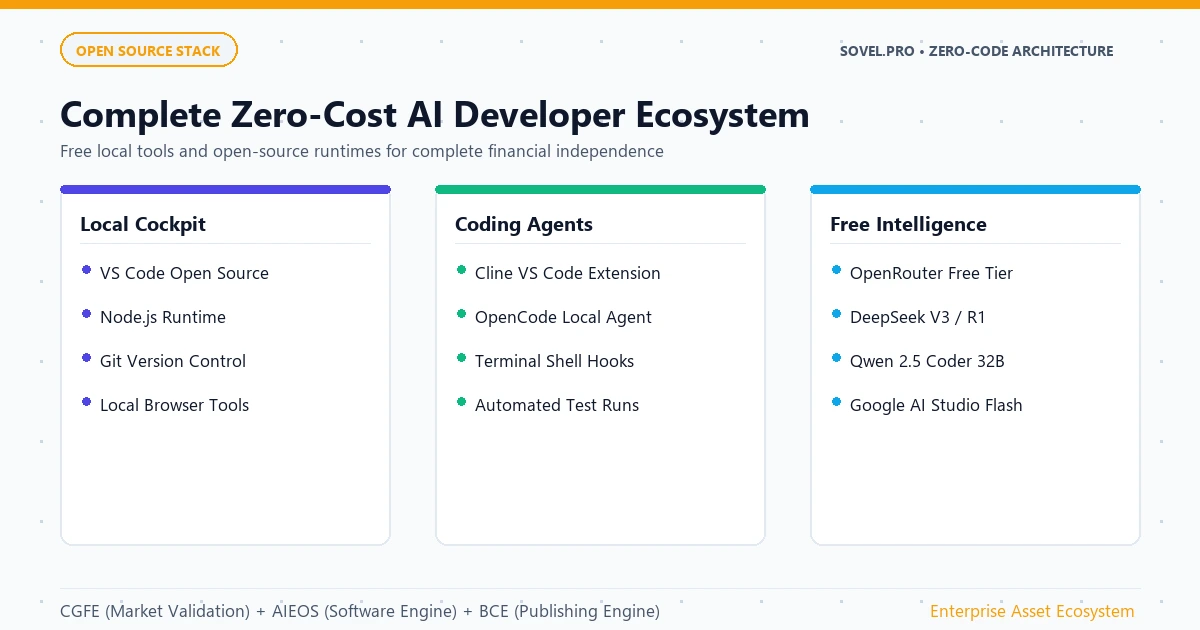
Figure 1: The complete zero-cost developer ecosystem pairing open-source runtimes, local code editors, and community token routers.
Connecting Free Community Token Routers and Open Models
The most expensive aspect of traditional artificial intelligence development is API inference tokens. Proprietary language model APIs charge per thousand tokens, which can rapidly exhaust a beginner’s budget during complex multi-file coding projects. The breakthrough that makes free ai coding tools for non programmers viable is the emergence of free community model routers and generous open-access tiers.
You can power your coding agents using the following free model providers:
- OpenRouter Free Tier: OpenRouter offers community access to state-of-the-art open models completely free of charge. You can route your coding requests to top-tier models including DeepSeek V3, DeepSeek R1, Qwen 2.5 Coder 32B, and Meta Llama 3.3 70B without paying subscription fees.
- OmniRouter, TokenHarbor, and Workbuddy: Community aggregator networks that provide free API keys and custom base URLs, enabling seamless connection to high-throughput language models.
- Google AI Studio: Google provides free API access keys to Google Gemini 2.0 Flash and Gemini 1.5 Flash with generous daily request limits, making it ideal for rapid architectural planning and code generation.
- Grok and Free ChatGPT Web Tiers: Excellent free conversational interfaces for deep research, competitor discovery, and structuring project head specifications.
By connecting your VS Code agent extensions to these free routers, you unlock enterprise-level coding capabilities without a credit card. Harnessing free ai coding tools for non programmers in this manner allows solo builders to run thousands of lines of code generation and unit testing daily with zero financial friction.
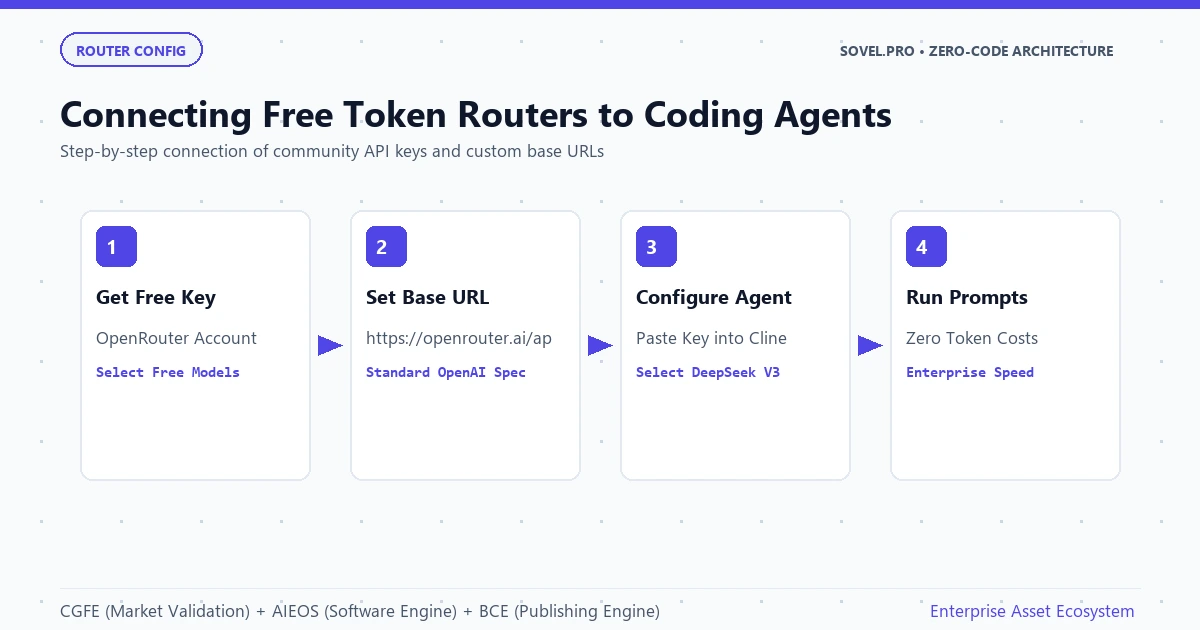
Figure 2: Configuring free token routers inside local coding agent settings using custom base URLs and community API credentials.
The 8,000-Character Project Head Strategy
Free language models are powerful, but their context windows can be overwhelmed if you attempt to manage an entire software project through a single sprawling chat thread. The architectural breakthrough that unlocks the full potential of free ai coding tools for non programmers is the Project Head Strategy.
Instead of relying on chat memory, you create a structured, 8,000-character custom instruction document in a free assistant like ChatGPT, Grok, or DeepSeek. This Project Head acts as the permanent constitution for your software build:
- System Role and Quality Mandate: Defines the agent as a senior software architect adhering to strict security, modularity, and clean coding standards.
- Target Stack and Environment: Declares the exact technology constraints (e.g., vanilla JavaScript, Node.js, SQLite, or PHP 8.2).
- Exhaustive Directory Treemap: Specifies every single folder and file to be created, eliminating confusion about where functions and classes belong.
- Function and Interface Contracts: Outlines exact function names, input arguments, and expected return types across all modules.
- Verification Checklist: Provides a step-by-step testing sequence that the agent must validate before concluding the project.
When you place this Project Head inside your project folder or paste it into your local agent instructions, the free model operates with laser focus. This disciplined methodology proves that you do not need paid proprietary platforms; disciplined prompt architecture turns free ai coding tools for non programmers into an enterprise software factory.
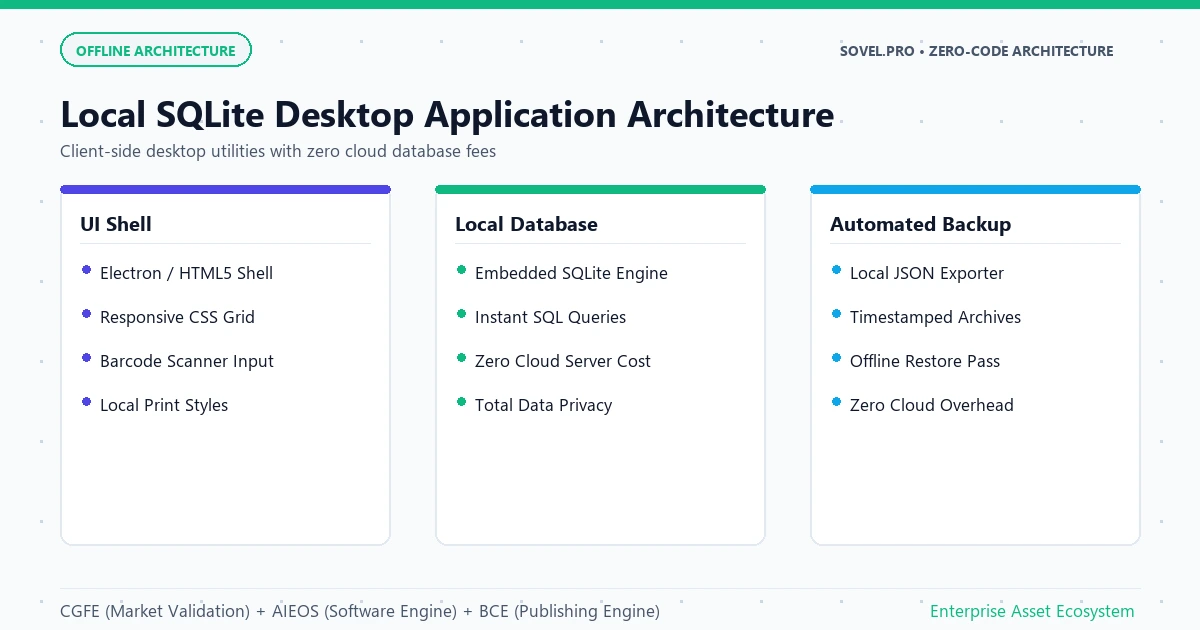
Figure 3: System architecture for a local offline inventory application utilizing embedded SQLite databases and client-side processing.
Detailed Real-World Project Case Study 5: The Offline Retail Inventory and Stock Reconciler
To demonstrate the practical power of free ai coding tools for non programmers, examine how a solo creator engineered the Local SQLite Inventory and Stock Reconciliation System for small retailers. The entire product was built and published without spending a single rupee on tools or API subscriptions.
The opportunity was identified using the Content Gap Finding Engine. Search analysis revealed over 16,000 monthly queries from retail shopkeepers and warehouse operators searching for “offline inventory software free” and “simple stock management without monthly subscription”. Established software vendors charged between $35 and $120 per month for bloated cloud platforms that required constant internet connectivity and held merchant data hostage behind proprietary formats. Small businesses wanted a lean, offline desktop tool that ran locally on their point-of-sale computers. The Content Opportunity Score was computed at an outstanding 94 out of 100.
The creator activated the AI Engineering OS powered exclusively by free ai coding tools for non programmers. Using VS Code, Cline, and free OpenRouter access to DeepSeek V3, the dual-agent pipeline went to work. The planner agent structured a clean Electron and Node.js application backed by an embedded SQLite database. The executor agent implemented stock tracking, barcode scanner input via USB HID, instant invoice and receipt printing, automated low-stock notifications, and local JSON backup routines. Automated testing scripts validated that the application executed with zero external cloud dependencies.
To complete the commercial package, the creator deployed the Book Creation Engine to write a 55,000-word authority book: The Small Business Retail Inventory and Cashflow Management Handbook. Drafted in under five hours, the publication explained optimal reorder formulas, dead stock elimination, and cashflow management. The software and handbook were packaged together and sold for a one-time perpetual license of ₹2,499 ($29). Within 90 days, the product generated 185 sales, delivering over $5,300 in net profit with exactly zero dollars incurred in software subscriptions, API bills, or cloud hosting overhead. This real-world triumph showcases the transformative leverage of free ai coding tools for non programmers.
Terminal Walkthrough: Setting Up Your Environment in Five Minutes
To maximize your efficiency when using free ai coding tools for non programmers, you do not need complex command-line wizardry. You only need a few fundamental commands to verify that your workstation is ready to execute automated coding pipelines.
Open your operating system terminal (PowerShell on Windows, or Terminal on macOS/Linux) and run the following verification sequence:
# Step 1: Verify Node.js and Git installations
node -v
git --version

# Step 2: Create a dedicated directory for your project
mkdir sovel-zero-cost-app
cd sovel-zero-cost-app

# Step 3: Initialize a clean Git repository
git init

# Step 4: Configure your local environment file for OpenRouter
echo "OPENROUTER_API_KEY=your_free_community_token_here" > .env
echo "MODEL_ENDPOINT=https://openrouter.ai/api/v1" >> .env
echo "PRIMARY_MODEL=deepseek/deepseek-r1:free" >> .env
With these four basic steps, your workstation is configured. When you deploy free ai coding tools for non programmers within this structured folder, your coding extensions automatically detect the environment variables, connect to the free router, and start generating application scaffolding without prompting for credit card details.
Documentation and Book Publishing at Zero Cost
A software application achieves maximum commercial value when paired with comprehensive documentation, implementation guides, and educational books. Many builders assume that publishing professional literature requires expensive formatting software like Vellum or Adobe InDesign. In reality, our framework pairs free ai coding tools for non programmers with a zero-cost publishing pipeline.
The Book Creation Engine utilizes a smart document strategy that costs nothing to execute:
- The engine drafts 50,000 to 70,000 words across twelve to sixteen structured chapters using free language model access.
- Output is generated in clean DOC format containing full front matter, copyright disclaimers, and structured headings.
- You open the document in Google Docs (completely free), pair classic fonts like EB Garamond for body text and Inter for clean headings, and verify table of contents links.
- You export production-ready PDF and EPUB files in a single click, perfectly formatted for distribution on Amazon KDP, Gumroad, or direct client downloads.
By leveraging Google Docs and open-source formatting protocols, you produce commercial-grade books without spending a dime on formatting software or wasting API tokens on styling. Combining free software engineering with free publishing protocols ensures that your entire business runs at 100 percent profit margins.
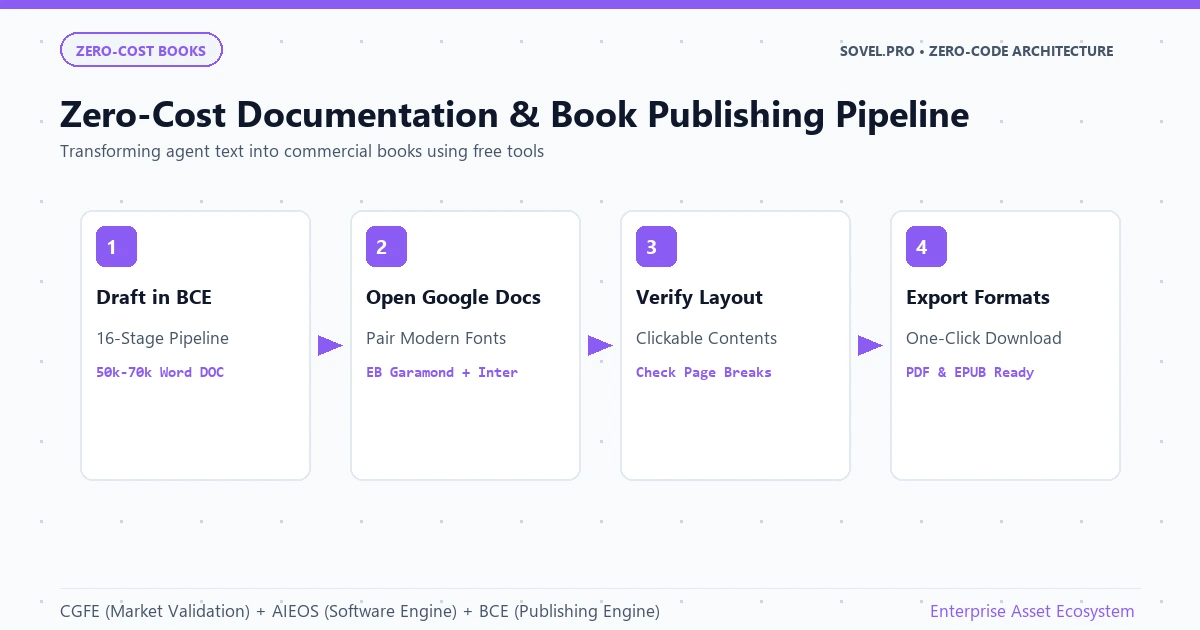
Figure 4: Complete zero-cost publishing workflow turning raw agent output into commercial PDF and EPUB books via Google Docs.
Real-World Authority Proof: The SOVEL Theme and EbookHunt.online
The methodologies outlined here are validated by tangible, functioning production platforms. The custom SOVEL WordPress theme driving sovel.pro and interactive web applications like Sovel Calc were developed without traditional coding agencies. By orchestrating free ai coding tools for non programmers through strict architectural guidelines, the site achieves elite Core Web Vitals, instant page responsiveness, and complete autonomy.
Furthermore, the founder built and deployed ebookhunt.online as an open, verifiable demonstration platform. Operating continuously for over six consecutive months, the site demonstrates that a non-programmer can construct sophisticated interactive platforms using zero-cost agent workflows. The platform hosts a digital book library and features a client-side interactive 3D page-turning flipbook reader tool built entirely with canvas rendering without paid software licenses. This living case study confirms that mastering free ai coding tools for non programmers produces enterprise-grade digital assets that thrive in real-world environments.
Comparison Table: Paid Software Suites vs. The Zero-Cost Stack
| Resource Category | Expensive Commercial Path | Zero-Cost Developer Stack |
|---|---|---|
| Code Editor & IDE | Commercial IDEs ($150 – $300/year) | Visual Studio Code (100% Free Open Source) |
| AI Model Access | Proprietary subscriptions ($20 – $50/month) | OpenRouter Free, OmniRouter, TokenHarbor ($0) |
| Autonomous Coding Agents | Paid subscription coding platforms | Cline and OpenCode VS Code extensions (Free) |
| Book & Manual Formatting | Vellum or InDesign ($249 – $500) | Google Docs + Book Creation Engine pipeline ($0) |
| Total Monthly Overhead | $150 to $400+ per month | Exactly $0.00 perpetual overhead |
Step-by-Step Blueprint: Launching With Zero-Cost Tools
Follow this exact operational checklist to master free ai coding tools for non programmers and build your first digital product:
- Step 1: Install Open-Source Runtimes: Download Node.js and Git from their official websites. Install Visual Studio Code on your machine.
- Step 2: Install Autonomous Agent Extensions: In VS Code, install Cline or OpenCode from the extension marketplace.
- Step 3: Register Free Community Router Keys: Sign up for OpenRouter or Google AI Studio to secure free API tokens. Configure your extension with the free model endpoints.
- Step 4: Conduct Market Gap Research: Use free search engine research and the Content Gap Finding Engine to identify underserved software or content niches.
- Step 5: Draft Your 8,000-Character Project Head: In ChatGPT or Grok, define your application logic, directory treemap, and file checklist.
- Step 6: Execute Dual-Agent Coding: Have the planner agent create your project scaffolding, and let the executor agent generate each code file with automated syntax checks.
- Step 7: Produce the Companion Authority Book: Feed your software concept into the Book Creation Engine to write an exhaustive 50,000-word user playbook.
- Step 8: Deploy and Monitize: Launch your tool on free edge hosting (GitHub Pages, Cloudflare) and sell licenses or companion handbooks on Gumroad.
Frequently Asked Questions
Can free ai coding tools for non programmers match the quality of paid subscriptions?
Yes. Open-source and community models like DeepSeek V3, DeepSeek R1, and Qwen 2.5 Coder achieve benchmark scores comparable to proprietary models on real-world coding tasks. When guided by strict project heads and dual-agent architecture, they produce exceptional code.
Are there hidden fees when using community token routers?
No. Community routers clearly distinguish between free tiers and paid tiers. Models labeled as free require zero credits and do not charge your account.
Do I need an expensive computer when using free ai coding tools for non programmers?
No. Because language model inference runs in the cloud through the model routers, your local computer only handles text editing in VS Code and lightweight testing. Any standard laptop or desktop with 8GB of RAM can run this entire setup smoothly.
How do I fix coding bugs when using free ai coding tools for non programmers?
When an error occurs, you simply copy the terminal error message or browser console log and paste it back into your executor agent. Guided by the project head, the agent identifies the root cause and generates an immediate fix.
Can I build commercial software using free open-source tools?
Yes. The tools in this stack (Node.js, VS Code, Git, SQLite) are licensed under permissive open-source licenses (MIT, Apache 2.0, Public Domain) that grant you full commercial rights to sell the software you build.
Conclusion: Financial Freedom Through Open Toolchains
The belief that you need substantial capital to build digital products is obsolete. By harnessing free ai coding tools for non programmers alongside the Content Gap Finding Engine, the AI Engineering OS, and the Book Creation Engine, you possess all the capabilities required to build enterprise software and commercial publications. Set up your local workstation, connect your free model routers, deploy your project head, and start creating permanent digital assets that generate revenue with zero overhead.