
The Underestimated Asset: Why Existing Content Holds Your Biggest Growth Opportunities
Most publishing teams operate on an endless treadmill of producing brand-new articles every week. They constantly brainstorm new titles while ignoring the dozens of articles already sitting on their server. Learning how to find content gaps in existing content is one of the highest-leverage skills in organic search because updating an established URL that already possesses indexation history and backlinks delivers rankings much faster than publishing on a blank URL.
A content gap in published work occurs when an existing article ranks for secondary search queries on page two or three of Google, but fails to provide a thorough, direct answer to those specific sub-queries. To systematically audit published articles and uncover hidden search demand on your local machine, many publishers deploy the Content Gap Finding Engine, an evidence-based Python research framework built to inspect content inventories and identify missing subtopics without recurring SaaS fees.
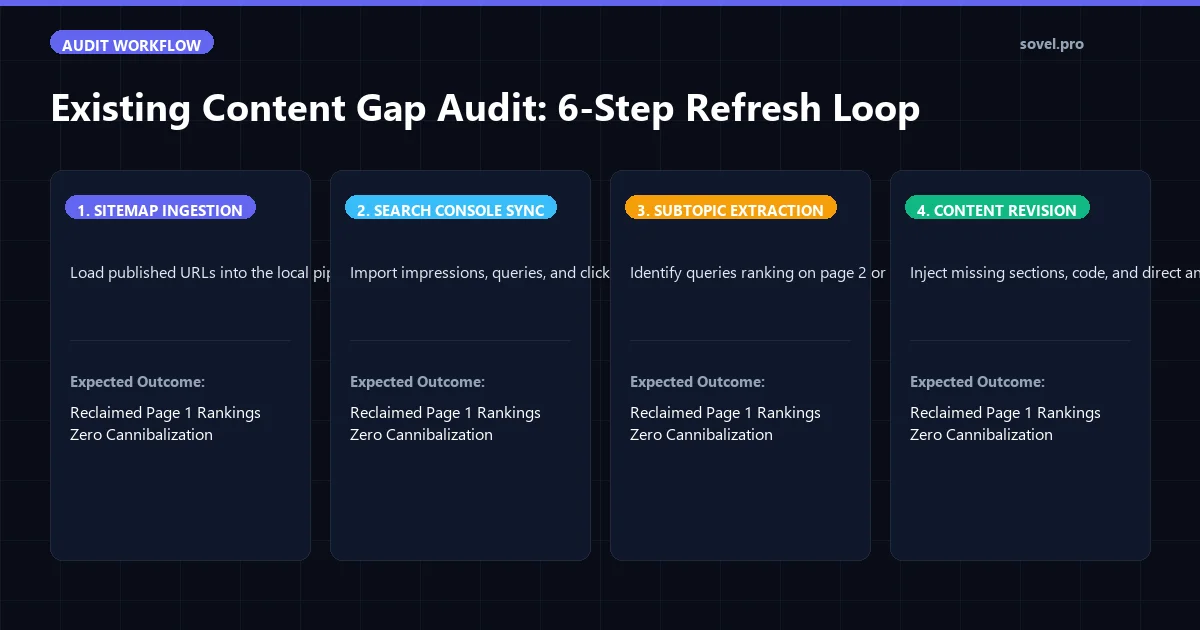
A systematic 6-step refresh loop turns declining or stagnant URLs into authoritative, high-ranking pages.
When you master how to find content gaps in existing content, you stop treating published posts as static museum pieces. Instead, your content library becomes an evolving, living system where every article is periodically audited, expanded with fresh data, and aligned with observed user search queries.
Step 1: Extracting Secondary Queries from Google Search Console
The first step in understanding how to find content gaps in existing content begins with your first-party search data. Google Search Console records the exact queries that cause your pages to appear in search results, even if those queries never received a click.
When learning how to find content gaps in existing content, to extract these high-probability opportunities, follow this diagnostic workflow:
- Open Google Search Console and improve to the Performance > Search Results report.
- Select a date range of the last six months to ensure statistically significant query volume.
- Filter by a specific target URL that you want to audit.
- Sort the query table by Impressions in descending order.
- Identify queries where the average position is between 8 and 25, but the click-through rate is below two percent.
These secondary queries represent explicit gaps. Google already associates your page with the topic, but because your article only mentions the term in passing or buries it near the footer, searchers bounce and the algorithm keeps your ranking on page two. Documenting these queries is the core foundation when learning how to find content gaps in existing content.
Step 2: Evaluating Search Intent Mismatch on Stagnant URLs
Once you have a list of impression-rich secondary queries, you must examine the actual search intent behind them. In many cases, an existing article fails to rank because its layout fails to match what searchers expect.
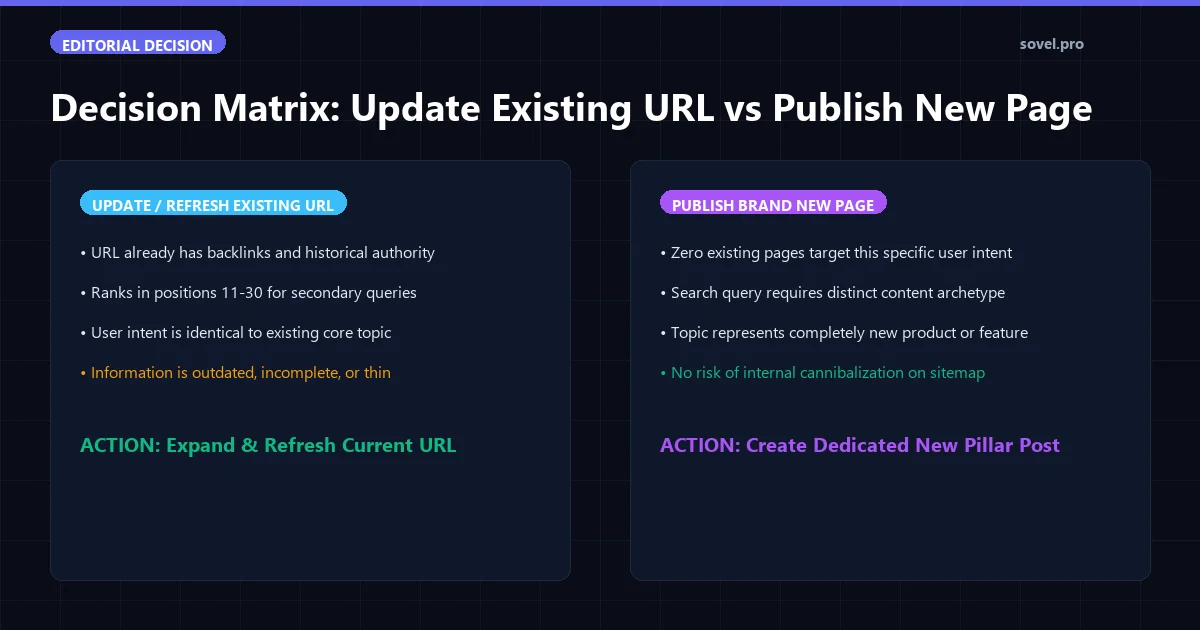
Evaluating whether to expand an existing URL or publish a separate page prevents internal competition.
When studying how to find content gaps in existing content, check whether the searcher wants a fast reference table, a command syntax snippet, or a complete troubleshooting workflow. If a user types “python sqlite cache schema” and lands on your high-level overview of database concepts, they will immediately leave. By adding a dedicated H3 heading with an explicit SQLite schema diagram and code sample, you satisfy that specific intent directly inside your existing article.
Using the Content Gap Finding Engine, creators can run automated keyword comparison checks that compare current page text against top-ranking SERP snippets, pinpointing the exact semantic terms and questions your article currently omits.
Step 3: Detecting Content Decay and Falling Traffic Patterns
Content decay is the gradual loss of organic search traffic over time as competitors update their resources, external links break, or search engine guidelines evolve. Recognizing content decay is a critical component of how to find content gaps in existing content.
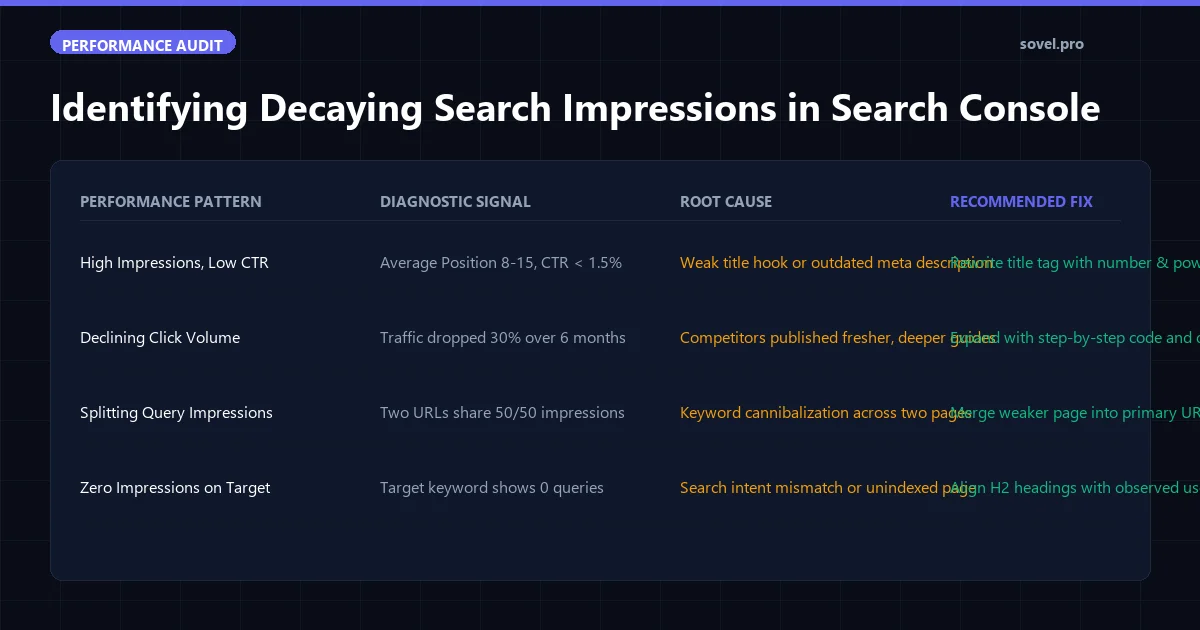
Analyzing impression drops and CTR declines highlights which legacy articles require urgent editorial expansion.
Look for pages that experienced peak traffic twelve to eighteen months ago and have steadily lost five to ten percent of their impressions each quarter. These URLs do not require deletion; they require an evidence-backed refresh. When you understand how to find content gaps in existing content, an afternoon spent updating three decaying URLs can restore thousands of monthly organic visits with zero new URL creation.
Step 4: Executing the 5-Gate Content Expansion Checklist
When updating an existing post, avoid superficial edits like tweaking a single sentence or changing the date stamp without adding real substance. Search algorithms evaluate information gain and user satisfaction. Apply this structured 5-gate checklist:
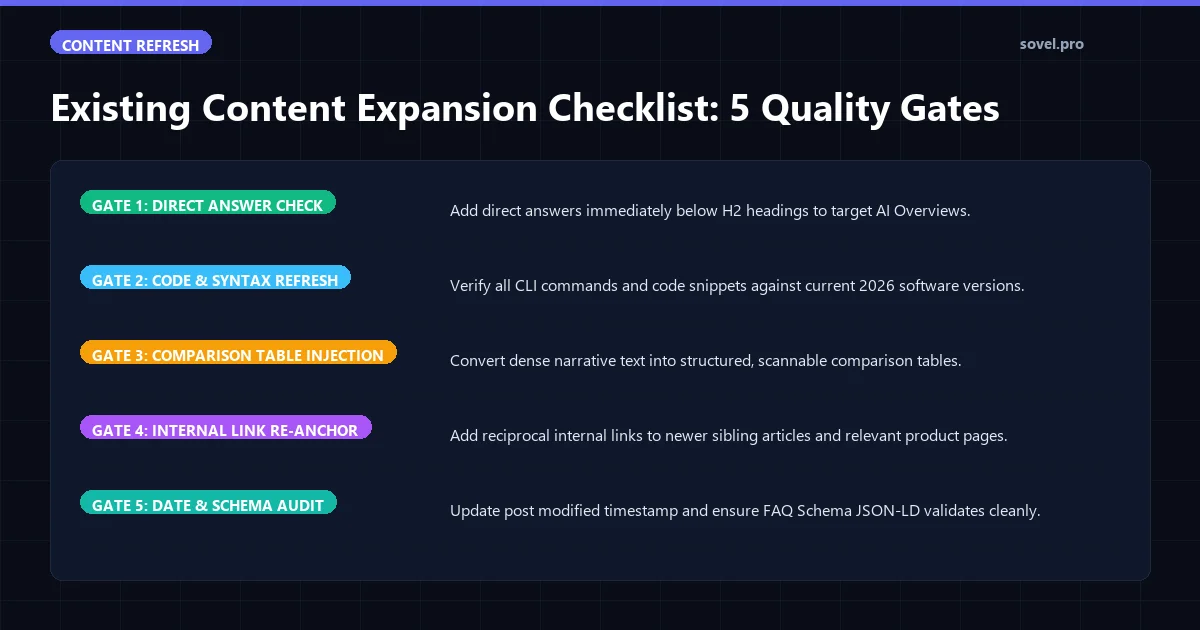
Five strict quality gates ensure that content updates deliver measurable ranking improvements.
- Gate 1: Direct Answer Verification. Place a concise, 40-word declarative answer immediately beneath the primary H2 to target Featured Snippets and AI Overviews.
- Gate 2: Code and Syntax Validation. Test all terminal commands, library imports, and code blocks to confirm compatibility with current 2026 software standards.
- Gate 3: Data Table Formatting. Replace narrative paragraphs with scannable HTML comparison tables containing specifications, limits, or parameters.
- Gate 4: Reciprocal Internal Linking. Add contextual links to newer sibling articles and relevant software tools across your domain.
- Gate 5: Structured Data Audit. Validate that your FAQPage and Article Schema JSON-LD markup complies with official Google Search Central documentation.
Following this disciplined process ensures that whenever you execute how to find content gaps in existing content, your refreshed articles deliver superior depth and actionable clarity.
Step 5: Deciding Between Updating an Existing URL vs Publishing a New Page
A frequent dilemma when learning how to find content gaps in existing content is determining whether a discovered gap should be added to an existing post or given its own dedicated page. Making the wrong decision can cause keyword cannibalization, where two of your pages fight for the same ranking position.
| Evaluation Factor | Expand Existing URL | Publish Dedicated New Page |
|---|---|---|
| Search Intent Match | Sub-topic directly supports the primary topic | Distinct intent requiring separate user journey |
| Current URL Authority | Page already has backlinks and historical clicks | No relevant URL currently exists on sitemap |
| Query Search Volume | Long-tail modifier query (under 200 monthly) | Substantial standalone head term (500+ monthly) |
| Content Format Fit | Requires a 300-word subsection or table | Requires a complete 2,200-word technical guide |
| Cannibalization Risk | Zero risk; consolidates topical authority | High risk if target query overlaps existing H2 |
This decision framework prevents content bloat and keeps your domain architecture clean and structured. Knowing how to find content gaps in existing content allows you to expand your search footprint safely without diluting existing page authority.
Step 6: Real-World Case Study: Transforming a Stagnant Technical Guide
To demonstrate the practical mechanics of how to find content gaps in existing content, consider an actual audit conducted on a technical programming article titled “Python SQLite Database Guide”.
Initially published twelve months prior, the article ranked in position 14 for several high-volume queries, generating approximately 180 monthly clicks despite registering over 9,500 impressions. A manual review revealed that users were typing queries such as “sqlite wal mode in python”, “pragma foreign keys python”, and “sqlite multithreading locking error”.
The original post mentioned none of these advanced execution details. It merely demonstrated basic table creation and simple insert queries. By knowing how to find content gaps in existing content, the editorial team performed a targeted surgical expansion:
- They added an H3 heading: “Configuring Write-Ahead Logging (WAL) for High Concurrency”, complete with four lines of Python code demonstrating
cursor.execute("PRAGMA journal_mode=WAL;"). - They inserted an explicit troubleshooting callout explaining how to prevent database locks when multiple worker threads write to disk simultaneously.
- They added an HTML comparison table contrasting Rollback Journal versus WAL mode performance across read-heavy workloads.
- They updated the schema markup and republished the article without changing the root URL slug.
Within eighteen days of Google recrawling the expanded URL, impressions grew by 240 percent, and the page jumped from position 14 to position 4 for the primary query cluster. This remarkable return on effort illustrates why learning how to find content gaps in existing content delivers superior ROI compared to publishing unproven new URLs from scratch.
Step 7: Automating Local Audits with the Content Gap Finding Engine CLI
Conducting manual audits across an inventory of fifty or one hundred published articles is labor-intensive. The Content Gap Finding Engine automates this entire audit pipeline directly on your local developer machine.
The engine includes a native command-line interface designed to inspect sitemaps, query search adapters, and cross-reference published text against observed search intent. Here is how developers run an automated audit:
# Step 1: Initialize local environment
python -m adhil_engine init --output ./audit_data

# Step 2: Ingest current published sitemap
python -m adhil_engine ingest --sitemap https://example.com/sitemap.xml

# Step 3: Run comprehensive content gap audit
python -m adhil_engine run --mode audit-existing --min-score 50
When you execute this command, the engine queries its ten local adapters, evaluates your existing page content against live Autocomplete and PAA question graphs, and calculates an objective Opportunity Score for each unaddressed subtopic. This local automation empowers creators to master how to find content gaps in existing content without recurring SaaS fees.
| Audit Pipeline Stage | Operational Command | Output Artifact |
|---|---|---|
| Environment Diagnostics | python -m adhil_engine doctor | System health status (0 errors, 79 tests passed) |
| Sitemap Parsing | python -m adhil_engine ingest | Local SQLite inventory of all published URLs |
| Intent Extraction | python -m adhil_engine run | Ranked CSV report of unaddressed subtopics |
| Editorial Briefing | python -m adhil_engine export --format md | Ready-to-write markdown content specification |