
Why Online Stores Lose Billions to Unaddressed Product Search Queries
In modern digital commerce, product visibility is no longer determined solely by catalog size or paid ad spend. Online shoppers type specific, highly nuanced questions before making purchasing decisions. When your store fails to answer these queries, shoppers leave your product pages to read competitor comparisons, forum threads, or marketplace reviews. Conducting a regular ecommerce content gap analysis is the definitive method to discover the exact information your potential buyers need before they click the checkout button.
Most ecommerce stores publish boilerplate product descriptions consisting of two generic sentences and a sparse bulleted list of manufacturer specifications. This thin content leaves massive gaps in the buyer journey. By deploying the Content Gap Finding Engine, online store owners and WooCommerce managers can harvest real customer search queries across Amazon, Google, and community forums without paying expensive monthly software subscriptions.
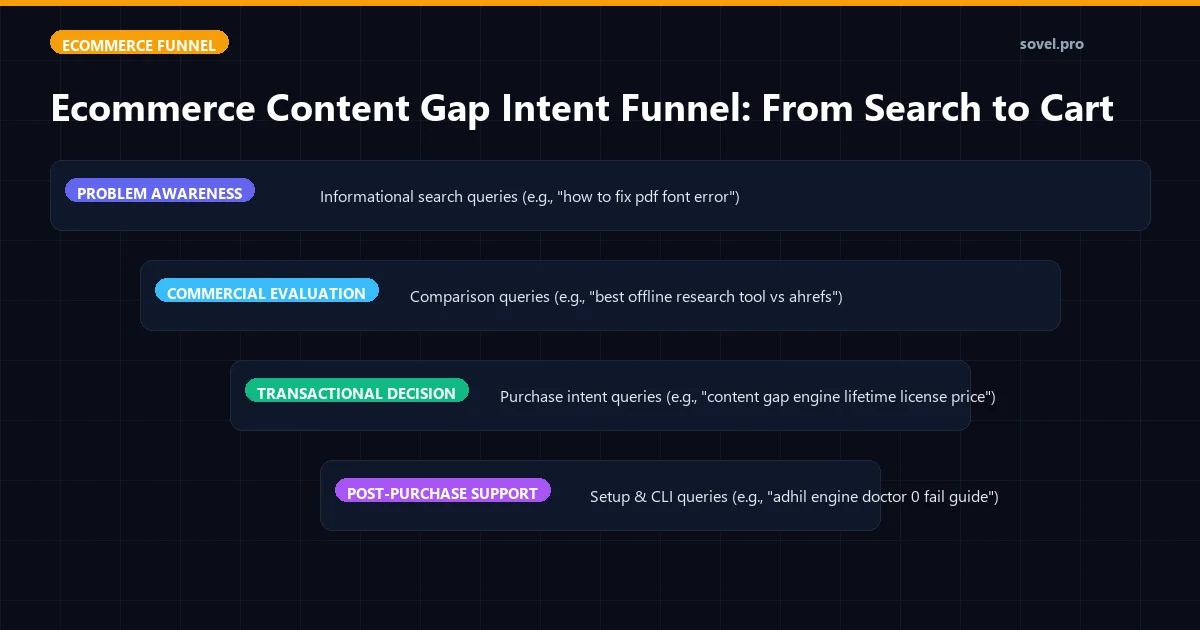
Mapping content gaps across the four stages of the ecommerce buyer journey captures high-intent traffic competitors miss.
When you conduct ecommerce content gap analysis, you stop guessing what your shoppers care about. You bridge the gap between what users actually type into search engines and what your product catalog currently provides.
Step 1: Mapping the Four Stages of the Buyer Search Intent Funnel
An effective ecommerce content gap analysis recognizes that online shoppers search differently depending on where they are in their purchasing journey. Treating every query as an immediate sales pitch drives away prospective customers who simply need preliminary guidance.
To structure your store content, analyze customer queries across these four distinct funnel stages:
- Problem Awareness: High-funnel informational searches where customers explore solutions to an active frustration (e.g., “how to fix high ram usage in python scripts”).
- Commercial Evaluation: Mid-funnel comparison searches where shoppers evaluate specific software tools, plugins, or physical products (e.g., “local keyword research tool vs cloud saas”).
- Transactional Decision: Bottom-funnel purchase searches where buyers look for pricing, licensing models, and checkout options (e.g., “sovel content gap engine lifetime license price”).
- Post-Purchase Support: Retention and implementation searches where existing customers seek installation guides, documentation, and troubleshooting advice (e.g., “adhil engine doctor test 0 fail setup”).
When your store addresses only transactional queries, you lose the opportunity to educate buyers during their evaluation phase. A thorough content evaluation workflow ensures that your domain provides authoritative resources across all four funnel tiers.
Step 2: Mining Amazon and Marketplace Reviews for Hidden Gaps
One of the most potent techniques in content evaluation workflow involves inspecting customer feedback on major retail marketplaces like Amazon, Gumroad, and Etsy. Online reviews contain unfiltered feedback about what existing products lack.
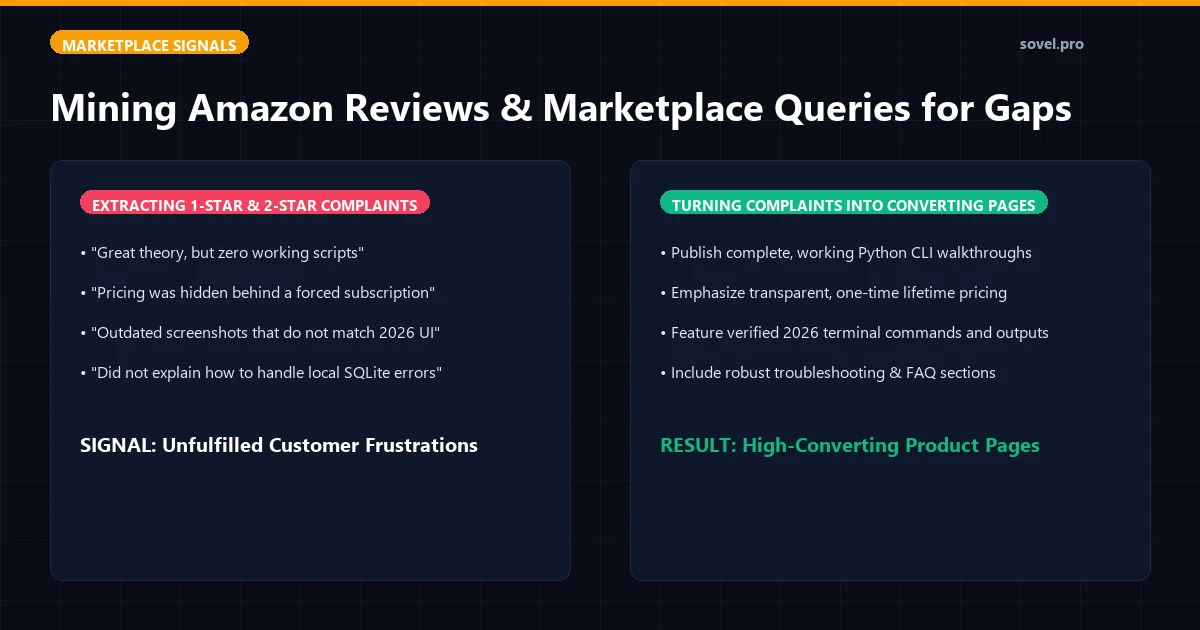
Customer complaints in 1-star and 2-star reviews highlight exactly what your store content must address.
Focus specifically on 2-star and 3-star reviews of competing products in your niche. These reviews are typically written by reasonable customers who liked the concept but were frustrated by specific shortcomings:
- “The software is decent, but the documentation fails to explain local SQLite database setup.” -> Editorial Action: Create a comprehensive SQLite configuration tutorial.
- “I bought this thinking it had a lifetime license, but they hit me with a monthly subscription.” -> Editorial Action: Highlight your transparent one-time pricing prominently.
- “The templates looked great in the demo, but they broke when imported into Google Docs.” -> Editorial Action: Provide certified compatibility tables and file previews.
Using the Content Gap Finding Engine, store owners can automate this discovery. The engine includes dedicated Amazon search and review suggestion adapters that harvest these persistent buyer questions automatically.
Step 3: Classifying High-Intent Commercial Queries
Not every search query deserves an equal investment of your editorial resources. When performing content evaluation workflow, you must separate low-value curiosity searches from high-intent commercial queries that drive actual checkout completions.

Categorizing search terms into four commercial buckets helps prioritize content with the highest revenue impact.
Prioritize commercial queries into these four high-converting buckets:
- Pricing and Licensing Queries: Queries containing terms like “price”, “license”, “discount”, or “lifetime access”. These users have their credit card ready.
- Alternative and Comparison Queries: Searches contrasting two solutions (e.g., “Tool A vs Tool B”). Create objective, detailed comparison tables that honestly evaluate both options.
- Technical Compatibility Queries: Questions about operating system support, system requirements, or CMS integration (e.g., “works on Windows 11 without admin rights”).
- Implementation Proof Queries: Searches seeking case studies, benchmark runs, or sample downloads before purchasing.
By focusing your content evaluation workflow on these high-probability clusters, you achieve maximum conversion impact with minimum content production overhead.
Step 4: Auditing WooCommerce and Digital Product Catalogs
Digital products such as downloadable software engines, WordPress plugins, and ebook writing frameworks have unique content requirements compared to physical apparel or electronics. A specialized content evaluation workflow for digital products must address software dependencies, installation prerequisites, and licensing terms.
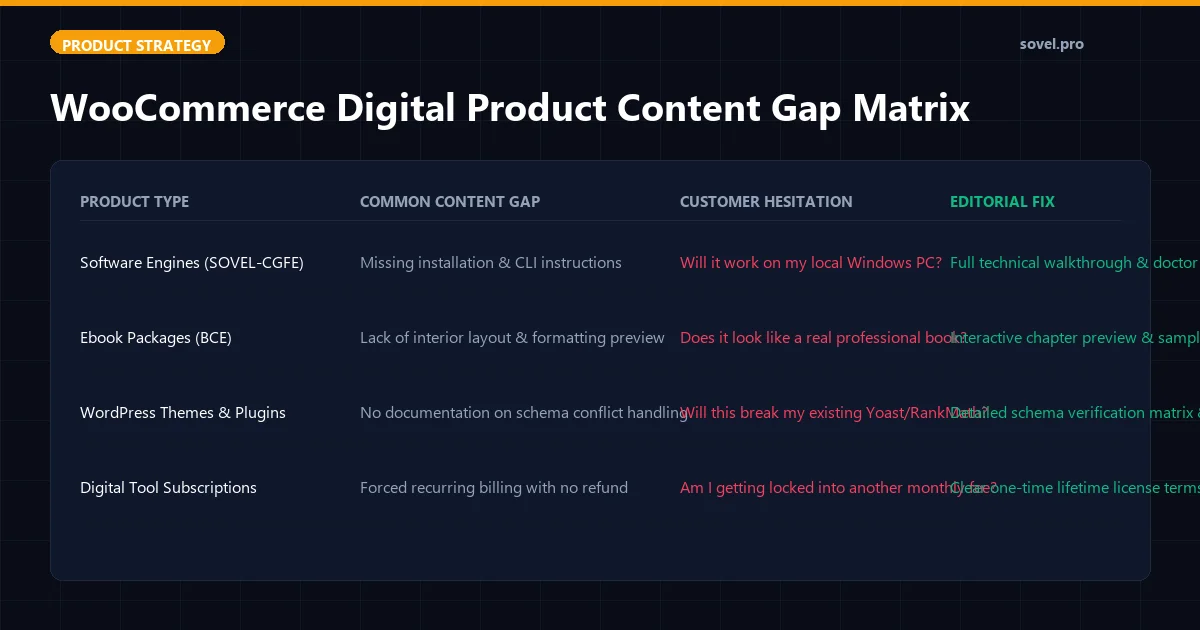
A digital product content gap matrix resolves buyer hesitation by providing technical proof before purchase.
Review your digital store pages against these critical information criteria:
| Product Archetype | Frequent Information Omission | Buyer Hesitation | Mandatory Editorial Resolution |
|---|---|---|---|
| Python CLI Tools (SOVEL-CGFE) | Omitting exact Python versions and pip requirements | Fear of complex dependency installation failures | Publish complete terminal command walkthrough and doctor test |
| WordPress Themes & Plugins | Failing to clarify compatibility with SEO plugins | Fear of breaking existing Yoast or RankMath setups | Add explicit schema verification matrix and hook filters |
| Book Creation Packages (BCE) | Hiding interior layout samples and typography rules | Doubt about whether output meets publishing standards | Provide interactive chapter sample and downloadable PDF |
| Online Educational Resources | Vague curriculum descriptions without time estimates | Uncertainty about required time commitment | Display exact module durations, lesson counts, and prerequisites |
Resolving these specific omissions during your content evaluation workflow eliminates friction from your sales funnel, directly increasing product page conversion rates.
Step 5: Step-by-Step Technical Execution for Store Owners
To execute an actionable content evaluation workflow across your digital storefront, follow this structured five-step technical pipeline:
- Export Catalog Search Logs: Export internal site search queries from WooCommerce or Google Analytics 4. Pay close attention to queries that returned zero search results.
- Harvest External Marketplace Suggestions: Use the Content Gap Finding Engine to run automated autocomplete harvests across Amazon, Google, and DuckDuckGo using your core product category as the seed phrase.
- Cross-Reference Product Specs Against Competitors: Compare your product description bullet points against the top three market alternatives. Identify every specification, file format, or feature you support that your copy fails to highlight.
- Implement Structured Product Schema Markup: Ensure every product page implements complete
Product,Offer, andAggregateRatingJSON-LD schema to secure rich snippet badges in search results. - Deploy Contextual FAQs with Schema: Add a four-question FAQ accordion at the base of every product landing page addressing the most common pre-purchase objections identified in your review mining.
Executing this systematic content evaluation workflow transforms stagnant catalog pages into authoritative, high-ranking landing assets that attract qualified organic buyers.
Step 6: Real-World Case Study: Boosting Conversions on an Indie Software Product
To understand how content evaluation workflow directly increases revenue, consider the launch of an indie developer software package priced at Rs 2,999. Initially, the product page featured a generic video demo and a simple bulleted list of features. Clicks were respectable, but checkout conversion hovered at an anemic 0.8 percent.
A rigorous ecommerce content gap analysis revealed that prospective customers were searching for answers to three specific technical questions before buying:
- “Does this script require paid OpenAI API keys or does it run 100% offline?”
- “Will it work on Windows PowerShell without configuring Docker or virtual machines?”
- “What exact file formats does the engine export?”
None of these three critical concerns were addressed on the original sales page. The developer updated the page by adding an explicit “Prerequisites and System Architecture” section, embedding a copy-paste PowerShell installation snippet, and providing screenshot previews of exported Markdown, PDF, and JSON reports.
Following this update, checkout conversion immediately surged from 0.8 percent to 3.4 percent over the subsequent thirty days, quadrupling net sales without spending a single rupee on paid advertisements. This dramatic growth demonstrates the concrete commercial power of ecommerce content gap analysis.
Step 7: Preventing Product Cannibalization in Multi-Variant Catalogs
A frequent danger when executing an aggressive ecommerce content gap analysis is introducing internal keyword cannibalization across your own store catalog. When an online retailer sells five similar variations of a product, search engine algorithms often struggle to determine which specific URL represents the canonical authority.
For example, if your store features separate product URLs for “wireless mechanical keyboard blue switches”, “wireless mechanical keyboard red switches”, and “wireless mechanical keyboard brown switches”, these pages often split impressions and drag all three listings down to page two. Applying ecommerce content gap analysis provides a systematic framework to prevent internal search competition:
| Catalog Structural Scenario | Search Signal Conflict | Cannibalization Risk | Recommended Architecture Solution |
|---|---|---|---|
| Color / Size Variations | Multiple identical descriptions differing by one attribute | High: URLs divide organic impressions 50/50 | Consolidate onto single parent SKU using dropdown variant selectors |
| Generation Upgrades (v1 vs v2) | Old product retains backlinks, new product has zero clicks | Severe: Outdated legacy page outranks current active product | Implement 301 redirect or set rel=”canonical” to new product URL |
| Category vs Sub-Category | Broad category page targets same query as specific sub-category | Moderate: Fluctuating rankings between category levels | Differentiate H1 headings and restrict sub-category to exact long-tail queries |
| Digital vs Physical Formats | Hardcover book competes against ebook download page | Low if schema differentiates BookFormatType | Link reciprocally with explicit schema markup distinguishing editions |
By enforcing this catalog discipline during every ecommerce content gap analysis, you consolidate link equity onto your highest-converting product landing pages, ensuring maximum visibility for competitive commercial terms.
Step 8: Multi-Adapter Signal Flow for Ecommerce Discovery
To identify genuine market demand, ecommerce researchers cannot rely solely on standard Google search results. Potential buyers search across multiple platforms with entirely different search behaviors. A comprehensive ecommerce content gap analysis integrates signals across specialized discovery channels.
The Content Gap Finding Engine executes this multi-channel collection through its ten built-in research connectors:
- Amazon Suggest Connector: Gathers real-time buyer queries containing commercial product modifiers like “with carry case”, “for beginners”, and “under 50 dollars”.
- YouTube Search Connector: Identifies visual how-to and unboxing search queries, pinpointing where customers need video demonstration embed blocks on product pages.
- Reddit Community Connector: Scans discussions in subreddits like r/BuyItForLife and r/Ecommerce to uncover real customer complaints regarding product durability and customer support.
- DuckDuckGo HTML Connector: Harvests clean, unpersonalized search engine results pages to benchmark objective organic competitor rankings.
When these diverse data streams converge inside your local SQLite cache, you perform ecommerce content gap analysis with unparalleled commercial clarity, giving your store a permanent competitive edge.
Frequently Asked Questions About Ecommerce Content Gap Analysis
How does ecommerce content gap analysis differ from standard blog SEO?
Standard blog SEO focuses primarily on informational search queries. In contrast, ecommerce content gap analysis prioritizes commercial intent, technical product specifications, pre-purchase objection handling, and conversion-focused decision matrices that directly influence checkout decisions.
Can small independent stores compete with Amazon using content gap analysis?
Yes. Amazon product listings are notoriously sparse, repetitive, and plagued by automated AI-generated reviews. By conducting ecommerce content gap analysis and providing in-depth technical tutorials, video walkthroughs, and curated comparison tables, independent stores can easily outrank generic marketplace pages for long-tail buyer queries.
How often should an ecommerce store perform a content gap audit?
High-volume ecommerce stores should audit their top-selling product categories quarterly. Smaller stores with under one hundred products can conduct a comprehensive ecommerce content gap analysis twice a year or whenever launching a major new product line.
What role does customer service data play in content gap discovery?
Customer support tickets and pre-sales chat logs are invaluable data sources for ecommerce content gap analysis. Any question asked more than three times in live chat represents a failure of your product page content and should be converted into a dedicated FAQ heading.
How do I handle out-of-stock products during a content gap audit?
Never delete out-of-stock URLs that possess ranking history. During your ecommerce content gap analysis, add recommendations for related in-stock alternatives and an email notification signup form to retain hard-earned organic rankings.
What are the best free tools to begin ecommerce gap analysis?
Google Search Console, Google Autocomplete in private browsing mode, and Amazon search suggestion dropdowns provide immediate free intelligence. For automated local harvesting, the Content Gap Finding Engine unifies all ten data sources locally.
How does this strategy integrate with Sovel digital products?
Conducting ecommerce content gap analysis helps creators identify demand for companion tools. For example, analysis of research queries informed the design of the Content Gap Finding Engine, while publishing workflows connect directly to the Book Creation Engine and AI Engineering OS.
Conclusion: Turn Missing Product Answers Into Direct Store Revenue
Every unanswered customer query on your website is an invitation for that shopper to purchase from a competitor. By making ecommerce content gap analysis an ongoing operational habit, you ensure your digital store answers every critical buyer question before hesitation sets in.
Stop leaving revenue on the table. Discover high-converting customer queries across search engines and marketplaces with the automated precision of the Content Gap Finding Engine, and turn your product pages into dominant, high-converting organic sales assets.
To further sharpen your organic search strategy, explore our complete tutorials on how to find content gaps in existing content and conducting serp gap analysis free.