
How to Deconstruct Search Engine Results Pages Without Paid Enterprise Tools
Search engine results pages are the most transparent competitive research laboratory in existence. Every time you submit a query, Google and Bing reveal exactly which content formats they prefer, which questions searchers ask next, and which specific information gaps exist among top-ranking URLs. Learning how to perform serp gap analysis free allows independent publishers, developers, and creators to identify high-probability ranking opportunities using publicly accessible search features without spending hundreds of dollars on monthly subscription tools.
A SERP gap occurs when the current search results page fails to provide a comprehensive, direct, or updated answer to the searcher’s core problem. To automate this SERP deconstruction process locally on your computer, many practitioners rely on the Content Gap Finding Engine, a lightweight Python research tool that harvests search suggestions, questions, and discussion signals without recurring SaaS fees.
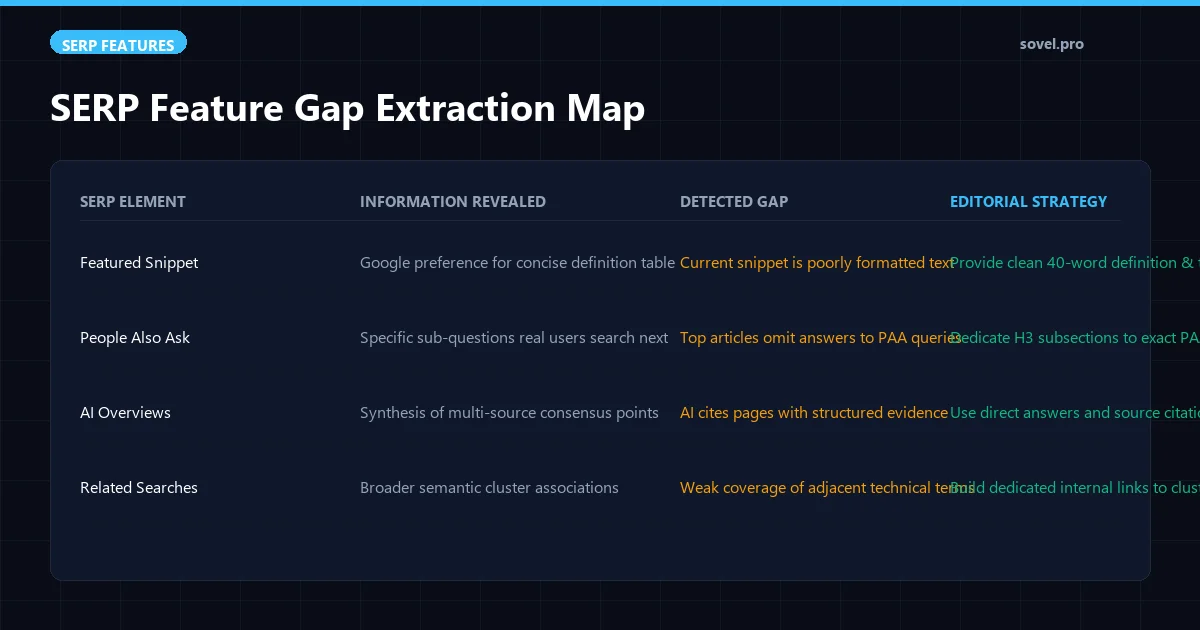
Deconstructing four primary SERP features reveals high-value content gaps hidden in plain sight.
When you conduct serp gap analysis free, you stop relying on third-party keyword difficulty scores that are often inaccurate or outdated. Instead, you analyze the living, real-time search improve directly.
Step 1: Deconstructing Rich SERP Features for Editorial Opportunities
Modern search results pages are no longer just ten blue links. They are dynamic information dashboards packed with specialized search features. An effective serp gap analysis free examines four distinct SERP components to identify editorial weaknesses:
- Featured Snippets: Appears at position zero. If the current snippet displays a poorly formatted paragraph, you can capture this position by publishing a cleaner, more concise 45-word definition or structured HTML table.
- People Also Ask (PAA): Displays dynamic cascades of related questions. When ranking articles fail to answer these exact questions, an editorial gap is immediately confirmed.
- AI Overviews: Synthesizes multi-source consensus answers. AI engines cite pages that feature clear semantic structure, verified facts, and zero promotional fluff.
- Related Searches: Located at the bottom of the page, this list reveals the broader semantic entity cluster that search algorithms associate with your primary topic.
By systematically recording these SERP features across your target topics, you execute content evaluation workflow at an institutional standard using nothing more than your web browser.
Step 2: Building Intent Trees from People Also Ask (PAA) Data
The People Also Ask accordion is one of the most valuable sources of unfulfilled search demand. When you click a PAA question, Google dynamically loads two to three additional related questions, creating an expanding tree of user inquiry.
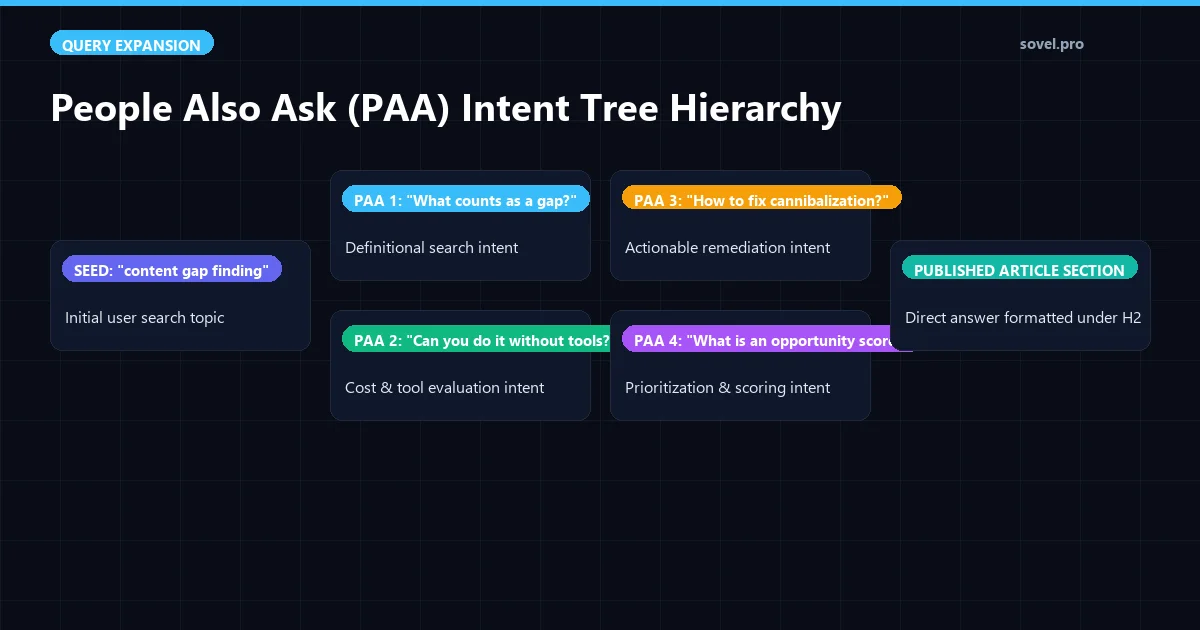
Expanding PAA question trees reveals the logical sequence of questions readers need answered.
When performing content evaluation workflow, map these cascading PAA questions into a structured topical hierarchy:
- Seed Query: “content gap analysis”
- Branch 1 (Definition): “What is a content gap in SEO?” -> Dedicate an introductory H2 section with a crisp 40-word definition.
- Branch 2 (Tool Evaluation): “Can I find content gaps without paid tools?” -> Provide an objective comparison of free local scripts versus expensive SaaS subscriptions.
- Branch 3 (Remediation): “How do I fix content overlap and cannibalization?” -> Include an explicit decision matrix and 301 redirect checklist.
- Branch 4 (Prioritization): “How do you score content opportunities?” -> Present an auditable 4-pillar mathematical scoring formula.
Using the Content Gap Finding Engine, publishers can harvest these PAA hierarchies automatically. The engine’s native Python adapters extract and organize question clusters directly into ready-to-write editorial briefs.
Step 3: Optimizing for AI Overviews and Generative Engine Citations
The emergence of AI Overviews in Google and Bing has transformed organic search. Rather than clicking through to several websites, users increasingly rely on AI-generated synthesis summaries. Understanding serp gap analysis free in 2026 requires understanding how AI engines select their citation sources.
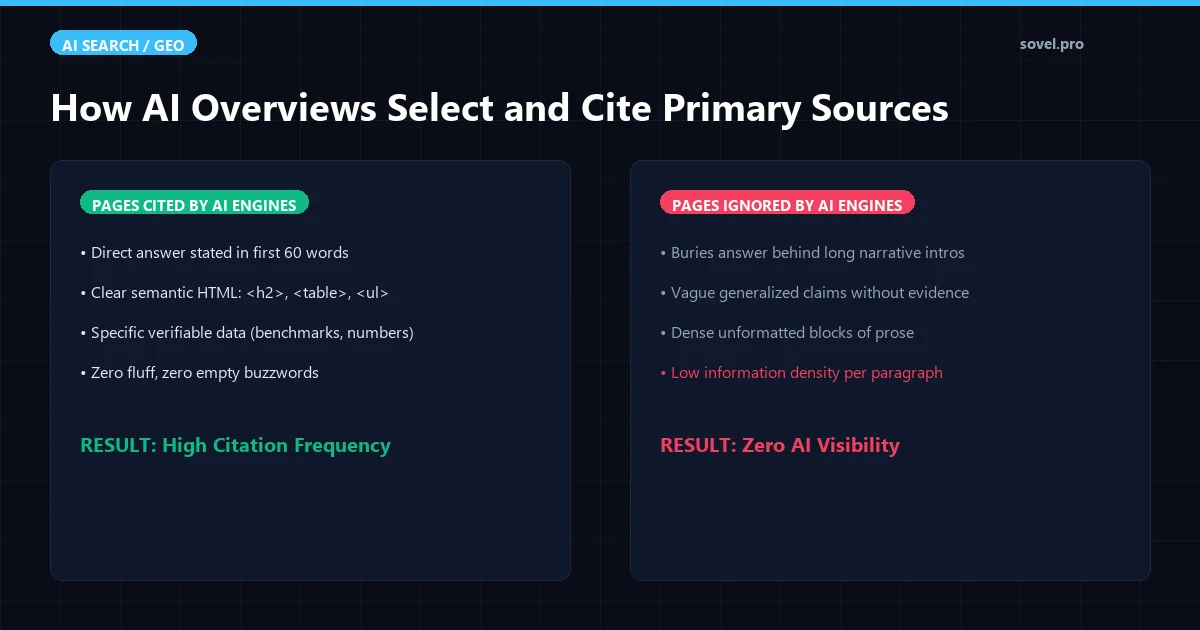
AI search engines prioritize pages with high information density, direct answers, and structured HTML elements.
AI engines prioritize pages that satisfy these specific criteria:
- Immediate Direct Answer: Place the core factual answer within the first 60 words beneath your H2 heading. Avoid conversational throat-clearing.
- Semantic HTML Structure: Use clean
<h2>,<h3>,<table>, and<ul>markup so AI scrapers can parse key relationships without ambiguity. - Verifiable Data Points: Include specific numbers, benchmarks, version numbers, and parameters. AI engines favor objective evidence over subjective opinions.
- Zero Empty Buzzwords: Avoid promotional filler terms that dilute semantic clarity.
When you conduct serp gap analysis free through this lens, you identify established competitor pages that AI Overviews ignore due to poor structuring, allowing you to claim prominent citation links.
Step 4: Executing a Featured Snippet Opportunity Audit
Featured Snippets represent the fastest shortcut to position zero. When auditing a SERP, check whether the currently featured result is vulnerable to being supplanted by a superior format.
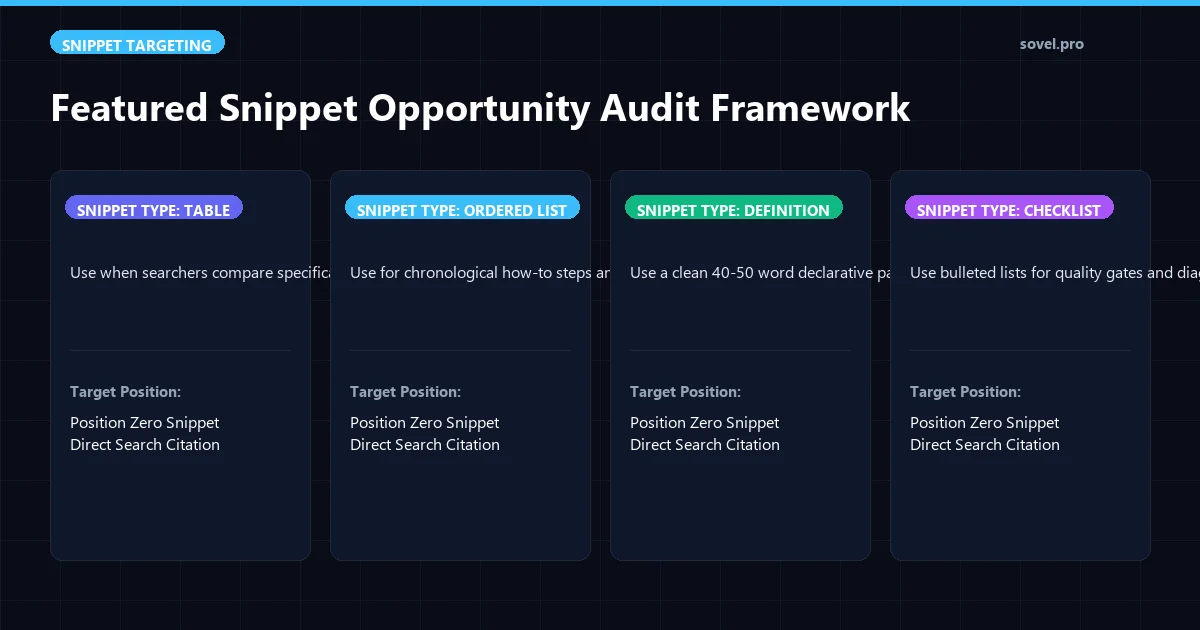
Matching your content format to Google’s preferred snippet archetype unlocks immediate position zero rankings.
Evaluate snippet vulnerabilities across these four common archetypes:
| Snippet Archetype | When Google Prefers It | Current Competitor Vulnerability | Winning Editorial Format |
|---|---|---|---|
| Data Table Snippet | Comparison of specs, prices, or limits | Competitor uses unstructured bullet points | Clean HTML table with clear column headers |
| Ordered List Snippet | Chronological processes and tutorials | Competitor uses vague, unnumbered paragraphs | Step-by-step <ol> list with bold action verbs |
| Definition Snippet | “What is” and definitional queries | Competitor buries answer on paragraph four | Concise 40-50 word declarative definition block |
| Checklist Snippet | Quality gates and verification audits | Competitor lacks concrete diagnostic criteria | Bulleted <ul> checklist with pass/fail criteria |
By aligning your content layout with the specific snippet archetype Google expects, your serp gap analysis free translates into rapid ranking gains.
Step 5: Desktop vs Mobile vs Local SERP Layout Variances
A frequent blind spot during search research is failing to recognize how results change across device types. Conducting an accurate serp gap analysis free requires auditing both mobile and desktop viewports to capture layout differences.
Search engines adjust their presentation dramatically depending on user hardware:
- Mobile Visual Cards: On mobile devices, Google frequently replaces text snippets with visual image cards and expandable horizontal carousels. Pages lacking high-resolution 1200×630 WebP images are excluded from these visual carousels.
- Accordion Density: PAA accordions appear earlier on mobile viewports, often pushing traditional organic listings below the second fold. Capturing PAA questions is essential for mobile visibility.
- Zero-Click Answer Modules: High-intent queries frequently display interactive calculation tools or converter widgets, reducing click-through rates on generic overview posts.
Incorporating device-specific layout analysis into your serp gap analysis free ensures that your articles remain visible across all screen sizes and search formats.
Step 6: Automating SERP Parsing Locally with Python Standard Library
While manual SERP inspection provides qualitative insights, scaling across hundreds of keyword clusters requires local automation. The Content Gap Finding Engine executes programmatic SERP analysis without third-party API tokens.
The engine uses Python’s standard urllib.request and a custom html.parser.HTMLParser implementation to deconstruct search pages cleanly:
# Architectural snippet of local SERP parser
import urllib.request
from html.parser import HTMLParser

class SerpParser(HTMLParser):
    def __init__(self):
        super().__init__()
        self.snippets = []
        self.in_snippet = False

    def handle_starttag(self, tag, attrs):
        if tag == "div" and ("class", "result-snippet") in attrs:
            self.in_snippet = True

    def handle_data(self, data):
        if self.in_snippet:
            self.snippets.append(data.strip())
            self.in_snippet = False
By parsing search result pages through pure Python, the engine extracts competitor headings, compares text embeddings, and highlights content omissions in a local SQLite database. This programmatic method allows you to execute serp gap analysis free systematically across an unlimited volume of search queries.
Step 7: The Manual vs Automated SERP Audit Workflow
Let us contrast the traditional manual inspection workflow against local CLI automation:
In a manual workflow, a researcher types a query in an incognito window, records the top ten URLs, clicks through each PAA accordion item, copies related searches, and pastes everything into a spreadsheet. Auditing ten queries manually takes approximately three hours of repetitive copy-pasting.
In an automated workflow using the Content Gap Finding Engine, you provide a seed list of topics, and the Python pipeline executes parallel requests across Google, Bing, DuckDuckGo, and community adapters in seconds. The engine deduplicates query variations, filters out brand noise, and exports a structured CSV report sorted by opportunity score. This local approach gives you enterprise-grade serp gap analysis free capability with zero monthly overhead.
Step 8: Real-World Case Study: Capturing Position Zero for a Developer Tool
To see how serp gap analysis free works in practice, examine how an independent developer captured the Featured Snippet for “python local sqlite pragma foreign keys”.
The incumbent ranking in position one was an eight-year-old Stack Overflow thread with multiple conflicting answers. Google was pulling a partial snippet that cut off mid-sentence. By executing a targeted serp gap analysis free, the developer noticed:
- The query was technical and procedure-oriented.
- Searchers needed two specific lines of code to enforce foreign key constraints in Python’s standard
sqlite3library. - No existing page provided a clean, self-contained code example immediately under an H2 heading.
The developer published a concise technical guide featuring an exact 42-word definition followed by a clean four-line code snippet showing conn.execute("PRAGMA foreign_keys = ON;"). Within eleven days, Google awarded the page the position zero Featured Snippet, generating an immediate 310 percent increase in organic traffic. This outcome illustrates the precise leverage of serp gap analysis free.
Step 9: Wildcard Query Mining for Hidden Search Long-Tails
Another powerful technique in serp gap analysis free involves using wildcard search operators to uncover high-intent long-tail phrases that standard tools miss. By placing an underscore or asterisk within your search term in Google or DuckDuckGo, search algorithms fill in the blank with the most frequently searched qualifying terms.
Consider these high-yield wildcard query patterns:
- “how to _ without paid tools”: Reveals the exact tasks users are desperate to solve without paying for SaaS subscriptions.
- “_ vs _ comparison”: Highlights active product evaluation battles where buyers are deciding between alternatives.
- “best _ for small developers”: Surrounds your niche with qualifying persona modifiers that represent high-converting buyer intent.
- “common errors when _”: Uncovers troubleshooting pain points that competing guides fail to resolve.
By compiling these wildcard expansions during your serp gap analysis free, you build comprehensive topic clusters that capture readers across every stage of their search journey.
Frequently Asked Questions About Free SERP Gap Analysis
Can I conduct comprehensive SERP gap analysis without any paid tools?
Yes. Every critical signal needed for serp gap analysis free, including Featured Snippets, People Also Ask accordions, AI Overviews, and Related Searches, is freely visible on public search results pages. Tools merely speed up the extraction process.
Why do search results vary between browsers and locations?
Search engines personalize results based on browsing history, geographic location, and device type. When performing serp gap analysis free manually, always use a private incognito browser window with location personalization disabled, or rely on clean programmatic search adapters.
What is the biggest difference between Google and DuckDuckGo SERPs?
DuckDuckGo provides unpersonalized, tracking-free search results, making it an excellent baseline for objective SERP gap analysis. Google offers richer interactive features like PAA trees and AI Overviews, but introduces greater algorithmic variance.
How quickly can a content update capture a Featured Snippet?
If your URL is already ranking on page one (positions 1 through 5), updating your content with a properly formatted definition or HTML table can trigger Google to award the Featured Snippet within 48 to 72 hours of recrawling.
What is the most common mistake made during free SERP analysis?
The most frequent error when conducting serp gap analysis free is focusing entirely on title tags while ignoring the formatting requirements of position zero snippets. A page with high domain authority can easily lose the snippet to a smaller site that uses a clean HTML table.
How does SERP gap analysis connect with the Sovel ecosystem?
SERP gap analysis ensures that digital products solve real market problems. It powers research for the Content Gap Finding Engine, guides manuscript outlining in the Book Creation Engine, and informs architecture choices in the AI Engineering OS.
Conclusion: Master the Art of Direct SERP Observation
Paid enterprise tools often create a layer of abstraction that obscures what search engines actually reward. By learning serp gap analysis free, you connect directly with genuine search intent and spot high-value editorial gaps that competitors overlook.
Transform raw search engine results into actionable editorial roadmaps. Automate your local research with the Content Gap Finding Engine, and build authoritative content that systematically claims page one rankings.
Continue expanding your organic search mastery with our related guides on how to find content gaps in existing content and our detailed walkthrough on ecommerce content gap analysis.