
Lead magnet formats are decided too late and chosen too loosely. Most teams pick the shape after the writing starts, or default to the PDF ebook because it is the only format they have seen at scale, and both habits cost conversion. The format is a structural decision: it determines how the reader consumes the promise, how long consumption takes, and whether the asset gets finished or abandoned in a downloads folder.
This guide walks the nine working formats, maps each to the promise verbs it serves, names the failure mode of each, and gives a short method for choosing when two formats both fit. The nine are: checklist, framework, case study, audit scorecard, mini course, tool template, hack list, system blueprint and prompt tool. Every format here can be produced with the same governed pipeline, which matters more than it sounds: if the shape can change without rebuilding the process, you will actually match the shape to the promise instead of to your production habits.
Why the format decision comes first
The promise sets the format, and the format sets the reader’s experience. A promise that says “in fifteen minutes” cannot be delivered as a forty-page ebook; a promise that says “understand the method” cannot be delivered as a one-line checklist. Choosing lead magnet formats first means the writing stage drafts against a concrete spec: required sections, required parts per section, one call to action, a capped intro. Choosing the format last means every draft is a negotiation between the content and a shape it was never built for.
There is a production reason too. When lead magnet formats are selected deliberately, the quality gates have something concrete to check: does the checklist contain verifiable steps, does the scorecard contain scoreable rows, does the case study contain a result. When the format is vague, the gates check vague things, and vague checks pass bad drafts. Format discipline is quality discipline wearing a different name.
The afterlife argument seals it. Different formats have different lifespans in a subscriber’s world: a checklist is consumed and discarded, a template gets reopened for months, a framework gets cited in meetings. Deciding which afterlife you want is a strategy decision, and it is only available if you treat lead magnet formats as a decision at all.
One practical artifact makes the decision stick: the format spec. Write the spec before any drafting; it fits on one page and lists the sections required, the parts per section, the intro cap, the call to action count and the length budget. The spec converts lead magnet formats from a label into an enforceable contract, and whatever fails the spec gets rewritten rather than shipped. Teams that skip the spec discover their format inside the draft, which is the habit this whole guide exists to break.
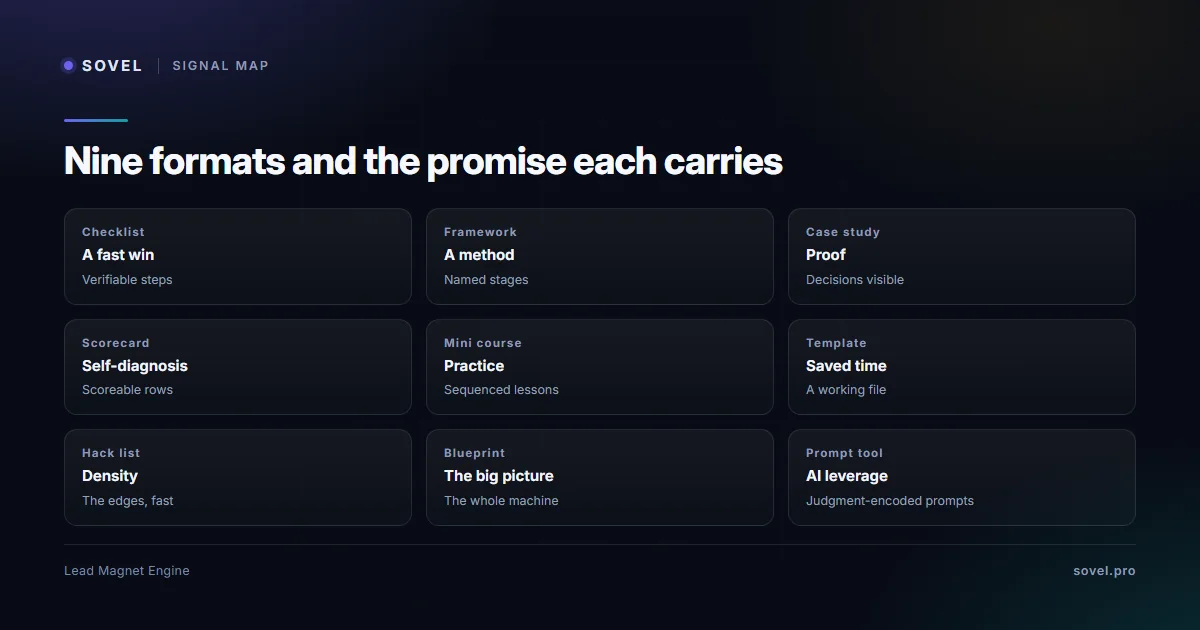
The nine formats
Two habits make the choice worse than it needs to be: defaulting to whatever shape the last project used, and letting the word count decide. Lead magnet formats work when the shape is chosen for the promise and dropped when the promise changes. The sections below give each format the same three-line treatment: what it is, when it wins, and the failure mode to watch for.
1. Checklist
Numbered, verifiable steps that promise a fast win. Lead magnet formats do not get more reliable than this one: the reader knows exactly what they are getting, consumption is minutes, and forwarding takes seconds. The checklist wins when the promise contains “before you”, “in order” or “without missing”. It fails when the underlying task actually requires judgment rather than sequence, because a checklist of ten fake steps reads as filler in ninety seconds. The honesty test for a checklist is brutal and useful: every step must be checkable by someone who has never done the task, and if a step cannot be checked, it is advice wearing a checkbox.
2. Framework
A named model with stages that teaches a repeatable method. Among lead magnet formats, this is the positioning play: the framework names the problem the way you solve it, and named things get cited. The framework wins when your method is genuinely repeatable across clients. It fails when the “framework” is a diagram over advice that only worked once, because readers try to apply the stages to their situation and discover the model has no load-bearing parts. The load-bearing test: each stage should name what goes in, what comes out, and what breaks if the stage is skipped, and a stage that cannot answer all three is decoration.
3. Case study
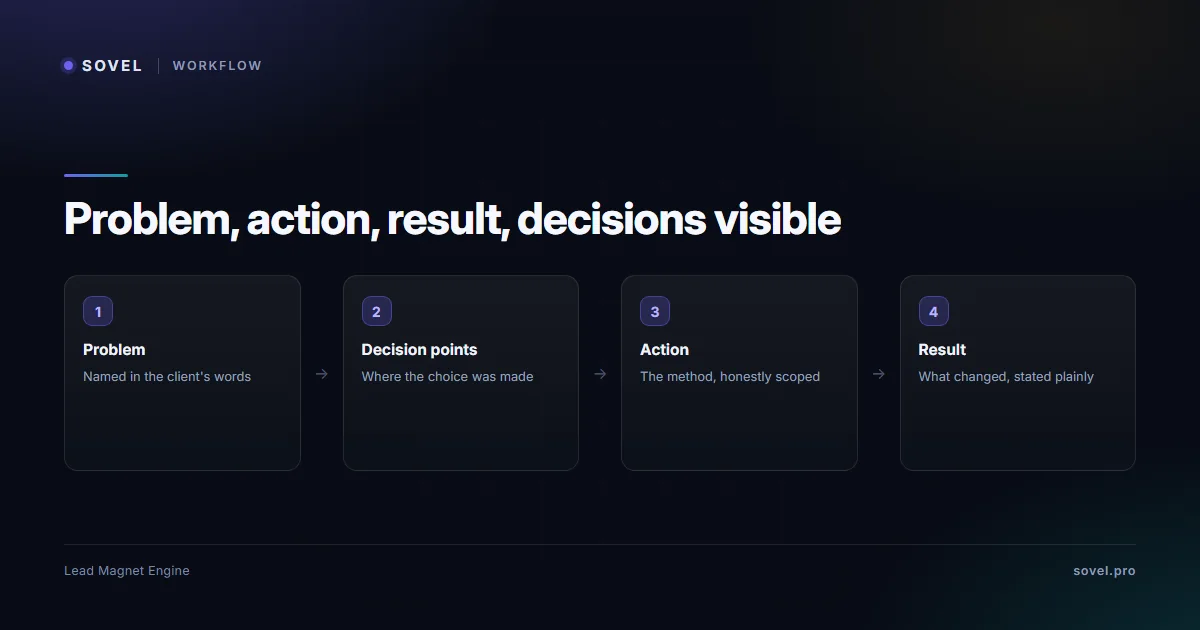
Problem, action, result, told with the decision points visible. This format carries proof, which makes it the format of choice for skeptical, senior readers; the case study as a research form earned that trust precisely by documenting decisions rather than outcomes. It wins when you have a real engagement with real outcomes and the willingness to include the messy middle. It fails when it is written as a success story without decisions, because prospects cannot map their situation onto a narrative that never faced a choice.
4. Audit scorecard
Criteria with scoring rows that let prospects assess themselves. Of the nine lead magnet formats, this one converts hardest for service businesses because self-diagnosis creates the discomfort a paid engagement resolves. The scorecard’s lineage is older than marketing: rubrics, in the academic sense, have graded judgment reliably for decades, and the scorecard is a rubric pointed at a business problem. It wins when your day-one diagnostic has twelve to twenty real criteria. It fails when the criteria are soft opinions rather than observable facts, because readers cannot score an opinion and abandon the asset halfway.
5. Mini course
Short sequenced lessons delivered over days. This format buys you a week of attention and shows the method rather than describing it, borrowing deliberately from microlearning, where short spaced lessons beat one long session for retention. It wins for transformation promises that genuinely take practice. It fails when the lessons are one idea split into five, because subscribers feel the padding by lesson two and the sequence trains them to ignore your sender address.
6. Tool template
A fill-in working asset: spreadsheet, planner, matrix, script skeleton. Among lead magnet formats, this one buys the most gratitude per minute of build time, because it does part of the reader’s actual work. It wins when you have a working internal asset that survives being generalized. It fails when the template is a printout of common sense, because a file that saves no time gets deleted rather than kept. The generalization pass is where most template builds die: an internal asset encodes a dozen assumptions about your clients, and a template that ships those assumptions unlabelled confuses the reader whose context differs.
7. Hack list
A compact list of tactical moves with quick density. The hack list wins when the audience already knows the domain and wants the edges: the shortcuts, the settings, the non-obvious moves. It fails as a first-touch asset for beginners, because tactics without foundations teach people to skip the fundamentals. Among lead magnet formats, this is the one most often misused as a substitute for having a method.
8. System blueprint
An end-to-end process map showing the whole machine: stages, inputs, outputs, handoffs. This is the big-picture format, and it wins when the reader is evaluating whether to trust your whole approach rather than solve one step. It fails when it is a diagram of the obvious, which is the most common blueprint failure: process maps impress process people and confuse everyone else, so the blueprint needs an audience that thinks in systems.
9. Prompt tool
A reusable prompt set for AI-heavy teams. The newest of the lead magnet formats and the most conversation-generating: teams that run the prompts get results they want to discuss. It wins when the prompts encode real professional judgment and their limits are labelled. It fails when the prompts are generic filler any chatbot could produce without help, because the reader concludes your judgment is equally generic. The labelling is what separates a professional prompt tool from a listicle: each prompt should state the role it plays, the inputs it needs, and where a human must override the output.
Matching format to the promise verb
The verb in your promise chooses the format faster than any comparison table. Audit, score, check and diagnose want the scorecard or checklist. Understand, learn and master want the framework or mini course. Save me time and set this up want the template. Show me proof want the case study. Give me the edges want the hack list. Show me the whole machine want the blueprint. Make AI useful for this want the prompt tool.
| Promise verb | Format the verb wants | Why |
|---|---|---|
| Check, verify, run through | Checklist | Sequence with verifiable steps |
| Score, assess, diagnose | Audit scorecard | Self-judgment against real criteria |
| Understand, learn the method | Framework | Named stages, repeatable |
| Walk me through, over days | Mini course | Sequenced practice |
| Set this up for me | Tool template | Working file, saved setup time |
| Show me it worked | Case study | Problem, action, result |
| Give me the shortcuts | Hack list | Tactical density |
| Show me the whole process | System blueprint | End-to-end machine |
| Make AI work for this | Prompt tool | Judgment-encoded prompts |
If the verb is weak, no format rescues it. “Improve your marketing” contains no verb you can match, which is the sign the promise itself needs sharpening before the lead magnet formats question is even worth asking. That upstream dependency is why format selection sits at stage two of the production process in the walkthrough on how to create a lead magnet, right after the brief that fixes the promise.

When each format fails
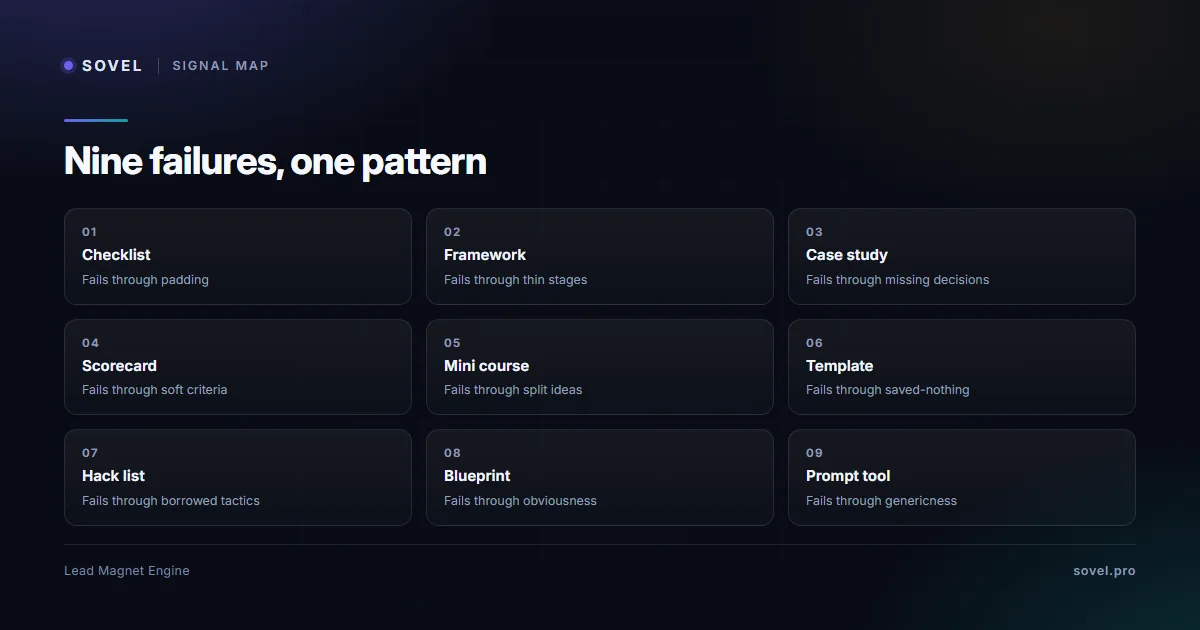
Every format has a signature failure, and knowing them is cheaper than discovering them in subscriber replies. The checklist fails through padding, the framework fails through thin stages, the case study fails through missing decisions, the scorecard fails through soft criteria, the mini course fails through split ideas, the template fails through saved-nothing, the hack list fails through borrowed tactics, the blueprint fails through obviousness, and the prompt tool fails through genericness.
The pattern behind all nine failures is the same: the format promised a kind of substance the content did not contain. Lead magnet formats do not create substance; they structure it, which is also why format swapping after a bad run rarely fixes anything, because the failure was upstream of the shape. The reliable repair sequence is: sharpen the promise, list the substance the asset genuinely has, then pick the lead magnet formats that structure exactly that substance and nothing more.
There is a failure outside the content too: format-audience mismatch. A blueprint sent to operators, a hack list sent to strategists, a prompt tool sent to non-technical readers; the asset is fine and the audience is wrong. Matching lead magnet formats to audiences is the same moment-matching logic used in consulting sales, where the asset must meet the reader’s actual stage rather than your production preferences. The audiences differ in what they trust: operators trust sequence, strategists trust models, teams already working trust tools, and the format carries that trust only when it matches.
Choosing between two formats that both fit
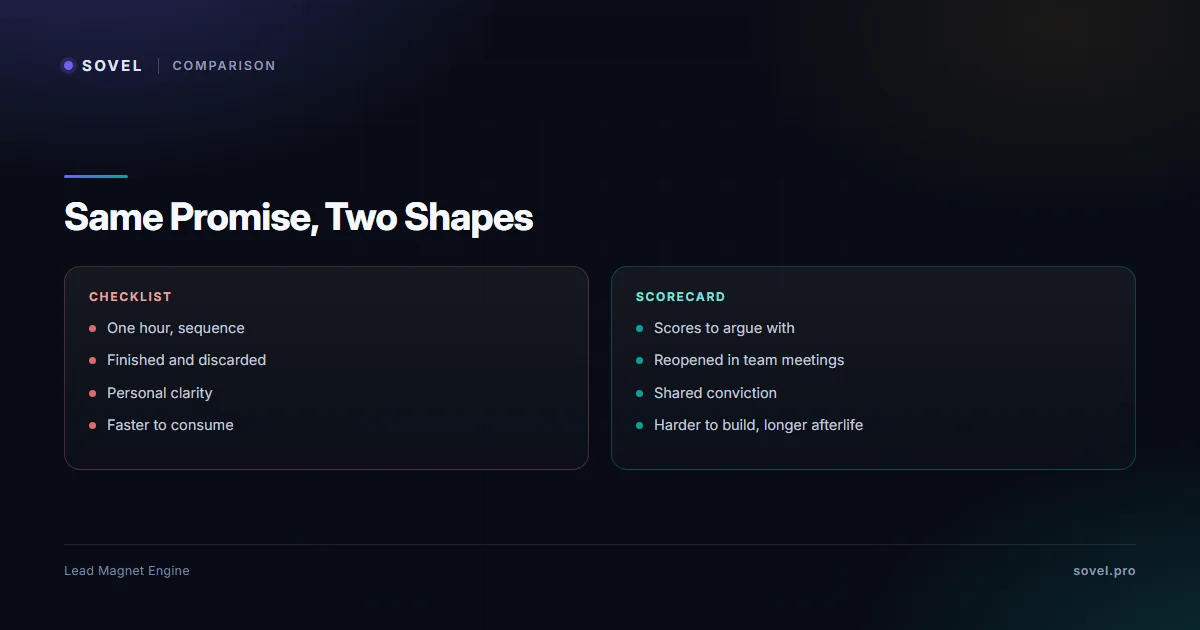
Sometimes the verb genuinely supports two shapes, and the tie-breakers are three. First, consumption time against the promise: the format the reader can finish inside the claimed time wins, always. Second, afterlife: if you want the asset reopened and reused, the template beats the checklist; if you want it cited in meetings, the framework beats the hack list. Third, production honesty: the format whose spec your substance can actually fill wins over the format you wish you could fill.
A worked tie-break: “check your onboarding before you launch” supports a checklist and a scorecard. The checklist wins if the reader has one hour and needs sequence; the scorecard wins if the reader needs to convince a team and wants scores to argue with. Same promise, different afterlives, and choosing between lead magnet formats in this situation is a strategy call rather than a stylistic one. Most close calls resolve on the afterlife question alone, which is why it pays to decide what the asset should be doing in three months before deciding what it should look like. When the tie-breaker produces no winner, build the smaller format first, measure consumption, and let the data pick the second.
Formats inside a governed production run
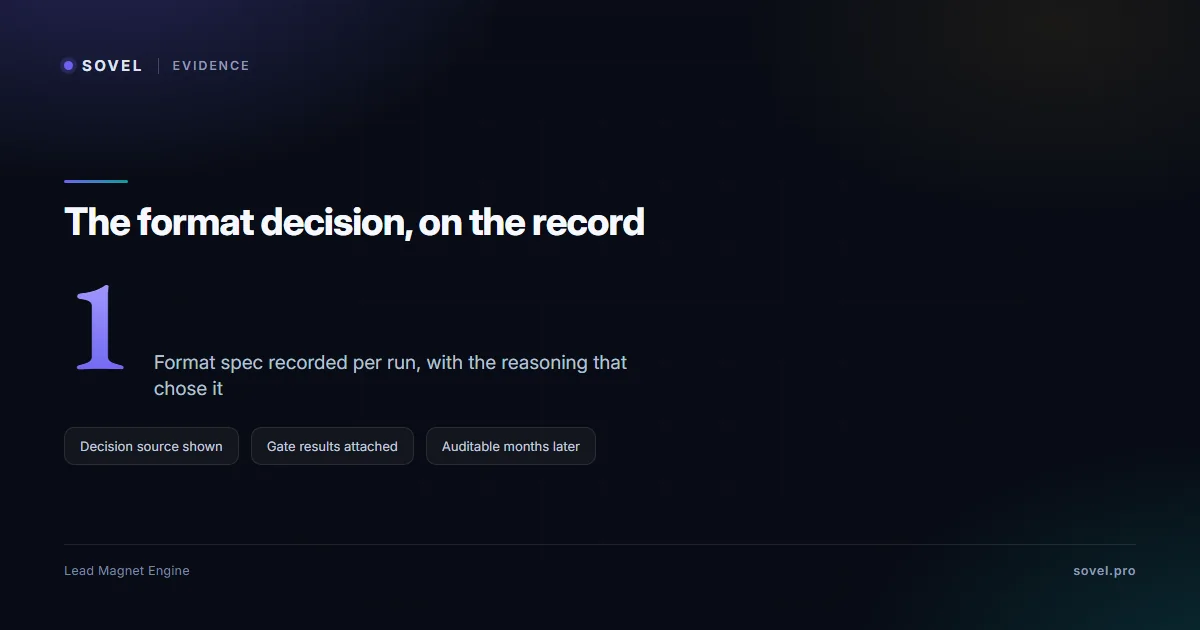
In a governed pipeline the format is recorded, not remembered. The run report carries the format decision and its reasoning, the format spec the writing stage drafted against, and the gate results that checked the draft against that spec. That record is what makes lead magnet formats auditable: months later, you can see why a checklist was chosen for one brief and a scorecard for another, and whether the reasoning held. The SOVEL LEAD MAGNET ENGINE product page documents a full run with all nine formats available from the same pipeline, which is the practical payoff: switching shapes is a flag, not a rebuild. The same governed pipeline underlies the asset library behind the plays in the consultant guide on lead magnet ideas for consultants, where each play maps to one of these nine shapes.
The governed route also protects the format from drift. Voice drifts, intros swell, sections merge; a recorded spec catches all three at the gate. Teams that produce magnets regularly eventually face the question of whether to rebuild an old asset in a new shape, and the run record answers it with evidence instead of opinion.
The record also makes the choice legible to reviewers who were not in the room. A client or a colleague can read the recorded reasoning without re-reading the brief, and the lead magnet generator software comparison shows which tools record that reasoning and which leave the choice implicit. Not every tool records it; when the reasoning is on the record, disagreement about lead magnet formats moves from taste to evidence, and the next run starts from the corrected reasoning instead of from memory.
FAQ
How many lead magnet formats should a team actually use?
Two or three, chosen deliberately, produced repeatedly. Teams that use all nine shallowly produce mediocre assets in every shape; teams that master one or two lead magnet formats produce excellent assets that compound. The format should vary by promise and audience, not by whoever wrote it that week.
Which lead magnet format converts best?
The audit scorecard for service businesses, the checklist for fast-decision products, and the mini course for considered purchases. “Best” is always a property of the promise and the audience; a format in isolation has no conversion rate. The scorecard edges ahead in services because self-diagnosis creates the conversation the business sells.
Is the PDF ebook one of the lead magnet formats that still work?
As a container, sometimes; as a format choice, rarely. Long-form still fits genuine deep-reference promises, but most ebook requests are checklists, scorecards or courses wearing a page count. The honest test: if the ebook can be cut to a quarter of its length without losing a single usable step, it was one of the other formats all along. Length never made the ebook a format; the container was always the least load-bearing part of it, which is why lead magnet formats are chosen by promise verb rather than by page count.
How long should each format be?
Short enough to fulfill the promise and no longer: checklists one to three pages, scorecards two to five, frameworks one to four, case studies two to four, templates as long as the work requires, hack lists one to two, blueprints one page of diagram plus annotations. Consumption time is the budget, and lead magnet formats that break their own time promise train subscribers not to open the next one.
Can one asset combine two formats?
Yes, in one specific way: a primary format with the other as an appendix, clearly subordinate. A framework with a one-page checklist appendix works; a checklist with a framework inside it confuses. Lead magnet formats mix badly at equal weight because the reader does not know what the asset is for; mix with a clear hierarchy or not at all.
Do lead magnet formats matter for AI-generated drafts?
More, not less. Generation produces fluent prose cheaply, which makes structure the differentiator: a drafted scorecard with real scoring rows is verifiable, a drafted essay is not. In a governed run the format spec gives the gates something concrete to enforce, which is why lead magnet formats produced through a spec-and-gate pipeline read sharper than free-form generated text.
Where should a beginner start among the nine?
The checklist, because its spec is the strictest and its failure modes are the most visible. Building three checklists teaches the discipline that every other format inherits: verifiable steps, capped intro, one call to action, honest scope. From there the scorecard and the framework are natural next steps, and the full mapping is in the format guide table above.