
Lifetime License vs Subscription SEO Tools: Which Pays Off?
The most expensive SEO tool is not the one with the highest price tag. It is the one you pay for every month for years and barely use. The debate between a lifetime license vs subscription SEO tools comes down to one question: are you buying a recurring cost, or a tool that keeps working for you indefinitely?
This guide compares the two models honestly — upfront cost, long-term value, feature updates, and risk — and shows where a lifetime license wins, where a subscription still makes sense, and how this decision applies to content gap analysis tools like SOVEL GAP BRAIN. By the end, you will be able to make a lifetime license vs subscription SEO tools evaluation for any tool on your stack.
The two pricing models explained
A subscription SEO tool charges a recurring fee under a software-as-a-service model — usually monthly or yearly — for continued access. Pricing stops, and so does the tool. Every conversation about a lifetime license vs subscription SEO tools starts here: what happens when the payments end, and what does each model really cost across your full usage period?
A lifetime license charges once as a perpetual license and grants permanent use. You pay today and continue using the software for as long as you want, without further payments.
Both models have real trade-offs. The right choice depends on how you work. This guide walks through the full cost picture — not just the sticker price, but the multi-year reality of each model — so you can make a lifetime license vs subscription SEO tools choice with numbers in hand.
The detailed cost comparison
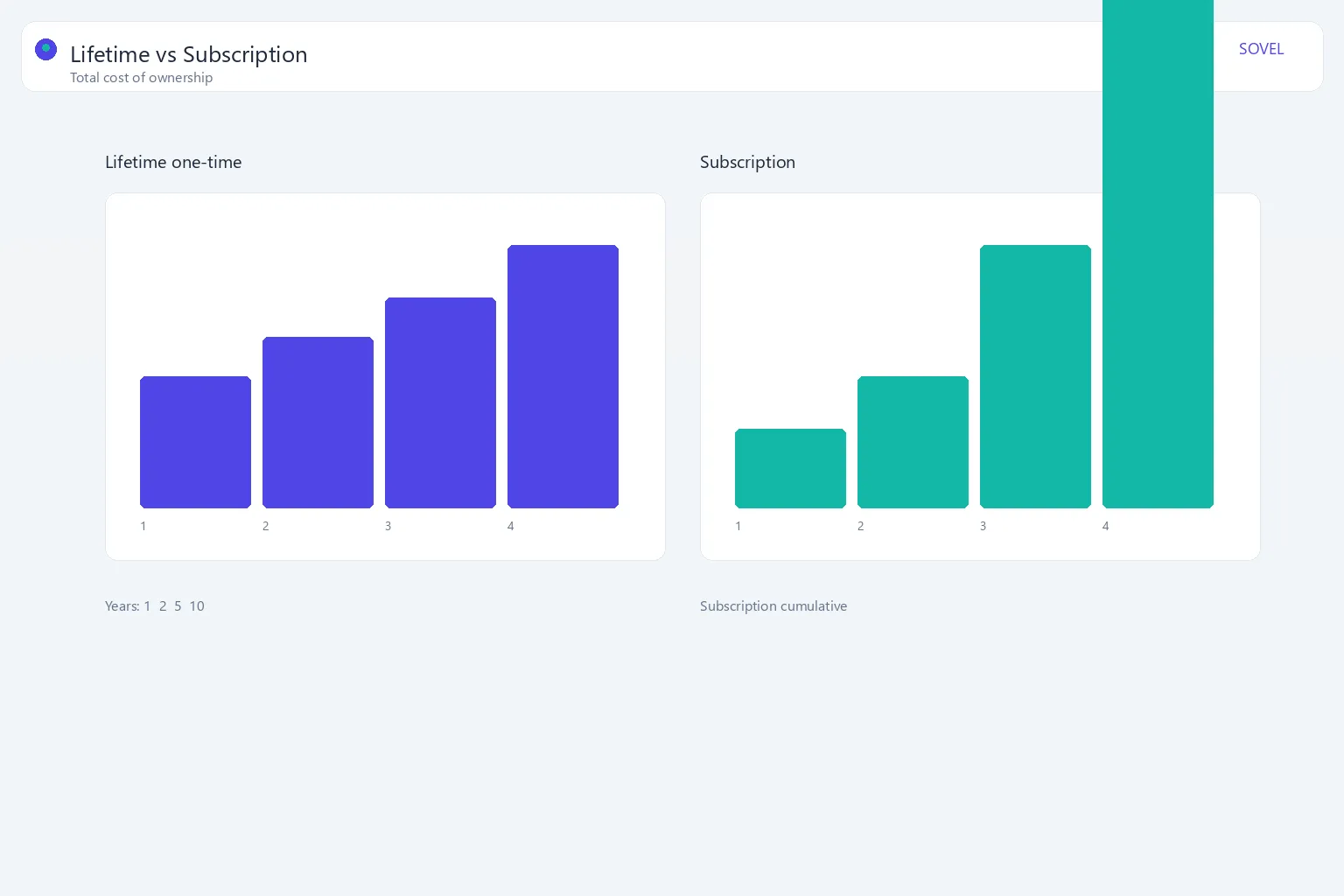
To make a lifetime license vs subscription SEO tools decision concrete, let’s build a real comparison. Assume a subscription SEO tool costs ₹499 per month (or ₹4,999 per year), and a comparable lifetime license costs ₹4,099 once. Here is how the totals stack up over one, two, and five years.
| Time horizon | Subscription (monthly) | Subscription (yearly) | Lifetime license | Lifetime wins by |
|---|---|---|---|---|
| 1 year | ₹5,988 | ₹4,999 | ₹4,099 | ₹900–₹1,889 |
| 2 years | ₹11,976 | ₹9,998 | ₹4,099 | ₹5,899–₹7,877 |
| 5 years | ₹29,940 | ₹24,995 | ₹4,099 | ₹20,896–₹25,841 |
| 10 years | ₹59,880 | ₹49,990 | ₹4,099 | ₹45,891–₹55,781 |
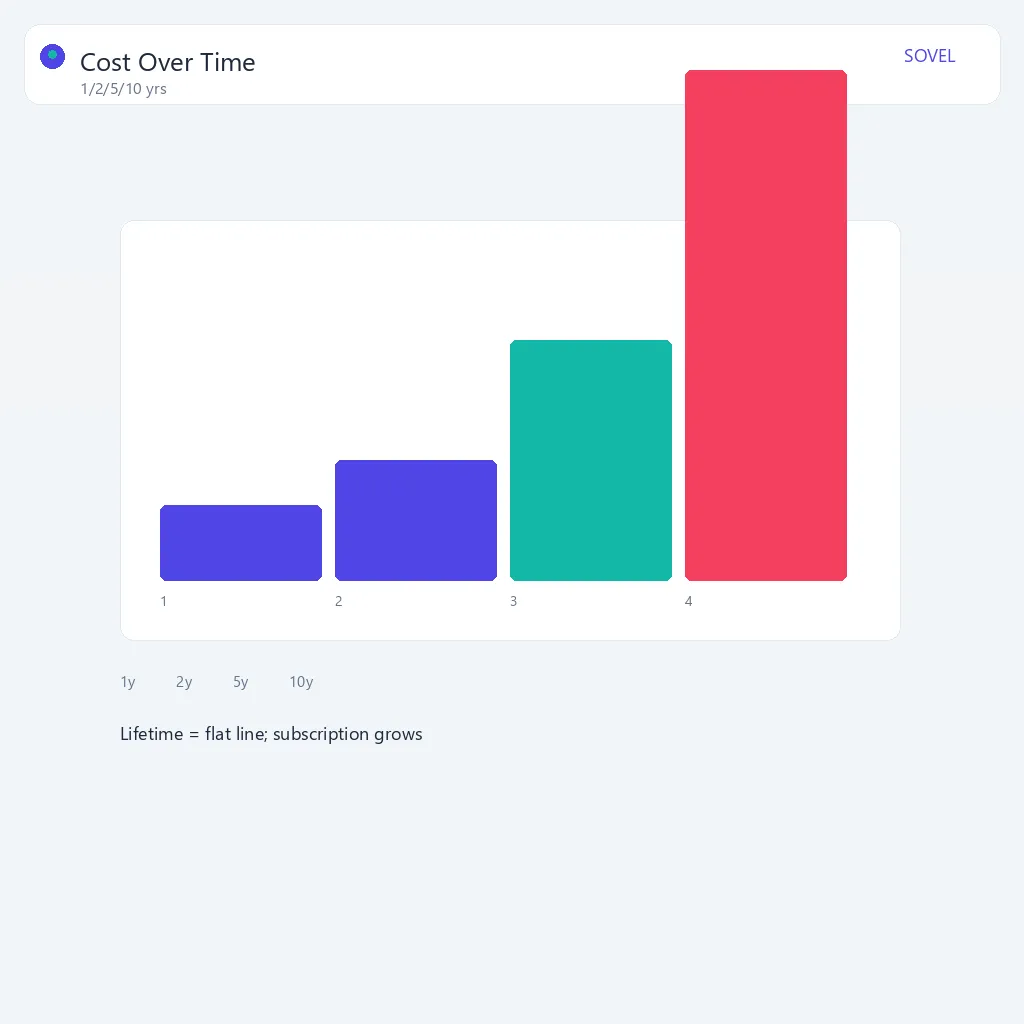
The pattern is unmistakable. The longer you use the tool, the wider the gap grows. Even the most generous interpretation — a discounted yearly subscription — leaves a lifetime license far ahead once you pass the second year. If you plan to run a tool for three or more years, the license is almost always the cheaper route. This is the heart of the lifetime-versus-subscription argument: the math compounds in favor of the license the longer your horizon stretches.
That is not to say the subscription never makes sense. The rest of this guide explains when a recurring fee is justified, and when it is simply money you could have kept.
The case for subscription SEO tools
Subscriptions are not automatically bad. They make sense when:
- The product ships major new value every month.
- You need support, cloud infrastructure, and constant data feeds.
- You only need the tool for a short, defined campaign.
- The provider’s data costs real money to maintain.
For tools that depend on live search data or proprietary indexes, a subscription is often the only sustainable model. The recurring fee pays for the data that makes the tool useful. This is the main caveat in any lifetime license vs subscription SEO tools discussion: if the tool’s value is inseparable from fresh data, the recurring fee is paying for something real.
When a subscription is genuinely justified
Understanding the subscription case is part of a fair lifetime license vs subscription SEO tools analysis. There are clear situations where paying monthly is the rational choice, not a mistake:
- Live data is the product. Rank trackers, keyword volume databases, backlink indexes, and ad platforms derive value from data that changes daily. The fee funds servers that refresh that data. A one-time license could not sustain a live feed, so the subscription is not a choice — it is the only way the product can exist.
- Ongoing infrastructure. Cloud-hosted tools that crawl the web at scale need continuous compute. That cost is real and recurring.
- Short-term campaigns. If you need a tool for a three-month product launch and will not need it afterward, a subscription lets you pay only for the period you use.
- You want to test before committing. A monthly plan is a low-risk way to evaluate a tool before you decide whether a longer-term purchase is worthwhile.
- The vendor adds major value monthly. Some tools ship significant new features every release, so the recurring fee buys genuine accumulation of capability.
None of these descriptions fit a local, method-based analysis tool. When the software runs on your own machine and does not need a live database, the subscription justification largely collapses — and the lifetime license becomes the smarter economic play. In that situation, a lifetime license vs subscription SEO tools comparison is not close: the subscription premium buys almost nothing you need.
The case for a lifetime license
A lifetime license wins when the core value is software that runs on your own machine and does not need a monthly data feed. In a lifetime license vs subscription SEO tools comparison, this is the profile that makes the license look almost too good to be true — until you do the math. Consider:
- One-time cost — you pay once, and the cost is known forever.
- No lock-in — you keep the tool even if your budget shrinks.
- Predictable ROI — after the break-even point, every use is free.
- Independence — no dependency on a vendor’s continued subscription.
A lifetime license is especially appealing for tools whose value comes from a method or a local engine, not from a live database.
The risk of lifetime licenses and how to mitigate it
No honest lifetime license vs subscription SEO tools comparison ignores risk. A lifetime license has real downsides, and you should understand them before you buy.
- The vendor could stop supporting the product. If the maker goes out of business or abandons the software, you may not get future updates. The mitigation is to buy software that functions standalone today, so you are never dependent on the vendor’s servers to keep working.
- The platform could change. If the tool only runs on a specific version of a hosting stack, an upgrade elsewhere could break it. The mitigation is a tool with minimal, stable dependencies — ideally plain PHP on commodity hosting — so it keeps running across environment changes.
- Features may never grow. A lifetime license often freezes a snapshot of features. The mitigation is to buy a product that is already complete and does its core job well, rather than one you hope will mature.
- Opportunity cost. The up-front payment is larger, and you cannot reclaim it if you stop using the tool. The mitigation is to validate the workflow with a free tier first, as SOVEL offers, so you only pay once you know the tool earns its keep.
A lifetime license is not reckless — it is a calculated trade of recurring cost for up-front risk. When the product runs locally, is feature-complete, and has no live-data dependency, the risks shrink to near zero while the savings compound every month. For a careful buyer, the risks of a lifetime-versus-subscription choice are manageable; the cost difference is not.
Total cost of ownership method
If you want to run this analysis for your own tools rather than relying on fixed numbers, here is a simple method to estimate total cost of ownership (TCO).
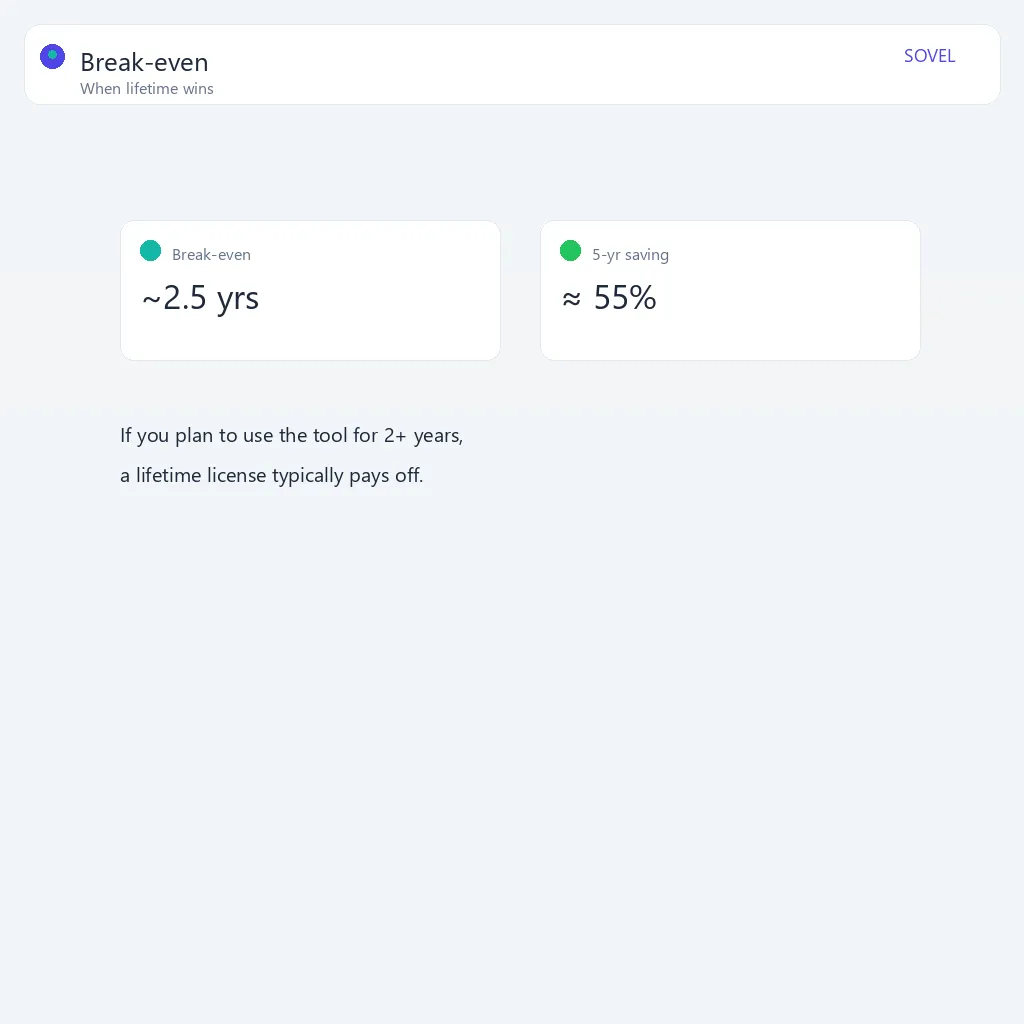
- Find the break-even point. Divide the lifetime price by the monthly subscription rate. In the example above, ₹4,099 ÷ ₹499 ≈ 8.2 months. After that point, the license has paid for itself.
- Estimate your usage horizon. How long do you realistically expect to use the tool? Be honest. If you genuinely need it for 18 months or more, the license is mathematically ahead.
- Add the yearly discount. If the vendor sells a discounted yearly plan, use that figure instead of the monthly rate to test the worst case for the license.
- Factor in switching cost. Moving between tools costs time. A tool you keep for years avoids repeated migration overhead.
- Weigh the value of updates. If live updates matter to you, add an estimated value of those updates to the subscription side. For a method-based tool, that value is usually small.
This TCO method takes five minutes and turns a gut feeling into a defensible number. It is the same reasoning a finance team would apply to any multi-year software purchase. Run it on every tool you own, and your lifetime license vs subscription SEO tools decisions become a routine spreadsheet exercise rather than a gamble.
What about updates and support?
The common objection to a lifetime license is “what if it stops getting updates?” That is a fair question. Look for a lifetime product that:
- Sells a complete, finished capability rather than a promise of future data.
- Runs locally so it does not depend on the vendor’s servers to function.
- Is backed by a maker that keeps improving it voluntarily.
SOVEL GAP BRAIN matches this profile. The engine runs directly on your own hosting in pure PHP. There is no live data feed and no external API key, so it keeps working completely on its own. Updates are a bonus, not a requirement for the tool to function. That makes it a clear example of the lifetime license vs subscription SEO tools model working as intended: you pay once and own the capability outright.
Applying the decision to content gap analysis
Content gap analysis is a strong candidate for a lifetime license because the valuable part is the method, not a live database. You paste a topic and the engine scores the coverage. That logic does not become obsolete monthly. When you weigh a lifetime license vs subscription SEO tools for this kind of tool, the method is durable and the recurring fee adds no data value — so the license wins. This reflects the same evidence-led thinking behind evidence-led content research and market gaps.
So for a content team:
- Start with the free tool — https://sovel.pro/tools/content-gap-analysis/ — to confirm the workflow with a fair daily limit.
- Buy the lifetime engine — https://sovel.pro/sovel-gap-brain-engine/ — once you know you will use it long term, removing the limit and the recurring fee question entirely.
When a subscription still makes sense
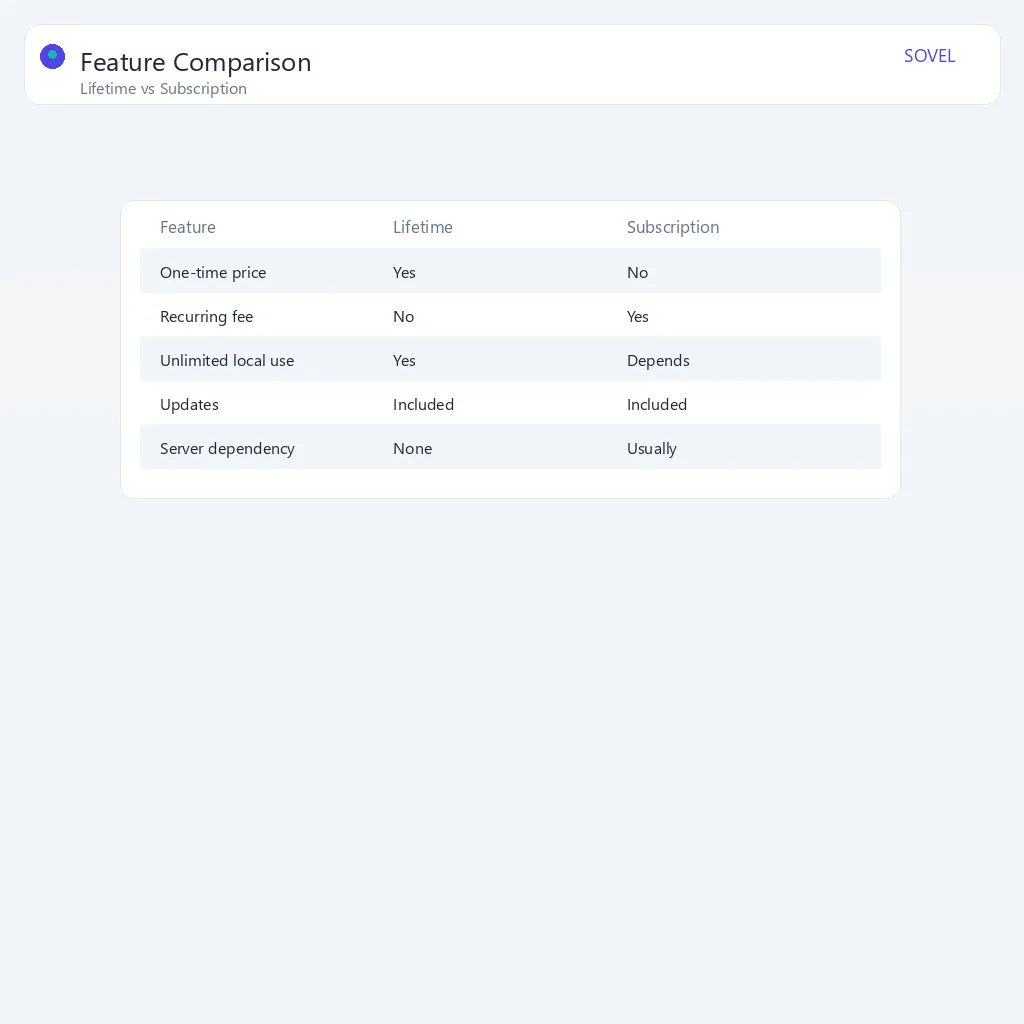
Stay with a subscription for tools that truly need live data: rank trackers, keyword databases with real volume, backlink indexes, and ad platforms. Their value genuinely depends on fresh data, and the recurring fee buys that data. Recognizing this boundary is half of mastering the lifetime license vs subscription SEO tools question — you keep the subscription where it earns its keep and switch to a license where it does not.
The mistake is paying a subscription for software whose main job is local processing. That is where a lifetime-versus-subscription comparison usually favors the license.
How to decide for your team
Ask three questions:
- How long will I use this? Years → license. Months → subscription.
- Does it rely on live data? Yes → subscription. No → license.
- Can I afford the risk of no updates? If the tool works standalone, updates matter less.
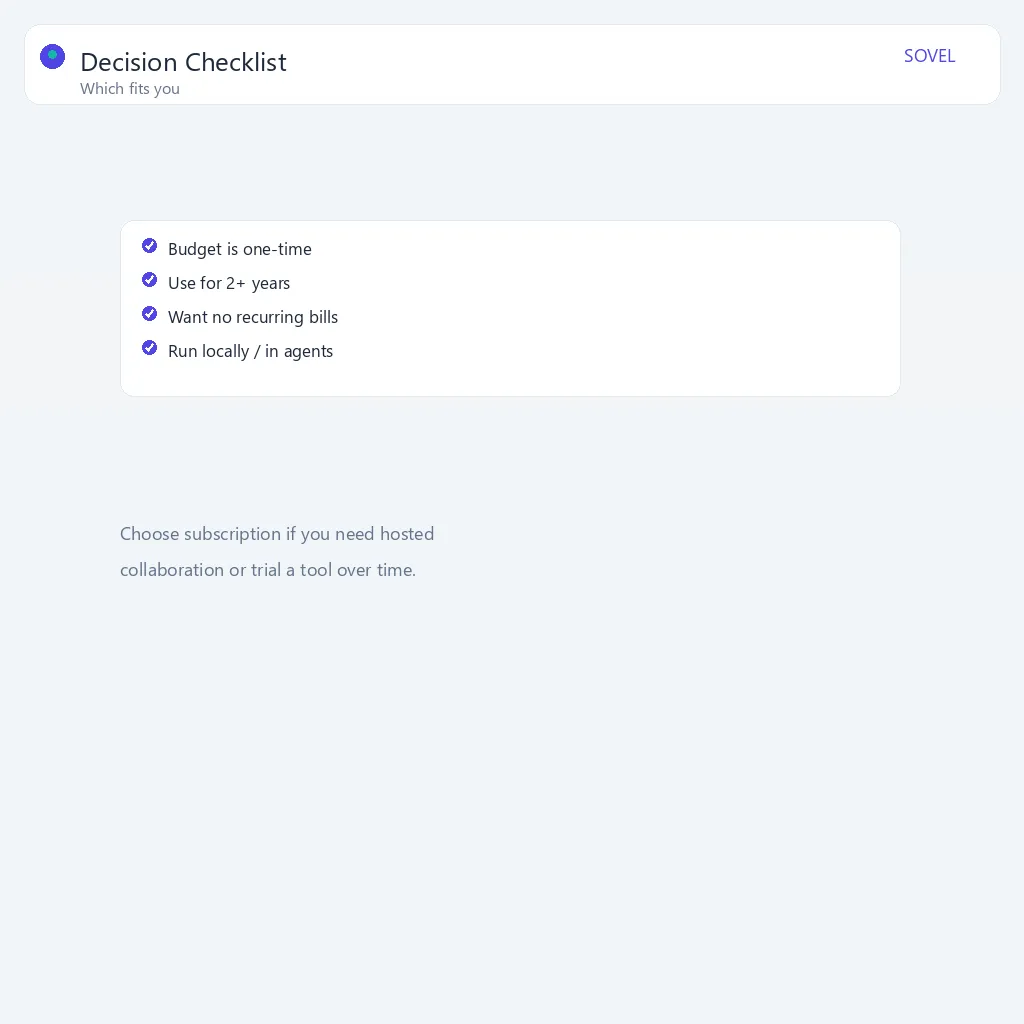
If you answered “years, no live data, works standalone,” a lifetime license is the economical call. That triple answer is the cleanest signal a lifetime license vs subscription SEO tools decision can give you: when all three point to the license, stop hesitating and buy it.
A decision checklist for your team
Before you commit to either model, run through this checklist to keep your decision objective.
- [ ] List the tools you actually use and note which are daily essentials.
- [ ] For each, write the monthly or yearly fee you currently pay.
- [ ] Find whether a lifetime license exists for the same tool or a close equivalent.
- [ ] Calculate the break-even point: lifetime price ÷ monthly fee.
- [ ] Estimate your realistic usage horizon for each tool in months.
- [ ] Ask whether the tool depends on live data to be useful.
- [ ] Check whether the tool runs locally or requires the vendor’s servers.
- [ ] Confirm the lifetime license is feature-complete today, not a roadmap promise.
- [ ] Test the workflow with a free tier before buying anything.
- [ ] Rank the options by five-year total cost, not first-month price.
If the tool clears the checklist — long horizon, no live-data need, works standalone, complete today — a lifetime license is the right call. If any item fails, keep the subscription and treat the premium as the cost of the data or infrastructure it buys. The whole point of the checklist is to stop making a lifetime license vs subscription SEO tools decision on sticker price alone and start making it on the total cost picture.
Frequently asked questions
Is a lifetime license always cheaper?
Over a long enough period, usually yes. Compare the break-even point: divide the lifetime price by the monthly subscription to see how many months until the license pays for itself. For most tools, a lifetime license vs subscription SEO tools comparison flips in the license’s favor after roughly a year of steady use.
Do lifetime licenses get updates?
It depends on the maker. A good lifetime product ships a complete, working capability, and updates are an ongoing benefit rather than a condition of use. In a lifetime license vs subscription SEO tools comparison, this is the point that separates a real license from a subscription in disguise.
What if the vendor stops selling the lifetime license?
If the software runs locally and does not need the vendor’s servers, it keeps working. That is why a self-hosted engine is a safer lifetime purchase.
Is SOVEL GAP BRAIN a subscription?
No. The full engine is a one-time lifetime purchase in three editions. The free tool is free with a daily limit.
What does the free tool include?
A full analysis per search with scored keywords, gaps, opportunities, and a summary, exportable as HTML, Markdown, Word, or PDF.
What is the daily limit on the free tool?
Five searches per day per device by default, resetting at midnight.
Should I keep my subscription tools?
Keep subscriptions for live-data tools. For local-method tools, replace the recurring fee with a lifetime license where possible. That split is the practical conclusion of the lifetime license vs subscription SEO tools debate for most teams.
Can a lifetime license save money even if I leave the tool unused sometimes?
Yes. A license is a sunk cost that stays valid whether you use it weekly or monthly. A subscription keeps charging even during inactive months, so a license rewards irregular but long-term use. That asymmetry is a quiet but real advantage in the lifetime license vs subscription SEO tools picture.
Are lifetime licenses a scam?
Some cheap “lifetime” deals are — typically ones from unknown vendors with no track record. But a lifetime license is legitimate when the software is complete, runs locally, and does not depend on live data. Judge the vendor, not the model.
What happens to my data if I stop paying a subscription?
You usually lose access to the tool and may lose hosted data after a grace period. With a lifetime license that runs locally, your data stays on your machine and keeps working.
Does a lifetime license ever become obsolete?
Any software can become obsolete if the web changes radically. A method-based tool is more resilient because its logic stays relevant longer than a data feed. Check that the vendor keeps the tool compatible with common hosting environments.
How do I know if a tool is “complete enough” for a lifetime license?
Ask what the tool does today. If its core value is a method or analysis you can run now, it is complete. If you are buying a promise of future search, you are buying a subscription in disguise.
What should I check before buying a lifetime SEO tool?
Check the break-even point, whether it runs locally, whether it needs an API key or live data, the vendor’s track record, and whether a free tier exists to test it first. Do all five before you commit, and your lifetime license vs subscription SEO tools decision will be grounded in facts, not marketing.
Final word
The lifetime-versus-subscription decision is really a decision about recurring cost versus one-time value. For software that runs locally and follows a method — like content gap analysis — a lifetime license is usually the smarter investment. Start free to validate the workflow, then buy the lifetime engine and stop paying monthly for a tool you already own.