
GEO Content Optimization Tool: Win AI Overview Citations in 2026
Generative Engine Optimization, or GEO, is the discipline of making your content citeable by generative artificial intelligence. A GEO content optimization tool is the software that tells you which topics your site is missing and how to structure the pages you have so an AI Overview or an LLM chooses you as the source. For the deeper mechanics of earning citations from large language models, see our LLM content optimization guide.
Google’s AI Overviews and similar generative answer surfaces pull from the web and summarize. If your site is not structured to be understood and quoted, you lose those citations to a competitor. This guide explains what a GEO content optimization tool does, how to use one, and which features matter most in 2026.
What generative engine optimization actually is
Generative engine optimization is the practice of optimizing content so that generative AI systems — AI Overviews, chatbot search, and answer engines — can access, understand, and cite it. It is distinct from classic SEO in one important way: classic SEO targets a ranking list, while GEO targets being selected and quoted inside a generated answer.
A GEO content optimization tool supports this by analyzing the same signals AI systems weigh:
- Clear, answer-first structure.
- Complete topical coverage.
- Verifiable evidence and citations.
- Machine-readable formatting.
- Fresh, relevant signals.
How AI Overviews select their sources
To use a GEO content optimization tool effectively, you need to understand the mechanics behind an AI Overview, which Google documents. Google’s generative answer systems do not simply rank pages the way a classic search results page does. Instead, they retrieve candidate passages from across the web, evaluate them against the query, and then assemble a synthesized answer by selecting the most relevant and credible passages.
A few factors weigh heavily in that selection:
- Directness. An AI system prefers a passage that states the answer in its first hundred words over one that buries the answer in a long introduction.
- Completeness. A source that covers the full scope of the question, including related sub-topics, is more likely to be selected than one that covers only a slice.
- Authority and verifiability. Content with clear authorship, citations, and consistent facts is favored.
- Structured formatting. Headings, lists, tables, and FAQ blocks make it easier for the system to extract and reuse content.
When you understand these selection criteria, you can see why a GEO content optimization tool is valuable: it operationalizes the criteria into an analysis you can act on. Instead of guessing what a generative engine wants, you get a concrete map of the topics, gaps, and structural fixes that make your content more likely to be cited.
Why 2026 makes GEO essential
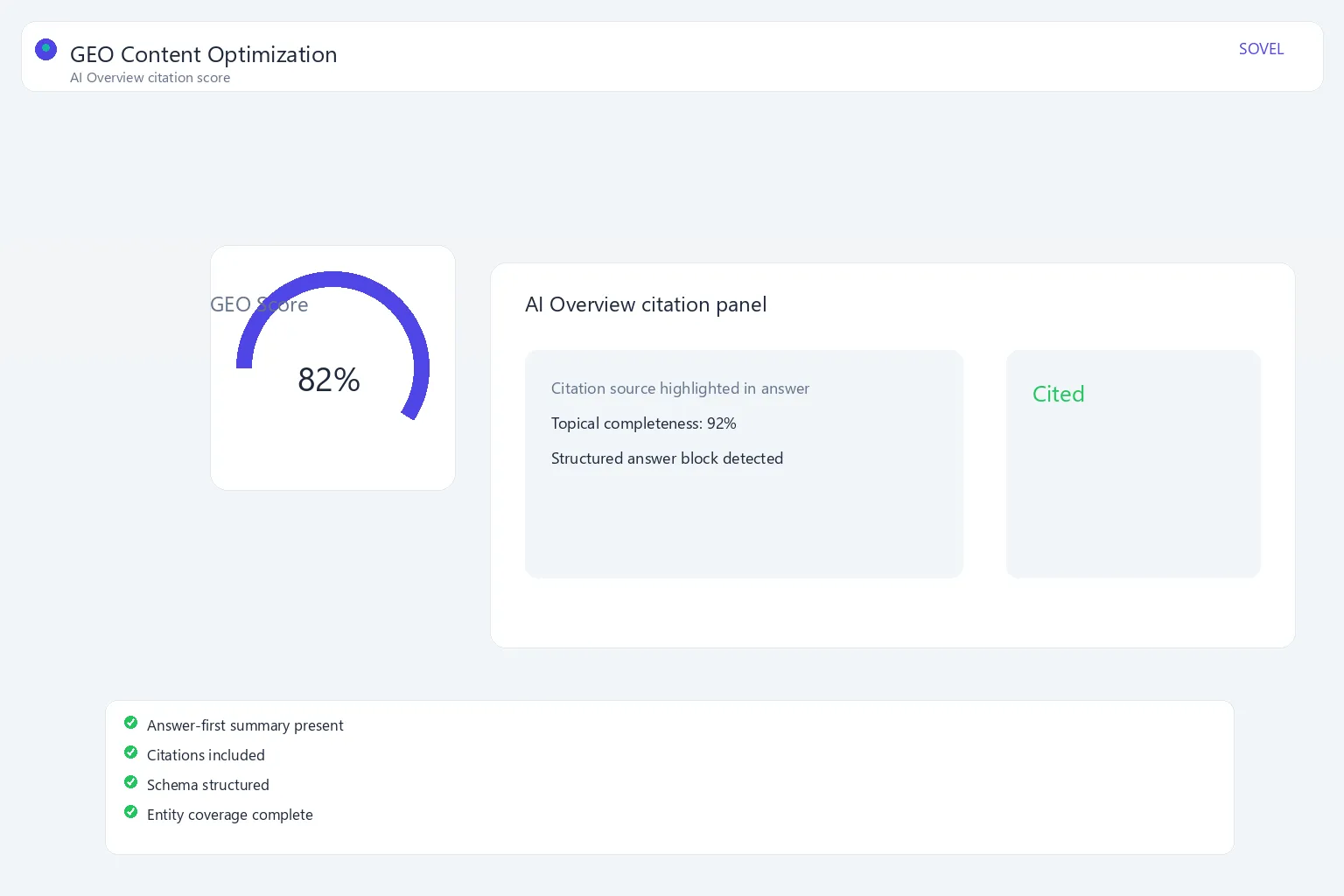
Search behavior keeps shifting toward Q&A, driven by SGE-style answer surfaces. Users ask a question and get a synthesized answer, with the source pages cited beneath it. The brands that appear in those citations receive brand lift, traffic, and trust even when the user never clicks.
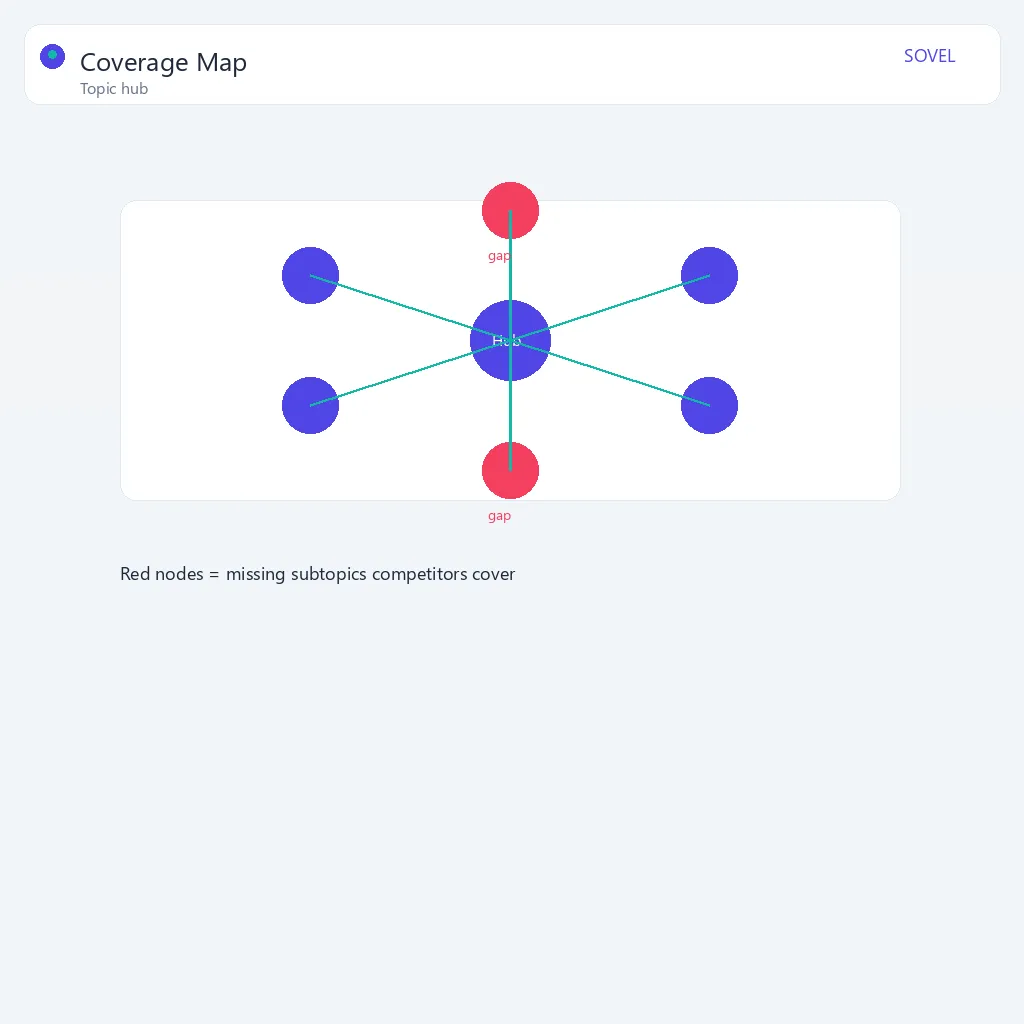
If your site is missing the exact sub-topic the AI needs, it cannot cite you. A GEO content optimization tool finds those gaps before your competitor does — the core job of our content gap analysis tool.
What a GEO content optimization tool does
A good GEO content optimization tool performs five jobs:
- Finds coverage gaps. It analyzes a topic and lists the sub-topics a complete answer would need.
- Scores opportunities. It ranks gaps by importance and commercial value.
- Checks answer-first structure. It flags pages that bury their answer below fluff.
- Suggests evidence. It recommends where to add sources, definitions, and data.
- Exports a ready brief. It packages the analysis into a format a writer can use.
A worked example: how the tool reveals gaps
Let’s make this concrete with a real scenario. Imagine you run a site about home espresso machines, and your focus is the topic “how to choose an espresso machine.” You already have a solid page that covers grinder types, boiler options, and price ranges. You rank well in classic search for a few related terms.
Now you paste “how to choose an espresso machine” into a GEO content optimization tool. The tool returns a semantic cluster of related sub-topics that a complete answer would need, including:
- Maintenance and descaling — how often to clean a machine.
- Milk steaming capability — which buyers need a steam wand.
- Space and countertop dimensions — a practical buying constraint.
- Warranty and support — a trust and risk factor.
- Noise levels and workflow speed — everyday-use concerns.
- Budget tiers — entry, mid-range, and pro categories.
Your existing page covers the grinder and boiler angle well, but it is thin on maintenance, warranty, and noise. The tool flags these as coverage gaps. That is the critical moment in a GEO content optimization tool’s job: it tells you precisely which sub-topics the AI is likely to need, and which of them you are missing.
When an AI Overview assembles an answer about choosing an espresso machine, it pulls from sources that collectively cover all those sub-topics. If your page is the only one that answers the maintenance question clearly, you have a strong chance of being cited for that specific point — even if your page does not rank number one overall. You can then write targeted sub-pages or expand sections to close each gap, linking them back to your hub page.
This loop — analyze, identify gaps, create content, re-analyze — is what makes a GEO tool different from a keyword research tool. Keywords tell you what people search; a GEO tool tells you what a generative engine needs in order to answer a question fully.
The SOVEL GAP BRAIN tool as a GEO optimizer
SOVEL GAP BRAIN, at https://sovel.pro/tools/content-gap-analysis/, is a practical GEO content optimization tool. Paste a topic, and it returns:
- Top keywords — the semantic cluster AI systems expect.
- Content gaps — the sub-topics your coverage misses, which are exactly the pieces an AI answer would cite.
- Opportunities — gaps ranked by priority and format.
- Research summary — a complete, exportable report.
The tool is free with a fair daily per-device limit, and it runs on your own server with built-in logic, so it needs no external API key.

How to structure content for AI citation
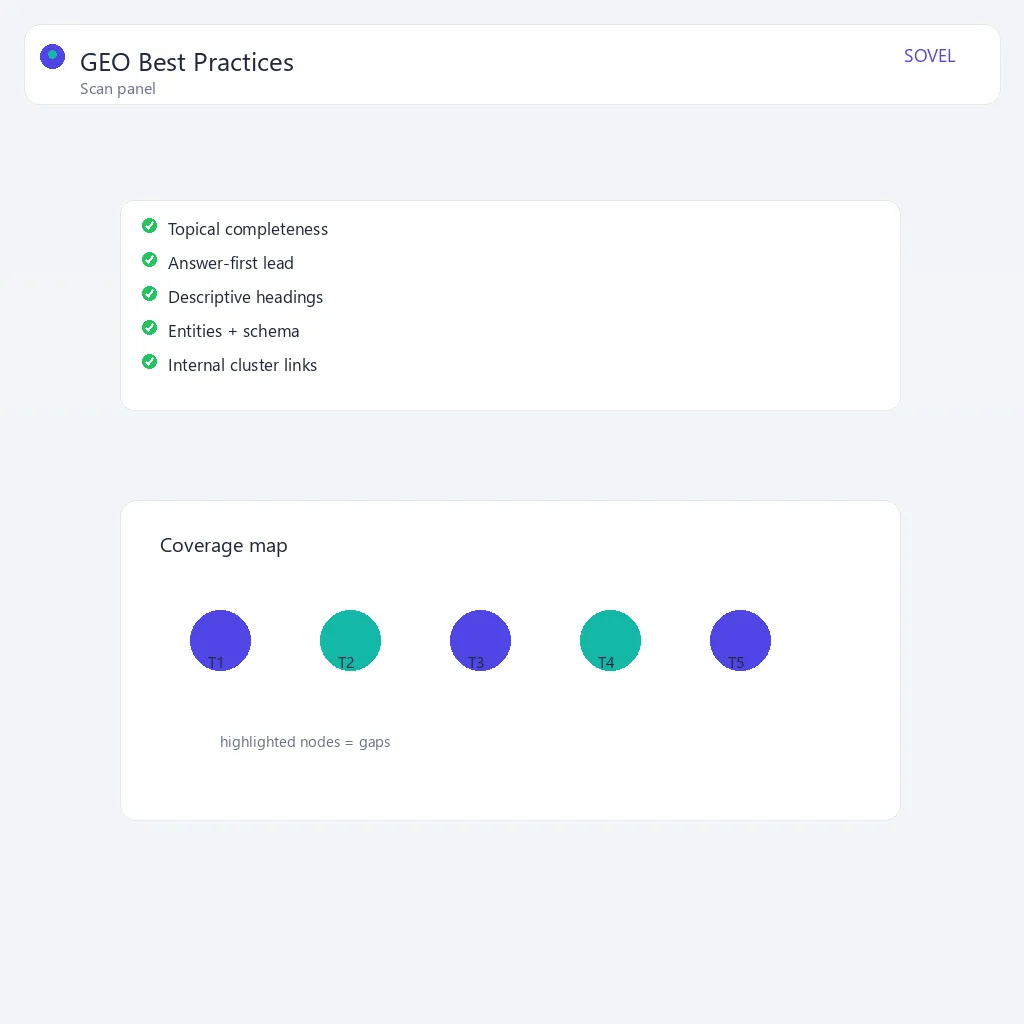
A GEO content optimization tool points you to the right topics, but you also need the right structure. Use this checklist on every page:
- Answer in the first hundred words. State the direct answer before any background.
- Use clear headings. H2 and H3 headings that mirror the question.
- Define terms inline. The first time you use a specialist term, define it in plain words.
- Use bullets and tables. AI systems extract these cleanly.
- Cite sources. Link claims to credible, relevant references.
- Include a compact FAQ. Direct question-and-answer pairs are highly citeable.
This structure is what makes a page legible to both search engines and generative models.
GEO best practices mapped to tool features
Every GEO best practice has a corresponding feature you should look for in a GEO content optimization tool. The table below maps them side by side, so you know what to expect before you invest time in an analysis.
| GEO best practice | Tool feature that supports it | Why it matters |
|---|---|---|
| Answer first in the opening | Answer-position scoring | Generates engines favor immediate, direct answers |
| Cover every relevant sub-topic | Gap and opportunity detection | Missing sub-topics mean the AI looks elsewhere |
| Use clear headings and structure | Structure audit of H2/H3 tags | Well-structured pages are easier to extract from |
| Cite credible sources | Evidence suggestions with links | Citations build authority and verifiability |
| Keep content fresh | Freshness signals and recency flags | Outdated answers lose selection |
| Use lists and tables | Formatting detection | Scannable elements are AI-friendly |
| Address follow-up questions | Related-question expansion | Fills corners of the answer map |
| Match search intent | Topic intent classification | Wrong intent rarely earns a citation |
When you evaluate a GEO tool, check that it covers most of these columns. The SOVEL GAP BRAIN tool spans them: it scores opportunities, flags gaps, checks structure, and exports a ready brief. A tool that only lists keywords is not doing GEO work; it is doing classic keyword research.
Winning the AI Overview with gap coverage
Think of an AI Overview as a paragraph built from the best available sources. If your site is the only one that covers a niche sub-point clearly, the AI has little choice but to cite you. That is why gap coverage is the lever: the more complete your topical map, the more chances the AI has to pick your site.
A GEO content optimization tool makes that advantage visible. Run the analysis, see the missing sub-topics, write them well, and link them together. Over time, your site becomes the default source for the whole question. To see how this maps to a full strategy, read about generative engine optimization content gaps.
How to use the free tool for GEO
Step 1: Go to https://sovel.pro/tools/content-gap-analysis/.
Step 2: Enter your target topic or a competitor URL.

Step 3: Read the opportunities list. These are the sub-topics to add.
Step 4: Export the report as HTML, Markdown, Word, or PDF.
Step 5: Hand the brief to a writer and publish the new pages with answer-first structure.
How to measure GEO success
A GEO content optimization tool helps you create the right content, but you also need to know whether it is working. Measuring the success of GEO is different from measuring classic SEO, because the goal is not a higher ranking alone — it is appearing inside AI answers.
Track these signals:
- AI Overview presence. Check which of your pages are cited in AI Overviews for your target topics. Tools and manual inspection both work. If your page appears, that is the clearest sign your GEO effort is paying off.
- Referral traffic from AI surfaces. Look for sessions that arrive from AI Overviews or answer engines. Even without a click, brand visibility matters, but visits give you a measurable number.
- Citation share. Among the sources the AI selects for a topic, what share is yours? Improving from zero to one or two citations per topic is meaningful progress.
- Coverage score. Re-run the gap analysis and watch the number of unresolved gaps shrink. Fewer gaps usually predicts stronger citation rates.
- Content freshness. Pages that stay current are cited more often over time, so monitor for content that is drifting out of date.
Set a baseline before you start, then re-check every four to six weeks. A good cadence makes the effect of a GEO tool visible and lets you double down on what works.
When to move to the full engine
The free tool is ideal for testing and small workflows. When you need to optimize many topics across your whole domain — and remove the daily limit — the full SOVEL GAP BRAIN engine at https://sovel.pro/sovel-gap-brain-engine/ is the right step. It is a lifetime, one-time purchase, available in three editions, and it runs locally without per-search cost.
A content team using the full engine can analyze every product page and every buying-intent query, keep a running GEO map, and continuously close the gaps AI systems would otherwise fill with competitors.
Avoiding common GEO myths
Because GEO is a young discipline, plenty of myths circulate. A GEO tool clears up most of them by grounding your work in data, but it helps to name the misconceptions explicitly.
- Myth: GEO is exactly the same as SEO. Not true. Classic SEO optimizes for ranked lists of blue links. GEO optimizes for being selected and quoted within a synthesized answer. Different goals call for different tactics, and a GEO content optimization tool supports the AI answer.
- Myth: Ranking first guarantees a citation. You can rank first and still be ignored by an AI Overview if your page is unstructured, buried, or incomplete. Citation selection rewards clarity and coverage, not rank position alone.
- Myth: You need a separate site for AI. No. The same pages can serve both classic and generative engines if they are structured well. The key is expanding coverage and clarity, not building a parallel property.
- Myth: Quantity beats quality. Publishing hundreds of thin pages does not help. A GEO tool ranks gaps by importance so you can focus on the few sub-topics that matter most.
- Myth: GEO is a one-time project. Competition changes and AI systems update. GEO is a continuous loop of analyze, create, measure, and refine.
Frequently asked questions
What is the difference between SEO and GEO?
SEO optimizes for a ranked list of results. GEO optimizes for being selected and quoted inside a generative AI answer. A GEO content optimization tool focuses on the second goal.
Do I need a GEO tool if I already have SEO tools?
Yes, ideally. Classic SEO tools show rankings and keywords. A GEO content optimization tool shows coverage gaps and answer-first structure, which are the signals AI systems rely on.
Is the SOVEL GAP BRAIN tool free?
Yes, the browser tool is free with a fair daily per-device limit. No credit card is needed to try it.
How do I get cited in an AI Overview?
Cover the full topic completely, answer first, cite credible sources, and use clean structure. A GEO content optimization tool tells you which sub-topics to add.
What export formats does the tool support?
HTML, Markdown, Word, and PDF, all branded with SOVEL and timestamped.
What is the daily limit?
The free tier defaults to five searches per day per device, resetting at midnight.
Is the full engine a subscription?
No. The full engine is a one-time lifetime purchase. There is no monthly and no yearly fee.
How long does a GEO analysis take?
Usually seconds. You paste a topic and get the semantic cluster, gaps, and opportunities immediately. Exporting the report takes another moment.
Can the tool analyze a competitor?
Yes. Enter a competitor URL as the topic and the tool returns their coverage and your missing gaps relative to them. This is a useful competitive GEO tactic.
Does the tool replace a human writer?
No. It produces a brief, priorities, and structure guidance. A skilled writer is still needed to produce the authoritative prose that earns citations.
What is the difference between a keyword and a gap?
A keyword is a term people search. A gap is a sub-topic within a question that your content does not fully answer. A GEO content optimization tool converts queries into a list of gaps to close.
Your GEO content optimization checklist
Use this checklist to put everything in this guide into practice.
- [ ] Identify your high-value topics and questions.
- [ ] Run each topic through a GEO content optimization tool.
- [ ] Review the semantic cluster and note missing sub-topics.
- [ ] Prioritize gaps by importance and business value.
- [ ] Create or expand pages to close the top gaps.
- [ ] Structure every page answer-first with clear headings.
- [ ] Add credible citations, evidence, and inline definitions.
- [ ] Use lists and tables to make content AI-friendly.
- [ ] Link related pages into a coherent topical cluster.
- [ ] Publish, then re-run the analysis to confirm gaps are closed.
- [ ] Monitor AI Overview presence and referral traffic monthly.
- [ ] Repeat the loop quarterly to stay ahead of changes.
Final word
A GEO content optimization tool is no longer optional for sites that want to appear in AI answers. Use SOVEL GAP BRAIN to find the gaps, structure the pages for citation, and close the coverage before your competitors do. Start free today, and scale to the lifetime engine when your whole domain needs GEO coverage.