
The Viral Internet Debates That Split Social Media in Half
Every few months, a deceptively simple mathematical equation surfaces on Reddit, Twitter, or TikTok, igniting heated disputes among millions of commenters. One faction vigorously insists the answer is 16, while an equally passionate camp claims with absolute certainty that the answer is 1. The problem is not that arithmetic has fundamentally changed; rather, human intuition often falters when applying operator precedence rules. To settle these mathematical controversies definitively, students and teachers rely on an automated pemdas calculator with steps that makes every precedence decision completely transparent.
When arithmetic expressions contain mixed operations, such as parentheses, exponents, multiplication, division, and subtraction, evaluating terms in the wrong sequence produces entirely incorrect values. In high school algebra and university engineering coursework, an order-of-operations slip on step one invalidates the remainder of an entire multi-page derivation. By mastering the underlying hierarchy and verifying your reasoning with a reliable pemdas calculator with steps, you can approach complex algebraic challenges with absolute certainty.
The PEMDAS Hierarchy: Understanding the Universal Operator Rules
In American and Canadian mathematics education, the mnemonic acronym PEMDAS serves as the foundational framework for resolving multi-term expressions. Each letter corresponds to an explicit priority level in the mathematical hierarchy:
- P — Parentheses and Grouping Symbols: Evaluate everything enclosed within parentheses ( ), brackets [ ], and braces { } first. When brackets are nested, always evaluate from the innermost layer outward.
- E — Exponents and Radicals: Once grouping symbols are resolved, evaluate all powers, indices, and roots (such as square roots or cube roots) before proceeding to arithmetic operators.
- MD — Multiplication and Division (Equal Left-to-Right Priority): This is where the majority of student errors occur. Multiplication does NOT take precedence over division. Both operators share identical priority and must be resolved in strict left-to-right reading order.
- AS — Addition and Subtraction (Equal Left-to-Right Priority): Following multiplication and division, resolve addition and subtraction. Like their multiplicative counterparts, addition and subtraction share equal rank and resolve strictly from left to right.
When an expression is parsed by a pemdas calculator with steps, the underlying algorithm does not guess. It constructs a formal operator precedence tree according to universal mathematical standards established across centuries of academic literature.
PEMDAS vs BODMAS: Dissecting International Nomenclature
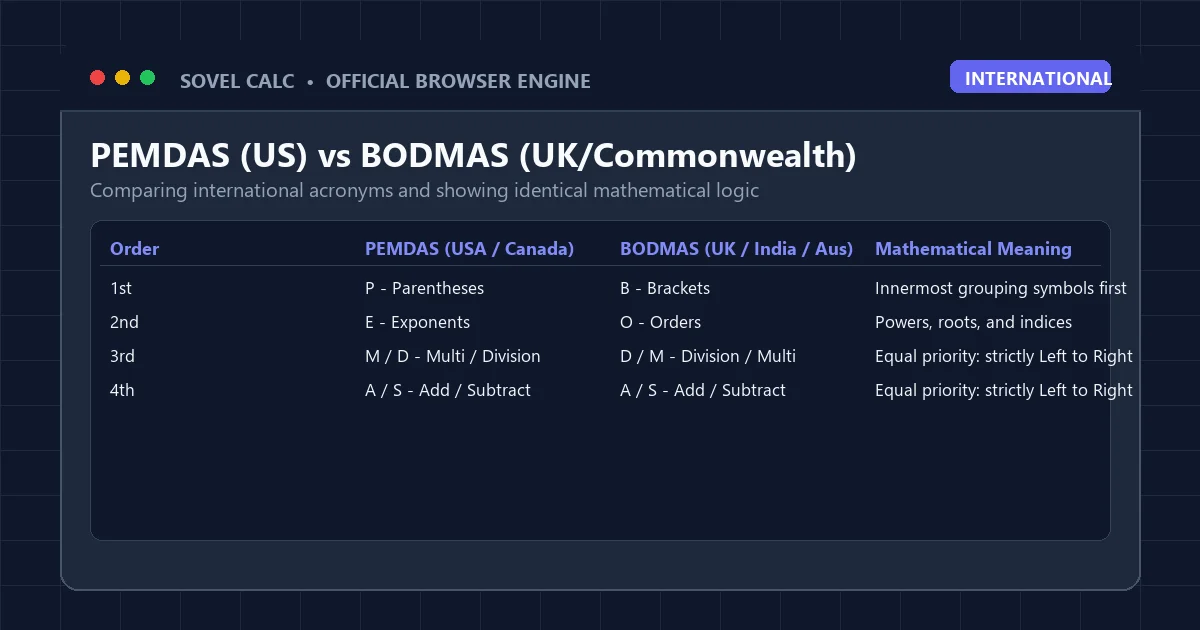
Depending on where you attend school, the acronym you learned may differ. While North American curricula teach PEMDAS, schools in the United Kingdom, India, Australia, and New Zealand teach BODMAS (Brackets, Orders, Division, Multiplication, Addition, Subtraction). Other regions utilize GEMDAS (Grouping, Exponents, Multiplication, Division, Addition, Subtraction) or PEDMAS.
A frequent misconception among students is that BODMAS places division before multiplication, whereas PEMDAS places multiplication before division. In reality, both systems describe identical mathematical laws. A well-constructed pemdas calculator with steps applies the exact same logic regardless of regional naming conventions:
| Acronym System | Primary Region | Grouping Symbol Term | Exponents / Orders Term | Multiplication & Division Rule |
|---|---|---|---|---|
| PEMDAS | United States, Canada | Parentheses (P) | Exponents (E) | Equal priority, strictly Left to Right |
| BODMAS | UK, India, Australia, NZ | Brackets (B) | Orders / Indices (O) | Equal priority, strictly Left to Right |
| GEMDAS | Modern US Curriculum | Grouping Symbols (G) | Exponents (E) | Equal priority, strictly Left to Right |
| BIDMAS | British Secondary Schools | Brackets (B) | Indices (I) | Equal priority, strictly Left to Right |
Viral Problem 1: Dissecting 8 ÷ 2(2 + 2) Step by Step
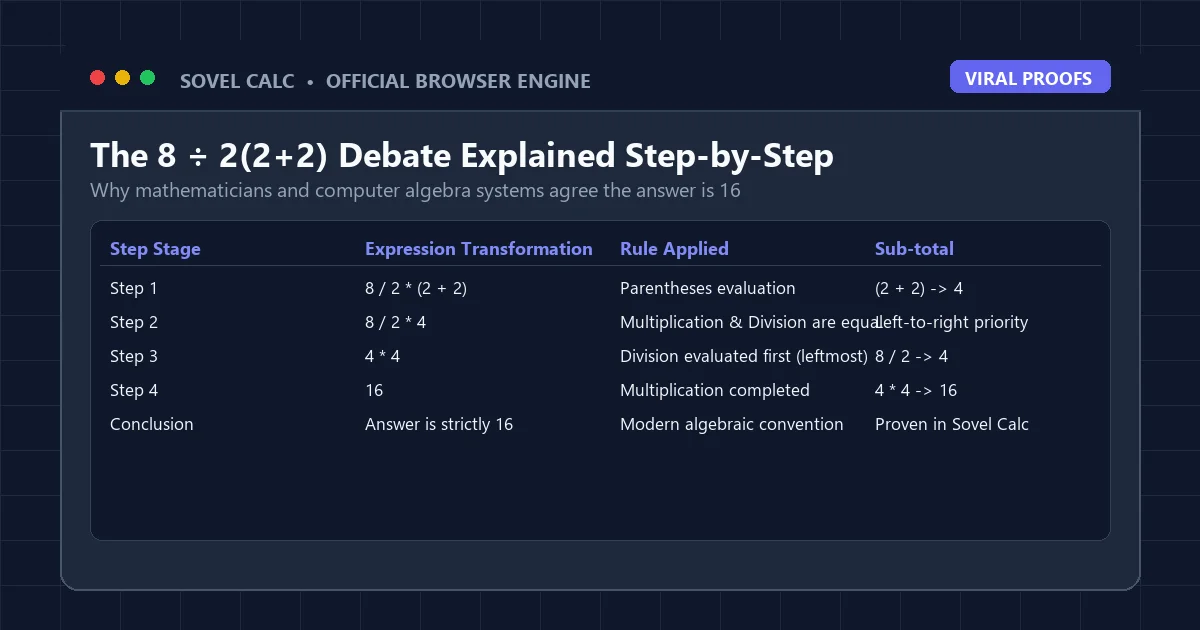
Let us rigorously analyze the most contentious problem on the modern internet: 8 / 2(2 + 2). When entered into a pemdas calculator with steps, the evaluation unfolds in four distinct stages:
- Evaluate Innermost Parentheses (P): Compute the sum inside the bracket: (2 + 2) = 4. The expression now simplifies to
8 / 2 * 4. Note that in standard notation, juxtaposition without an explicit symbol implies standard multiplication. - Identify Operator Ranks (MD): The remaining expression contains one division operator and one multiplication operator. Because both operators belong to the same precedence tier, the engine enforces the left-to-right tie-breaker rule.
- Execute Leftmost Operation: The leftmost operator is the division: 8 / 2 = 4. The expression collapses to
4 * 4. - Execute Final Multiplication: Compute 4 * 4 = 16.
- Final Result: = 16 (Mathematically Proven).
Why do millions of people arrive at 1? Individuals who obtain 1 treat 2(2 + 2) as a unified, indivisible denominator, effectively computing 8 / [2(4)] = 8 / 8 = 1. While historical texts from the early twentieth century occasionally favored implicit multiplication binding, modern computer algebra systems and academic bodies like the Mathematical Association of America treat implicit multiplication as standard multiplication, confirming 16 as the correct answer in any modern pemdas calculator with steps.
Viral Problem 2: The Infamous 60 ÷ 5(7 – 5) Dilemma
Another classic viral arithmetic challenge is 60 / 5(7 - 5). Just as with the previous example, two competing answers frequently emerge: 24 or 6. Processing this through a pemdas calculator with steps clarifies the exact sequence:
- Phase 1: Evaluate parentheses: (7 – 5) = 2. The expression becomes 60 / 5 * 2.
- Phase 2: Scan from left to right. The division 60 / 5 appears first. Evaluate 60 / 5 = 12.
- Phase 3: Multiply the quotient by the bracket result: 12 * 2 = 24.
- Verified Solution: = 24.
Students who get 6 mistakenly multiply 5 by 2 first, producing 60 / 10 = 6. Viewing the step derivation in a pemdas calculator with steps visually exposes this left-to-right sequencing rule, ensuring students do not repeat the mistake on classroom exams.
Viral Problem 3: Multi-Layer Nested Brackets [3 × (2 + 4²)]
When expressions feature multiple layers of nesting, such as brackets containing parentheses containing exponents, working systematically from the inside out is mandatory. Consider: [3 * (2 + 4^2)]. When parsed by a pemdas calculator with steps, the derivation proceeds inward-to-outward:
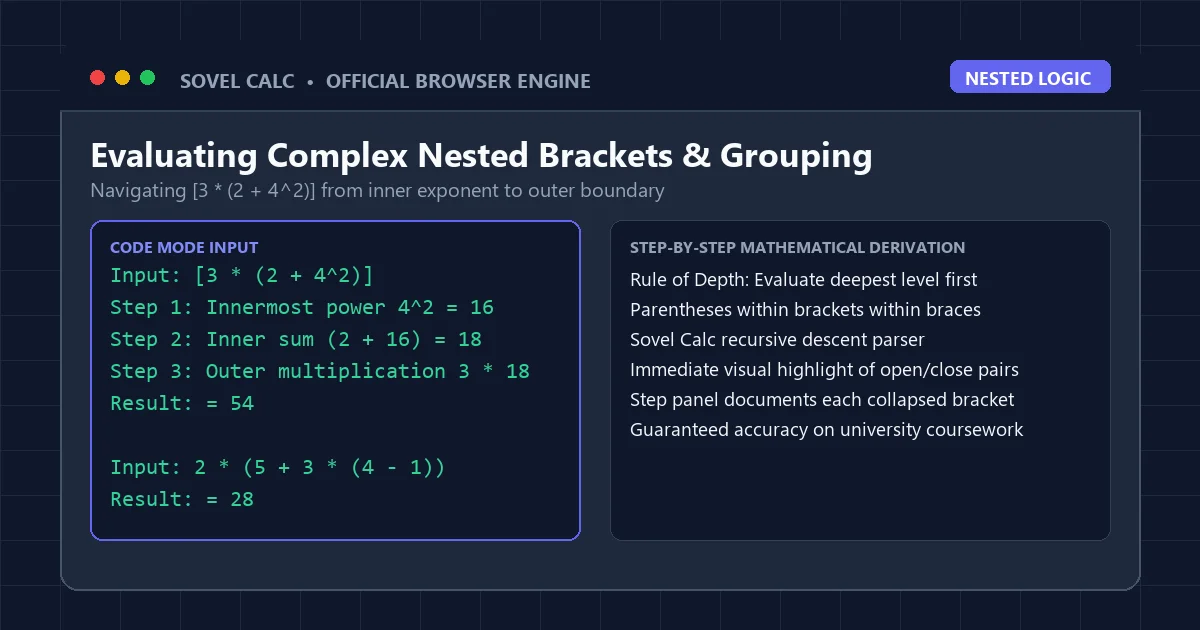
- Innermost Exponent Evaluation: Inside the parentheses (2 + 4^2), the exponent 4^2 takes precedence over addition: 4^2 = 16. The bracket becomes (2 + 16).
- Innermost Parentheses Summation: Complete the parentheses: 2 + 16 = 18. The entire inner term collapses to 18.
- Outer Bracket Multiplication: The outer expression is now [3 * 18]. Evaluate the product: 3 * 18 = 54.
- Final Verified Total: = 54.
By observing each stage collapse inside a pemdas calculator with steps, students gain spatial intuition for how complex mathematical sentences deconstruct into manageable arithmetic units.
Viral Problem 4: The Negative Exponent Trap: (-3)² versus -3²
Perhaps no single concept generates more lost points on high school algebra tests than the subtle distinction between (-3)^2 and -3^2. While both look superficially similar, they represent entirely different mathematical statements:
| Expression Syntax | Base Being Squared | Explicit Mathematical Meaning | Evaluated Result |
|---|---|---|---|
| (-3)^2 | The negative number -3 | (-3) * (-3) | +9 (Positive) |
| -3^2 | The positive number 3 | -(3 * 3) or -1 * (3^2) | -9 (Negative) |
| (-4)^2 | The negative number -4 | (-4) * (-4) | +16 (Positive) |
| -4^2 | The positive number 4 | -(4 * 4) | -16 (Negative) |
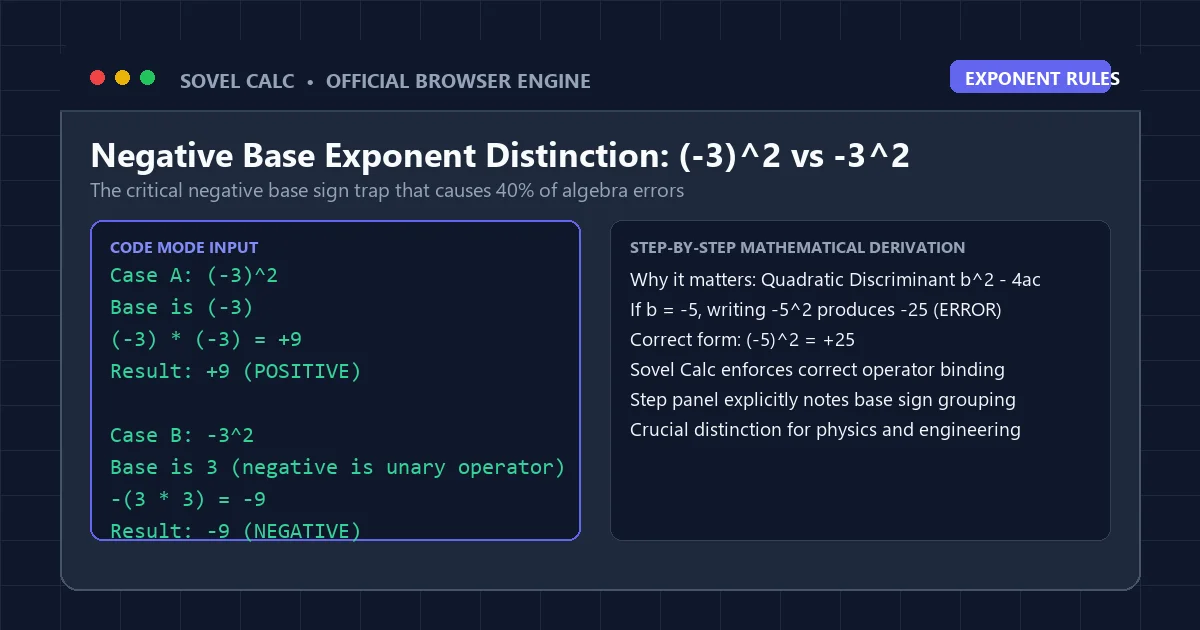
When evaluated in a pemdas calculator with steps, the reason becomes clear. In (-3)^2, the parentheses wrap the negative sign, establishing -3 as the complete base. In -3^2, the exponent (E) holds higher priority than the unary negative sign (which acts as a multiplication by -1). The exponentiation executes first: 3^2 = 9. Then the negative sign attaches: -9. This distinction is vital when evaluating the quadratic formula discriminant b^2 – 4ac, where a negative b-value must always be enclosed in parentheses.
Viral Problem 5: Complex Rational Expressions and Fractions
Consider evaluating mixed fraction operations: (1/2 + 3/4) * 8 - 5. In this scenario, fraction bars act as implicit grouping symbols. When processed through a pemdas calculator with steps, the evaluation breaks down logically:
- Parentheses Phase: Find common denominators for 1/2 and 3/4. 1/2 converts to 2/4. Sum 2/4 + 3/4 = 5/4, which equals 1.25.
- Multiplication Phase: Next, multiply the bracket fraction by 8: 1.25 * 8 = 10.
- Subtraction Phase: Finally, subtract 5 from the product: 10 – 5 = 5.
- Final Answer: = 5 (Exact).
Because the pemdas calculator with steps displays each conversion explicitly, students can verify both their fraction arithmetic and their operator sequencing in one unified view.
Viral Problem 6: The Extended Arithmetic Chain: 100 – 25 × 2 + 10 ÷ 2
Our final viral test case is a long linear chain without parentheses: 100 - 25 * 2 + 10 / 2. A student reading strictly left to right might compute: 100 – 25 = 75, then 75 * 2 = 150, then 150 + 10 = 160, then 160 / 2 = 80. This is completely incorrect. Let us examine how a pemdas calculator with steps evaluates it properly:
- Scan for Multiplication and Division (Left-to-Right): Identify 25 * 2 and 10 / 2.
- Evaluate 25 * 2: 25 * 2 = 50. The expression becomes 100 – 50 + 10 / 2.
- Evaluate 10 / 2: 10 / 2 = 5. The expression becomes 100 – 50 + 5.
- Scan for Addition and Subtraction (Left-to-Right): The leftmost operation is 100 – 50 = 50.
- Complete Final Addition: 50 + 5 = 55.
- Final Result: = 55 (Correct).
The true answer is 55, not 80. The step-by-step display inside a pemdas calculator with steps illustrates how multiplication and division pull ahead of subtraction and addition, transforming potential confusion into crystal-clear logic.
Classroom Integration: How Sovel Calc Empowers Students
Sovel Calc implements these mathematical rules using Math.js, a battle-tested mathematical evaluation library that guarantees deterministic, IEEE 754-compliant results. With Code Mode, students can type long expressions like 100 - 25 * 2 + 10 / 2 directly from their keyboards and see live updates instantly.
Once your calculations are complete, you can download a complete homework sheet using our step by step equation solver pdf tool, or compare our feature set in our full Sovel Calc review. For school Chromebook setups, check out our guide on the online scientific calculator for chromebook.
For additional historical context on how precedence rules evolved across human mathematics, explore Wikipedia’s Order of Operations Documentation.
Frequently Asked Questions
What is the definitive answer to 8 ÷ 2(2 + 2)?
Under modern mathematical precedence rules, the answer is 16. Parentheses are evaluated first (2 + 2 = 4). Then, division and multiplication resolve strictly from left to right (8 / 2 = 4, followed by 4 * 4 = 16).
Does multiplication always come before division in PEMDAS?
No. Multiplication and division share identical priority. When both appear in an expression, they must be resolved strictly in left-to-right reading order.
Why does (-3)^2 equal 9 while -3^2 equals -9?
In (-3)^2, parentheses make -3 the base, yielding (-3) * (-3) = 9. In -3^2, the exponent applies strictly to 3 first (3^2 = 9), and the negative sign attaches afterward, producing -9.
Is this PEMDAS calculator with steps free to use on mobile devices?
Yes. Sovel Calc is 100% free with no login required, running smoothly across smartphones, tablets, Chromebooks, and desktop computers.
Can I export my PEMDAS calculation steps to a PDF document?
Yes. Clicking the Export PDF button generates a clean, printable homework document containing your input, final answer, and complete step-by-step proof.
Conclusion: Eliminate Math Confusion Forever
Order of operations is not an arbitrary set of trick rules; it is the universal grammar that allows mathematicians, scientists, and engineers to communicate equations without ambiguity. When you face an intimidating expression, guessing is never the answer. Using a dedicated pemdas calculator with steps provides the transparency and validation needed to master every calculation.
Stop losing points to simple sequencing slips. Launch Sovel Calc today, type your most challenging order of operations problems, and verify every single step with complete confidence.