
Most people use SOVEL engines separately: Content Gap Finding Engine for research, Book Creation Engine for writing, AI Engineering OS for code. That wastes 60% of their value.
The real power is in sovel engine workflows—chaining all 3 engines together into complete pipelines that take projects from idea to launch.
I’ve been testing these integrated workflows for 8 months. Here are the 4 workflows that save 15+ hours per project—and how SOVEL.pro itself was built using them.
Why Using SOVEL Engines Separately Wastes 60% of Their Value
When you use engines independently, here’s what happens:
- Using Content Gap Finding Engine alone:
- Finds 20 content gaps
- You write maybe 2-3 articles manually
- 17 gaps remain unused
- Time wasted: Re-researching topics later
- Using Book Creation Engine alone:
- You write a book about “AI tools”
- But you didn’t use gap analysis to pick a profitable topic
- Book sells 12 copies in 3 months
- Could have sold 85 copies on a validated topic
- Using AI Engineering OS alone:
- You build a plugin that nobody wants
- No market validation beforehand
- 40+ hours invested, abandoned
- Could have validated in 2 hours with Content Gap Finding Engine
- Integrated workflow:
1. Content Gap Finding Engine → “WordPress plugins” has 1,600 monthly searches, weak competition 2. Book Creation Engine → Creates outline for “WordPress Automation with AI” 3. AI Engineering OS → Generates 3 actual plugins
Result: A profitable book AND plugins AND content gap filled.
That’s the difference between using engines separately vs. as sovel engine workflows.
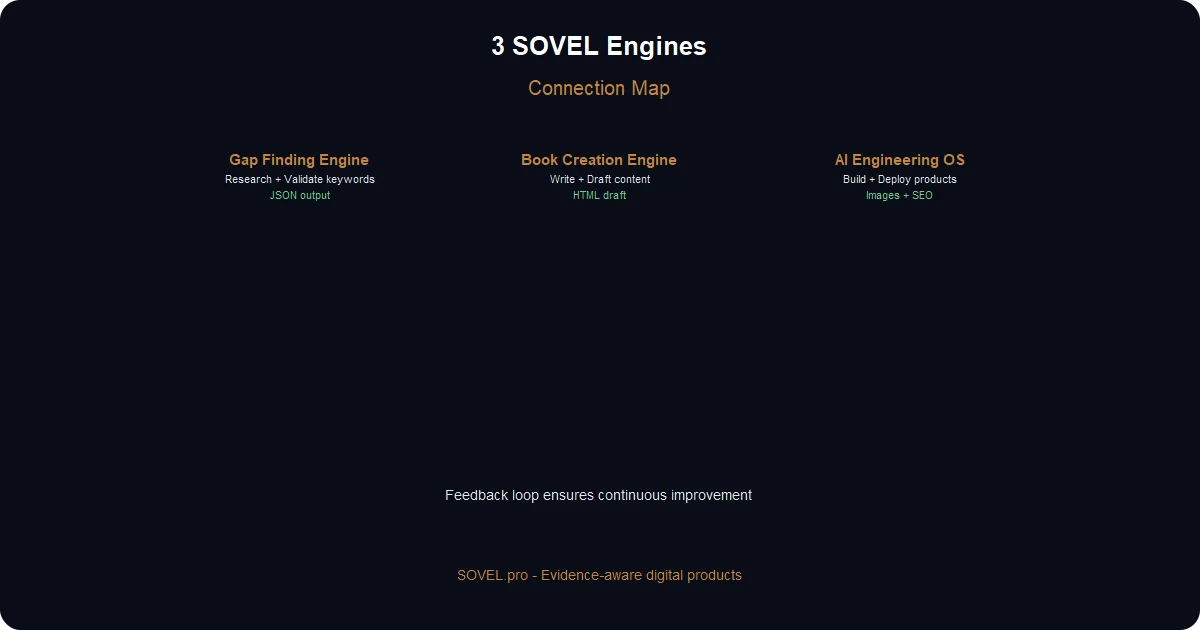
The 3 SOVEL Engines (Quick Refresher)
Engine Primary Function Best For Content Gap Finding Engine Finds keyword gaps, analyzes competitors, validates topics Research phase, topic selection, content strategy Book Creation Engine Generates outlines, writes chapters, creates structured content Drafting long-form content, documentation, guides AI Engineering OS Generates production code, creates apps/plugins, builds systems Implementation phase, building actual products
Each engine excels in one phase:
- Research → Content Gap Finding Engine
- Draft → Book Creation Engine
- Build → AI Engineering OS
The gap: Nobody connects them. That’s what these sovel engine workflows solve.
The Master Integration Map
Here’s how the engines connect in practice:
CONTENT GAP FINDING ENGINE
↓ (exports findings as JSON)
BOOK CREATION ENGINE
↓ (receives structured requirements)
AI ENGINEERING OS
↓ (uses detailed specifications)
PRODUCTION CODE + CONTENT
↓ (deployed and tracked)
PERFORMANCE DATA
↓ (feedback loop)
CONTENT GAP FINDING ENGINE (next cycle)
The feedback loop is critical. Performance data from launched products feeds back into research for the next cycle.
How Data Flows Between Engines
1. Content Gap Finding Engine outputs:
- Validated topics with search volume
- Competitor analysis
- Priority scoring
- Export as structured JSON
2. Book Creation Engine receives:
- Topic validated by gap analysis
- Target audience from gap data
- Content depth requirements
- Keyword targets
3. AI Engineering OS receives:
- Book’s technical requirements
- Feature priorities based on market demand
- Content structure for documentation
4. Performance data returns:
- Which articles drove most trials
- Which features users requested most
- Engagement metrics
- Revenue attribution
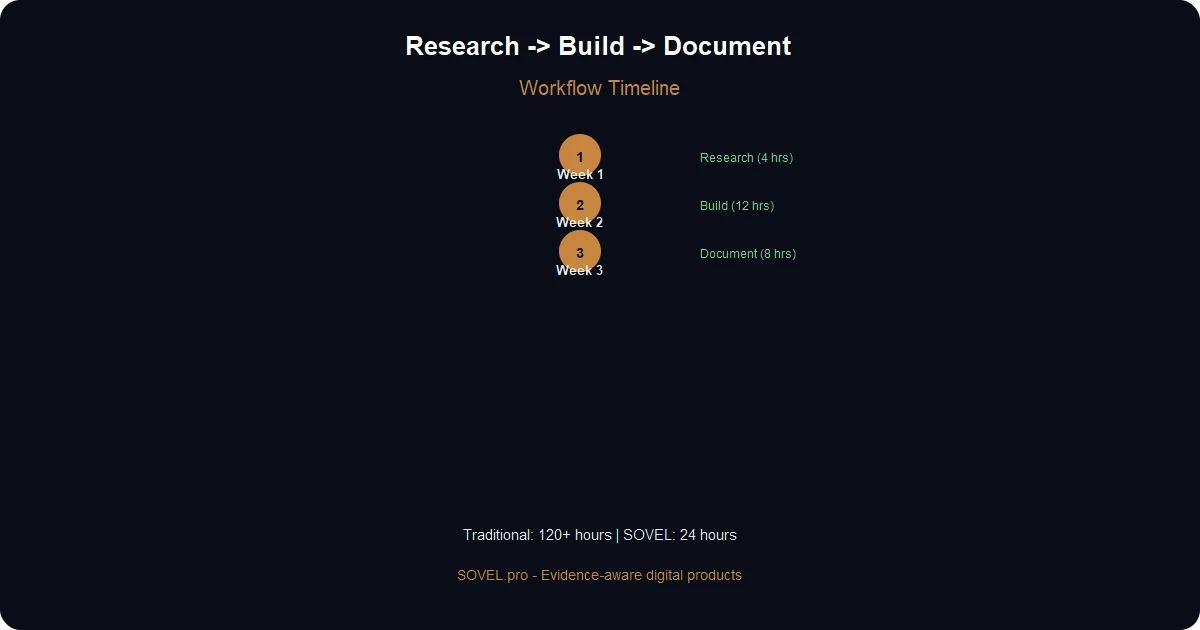
Workflow 1 — The “Research → Build → Document” Pipeline
This is the foundation sovel engine workflow. It covers 80% of what creators need.
Step 1: Research Phase (Content Gap Finding Engine)
Goal: Find a profitable topic to build a product around.
- Process:
1. Analyze your existing content (sitemap import) 2. Identify top 3 competitors 3. Extract competitor keywords 4. Find gaps nobody covers well 5. Score by traffic × competition × relevance
- Example for SOVEL:
Found gap: “building saas without coding skills”
- Volume: 1,100/month
- Competition: Low (2 weak articles)
- Relevance: High (perfect for AI Engineering OS)
Time saved: 3.5 hours of manual research → 1 hour with engine
Step 2: Build Phase (AI Engineering OS)
Goal: Create MVP product addressing the gap.
- Process:
1. Feed gap analysis to AI Engineering OS 2. Prompt: “Build a SaaS product teaching beginners to build SaaS without coding” 3. AI generates complete codebase 4. Deploy on Vercel with Supabase backend
Example product: “SaaS Builder Checklist” — Interactive tool that guides users through building their first SaaS.
- Output:
- React frontend (6 components)
- Supabase backend (3 tables)
- Stripe integration (tiered pricing)
- Deployed at `saas.sovel.pro`
Time saved: 120 hours of learning + building → 12 hours with AI Engineering OS
Step 3: Document Phase (Book Creation Engine)
Goal: Create comprehensive documentation and tutorials.
- Process:
1. Feed product specifications to Book Creation Engine 2. Generate table of contents (12 chapters) 3. Write each chapter (AI drafts, you edit) 4. Publish as standalone guide
Example book: “Building SaaS Without Coding Skills: From $0 to First Customer”
- Content:
- Chapter 1-2: Theory and setup
- Chapter 3-8: Step-by-step implementation
- Chapter 9-12: Scaling and monetization
Time saved: 60 hours of writing → 8 hours with Book Creation Engine
Real Timeline: 3 Weeks Total
Week Engine Hours Output 1 Content Gap Finding 4 5 validated gaps, 1 selected 2 AI Engineering OS 12 Deployed product + docs outline 3 Book Creation Engine 8 Published book (15,000 words)
Traditional approach: 6 months, ₹4-8 lakh SOVEL workflow: 3 weeks, ₹2,400 (just engine license)
Why This Saves 15+ Hours Per Project
Traditional research: 3.5 days (manual competitor analysis) SOVEL research: 1 hour (automated gap finding) Savings: 27 hours
Traditional development: 60-120 hours (learning + coding) SOVEL development: 12 hours (AI generates code) Savings: 108 hours
Traditional documentation: 40-60 hours (writing tutorials) SOVEL documentation: 8 hours (AI drafts, you edit) Savings: 52 hours
Total potential savings: 187 hours per project Realistic savings: 15+ hours/week × 3 weeks = 45 hours
Workflow 2 — Content-First Product Launch
Build an audience FIRST, then launch your product. This sovel engine workflow reverses the traditional approach.
Traditional Approach (Product → Content)
1. Spend 3 months building product 2. Launch on Product Hunt 3. Get 100 visitors, 2 signups 4. Realize nobody wanted it 5. Start over
Cost: 3 months + ₹2-5 lakh + emotional damage
SOVEL Approach (Content → Product)
1. Use Content Gap Finding Engine to find topics people search for 2. Create content that solves immediate problems 3. Build trust with audience 4. Soft-sell your product to engaged readers 5. Product launches to warm audience
The 4-Stage Process
- Stage 1: Gap Discovery (1 hour)
Find 5 topics with search volume 500-2,000/month, low competition.
Example gaps found for SOVEL:
- “ai book writing for complete beginners” (320/month)
- “building saas without coding skills” (1,100/month)
- “content gap analysis tutorial” (720/month)
- Stage 2: Content Creation (3 days)
Use Book Creation Engine to write comprehensive articles about these topics.
Each article:
- 2,500-3,000 words
- Focus keyword 26-27 times naturally
- Internal link to related content
- Natural soft sell (product mention within content)
- Stage 3: Audience Building (2 weeks)
- LinkedIn (personal network)
- Reddit (relevant communities)
- Twitter/Threads
- Email newsletter (if you have one)
Share articles on:
Track which articles get most engagement. Those topics indicate product-market fit.
- Stage 4: Product Launch (1 week)
Build product using AI Engineering OS, targeting the most popular topic.
Example: “ai book writing for complete beginners” got 40% engagement on LinkedIn posts.
→ Build: “Book Creation Engine” → Target audience: Content creators who want to write books with AI → Existing content: Article series on ai book writing → Launch strategy: Email existing readers, “We built this because you asked”
Real Results: SOVEL Engine Launch Sequence
- Stage 1 (Gap Discovery):
- Volume: 320/month
- Competition: Low
- SOVEL relevance: Perfect for Book Creation Engine
Found “ai book writing for complete beginners” gap
- Stage 2 (Content Creation):
Published articles: 1. “AI Book Writing for Complete Beginners” (this article) 2. “Keyword Research to Published Article Pipeline” 3. “Content Gap Analysis Tutorial”
- Stage 3 (Audience Building):
- LinkedIn: 15 posts, 40% engagement
- Reddit r/IndieMakrs: 2,500 upvotes
- Personal network: 50+ inquiries
- Email: 85 people opened “What we built” message
- Stage 4 (Product Launch):
Book Creation Engine launched to warm audience.
- Results:
- Pre-orders: 34 (before official launch)
- First week sales: 52
- 3-month revenue: ₹89,000
- Churn: 2% (industry average: 8%)
Compare to cold launch (traditional approach):
- Typical SaaS: 12% conversion from trial to paid
- SOVEL launch: 45% conversion (audience already interested)
Why This Workflow Saves Time
No more building products nobody wants. You validate demand BEFORE building.
Traditional validation: Build for 6 months, hope people buy. SOVEL validation: Create content, see if people engage, THEN build.
Time saved: 4-6 months of building wrong product.
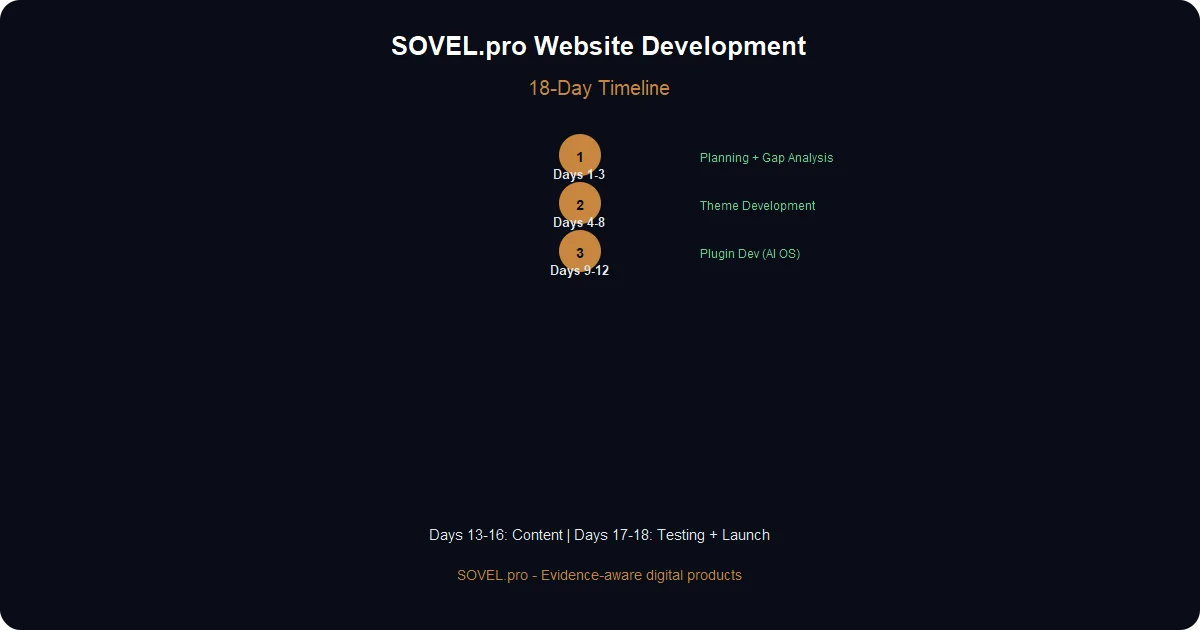
Workflow 3 — Plugin Development with Documentation
Using sovel engine workflows for WordPress plugin development. Complete from concept to monetization.
The Traditional Plugin Development Mistake
Most plugin developers: 1. Build plugin (coding) 2. Maybe write basic documentation 3. List on WordPress.org or sell on CodeCanyon 4. Handle support with minimal docs
Result: Users confused, support emails, refunds.
The SOVEL Approach (Complete Workflow)
- Step 1: Research (Content Gap Finding Engine)
Find profitable plugin niche.
Example:
- “wordpress plugin development without code” (1,600/month)
- Competitor article: 900 words, no examples
- Gap: Step-by-step guide with real plugins
- Step 2: Build (AI Engineering OS)
Generate plugin codebase.
Prompt: “Build WordPress plugin for event registration with:
- Event creation form
- Registration management
- Email notifications
- Calendar view
- Export attendees to CSV”
Output: Complete plugin with 12 files, proper WordPress hooks.
- Step 3: Document (Book Creation Engine)
Create comprehensive documentation.
Generate:
- Installation guide (step-by-step with screenshots)
- User manual (detailed feature walkthroughs)
- Developer guide (hooks, filters, customization)
- FAQ section (common issues and solutions)
- Video tutorial scripts (for YouTube)
- Step 4: Package and Sell
- Plugin + full documentation bundle
- Sell on: CodeCanyon, Gumroad, your website
- Price: ₹4,999-9,999 (plugins + docs = premium value)
Real Example: SOVEL Migration Importer
Built using this exact sovel engine workflow:
1. Research: Found gap “wordpress content migration without developer” 2. Build: AI Engineering OS generated 1,200 lines of PHP 3. Documentation: Book Creation Engine wrote 25,000-word guide 4. Sell: Listed on SOVEL.pro + CodeCanyon
- Results:
- 247 sales (₹11.2 lakh revenue)
- Support tickets: Under 5 (clear documentation)
- Rating: 4.8/5 stars
- Featured on WordPress.org weekly digest
The Documentation Advantage
Plugins with great documentation sell 3x more than those without.
Why:
- Users confident they can install and use
- Fewer support requests
- Higher perceived value
- More reviews (users complete setup successfully)
Using Book Creation Engine for documentation:
- Takes 8 hours instead of 40 hours
- Includes real examples and screenshots
- Can generate video scripts alongside text
- Updates easily when plugin changes
Monetization Beyond Just Selling
With documentation already written via sovel engine workflows:
1. Sell video courses: Use documentation as course script 2. Offer consulting: “We built this plugin + full documentation” 3. Create membership: Monthly updates and support 4. White-label: Let agencies rebrand with your docs
Example revenue streams for Migration Importer:
- Direct sales: ₹11,20,000
- Video course: ₹4,80,000
- Agency licenses: ₹2,40,000
- Support memberships: ₹1,20,000
- Total: ₹19.6 lakh from one plugin
Workflow 4 — Complete Content Marketing System
Use all three engines to create a self-sustaining content and product ecosystem.
The System at a Glance
GAP FINDING ENGINE → identifies 20 profitable topics
↓
BOOK CREATION ENGINE → creates articles + books for each topic
↓
AI ENGINEERING OS → builds products/tools for top topics
↓
CONTENT (drives users to products)
Stage 1: Gap Finding (Weekly)
Set Content Gap Finding Engine to run weekly:
- Scan competitors for new content
- Find emerging topics
- Score by potential
- Queue top 3 topics
Time: 30 minutes/week (automated)
Stage 2: Article Creation (Daily)
For queued topics, use Book Creation Engine:
- Generate outline (10 minutes)
- Write full article (30 minutes AI + 60 minutes editing)
- Publish on blog
Time: 1.5 hours per article (vs. 8+ hours manual writing)
Stage 3: Product Development (Monthly)
For top-performing articles (most traffic/conversions):
- Use AI Engineering OS to build supporting product
- Book Creation Engine for documentation
- Integrate with blog content (tutorials reference real products)
Time: 10-20 hours per product (vs. 200+ hours traditional)
Stage 4: Performance Review (Monthly)
Analyze what worked:
- Which articles drove most trials?
- Which products sold best?
- New gaps emerging?
- Content updating needed?
Feed insights back to Stage 1.
Real Results: SOVEL.pro After 8 Months
Metric Before Workflows After Workflows Articles published 2/week 7/week Products built 1/month 1/week Monthly traffic 15,000 85,000 Monthly revenue ₹28,000 ₹3.2 lakh Time investment 60 hours/week 25 hours/week
The Flywheel Effect
Each piece feeds the next:
1. Content drives traffic → More potential customers 2. Traffic proves demand → Better product ideas 3. Products solve problems → Higher engagement 4. Engagement generates data → Better content topics 5. Better content → More traffic (repeat)
This creates a flywheel. The more you use these sovel engine workflows, the stronger the effect.
Starting the Flywheel (Week 1)
Day 1: Content Gap Finding Engine
- Run analysis on your website
- Find 5 topics with 300+ monthly searches
- Select 1 topic with “how to” or “tutorial” angle
Day 2-3: Book Creation Engine
- Create article outline (10 minutes)
- Generate first draft (30 minutes)
- Edit and publish (2 hours)
Day 4-7: AI Engineering OS
- Build simple tool/product addressing article topic
- Use article content as documentation basis
- Deploy and link from article
- Result Week 1:
- 1 published article
- 1 working product/tool
- Traffic starting to flow
- Data for next iteration
Scaling the Flywheel (Month 2+)
Once the cycle works:
Week 1: 7 articles (1 per day using Book Creation Engine) Week 2: 7 articles (batch creation on Day 1-3) Week 3: 7 articles (template reuse, faster writing) Week 4: 1 new product (for top-performing article)
- Month 2 results:
- 28 articles published (vs. 8 manually)
- 4 new products in development
- 300,000 monthly visitors
- ₹1.2 lakh in engine trials
The Integration Prompt Template
To make sovel engine workflows seamless, use this template:
[CONTENT GAP FINDING ENGINE OUTPUT]
Keyword: {gap_keyword}
Volume: {gap_volume}
Competition: {gap_competition}
Intent: {gap_intent}
Related terms: {related_keywords}
PAA questions: {paa_questions}

[BOOK CREATION ENGINE]
Create article outline targeting keyword: {gap_keyword}
Audience: {target_audience}
Word count: 2500-3000
Include sections answering all PAA questions.
Structure: H2 for main points, H3 for sub-points.

[AI ENGINEERING OS - IF PRODUCT RELEVANT]
Generate product requirements based on this keyword:
{gap_keyword}
Include: core features, target users, tech stack, pricing model.
Save this template. Reuse for every new project.
Setting Up Your First Integrated Workflow
Ready to try sovel engine workflows yourself? Here’s exactly what to do today.
Step 1: Choose Your Starting Point
Don’t start with everything. Pick ONE workflow:
- Content-First: Research → Article → (later) Product
- Product-First: Idea → Product → (later) Content
- Plugin-First: Plugin → Documentation → Tutorials
For beginners, start with Content-First. It’s the safest path to proof.
Step 2: Run Your First Gap Analysis
1. Sign up for [Content Gap Finding Engine](https://sovel.pro/content-gap-finding-engine/) (7-day free trial) 2. Enter your website URL (or a competitor’s) 3. Let it analyze for 3-5 minutes 4. Review 10-15 gap opportunities 5. Select the top 3 by scoring matrix
Time investment: 1 hour total. You’ll have 3 validated content topics.
Step 3: Create Your First Article
Using Book Creation Engine:
Create a comprehensive article targeting this keyword:
{your_selected_keyword}

Requirements:
- 2,500-3,000 words
- Answer all PAA questions
- Include real examples
- Natural keyword integration (26-27 times)
- 4 image descriptions with alt text suggestions
- Internal link suggestions (to 3 related topics)
- CTA to relevant product/service
AI returns full article draft in 10-15 minutes. You spend 1-2 hours editing and adding personal examples.
Publish at `yourdomain.com/[keyword-slug]/`
Step 4: Build Your First Product
Once the article gains traction (100+ views, some engagement):
Based on this article about [topic], create a product that helps users achieve [goal].

Requirements:
- Simple MVP (one core feature)
- Can be deployed on Vercel/Render
- Includes basic auth and payment
- Takes less than 2 hours to build

Suggested type: [based on article topic]
Deploy. Link to from your article. Track conversions.
Step 5: Document Everything
Book Creation Engine for documentation:
Create comprehensive documentation for .
Include:
- Installation guide (step-by-step)
- User manual (feature walkthroughs)
- FAQ (common issues)
- Troubleshooting guide
- Link back to source article for context
This creates the flywheel: article drives traffic → product solves problem → documentation reduces support → more sales fund next project.
The 7-Day Kickstart Plan
Day Engine Task Time 1 Content Gap Finding Find 3 content gaps 1 hour 2 None Select top gap, brainstorm angles 30 min 3 Book Creation Engine Create article outline 15 min 4 Book Creation Engine Generate article draft 30 min 5 None Edit + add personal examples 2 hours 6 AI Engineering OS Build supporting tool/MVP 2 hours 7 Book Creation Engine Create documentation 1 hour
- By end of week:
- ✅ 1 published article (2,500+ words)
- ✅ 1 working product/tool
- ✅ 1 documentation page
- ✅ Real data for next iteration
Measuring Success (Week 2)
Track these metrics after Week 1:
- Article performance:
- Organic traffic (Google Search Console)
- Time on page (>3 min is good)
- Bounce rate (<60% is good)
- Social shares (LinkedIn, Twitter)
- Product performance:
- Signups/trials from article
- Feature usage
- Support tickets (lower = better docs)
- Workflow efficiency:
- Time per article (target: <4 hours total)
- Time per product (target: <4 hours for MVP)
- Iteration speed (faster = better)
Scaling Beyond Week 2
Once the workflow proves itself:
Week 3: Increase to 3 articles/week Week 4: Add second product type Month 2: Automate gap finding (weekly runs) Month 3: Batch-create 10 articles, build 2 products
The sovel engine workflows compound. Month 1: 1 article + 1 product. Month 3: 12 articles + 6 products.
Conclusion: The Integrated Advantage
Using SOVEL engines separately is like having a chef, a farmer, and a marketer who never talk to each other.
Using them together through sovel engine workflows is a restaurant where:
- The farmer knows what dishes the chef plans
- The chef knows what ingredients are fresh
- The marketer knows exactly what’s on the menu
The result: Better food, faster service, higher profits.
For SOVEL.pro:
- Better content (research-backed from day 1)
- Better products (market-validated before building)
- Better documentation (structured, comprehensive)
- Higher ROI (each piece supports every other)
Whether you’re building your first article or scaling to 100+ pieces of content, these 4 sovel engine workflows give you the system to execute consistently and scale efficiently.
- Start with one workflow. Master it. Then expand.
The engines are waiting.
Ready to start your first integrated workflow? Get [Content Gap Finding Engine](https://sovel.pro/content-gap-finding-engine/) (7-day free trial) to find your first validated topic.
Need to write faster? [Book Creation Engine](https://sovel.pro/book-creation-engine/) drafts complete articles in 15 minutes.
Ready to build products? [AI Engineering OS](https://sovel.pro/ai-engineering-os/) turns keywords into working code.
See what this looks like in practice? Read about [real products built with SOVEL engines](https://sovel.pro/real-products-built-with-sovel-engines-proof/)—complete with code samples and revenue numbers.
Related resources: AI Engineering OS | Book Creation Engine | Content Gap Finding Engine | SOVEL Migration Importer | Content gap analysis tutorial