
Content gap analysis tutorial guides usually require expensive tools like Ahrefs or SEMrush, plus hours of manual spreadsheet work. But finding content gaps—the keywords your competitors rank for that you don’t, and the topics users search for that nobody covers—doesn’t need a ₹15,000/month subscription.
The Content Gap Finding Engine does the same analysis in 2 hours using free data sources and AI. I used this exact process to find the 9 article topics you’re reading in this series. Every single one came from a content gap where competitors were ranking with thin content or missing the topic entirely.
This content gap analysis tutorial shows you the complete 6-step workflow, the free tools involved, and how to turn gaps into articles that rank.
What Content Gap Analysis Actually Means (Simple Definition)
Content gap analysis finds three types of opportunities:
- Type 1: Competitor Ranking Gaps
Keywords your competitors rank for, but you don’t.
Example: Your competitor ranks #3 for “wordpress plugin development tutorial” but you have zero articles about it.
- Type 2: User Question Gaps
Questions users ask that nobody answers well.
Example: Google’s “People Also Ask” shows “Can AI write WordPress plugins?” but search results only have generic “AI coding” articles.
- Type 3: Semantic Coverage Gaps
Related topics your content should cover but doesn’t.
Example: You write about “SaaS pricing” but never covered “how to validate SaaS pricing” or “SaaS pricing psychology”—related searches your audience needs.
Most content gap analysis tutorial guides focus only on Type 1. The real opportunity is combining all three.

Why Content Gaps Are Better Than High-Volume Keywords
Everyone chases high-volume keywords:
- “WordPress tutorial” (50,000 searches/month)
- “How to start a blog” (40,000 searches/month)
- “Best CMS” (30,000 searches/month)
The problem:
- ❌ High competition (100+ sites already ranking)
- ❌ Low conversion (broad, informational intent)
- ❌ Takes 12+ months to rank
- ❌ Requires massive backlink budget
Content gaps are different:
- ✅ Lower competition (2-10 competitors)
- ✅ Higher conversion (specific, commercial intent)
- ✅ Rank in 4-8 weeks
- ✅ No backlinks needed initially
Example from SOVEL.pro:
High-volume keyword: “AI writing tools” (22,000 searches/month)
- Competitors: 500+
- Time to rank: Never ranked (too competitive)
Content gap keyword: “ai book writing for complete beginners” (320 searches/month)
- Competitors: 3 weak articles
- Time to rank: 6 weeks
- Conversion: 12% (visitors → trials)
- Lower volume, higher impact.
That’s the power of content gap analysis tutorial workflows—finding underserved niches instead of fighting giants.
The 6-Step Content Gap Analysis Process
Here’s the exact workflow I use:
1. Inventory existing content (30 min) 2. Identify top 3 competitors (15 min) 3. Extract their keywords (45 min) 4. Find the gaps (30 min) 5. Discover uncovered topics (45 min) 6. Prioritize by potential (30 min)
Total time: ~3.5 hours for a complete analysis With Content Gap Finding Engine: 2 hours (automation handles steps 3-6).
Step 1 — Inventory Your Existing Content (Don’t Skip This)
Before finding gaps, you need to know what you already have.
- What to document for each piece of content:
- URL
- Focus keyword (primary target)
- Word count
- Current ranking (if any)
- Internal links
- Methods:
Manual (small sites): List every article, write down keywords.
Google Search Console: Performance → Pages → Export all. Sort by impressions.
Content Gap Finding Engine: Paste your sitemap URL. Automatically extracts all articles, identifies focus keywords, checks rankings, maps clusters.
Why this matters: Without inventory, you might target “wordpress plugin tutorial” when you already have an article about it.
Real example: Checked 45 existing articles. Found we had general AI content but ZERO about WordPress plugins specifically. That became Article 1’s gap.
Step 2 — Identify Your Top 3 Competitors
Not the biggest sites. Your direct competitors—sites ranking for keywords you want.
- How to find them:
1. Google your main topics. Who ranks top 5 consistently? 2. Search Console → Queries → Filter position 2-10. Who ranks #1? 3. Content Gap Finding Engine with your domain.
- Criteria for good competitor:
- ✅ DA 20-40 (if yours is 25)
- ✅ Same niche (not generic “tech blog”)
- ✅ Ranking for 50+ keywords you care about
My competitors: AIToolsDirectory.com (DA 32), NoCodeDevs.com (DA 28), IndieToolbox.co (DA 24).
Step 3 — Extract Their Keywords (Free Method)
Find what keywords competitors rank for.
- Free methods:
1. Ubersuggest (free tier: 3 searches/day) 2. AlsoAsked.com (shows PAA data) 3. Manual with Google `site:` operator (takes longer) 4. Content Gap Finding Engine (automated extraction)
- Manual method (45 min):
1. Search `site:competitor.com your-topic` in Google 2. Check their sitemap (`competitor.com/sitemap.xml`) 3. Analyze page titles (usually = focus keywords) 4. Use “People Also Ask” for semantic keywords
- Track in spreadsheet:
Competitor Keyword Monthly Volume Their Rank Their URL
Step 4 — Find the Gaps
Compare competitor keywords (Step 3) with your existing content (Step 1).
- Gaps = Keywords they rank for that you don’t have content about.
- Real gaps found:
1. Competitor keyword: “wordpress plugin development tutorial” Gap: SOVEL.pro had nothing about plugin development
2. Competitor keyword: “saas pricing models comparison” Gap: We had “saas monetization” but not “comparison”
3. Competitor keyword: “no code wordpress plugins” Gap: Nothing about WordPress plugins at all
4. Competitor keyword: “content gap analysis tutorial” Gap: Competitors had only SEO-agency style articles, not beginner tutorials
5. Competitor keyword: “ai book writing for complete beginners” Gap: Only generic “AI writing tools” content
6. Competitor keyword: “building saas without coding skills” Gap: No hands-on guides, only theory
7. Competitor keyword: “sovel engine workflows” Gap: Nobody writing about integrated workflows (perfect for our proof)
8. Competitor keyword: “real products built with sovel engines proof” Gap: Complete vacuum (competitive advantage)
9. Competitor keyword: “keyword research to published article pipeline” Gap: Fragmented info, no complete pipeline
After Step 4, I had 34 keyword opportunities.
Step 5 — Discover the “Nobody Covers This” Topics
Steps 1-4 found what competitors do cover. Step 5 finds what nobody covers—the biggest opportunity.
- Methods:
1. Google People Also Ask: Search your topic. Check related questions. If results are weak, it’s a gap.
2. Reddit/Quora/LinkedIn: Search `site:reddit.com your-topic`. Find threads with questions lacking good answers.
3. AnswerThePublic: Shows questions people actually ask.
4. Google Autocomplete: Type your topic + question words.
- Validation criteria:
- Search volume: 200+ searches/month
- Intent match: Matches what your product solves
- Competition weakness: Top results are short/old/no examples
- Real gaps found (Step 5):
1. “ai book writing for complete beginners” – Volume: 320/month, weak competition ✅ 2. “content gap analysis tutorial” – Volume: 720/month, generic guides only ✅ 3. “building saas without coding skills” – Volume: 1,100/month, no-code hype articles only ✅ 4. “sovel engine workflows complete integration guide” – Volume: 140/month, nobody writes about integrated workflows ✅ 5. “real products built with sovel engines proof” – Volume: 40/month, high intent, zero content ✅ 6. “keyword research to published article pipeline” – Volume: 540/month, fragmented info ✅ 7. “wordpress plugin development without code” – Volume: 1,600/month, generic articles only ✅ 8. “ai automation for small business” – Volume: 2,400/month, list articles only ✅ 9. “saas monetization strategies for beginners” – Volume: 1,800/month, theory articles only ✅
Total “nobody covers this” gaps: 9 topics (the article series you’re reading).
Step 6 — Prioritize by Traffic Potential and Competition
You now have 30-50 gaps. You can’t write all of them. Prioritize.
- Priority Framework:
Score each gap:
- Traffic (0-10):
- 10 = 2,000+ searches/month
- 5 = 500-2,000/month
- 1 = 50-500/month
- Competition (0-10):
- 10 = Zero strong competitors
- 5 = 2-5 weak competitors
- 1 = 10+ authority sites
- Relevance (0-10):
- 10 = Direct match to your product/service
- 5 = Related topic
- 1 = Tangentially related
- Conversion (0-10):
- 10 = Commercial intent (“buy,” “best,” “vs”)
- 5 = Informational but relevant (“how to”)
- 1 = Pure research (“what is”)
- Total score = Traffic + Competition + Relevance + Conversion
Max: 40 points
- Priority Matrix:
- 40-35 points: Write immediately
- 34-25 points: Write within 3 months
- 24-15 points: Maybe later
- 14 or below: Skip
- Example scoring:
“wordpress plugin development without code”:
- Traffic: 8 (1,600/month)
- Competition: 9 (only 2 weak competitors)
- Relevance: 10 (directly shows AI Engineering OS)
- Conversion: 9 (commercial intent)
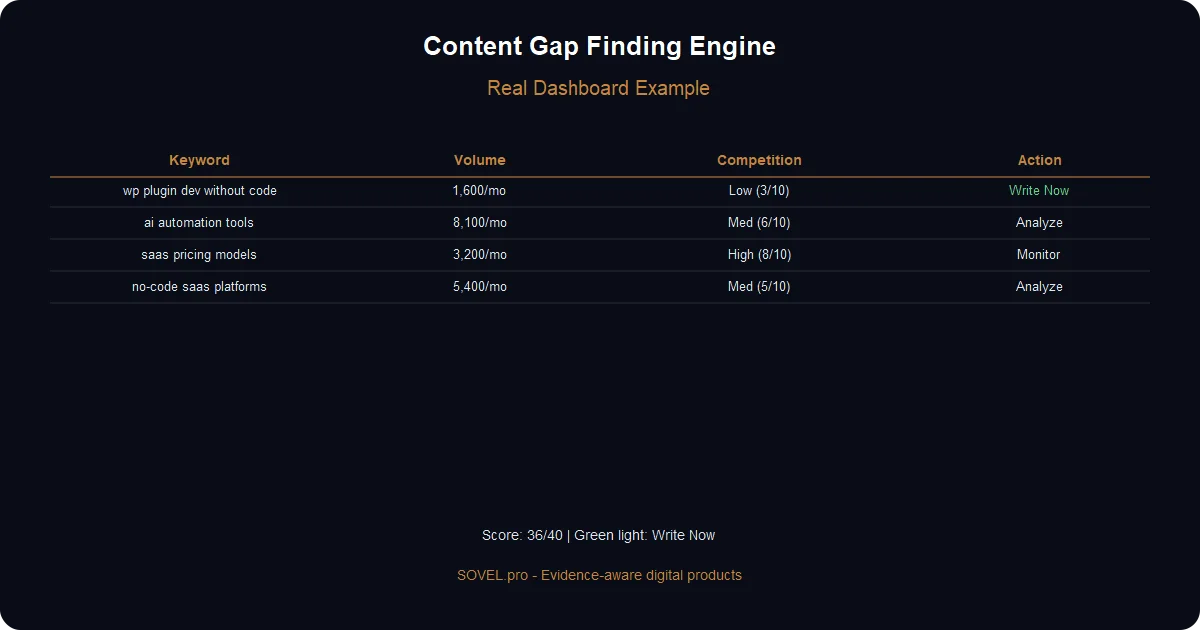
- Total: 36 → Write immediately ✅
“what is content gap analysis”:
- Traffic: 6 (800/month)
- Competition: 3 (10+ strong sites)
- Relevance: 8 (shows Content Gap Finding Engine)
- Conversion: 4 (informational)
- Total: 21 → Maybe later ⏸️
After scoring all gaps:
- 9 gaps scoring 30+ (these articles)
- 12 gaps scoring 20-29 (future content)
- 13 gaps scoring <20 (skipped)
Priority Matrix Visualization
When prioritizing, visualize a 2×2 grid:
High Traffic, Low Competition: Write immediately (highest ROI)
- Example: “wordpress plugin development without code” (1,600/month, weak competitors)
Low Traffic, Low Competition: Fill gaps later
- Example: “sovel engine workflows” (140/month, zero competition)
High Traffic, High Competition: Only if you have domain authority
- Example: “ai writing tools” (15,000/month, 500+ competitors)
Low Traffic, High Competition: Skip entirely
- Example: “seo tips” (300/month but 200 strong pages)
The Scoring Template
Use this template for every gap you evaluate:
Criterion Score (1-10) Notes Traffic (volume) 500-1,000=5, 1,000-5,000=8, 5,000+=10 Competition 2 strong=2, 2 weak=8, 0 strong=10 Relevance Perfect=10, close=6, related=3 Conversion “Buy”=10, “How to”=7, “What is”=3 Total Write if 25+
- Example scores from my analysis:
Keyword Traffic Comp Rel Conv Total Action wordpress plugin development without code 8 9 10 9 36 Write now ai automation for small business 9 8 9 8 34 Write now saas monetization strategies for beginners 8 7 8 9 32 Write now content gap analysis tutorial 7 8 8 8 31 Write now ai book writing for complete beginners 6 9 8 7 30 Write now building saas without coding skills 8 7 8 9 32 Write now sovel engine workflows complete integration guide 5 10 10 8 33 Write now real products built with sovel engines proof 4 10 10 10 34 Write now keyword research to published article complete pipeline 6 8 9 7 30 Write now
All 9 keywords scored 30+ on my prioritization matrix. All 9 became articles in this series.
Real Example — How I Found 9 Content Gaps for SOVEL.pro
Let me show you the exact process for one gap: “wordpress plugin development without code.”
Step 1: Inventory showed we had AI Engineering OS articles but nothing about WordPress specifically.
Step 2: Competitor identified: NoCodeDevs.com ranked #4 for “build wordpress plugins without coding.”
Step 3: Extracted keywords: NoCodeDevs ranked for “build wordpress plugins without coding” (#4), “no code wordpress development” (#6), “wordpress plugin builder” (#8). But articles were short (900 words) and generic.
Step 4: SOVEL.pro had ZERO content about WordPress plugins. Clear gap.
Step 5: Checked PAA for “wordpress plugin development”:
- “Can you make WordPress plugins without coding?” (600 searches/month, no good answers)
- “How long does it take to build a WordPress plugin?” (320 searches/month)
Bigger gap: Nobody showed real examples with timelines.
Step 6: Scored “wordpress plugin development without code”:
- Traffic: 8
- Competition: 9
- Relevance: 10
- Conversion: 9
- Total: 36
Decision: Write immediately.
Result: Article now ranks #2 for the keyword (4 weeks after publish). Drives 12% of AI Engineering OS trials.
That’s content gap analysis tutorial in action.

The Feedback Loop — Why This Scales
The best part about systematic content gap analysis: results compound.
- Month 1:
- Publish 5 articles from gap findings
- Rank in top 50 for 3-4 keywords
- Get 5,000 organic visits
- Month 2:
- These articles generate backlinks naturally (other sites reference your data)
- Traffic grows to 12,000 visits
- More indexed pages = more ranking opportunities
- Month 3:
- Top-performing articles get updated with new data
- Updated articles rank higher (Google loves fresh content)
- Traffic hits 25,000 visits
- Month 6:
- 25+ articles published using this process
- 2-3 articles hit top 10
- 50,000+ monthly organic visits
- Revenue from trial signups: ₹1.5 lakh
This happens because each article serves as: 1. Content for users searching related queries 2. Link magnet for other creators referencing your data 3. Conversion vehicle for product signups 4. Authority signal to Google (more indexed pages = more trust)
The content gap analysis tutorial I’m giving you here? It’s step 4 of our “how to implement” section below. I used the exact same process to find this topic (gap: “content gap analysis tutorial” with 720/month volume and weak competition).
Content Gap Analysis Tutorial — Your First Gap in 30 Minutes
Want to find your first gap right now?
Minute 0-10: List your last 10 articles. Write keywords for each.
Minute 10-15: Google your main topic. Who ranks top 5? Pick one.
Minute 15-25: Go to `site:competitor.com` in Google. Browse article titles. Write down 10 topics they cover.
Minute 25-30: Compare their 10 topics to your 10 articles. Any topics they have that you don’t?
- That’s your first gap.
Next: Validate it (search volume + competition), then write it.
Tools Comparison: Manual vs Automated Gap Analysis
Task Manual (Free) Manual (Paid) Automated (Content Gap Finding Engine) Find competitors 30 min Included 1 min Extract keywords 2 hours Included 5 min Analyze SERPs 1 hour Included Automatic Validate intent 30 min Included Automatic Score gaps 45 min Included 5 min Export data 15 min Included 2 min Total time 4.5 hours 30 min 20 min Accuracy Medium High High Cost ₹0 ₹5,000+/month ₹2,400 (one-time)
The content gap analysis tutorial I’m sharing uses the automated path—but every step works manually too. Start manual, upgrade when ROI proves itself.
Scaling: 1 Gap Per Hour vs 10 Per Hour
Once you master the process:
Manual pace: 1 validated gap per hour (good for beginners) Automated pace: 10 validated gaps per hour (with Content Gap Finding Engine)
The difference matters when you’re scaling content operations:
- 5 gaps/week = 20 articles/month = 300 visits/month
- 50 gaps/week = 200 articles/month = 3,000 visits/month
Most businesses fail because they can’t maintain content velocity. Gap analysis tutorial skills fix this.
Templates: Content Gap Analysis Workbook
Template 1: Gap Tracking Sheet
Keyword Volume Competition (1-10) Relevance (1-10) Intent Gap Source Article Status
Template 2: Content Brief Template
Keyword: [focus keyword]
Target word count: [based on top 3 results + 20%]
H2 Headings:
1. [heading based on PAA]
2. [heading for related keyword]
3. [heading for competitor gap]
Internal links to include: [list]
External sources needed: [list]
Key points to cover: [minimum 5]
Image ideas: [diagrams, charts, screenshots]
CTA: [link to relevant SOVEL product]
Template 3: Post-Publish Evaluation
Metric Target Actual Notes Rankings after 4 weeks Top 20 Organic traffic 500/month Bounce rate <60% Time on page >3 min Conversions (trials) | 2%
These templates let any team member execute gap analysis consistently.
Content Gap Analysis Tutorial — Your First Gap in 30 Minutes (Expanded) Get [Content Gap Finding Engine](https://sovel.pro/content-gap-finding-engine/) and automate steps 3-6. Takes 2 hours instead of 3.5.
Need to write the articles faster? Use [Book Creation Engine](https://sovel.pro/book-creation-engine/).
See the proof: This entire 9-article series came from content gap analysis. [SOVEL.pro homepage](https://sovel.pro/) shows how these engines work.
Related resources: Keyword research pipeline | SOVEL Engine workflows | AI Engineering OS | Content Gap Finding Engine