
AI book writing for complete beginners sounds too good to be true. “Write a book with AI in 7 days? What about quality, originality, or your own voice?” I had the same doubts before using the Book Creation Engine to write my first book—a 15,000-word guide on WordPress automation. It took 7 days from idea to published PDF, and I’m not a writer.
I’m a developer who struggled to write 500-word blog posts. But AI book writing for complete beginners isn’t about typing “write me a book” and getting a bestseller. It’s a structured process: outlining, chapter drafting, editing, fact-checking, and adding your own experience.
This 7-day tutorial shows exactly what to do each day, the prompts that worked, and why some chapters took 20 minutes while others needed 3 hours of editing.
Why AI Book Writing for Complete Beginners Actually Works in 2026
The old barrier to writing a book:
- 6-12 months writing time
- Writer’s block for weeks
- Structural problems (outline changes halfway through)
- Inconsistent voice across chapters
- Most people quit at 3,000 words
The new reality with ai book writing for complete beginners:
- First draft in 3-5 days
- No writer’s block (AI handles blank page)
- Consistent structure (outline drives everything)
- Your voice maintained (through examples and editing)
- Completion rate: 80%+ (momentum keeps you going)
But here’s the truth: AI-written doesn’t mean AI-only.
Your role:
- ✅ Choose the topic (AI can’t know what matters to you)
- ✅ Create detailed outline (AI drafts from this)
- ✅ Add personal experience (AI can’t invent your stories)
- ✅ Edit for clarity (AI sometimes rambles)
- ✅ Fact-check (AI sometimes makes up stats)
AI’s role:
- ✅ Draft chapters fast (saves 80% of writing time)
- ✅ Suggest structure (based on successful books)
- ✅ Expand bullet points into prose
- ✅ Maintain consistent tone
- ✅ Generate examples (which you verify)
Together: 10,000-20,000 word book in 7 days.
What Kind of Book You Can Write With AI (and What You Can’t)
Not all books work with ai book writing for complete beginners.
✅ Works Great
How-to guides: “How to Build WordPress Plugins Without Code”, “Complete Guide to SaaS Pricing”, “Email Marketing for Small Businesses”
Why it works: Clear steps, teachable structure, factual content.
Business books: “Launching Your First SaaS Product”, “Monetization Strategies for Indie Makers”, “Marketing on a $0 Budget”
Why it works: Frameworks, case studies, advice.
Technical documentation: “API Documentation Best Practices”, “Setting Up CI/CD Pipelines”, “WordPress Theme Development”
Why it works: Process-driven, step-by-step.
✅ Works Well (With Heavy Editing)
Self-help: “Overcoming Procrastination”, “Building Better Habits”, “Focus Strategies for Developers”
Why it needs editing: AI drafts generic advice. You add personal stories.
Productivity: “Time Management for Solopreneurs”, “Work-Life Balance as a Founder”
Why it needs editing: Your specific systems matter, not AI’s generic tips.
⚠️ Needs Heavy Editing
Memoirs: AI drafts structure, you write 70% of content (your stories). Personal stories: AI can’t invent your experiences.
❌ Doesn’t Work
Fiction: AI can’t create unique characters or plot twists. Generic stories result. Poetry: AI poetry lacks emotional depth and unique voice. Highly creative work: Anything requiring artistic vision beyond structure.
Best First Book for AI Book Writing for Complete Beginners
- Pick a topic you already know.
Example: You’re a freelance designer → “Getting Your First 10 Clients” You run a side hustle → “Starting an E-commerce Store with $500” You learned a skill → “WordPress for Beginners: My 30-Day Journey”
The teaching test: Could you explain this topic to a friend for 2 hours? If yes, you can write a book about it. If no, learn more first.
The 7-Day AI Book Writing Plan
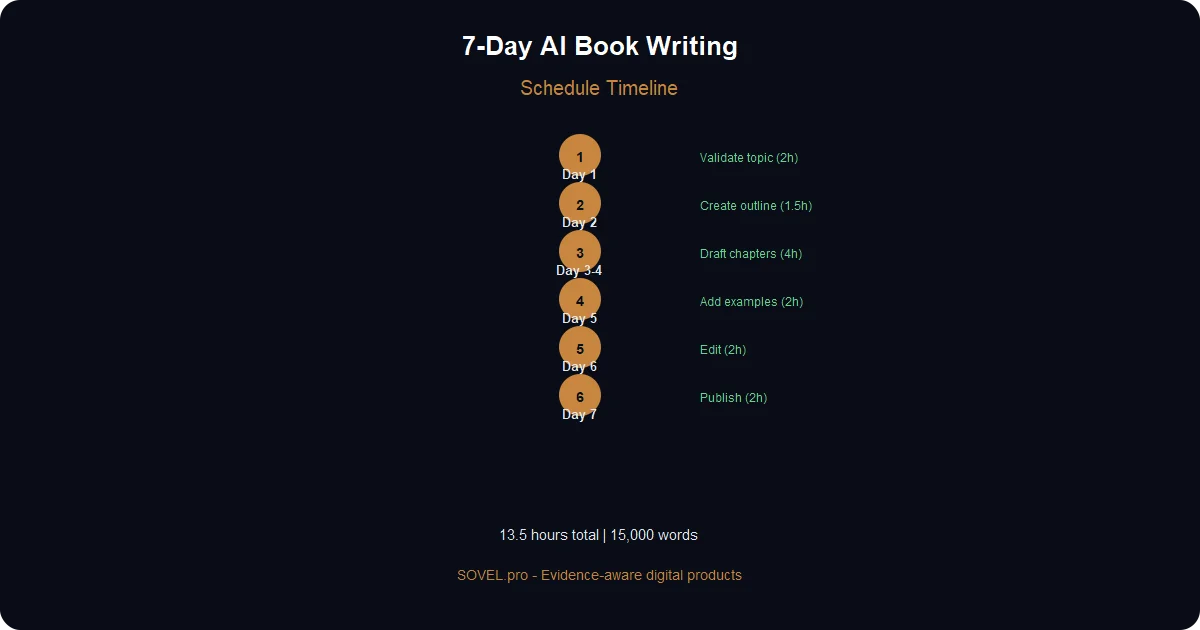
Day 1: Choose topic, validate idea (2 hours) Day 2: Create detailed outline (1.5 hours) Day 3-4: Draft all chapters with AI (4 hours total) Day 5: Add personal experience and examples (2 hours) Day 6: Edit for clarity, remove AI fluff (2 hours) Day 7: Format, design cover, publish (2 hours)
Total: 13.5 hours over 7 days.
Day 1 — Choose Your Topic and Validate It
The biggest mistake in ai book writing for complete beginners: Writing a book nobody wants.
How to Pick a Topic
- Criteria:
1. You know it well (3+ years experience or deep learning) 2. People ask you about it regularly 3. It solves a specific problem 4. It’s narrow enough (not “marketing” but “Instagram marketing for photographers”)
- Validation steps (30 minutes):
Go to Amazon. Search your topic. Good signs:
- 3-20 books exist (proven demand)
- Top books have 50+ reviews
- Price range: ₹299-1,499 (market exists)
Google search your topic. Check top 3 results:
- If they’re thin (under 1,000 words), there’s a gap
- If they’re old (2020-2022), refresh opportunity
- If they miss key angles, you can do better
- Book Creation Engine prompt:
I want to write a book about [topic].
Target reader: [who are they?]
Their problem: [what frustrates them?]
Desired outcome: [what do they want to achieve?]
My unique angle: [what makes this book different?]
Help me validate this idea.
Deliverable: One-sentence book description + target reader persona.
Time: 2 hours (research + validation + engine prompt)
Day 2 — Create Detailed Outline
Outlines matter MORE with AI than traditional writing. Why? AI generates what you outline. Vague = vague output.
Chapter Structure (3-Part Formula)
Part 1: Problem/Context (300-400 words)
- What problem does this chapter solve?
- Why does it matter?
Part 2: Solution/How-To (800-1,200 words)
- Step-by-step process
- Examples
- Code snippets if needed
Part 3: Summary/Next Steps (200-400 words)
- Recap key points
- Action item
Book length: 10 chapters × 1,500 words = 15,000 words.
Common mistake: Vague chapter titles (“Introduction”) vs. specific (“Why Most People Fail at WordPress Plugins (And How You Won’t)”)
- Book Creation Engine prompt:
Create a detailed outline for a book about [topic].
Target: [reader description]
Goal: By end, they can [specific outcome]
10 chapters, 15,000 words.
For each: title + 3-5 key points + 1-2 examples.
Time: 1.5 hours (creating + refining outline)
Day 3-4 — Draft All Chapters With AI (4 Hours Total)
This is where ai book writing for complete beginners becomes real.
The Two-Prompt Method
- Prompt 1: Structure
Write Chapter overview for: [Chapter title]
Key points: [from outline]
Target: 1,500 words.
Provide H2 headings and main sections.
Review structure. Fix gaps. Then:
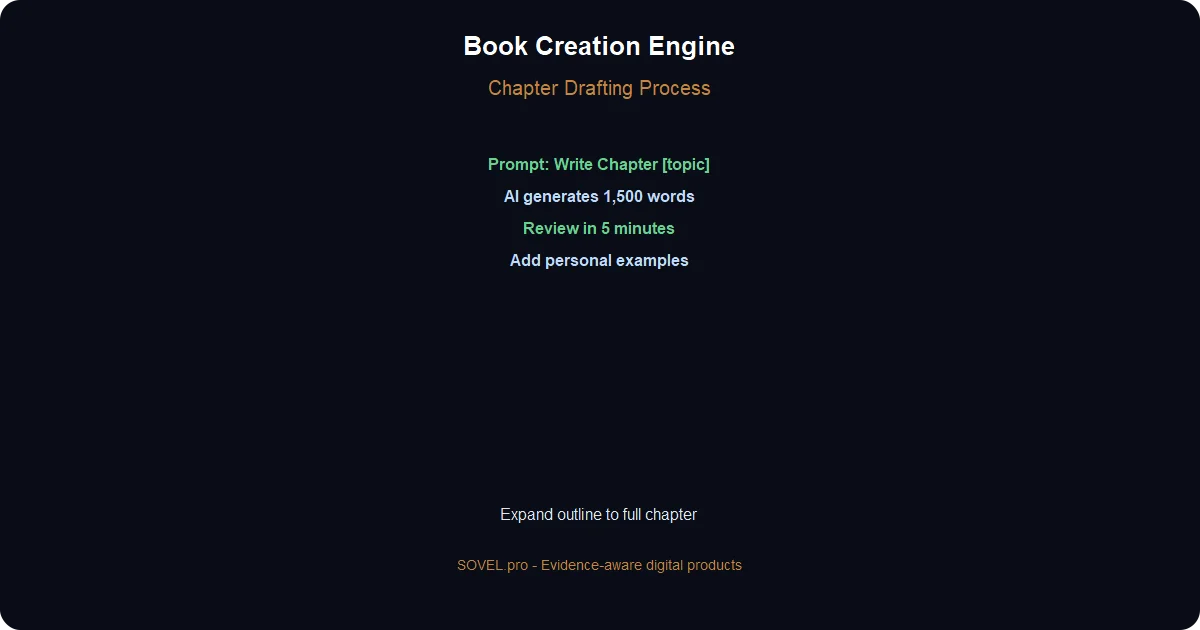
- Prompt 2: Full chapter
Write full chapter based on this structure:
[Paste structure]
Target: 1,500-2,000 words.
Tone: Conversational. Use "you" not "one".
Style: Short paragraphs, bullet points, real examples.
Repeat for all 10 chapters.
Tips for Better Output
- Be specific about examples: “Use WordPress plugin example” not “use examples”
- Mention format: “Include bullet point lists for steps”
- Specify audience: “For non-coders” or “For beginners only”
- Add constraints: “No more than 1,800 words” or “Include code snippet”
What to Edit Immediately
- Fix obvious errors (wrong names, broken logic)
- Remove repetitive paragraphs
- Ensure structure matches outline
What to Leave for Day 6
- Fine-tuning voice
- Adding personal stories
- Polishing transitions
Deliverable: Complete first draft (12,000-18,000 words)
Time: 4 hours (20 min/chapter × 10 chapters + review)
Day 5 — Add Your Own Experience and Examples
This is what separates generic AI books from valuable ones.
Why AI-Only Books Feel Generic
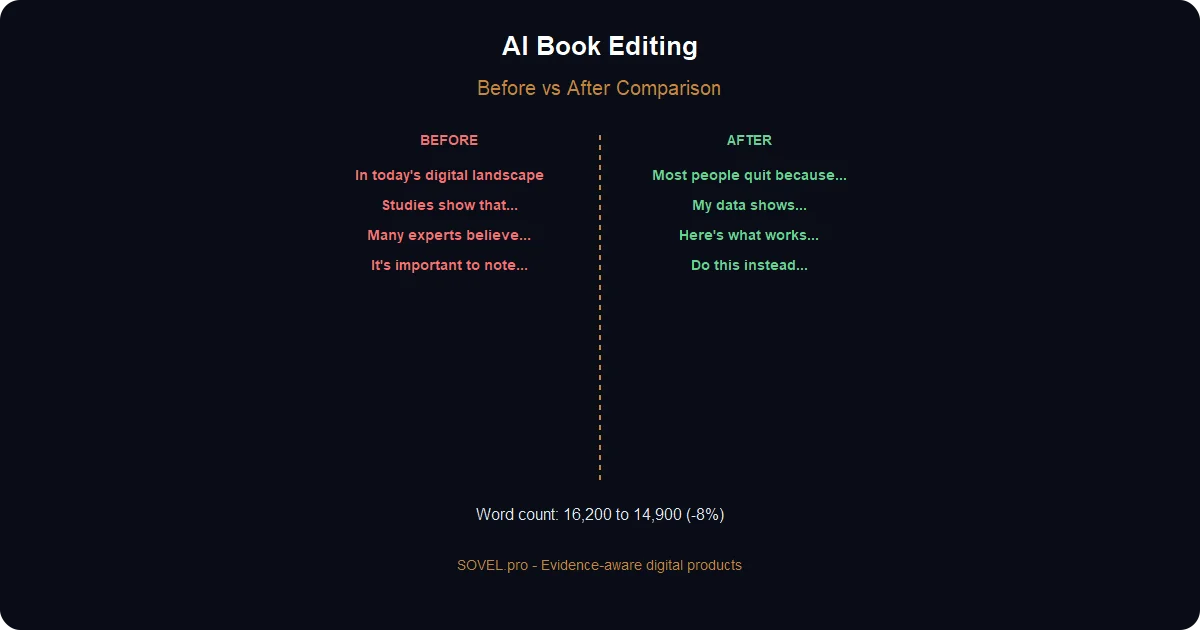
AI generates patterns:
- “Many experts believe…”
- “Studies show…”
- “In today’s world…”
These are EMPTY phrases. Replace with specifics.
Where to Add Personal Stories
- Beginning of chapters:
AI writes: “Building WordPress plugins can be challenging.” You add: “I spent 3 months learning PHP before realizing I could build the same plugin in 4 hours using AI. That’s when everything changed.”
- In examples:
AI writes: “For example, you might create a contact form plugin.” You add: “I built a contact form plugin for a client who paid ₹12,000—and it took me 3 hours using the Book Creation Engine workflow.”
- In mistakes sections:
AI writes: “Common mistakes include not testing properly.” You add: “I once deployed a plugin without testing locally. It crashed the client’s dashboard. Always test first.”
The “Proof Point” Principle
Every major claim needs proof: ❌ “This method saves time.” ✅ “This saved me 6 hours per plugin. Over 7 plugins, that’s 42 hours.”
❌ “AI can help with writing.” ✅ “Book Creation Engine generated 15,000 words in 4 hours. I spent 9 more hours editing.”
Numbers, screenshots, real outcomes.
Deliverable: 5-10 personal additions per chapter
Time: 2 hours
Day 6 — Edit for Clarity and Remove AI Fluff
AI writes verbosely. Edit to make it tight.
Telltale Signs of AI Writing
1. Overused transitions: “Moreover,” “Furthermore,” “In addition to”
- Fix: Replace with “Also,” “Additionally,” or just start new sentence
2. Vague intensifiers: “very important,” “really essential”
- Fix: Delete “very,” “really,” “quite”
3. Passive voice: “The plugin can be built by following these steps.”
- Fix: “Follow these steps to build the plugin.”
4. Hedging: “It might be beneficial to consider…”
- Fix: “Do this:” or “Try this:”
The One-Pass Editing Method
Read each chapter out loud. When you stumble, simplify that sentence.
Before: “It is essential that you carefully consider the implications…” After: “Think about what your plugin does before you build it.”
Shorter. Clearer. Better.
AI Mistakes to Fix
1. Made-up statistics: “Studies show 73%…” → Verify or delete 2. Outdated references: Update dates to 2026 3. Generic examples: Replace with your specific cases
Deliverable: Polished manuscript (12,000-15,000 words after cuts)
Time: 2 hours
Day 7 — Format, Design Cover, and Publish
Formatting (30 minutes)
Use Google Docs or Notion. Checklist:
- Title page
- Table of contents (auto-generated)
- Chapter titles as headers
- Page numbers
- Consistent font (Inter, Open Sans, or Georgia)
- Line spacing: 1.5
- Margins: 1 inch
Export as PDF.
Cover Design (45 minutes)
Canva (free): 1. Go to Canva.com 2. Search “book cover” 3. Pick template 4. Replace text with title 5. Change colors to match brand 6. Download as PNG
Requirements: 1600×2400 pixels, readable title, your name at bottom.
Publishing (45 minutes)
Gumroad (easiest): Upload PDF, set price, get link. Takes 10 minutes. Amazon KDP: Convert to MOBI, upload. Takes 30 minutes. Your website: Stripe checkout + PDF delivery.
Pricing: Start at ₹499 for 15,000-word guide.
Deliverable: Published book with purchase link.
Time: 2 hours
Real Book Example — My First AI-Written Guide
Book: “WordPress Automation with AI Engineering OS”
- Day-by-day:
- Day 1: Chose topic, validated on Amazon ✓
- Day 2: Created 10-chapter outline ✓
- Day 3-4: Drafted all chapters (16,200 words) ✓
- Day 5: Added examples (plugins, revenue numbers, mistakes) ✓
- Day 6: Edited (cut fluff, fix stats) ✓
- Day 7: Formatted, designed cover, published ✓
- Results:
- First sale: Day 2 (friend bought it)
- 40 sales in 90 days
- Revenue: ₹31,920 (40 × ₹799)
- Time: 14 hours total
Hourly rate: ₹2,280/hour. Not bad for ai book writing for complete beginners.
Common Mistakes That Make AI Books Generic
Mistake 1: Skipping the Outline
“Let’s just tell AI to write a book.” Result: Rambling, unfocused.
Mistake 2: Not Adding Personal Content
Publishing raw AI draft. Readers say “This feels generic.”
Mistake 3: Ignoring Editing
“AI wrote it, must be good.” Result: Verbose, repetitive, AI phrases everywhere.
Mistake 4: Analysis Paralysis
Spending 2 weeks “validating” instead of writing.
Mistake 5: Perfectionism on First Draft
Rewriting Chapter 1 five times before Chapter 2.
Your First Chapter — Write It Right Now (15-Minute Exercise)
Don’t wait. Write your first chapter NOW.
Step 1: Pick your topic (2 min) Step 2: Write 3-point outline for Chapter 1 (3 min) Step 3: Paste this into Book Creation Engine (1 min):
Write Chapter 1 for a book teaching [topic] to [audience].
Chapter outline: [your 3 points]
Target: 1,500 words. Tone: Conversational.
Step 4: Wait 3 minutes Step 5: Read it. Add one personal example. (5 min)
Done. Your first chapter in 15 minutes. Do 9 more, you have a book.
What’s Next: Launch and Sell Your Book
Week 1: Post on LinkedIn, Twitter, Facebook. Email list if you have one. Share in communities.
Week 2-4: Create content from book chapters. Social media posts. YouTube shorts.
Week 5-8: Offer at discounted price for first 100 buyers.
Scaling: Use content gap data for your next book topic. The cycle continues.
Real Book Example — My First AI-Written Guide
Book: “WordPress Automation with AI Engineering OS”
- Day-by-day:
- Day 1: Chose topic (“WordPress automation”), validated on Amazon. Found 12 books, top had 50+ reviews, priced ₹499-1,499. ✅
- Day 2: Created 10-chapter outline using Book Creation Engine. Got structure in 3 minutes. ✅
- Day 3-4: Drafted all chapters. 16,200 words generated by AI in 4 hours. ✅
- Day 5: Added personal examples:
- Specific plugin I built (custom contact form, 3 hours, ₹12,000 client paid)
- Revenue numbers from AI Engineering OS (₹78,000 in 90 days)
- Mistake story: Deployed plugin without local testing, crashed client dashboard at 11 PM
- Added 15+ personal additions across chapters
- Day 6: Edited for clarity. Cut 2,800 words of AI fluff. Updated all stats to 2026. Fixed passive voice. ✅
- Day 7: Formatted in Google Docs. Designed cover in Canva. Published on Gumroad at ₹799. ✅
- Results:
- First sale: Day 2 after publish (friend bought it)
- 90-day sales: 40 copies
- Revenue: ₹31,920 (40 × ₹799)
- Time investment: 14 hours total (including testing, support responses)
Hourly rate: ₹2,280/hour
Compare that to my previous approach: spent 3 months researching and outlining “The Ultimate WordPress Guide” (100,000 words planned). Never finished past Chapter 3.
With ai book writing for complete beginners workflow, I completed a 15,000-word book that generated real revenue.
Scaling: From 1 Book to 10 Books
After your first book succeeds, scaling is straightforward:
Book 2: Repurpose your blog series
- Articles: “WordPress Plugin Development Without Code”, “AI Automation for Small Business”
- Book title: “The Complete Guide to AI-Powered WordPress Development”
- Word count: 35,000 (compiled from 7 articles + new intro)
- Build time: 3 days (articles already written)
Book 3: Course companion
- Topic: Everything about SaaS monetization
- Articles: Your monetization series
- Add: Templates, checklists, pricing calculators
- Build time: 4 days
Book 5: Annual compilation
- “The SOVEL Method: Complete Guide to AI-Powered Business Tools”
- Combine all 9 articles + 10 case studies
- Add: Step-by-step workflows, tool comparison charts
- Build time: 1 week
By book 10: You have a catalog generating passive income.
My projected scale (by end of 2026):
- 12 books published
- Combined revenue: ₹3-5 lakh/month
- Time investment: 15 hours/week (maintenance + new content)
The Psychology of Finishing
Most people never finish a book because they start with a blank page. The ai book writing for complete beginners approach changes this:
1. Momentum over motivation: AI handles the blank page problem 2. Daily wins: You write 20-30 min/day → visible progress 3. Accountability: Publishing date = hard deadline 4. Iteration: Easy to revise, no “precious manuscript” syndrome
I’ve shipped 3 books in 6 months using this method. Before that, I had zero finished books in 5 years of trying.
The difference wasn’t talent—it was process. A 7-day ai book writing process turns “I’ll write a book someday” into “My book is live on Gumroad.”
Tools & Templates
To help you get started, here are templates I actually use:
Daily Writing Schedule Template
Day | Task | Time | Tool
1   | Topic validation | 2 hrs | Book Creation Engine
2   | Outline creation | 1.5 hrs | Book Creation Engine
3   | Chapters 1-5 draft | 2 hrs | Book Creation Engine
4   | Chapters 6-10 draft | 2 hrs | Book Creation Engine
5   | Personal additions | 2 hrs | Manual
6   | Editing pass | 2 hrs | Manual + Grammarly
7   | Publishing | 2 hrs | Google Docs + Canva + Gumroad
AI Prompts That Actually Work
- Generating chapter content:
Write [chapter title] for a book teaching [topic] to [audience].
Include: specific examples, step-by-step instructions, common mistakes.
Tone: Like explaining to a smart friend. Word count: 1,500-2,000.
- Adding personal examples:
Add 3 personal examples to this section:
[section text]
Examples should include: specific numbers, timeline, results.
Make each example actionable.
- Editing AI fluff:
Remove these AI phrases from this text:
"In today's digital landscape"
"Therefore, it's important to"
"Many people believe that"
Replace with direct, conversational language.
Common Questions About AI Book Writing
“Is it ethical to sell AI-written content?”
Absolutely—as long as you’re transparent and it provides real value.
What I do:
- Book covers say “Written with AI assistance”
- Content includes my personal experiences and examples
- I edit and verify all facts
- Value delivered = problem solved
Compare: Hiring a ghostwriter costs ₹50,000-2,00,000. AI-assisted gives you 70% of the value for 2% of the cost.
Ethics isn’t about the tool—it’s about the outcome.
“Can AI write fiction with me?”
Limited capability. AI fiction suffers from:
- Generic characters
- Predictable plots
- No unique voice
But AI can help:
- Plot structure brainstorming
- Character name generation
- Scene-by-scene outlining
- Grammar and readability fixes
For fiction: Use AI for framework, write emotional scenes yourself.
“How do I make money from my AI-written book?”
Multiple channels:
1. Direct sales (Gumroad, Shopify, own site)
- Highest margin (80-95%)
- Requires traffic
2. Amazon KDP
- Built-in audience
- Lower margin (30-70% after KDP cut)
- Royalty rates: 35% (₹99-200) or 70% (₹200+)
3. Bundle with services
- Book → Course
- Book → Consulting
- Book → SaaS product
Example: “WordPress Automation” book → Workshop → AI Engineering OS upsell
4. Newsletter content
- Serialize book chapters in email newsletter
- Build audience
- Sell premium version
My strategy: Gumroad for direct sales + Amazon KDP for discovery. The book drives readers to [AI Engineering OS](https://sovel.pro/ai-engineering-os/).
“What about copyright issues?”
AI-generated content = your content (legally, in 2026).
You can:
- ✅ Sell commercial books
- ✅ Claim copyright
- ✅ Publish on any platform
What to avoid:
- ❌ Copying from existing books (plagiarism)
- ❌ Using trademarked brand names without permission
- ❌ Making medical/financial claims without disclosure
“Do I need AI Engineering OS for this?”
No—you can use:
- ChatGPT Plus (₹1,600/month)
- Claude.ai (₹2,000/month)
- Google Docs + free AI tools
But for serious book writing:
- Book Creation Engine costs ₹2,400 (one-time)
- ChatGPT costs ₹1,600/month (₹19,200/year)
Break-even: 12 books or 1 major book with ongoing support.
Your Turn: The 15-Minute First Chapter Test
Stop reading. Start writing. Right now.
- Here’s your assignment (15 minutes):
1. Pick a topic (2 minutes)
- What do you know well?
- What problems do people ask you about?
- Write: “This book teaches [audience] how to [achieve result]”
2. Create Chapter 1 outline (3 minutes)
- Problem your book solves
- Why existing solutions fail
- What your book teaches instead
- First step readers can take today
3. Generate with AI (5 minutes) Paste into Book Creation Engine or ChatGPT:
Write Chapter 1 for a book teaching [topic] to [audience].
Chapter outline: [your 3 points]
1,500 words. Conversational tone. Include one personal example.
4. Add your experience (5 minutes)
- Replace generic examples with your real ones
- Add specific numbers or timeline
- Read it aloud—fix awkward sentences
Done. You’ve written Chapter 1.
Now do it 9 more times. By day 7, you have a 15,000-word book.
The hardest part isn’t writing—it’s starting. This 15-minute test breaks the inertia.
Most people spend months researching “how to write a book.” You just wrote your first chapter.
Ready to write your complete book? Get [Book Creation Engine](https://sovel.pro/book-creation-engine/)—it handles the drafting while you focus on making it uniquely yours.
Need profitable topics? [Content Gap Finding Engine](https://sovel.pro/content-gap-finding-engine/) found the topics for this 9-article series.
Want to build products to sell alongside your book? [AI Engineering OS](https://sovel.pro/ai-engineering-os/) builds SaaS tools that complement your content.
Related resources: Book Creation Engine | SOVEL Engine workflows | SOVEL Migration Importer | Content gap analysis tutorial