
Content Gap Analysis vs Keyword Research: Stop Confusing Them
Many teams treat keyword research and content gap analysis as the same task. They are not. Keyword research asks “what are people searching for?” Content gap analysis asks “what are my competitors ranking for that I do not cover?” Both are essential, but they answer different questions and produce different actions. Understanding the difference between content gap analysis vs keyword research is the difference between writing content that merely exists and writing content that wins. If you are new to the demand side, read the keyword research without paid tools guide first.
This guide explains the distinction between content gap analysis vs keyword research, when to use each, how the tools differ, and how to run them together to build a content strategy that actually ranks.
The core difference in one sentence
Keyword research finds demand; content gap analysis finds coverage holes. One tells you what to write about because people search for it. The other tells you what to write because it is what your competitors already win with, and you are missing it. If you collapse content gap analysis vs keyword research into a single activity, you lose the precision each one adds.
- Keyword research → “People search for X, so let’s create content about X.”
- Content gap analysis → “Competitors rank for Y, and we don’t have Y, so let’s create it.”
The comparison at a glance
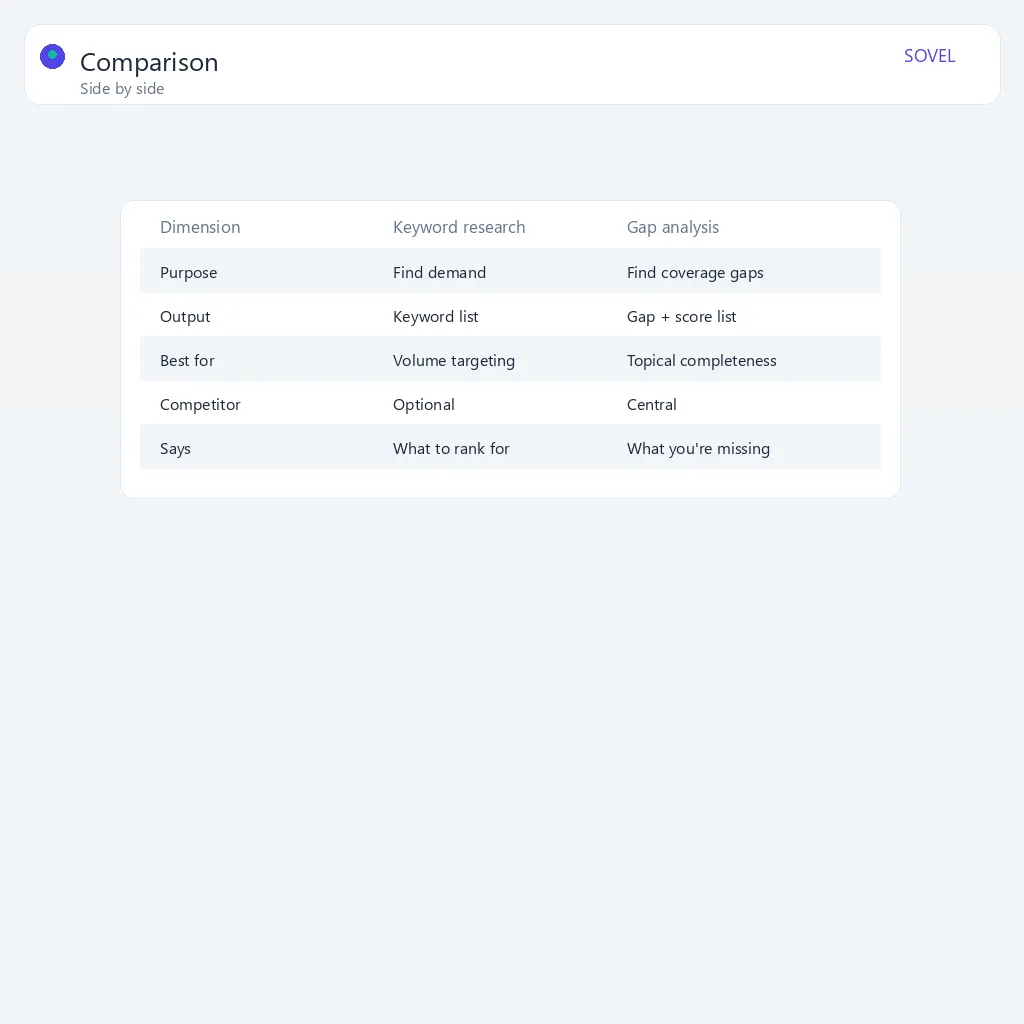
Before going deep, it helps to see content gap analysis vs keyword research side by side across the dimensions that actually matter.
| Dimension | Keyword research | Content gap analysis |
|---|---|---|
| Core question | What do people search for? | What do competitors win that we miss? |
| Unit of analysis | Keywords and demand | Coverage and competition |
| Input | Seed terms, market data | Your URLs vs competitor URLs |
| Output | Topic list with volume/difficulty | Gap list with opportunity scores |
| Best for | New sites, new categories | Existing sites, growth |
| Key answer | Is there demand? | Can I win it, and am I missing it? |
| Typical tool focus | Volume, difficulty, intent | Ranked coverage and positioning |
What keyword research actually does
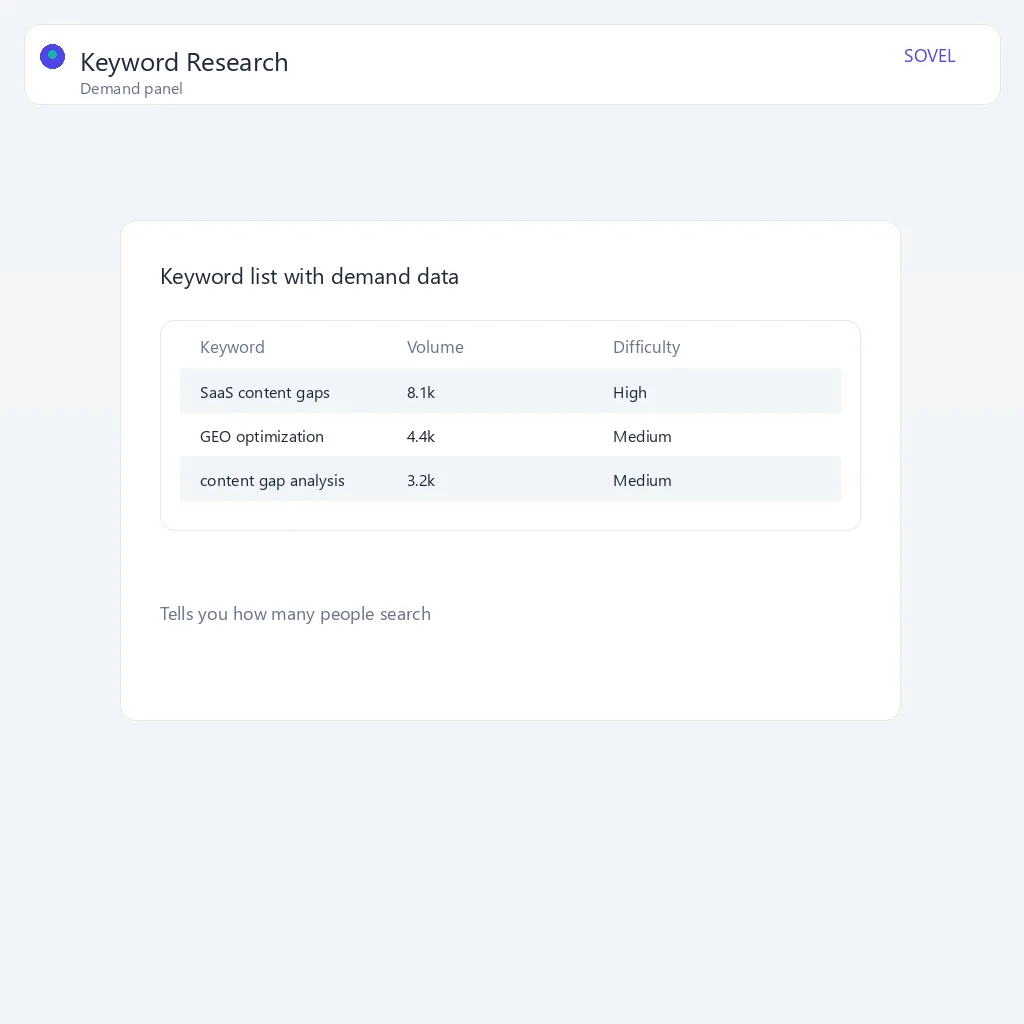
Keyword research identifies the terms and questions your audience searches for. It typically provides search terms and phrases, search volume estimates, difficulty or competition signals, and intent categories (informational, commercial, navigational). At its core it is the classic keyword research discipline of discovering what the market actively types into search engines. Its output is a list of topics and terms that have demonstrated demand. This is the starting point for deciding what could be worth writing. That is the first half of content gap analysis vs keyword research: discovering what the market wants in the abstract.
A deeper worked example: keyword research
Consider a skincare brand planning a year of content. Keyword research surfaces terms like “best moisturizer for dry skin,” “hyaluronic acid serum benefits,” and “how to layer skincare.” Volume estimates show thousands of monthly searches, and difficulty scores hint at how competitive each term is. The result is a map of demand — a broad sense of what the audience talks about and how much traffic each topic could theoretically command. What keyword research does not tell you is which of these topics your competitors already dominate, or which you can realistically displace.
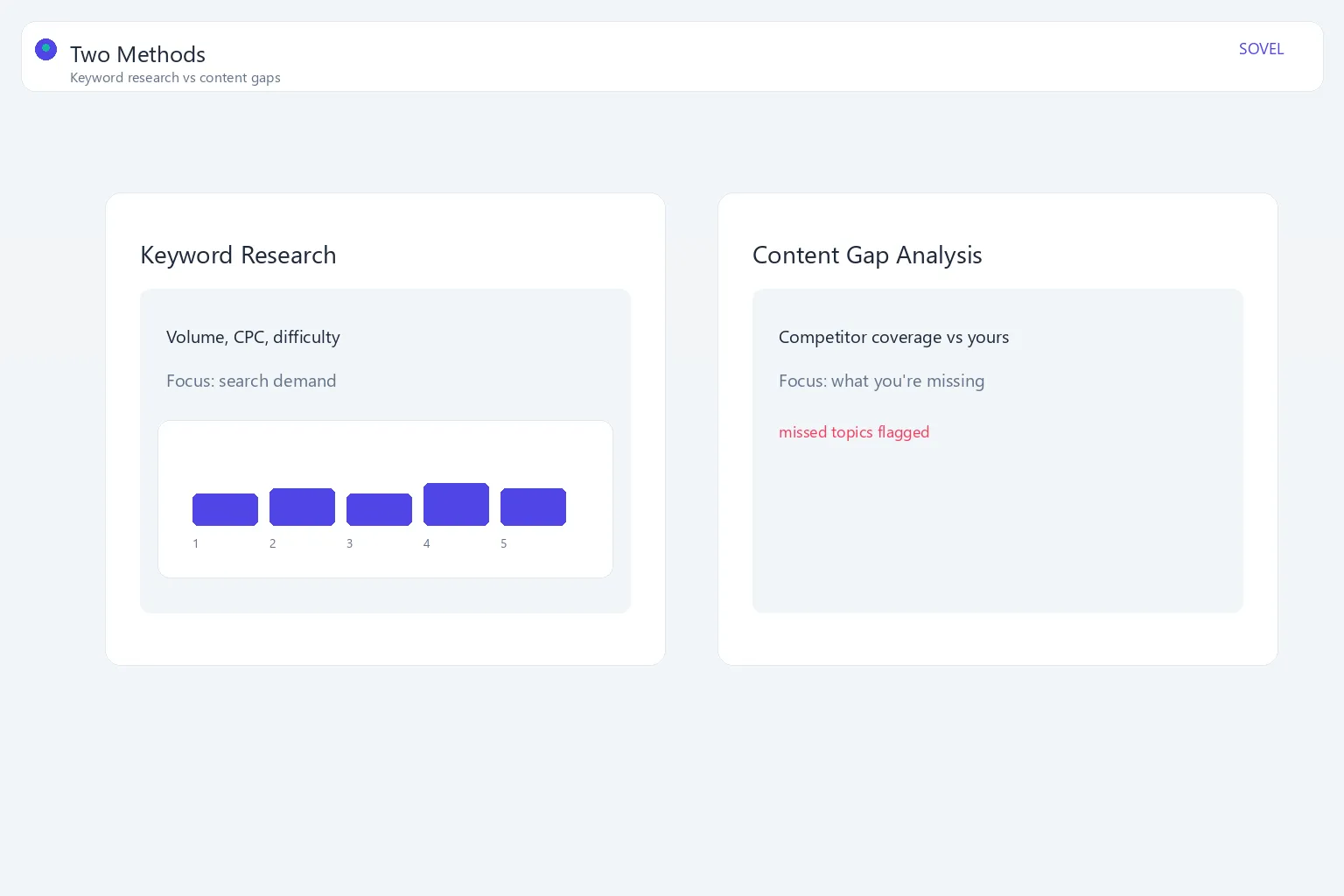
What content gap analysis does differently
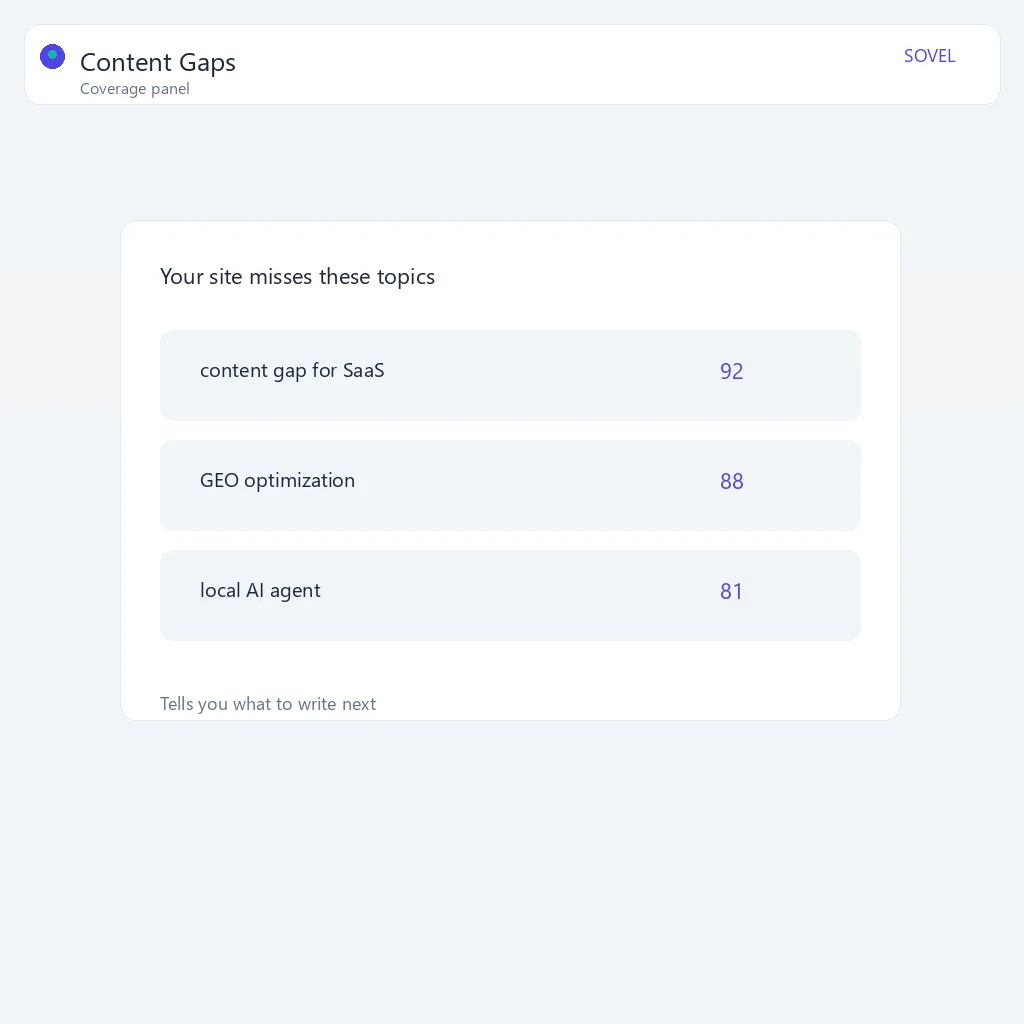
Content gap analysis starts from a different place: what already ranks. It compares the keywords your site already covers with the keywords your competitors cover. The difference — the gap — is the opportunity list. Content gap analysis produces keywords competitors rank for that you miss, opportunity scores ranking the best gaps, and recommendations for format and priority. Its output is not just “these terms have demand.” It is “these terms are winnable because competitors prove demand, and you are currently absent.” The second half of content gap analysis vs keyword research is coverage rather than volume.
A deeper worked example: content gap analysis
Now take the same skincare brand and run a content gap analysis. Feed in the brand’s URL and three competitors’ URLs. The tool surfaces gaps the brand does not cover, such as “dry skin routine for winter,” “niacinamide vs hyaluronic acid,” and “dermatologist-approved moisturizers.” Because competitors already rank for these, demand is proven, and the brand knows each one is winnable. The opportunity score ranks which gap to write first based on competition and relevance. This is the difference between knowing a topic is popular and knowing a topic is winnable for you specifically.
When to use keyword research first
Start with keyword research when you are:
- Launching a new site or a new product category.
- Trying to understand what demand exists at all.
- Building a broad topic map from scratch.
- Choosing a niche where you have no existing competitors to compare.
Keyword research gives you the landscape. It tells you what the audience already searches for.
When to use content gap analysis first
Use content gap analysis when you are:
- Trying to grow an existing site that already has content.
- Competing in a crowded niche where competitors prove demand.
- Deciding which of many possible articles to write next.
- Building topical authority in a defined market.
Content gap analysis is the stronger tool for an established site, because it points at proven, winnable coverage.
Tools for each method
Keyword research tools focus on volume, difficulty, and intent. Google Keyword Planner, Ahrefs, SEMrush, and Google’s autocomplete suggestions all fit here. They are strong for finding new terms, estimating traffic potential, and building a seed list. Their weakness is that they describe demand in the abstract; they rarely tell you which competing pages already own a query or how realistic your shot at it is. Keyword tools cover one half of content gap analysis vs keyword research.
Content gap analysis tools work differently. Instead of being volume-first, they are coverage-first: they compare your ranked keywords against your competitors’ ranked keywords. SOVEL GAP BRAIN is built around exactly this side of the equation. Its engine takes a topic and returns a scored cluster, the gaps, and the opportunities in seconds. Gap tools cover the other half of content gap analysis vs keyword research.
Combining them into one workflow
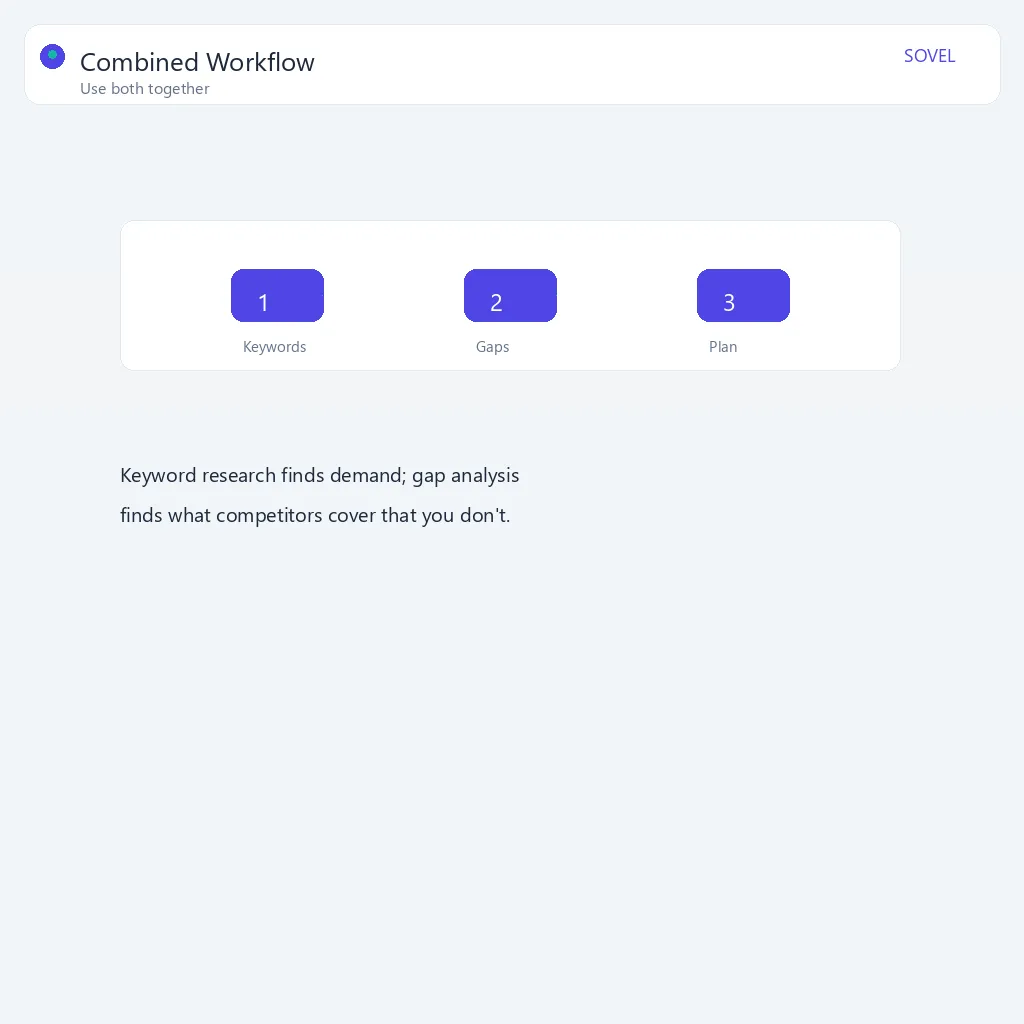
This is where content gap analysis vs keyword research stops being a debate and becomes a sequence. Neither replaces the other; each feeds the next. A mature content team runs a combined loop:
- Keyword research maps the demand landscape for your niche.
- Content gap analysis reveals which of those demanded topics your competitors already own and you miss.
- Prioritize by opportunity score and intent.
- Write the gaps that combine real demand with your ability to cover them.
- Re-run periodically as the market shifts.
Combined, you get both breadth (what people want) and precision (what you can win). If you only do keyword research, you know what people want but not what you can actually take. If you only do content gap analysis, you know what you can take but not whether the broader market is moving. Running content gap analysis vs keyword research together closes both blind spots.
A step-by-step combined walkthrough
To make the pairing tangible, here is how a team runs keyword research and gap analysis as one weekly process.
Monday: run keyword research for the quarter’s focus areas. Pull a seed list, note volumes and difficulty, and group terms by intent. Save this as the demand master list. Tuesday: take the top ten priority topics from that list and run a gap analysis on each, comparing your current pages against three strong competitors. Record which topics you fully cover, partially cover, or miss entirely. Wednesday: merge the two outputs. For each topic you now have three facts — the demand level, your coverage status, and competitor strength. Score each topic by combining these three signals rather than any single one. Thursday: draft briefs for the highest-scoring gaps. Include the intent, the preferred format, and the angle the gap data suggests. Friday: update the tracker and flag anything that has shifted since last week.
The value of running both in one cadence is momentum. Demand changes slowly, so keyword research can be a monthly refresh; coverage shifts faster as competitors publish, so gap analysis deserves a weekly check. When a competitor launches a major piece, your gap map changes immediately, even if overall demand stays flat. Running the two on different frequencies keeps you responsive to both forces.
A simple reporting ritual ties it together. Each month, show the client or stakeholder two numbers side by side: how many new demanded topics you identified, and how many winnable gaps you closed. Keeping the metrics separate prevents the two jobs from blurring into a single vague “SEO work” figure, and it gives you a clean way to prove the contribution of each half of the workflow. That discipline is exactly what an evidence-based SEO keyword strategy calls for, since every decision is tied to a measured signal.
If resources are tight, start small. Run keyword research once a month and gap analysis on just your five most important topics each week. As the workflow proves itself, widen the topic set. The aim is not to perfect both processes on day one; it is to get the loop moving so each method makes the other sharper, and so decisions rest on both demand and coverage rather than either alone.
A final note on cadence and roles. In larger teams, one analyst often owns keyword research while another owns gap analysis, but they need to sync weekly or the two outputs drift apart. Keep a single shared tracker so both halves inform the same content backlog. If you are a one-person team, alternate your focus by week rather than dropping either method entirely. The discipline of keeping the two questions separate while merging their outputs into one plan is the whole skill; once you have it, the combined workflow becomes a habit rather than a chore, and it reliably produces a backlog that is both broad and winnable.
The SOVEL GAP BRAIN approach
SOVEL GAP BRAIN is built around the gap side of the equation. Its engine takes a topic and returns the scored cluster, the gaps, and the opportunities — effectively doing the coverage analysis for you.
The free tool at /tools/content-gap-analysis/ lets you run this on any topic with a daily per-device limit. The full engine at /sovel-gap-brain-engine/ is a lifetime purchase that removes the limit and works for deeper, category-wise analysis.
Pair the gap output with your own keyword demand data and you have a complete strategy.
A practical decision rule
Before any content sprint, apply the content gap analysis vs keyword research pair of questions, using Google’s own guidance on how Search treats helpful content to sanity-check both answers:
- “Is there demand for this topic?” → keyword research answers this.
- “Can I actually win it, and am I missing it?” → content gap analysis answers this.
If both answers are yes, write the piece. If demand exists but you already cover it well, you may need to improve, not add. If competitors win a topic you miss, that is your priority gap. The two questions only make sense together, which is why content gap analysis vs keyword research belong in the same conversation.
Common mistakes to avoid
- Treating content gap analysis vs keyword research as interchangeable. They are complementary, not the same.
- Writing only to search volume. High-volume terms you cannot win are less useful than winnable gaps.
- Ignoring gaps because a keyword seems niche. A niche gap your competitors rank for is often easier to win and convert.
- Never re-running. Gaps change; revisit regularly.
Frequently asked questions
Is content gap analysis the same as keyword research?
No. Keyword research finds demand; content gap analysis finds coverage holes your competitors already rank for. Content gap analysis vs keyword research are related but not interchangeable.
Which should I do first?
It depends on your stage. For a new site, keyword research first. For an existing site trying to grow, content gap analysis is often the stronger start. Either way, content gap analysis vs keyword research pair once you have competitors to compare.
Can one tool do both?
Few tools do both halves of content gap analysis vs keyword research well. Many lean one way. SOVEL GAP BRAIN focuses on the gap analysis side, which you can pair with your keyword demand data.
What is the free tool’s limit?
The web tool defaults to five searches per day per device, resetting at midnight.
Does content gap analysis tell me search volume?
Not primarily. That is the keyword side of content gap analysis vs keyword research; gap analysis focuses on coverage and competition.
How often should I re-run gap analysis?
Quarterly, and whenever you launch a major new page or product, because content gap analysis vs keyword research both drift as the market shifts.
Is the full engine a subscription?
No. It is a one-time lifetime purchase in three editions.
Do the methods overlap?
Somewhat, but they target different decisions: one decides what people want, the other what you can win.
Is gap analysis useful for a brand-new niche?
Less so. Fall back on keyword research first — content gap analysis vs keyword research pairs best once competitors exist to compare against.
Which matters more for rankings?
Neither alone. The strongest strategies use content gap analysis vs keyword research together and prioritize the winnable gaps.
Decision checklist
Use this checklist to decide and combine content gap analysis vs keyword research:
- Starting a new site or category? Run keyword research first.
- Growing an established site? Run content gap analysis first.
- Want to know what people search for? Lean on keyword research.
- Want to know what you can actually win? Lean on content gap analysis.
- Combine both before writing any major content plan.
- Prioritize gaps by opportunity score, not raw volume.
- Re-run gap analysis quarterly and after launches.
- Pair a gap tool like SOVEL GAP BRAIN with your demand data.
- Write only what combines real demand with winnable coverage.
Final word
Content gap analysis vs keyword research is not a contest; it is a partnership. Keyword research tells you what people want. Content gap analysis tells you what you can actually win and what you are missing. Run both, prioritize the winnable gaps, and write the content that combines demand with coverage. Start with the free SOVEL GAP BRAIN tool and see your gaps today.