
Content Gap Analysis for Agencies: White-Label Client Wins
Agencies live and die by client results and by the speed at which they deliver them. Content gap analysis for agencies turns a slow, manual research task into a fast, repeatable service you can white-label and sell. It fits the same playbook as any white-label AI development workflow for agencies, where your brand, not the tool’s, sits in front of the client. Instead of guessing what a client should write, you hand them a scored, evidence-backed plan. That single shift — from selling hours to selling a repeatable, branded deliverable — is what separates an agency that competes on price from one that competes on proof.
This guide lays out a six-step agency workflow for content gap analysis, explains how to white-label the reports, shows how to price the work, and covers how the SOVEL GAP BRAIN tool keeps the unit economics healthy as you scale across dozens of clients.
Why agencies should add gap analysis as a service
Content gap analysis for agencies is not a nice-to-have bolt-on; it is a service that reinforces nearly every other engagement you already sell. It feeds your SEO retainers, powers your content marketing packages, and gives your client success team a measurable reason to renew. Because the analysis is fast and repeatable, it converts neatly from a one-off project into a recurring deliverable. Offering it as a service:
- Gives clients a concrete content roadmap, not vague advice.
- Creates a recurring deliverable you can produce on a schedule.
- Positions your agency as data-driven and evidence-led.
- Generates work for your writers — the gaps become the briefs.
- Opens a door to adjacent services: briefs, publishing, and reporting.
Best of all, the analysis itself is fast, so the margin is attractive. A service that costs you minutes to run and hands your writers a week’s worth of scope is exactly the kind of offering that makes a retainer profitable. Among your service lines, this analysis tends to carry one of the highest margins relative to effort.
The six-step agency workflow
The power of content gap analysis for agencies comes from consistency: every client gets the same disciplined process, so results are comparable and quality never dips. Here is the repeatable workflow that keeps the service consistent and fast.
Step 1: Onboard the client’s topic universe
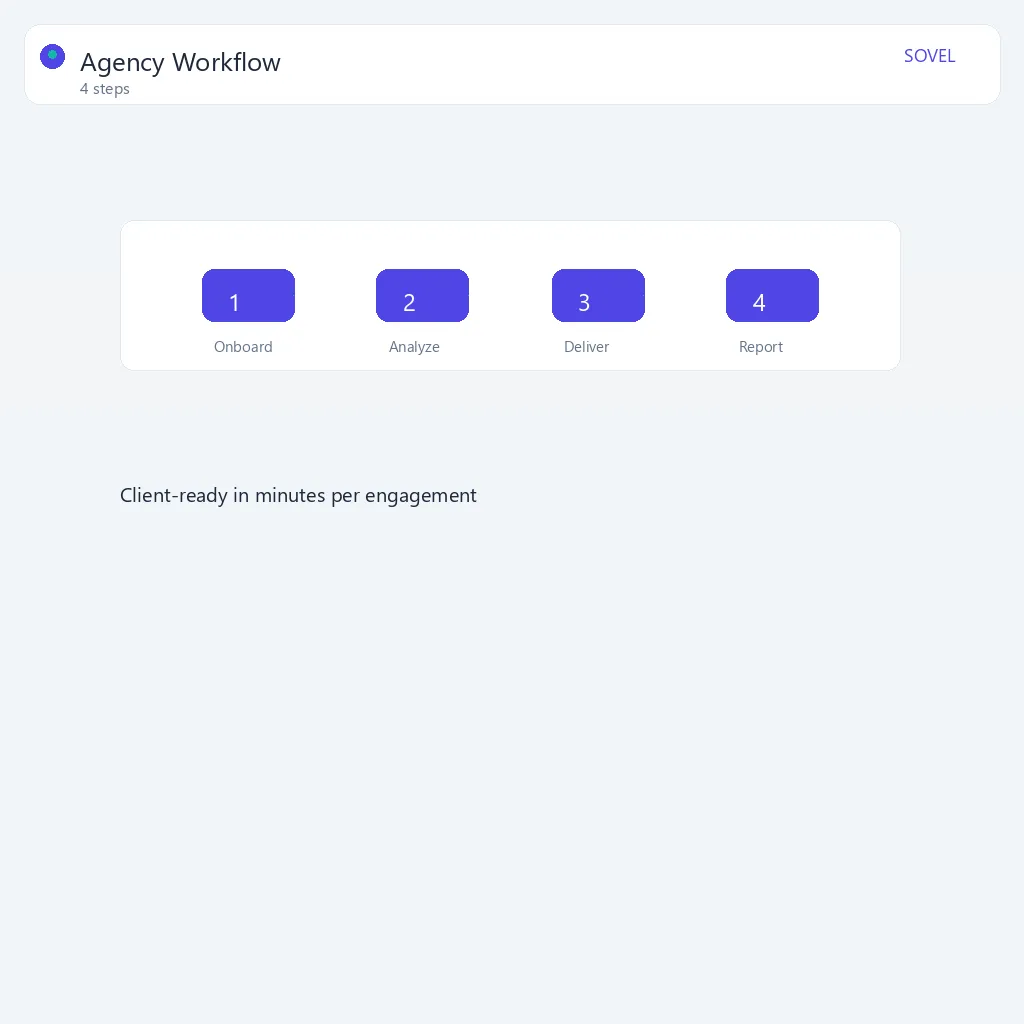
Meet with the client and define the core topics they want to own. Capture their products, services, target audience, and the questions their sales team hears most. This becomes the scope for every gap run. Agree on a master topic list up front and store it per client so future runs reuse the same foundation instead of starting over. The better this step is, the fewer surprises appear later in prioritization.
Step 2: Run the analysis per topic
For each core topic on the list, run a content gap analysis. Using the SOVEL GAP BRAIN tool, paste the topic or a competitor URL and get the scored keywords, gaps, and opportunities in seconds. Do not mix topics in one run; keep each analysis scoped so you can compare like for like. Log the raw export per client so you build an archive that proves progress month over month.
Step 3: Map gaps to the client’s funnel
Sort the gaps into top, middle, and bottom of funnel. Top-of-funnel gaps build awareness and authority; middle-of-funnel gaps capture evaluating buyers; bottom-of-funnel gaps (comparisons, pricing, alternatives) capture ready-to-buy traffic. As with any digital marketing strategy, stage matters because it changes what you ask the content to do. The bottom-of-funnel gaps are usually the most commercially valuable, so weight them accordingly when you present recommendations.
Step 4: Prioritize with the opportunity score
Rank each gap by its opportunity score and flag the top priorities for the quarter. This becomes the client-facing recommendation, and it maps onto how Google Search works because you are targeting queries with proven demand. Resist the temptation to dump all gaps on the client; a short, confidently ordered priority list outperforms a long spreadsheet every time. Tie each priority to a business outcome — lead capture, demo requests, or pipeline — so the client understands the why behind the order. This prioritization is where content gap analysis for agencies proves its value, because it turns raw data into a defensible, client-ready plan.
Step 5: Build content briefs from the report
Convert the highest-priority gaps into writer-ready briefs. The report’s recommended actions and formats become the outline, and the SEO content brief generator can speed up the production step. Include the target keyword, intent, format, and an angle drawn from the gap evidence. Doing this converts an analysis into actual production — the outcome the client pays for, not the analysis itself.
Step 6: Deliver a branded report
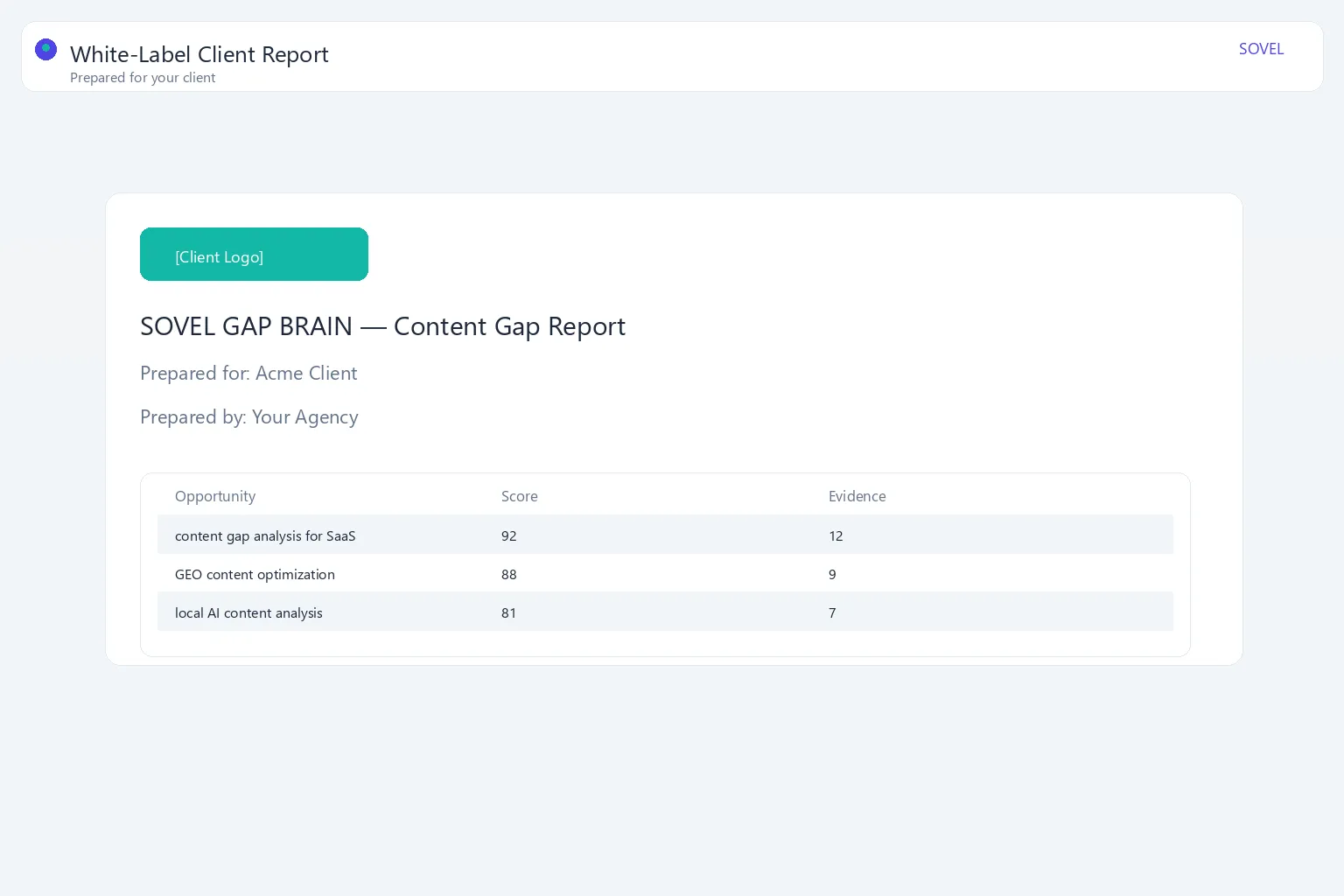
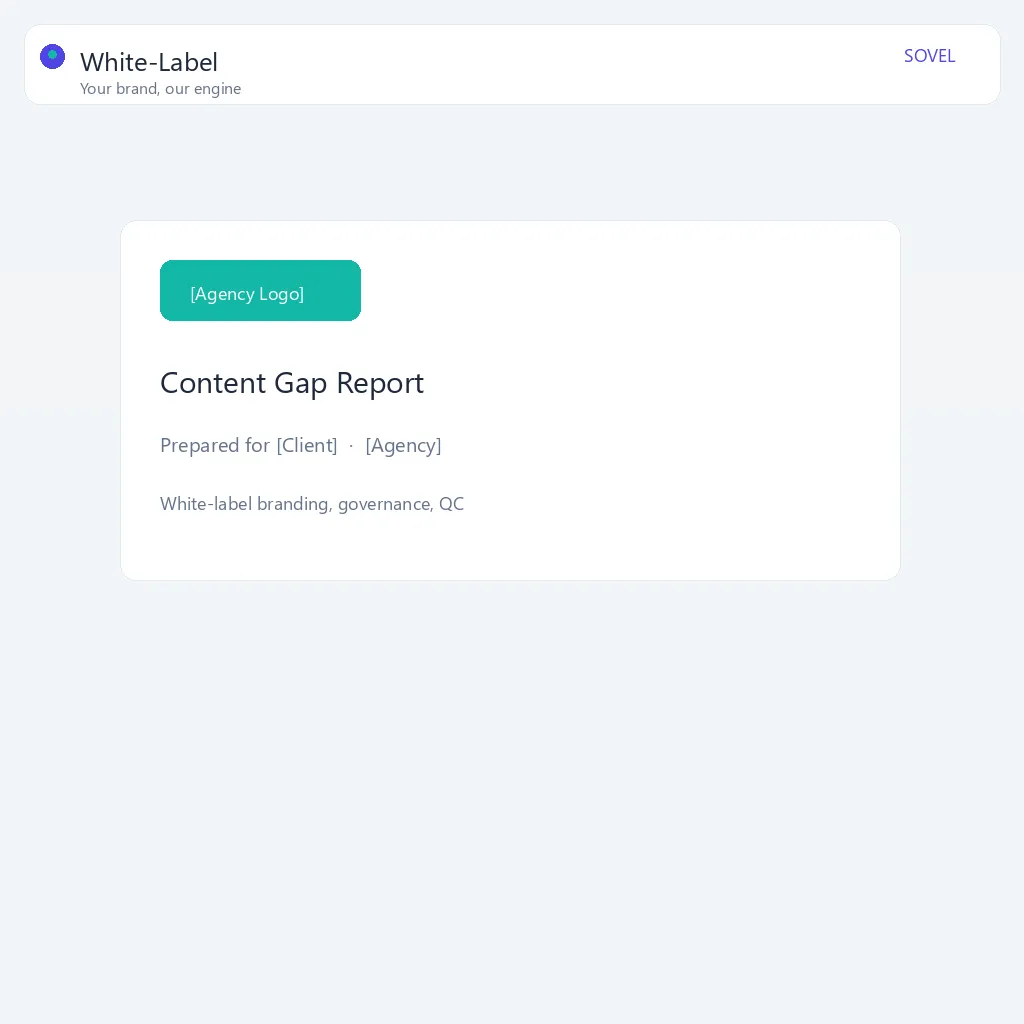
Export the analysis with your own branding. Since the SOVEL GAP BRAIN exports already include the SOVEL wordmark, source site, and timestamp, an agency can add its own cover and present it as a white-label deliverable. Fix a monthly cadence so the client knows when to expect the next report, making the service feel structural rather than episodic.
White-labeling the reports in depth
White-labeling means the client sees your brand, not the tool’s. Done well, content gap analysis for agencies looks like proprietary methodology; done poorly, it exposes the underlying product and erodes trust. The goal is to make the tool invisible while keeping the evidence fully visible.
Branding the output
Add your agency cover and logo to the exported report. Keep the analysis and methodology as the unnamed engine. Present the PDF as the official deliverable, and offer the Markdown version to your writers internally. Create a template slide deck, a cover page, and a signature footer so every report looks unmistakably yours even when different analysts prepare it.
Govern the engagement
White-labeling does not mean hiding the data source forever. Many agencies disclose that they use best-in-class research tooling while keeping the workflow branded. Set expectations on who owns the reports, what the client may redistribute, and what happens to the analysis if they cancel. A short license note in your proposal prevents awkward conversations later.
Quality control
Because the branding carries your name, the quality bar is yours. Assign a reviewer who checks every report for broken links, stale timestamps, and unsupported claims before it ships. Automate what you can and reserve human review for judgment calls such as prioritization and tone. The result is a professional, branded service that scales across clients without you building research tooling from scratch. Quality control is the last mile of content gap analysis for agencies, and it is worth the small investment of one review pass per report.
Client onboarding for a smooth start
Onboarding decides whether content gap analysis for agencies feels like a premium service or an ad-hoc favour. A tight onboarding script does three things: gathers context, sets expectations, and proves competence early. Before the first analysis, collect the client’s goals for the next two quarters, the keywords they believe matter, and any pages they are embarrassed about. Send a one-page project brief that restates the scope, the cadence, and the format of deliverables. Finally, run one pilot analysis on a single topic during onboarding so the client sees the output before they commit long term. That single pilot often closes the deal faster than any pitch deck.
Deliverables and formats agencies produce
A clear menu of deliverables makes content gap analysis for agencies easy to quote and easy to bill. Each format serves a different reader, and the best agencies offer a layered set.
| Deliverable | Format | Primary audience | When to deliver |
|---|---|---|---|
| Executive summary | PDF / slide deck | Client decision-makers | Every reporting cycle |
| Full gap report | Client SEO / content leads | Post-analysis | |
| Prioritized action list | Markdown / Word | Writers and editors | With each sprint |
| Raw data export | CSV / JSON | Data teams | On request |
| Content brief pack | Markdown | Freelance or in-house writers | Per priority gap |
Most agencies pair a polished PDF for the client with a Markdown or CSV version for internal execution. Keep the client-facing artifact clean and the working artifact functional.
Pricing the service
Pricing is where content gap analysis for agencies either earns its keep or leaks money. There are three workable models. Per-report pricing suits ad-hoc engagements: charge a flat fee per analyzed topic or per quarterly report. Retainer pricing bundles a set number of topics and reports into the monthly fee, which smooths revenue and deepens the relationship. Outcome-linked pricing ties part of the fee to the content produced from the gaps, though this works best once you trust the data. Whichever model you choose, remember that your cost per analysis is near zero after setup, so the margin is almost entirely yours to protect. Price against the value of the roadmap, not the few minutes the tool takes to run it. When you price this way, content gap analysis for agencies becomes one of the most profitable service lines on your menu.
The green scale for agencies
The biggest risk for an agency is cost-per-analysis. If the tool charges per search or per month per seat, running dozens of client analyses gets expensive fast.
This is where a lifetime engine changes the math. SOVEL GAP BRAIN’s full engine at /sovel-gap-brain-engine/ is a one-time purchase. It removes the daily limit and runs locally on your own server, so the cost per additional client analysis drops toward zero. The Agency edition is built for exactly this multi-client workload. For an agency, the choice between subscription seats and a lifetime engine is the difference between a growing software line-item and a flat one. Keeping the cost flat is how content gap analysis for agencies remains profitable as you add clients.
How the free tool fits agency trials
For a quick trial or a small client, the free tool at /tools/content-gap-analysis/ is enough. With its daily per-device limit, you can validate the service with a client or two before you invest in the full engine. It is the lowest-risk way to test the demand for content gap analysis for agencies within your own book of business.
Once you are running several clients daily, upgrade to the lifetime engine and stop counting searches. At that point, content gap analysis for agencies needs the unlimited engine to stay profitable.
The deliverable a client actually wants
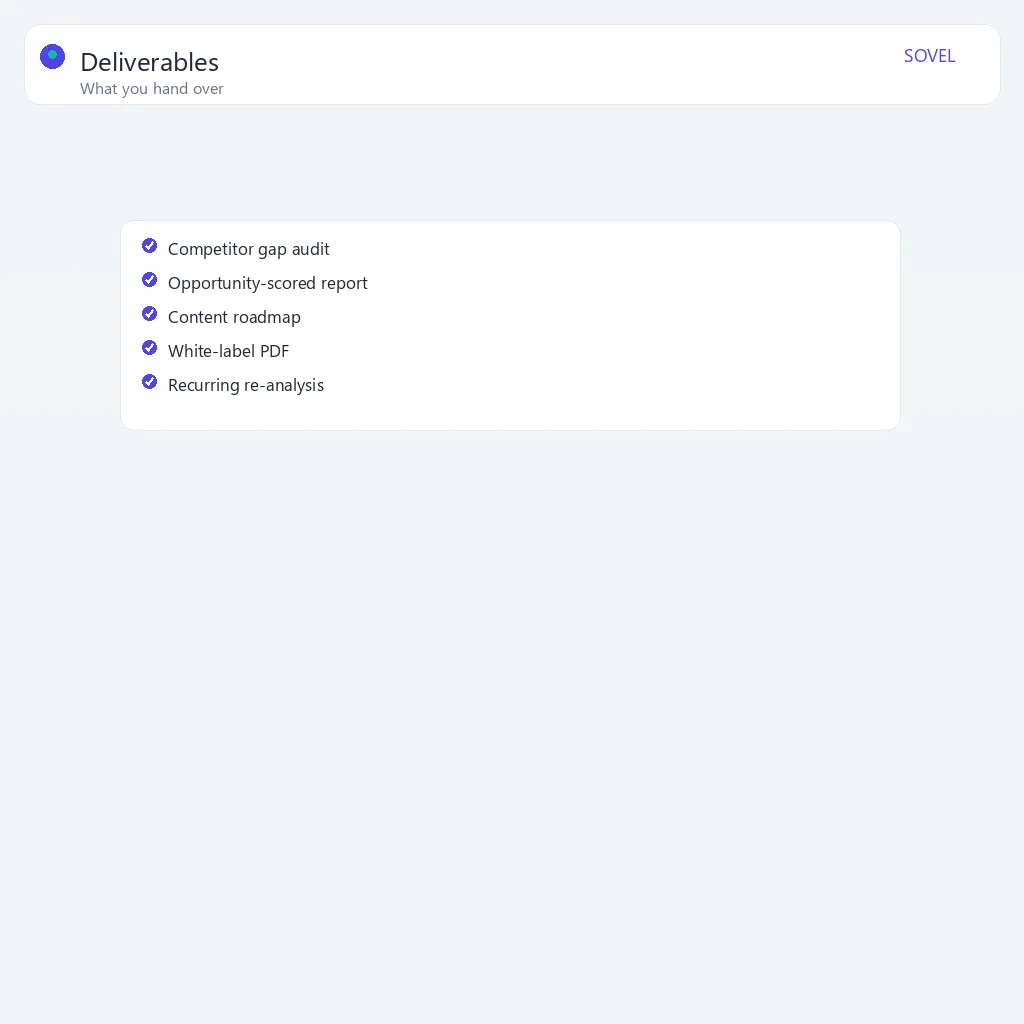
Clients want clarity. A good agency gap report presents:
- A summary of the top gaps.
- A prioritized list of recommended content.
- The reasoning for each recommendation.
- The expected intent each piece serves.
The SOVEL GAP BRAIN report provides this structure out of the box. You polish it, brand it, and deliver. The format matters as much as the findings: a clean executive page, a clear priority order, and an appendix for the full data. When clients can act on the report without asking questions, your content gap analysis for agencies has done its job.
Avoiding the common agency mistake
The most common mistake is delivering the raw analysis with no recommendation. A client does not want a list of 40 gaps; they want the five they should write this month. Always lead with the prioritization and the plan, then attach the full data. Too many agencies treat the report as the end of the job; in reality it is the middle. Your content gap analysis for agencies should end in a decision the client can execute, whether that is written briefs, a publishing calendar, or a revised topical roadmap. If the report ends with data instead of a decision, you have added cost without adding clarity.
Frequently asked questions
Is content gap analysis a good agency service?
Yes. It is fast, high value, and presents a clear, repeatable deliverable that fits a retainer or a one-off project.
Can I white-label the reports?
Yes. The exports are clean and branded; add your agency cover and logo to present them as your own.
Does the tool charge per client?
No. The tool has no per-client fee. The free web tool has a daily limit; the full engine is a one-time lifetime purchase that removes the limit.
Which edition should an agency choose?
The Agency edition is built for multi-client work. It gives you the lifetime engine without a daily cap, so you can run unlimited client analyses. For most firms, this is the fastest route to consistent content gap analysis for agencies at scale.
What formats can I deliver?
HTML, Markdown, Word, and PDF. The PDF is the standard client deliverable; Markdown feeds your writers. These formats cover every common delivery style for content gap analysis for agencies.
How fast is each analysis?
A typical topic analysis returns in seconds, so you can batch multiple clients quickly. That speed is why content gap analysis for agencies scales so well.
Do I need an API key?
No. The engine runs on your own server with no external API key.
Who should own the analysis inside the agency?
Assign a single owner per client — typically an SEO strategist — so reports stay consistent and the client always knows who to ask.
Can I resell the service to white-label clients?
Yes, that is the core model. Set your own pricing and branding; the engine stays behind the scenes.
How do I prove ROI to the client?
Track which prioritized gaps turned into published content and, later, into rankings or conversions. Re-run the analysis quarterly to show coverage growth.
Scaling the service across a client roster
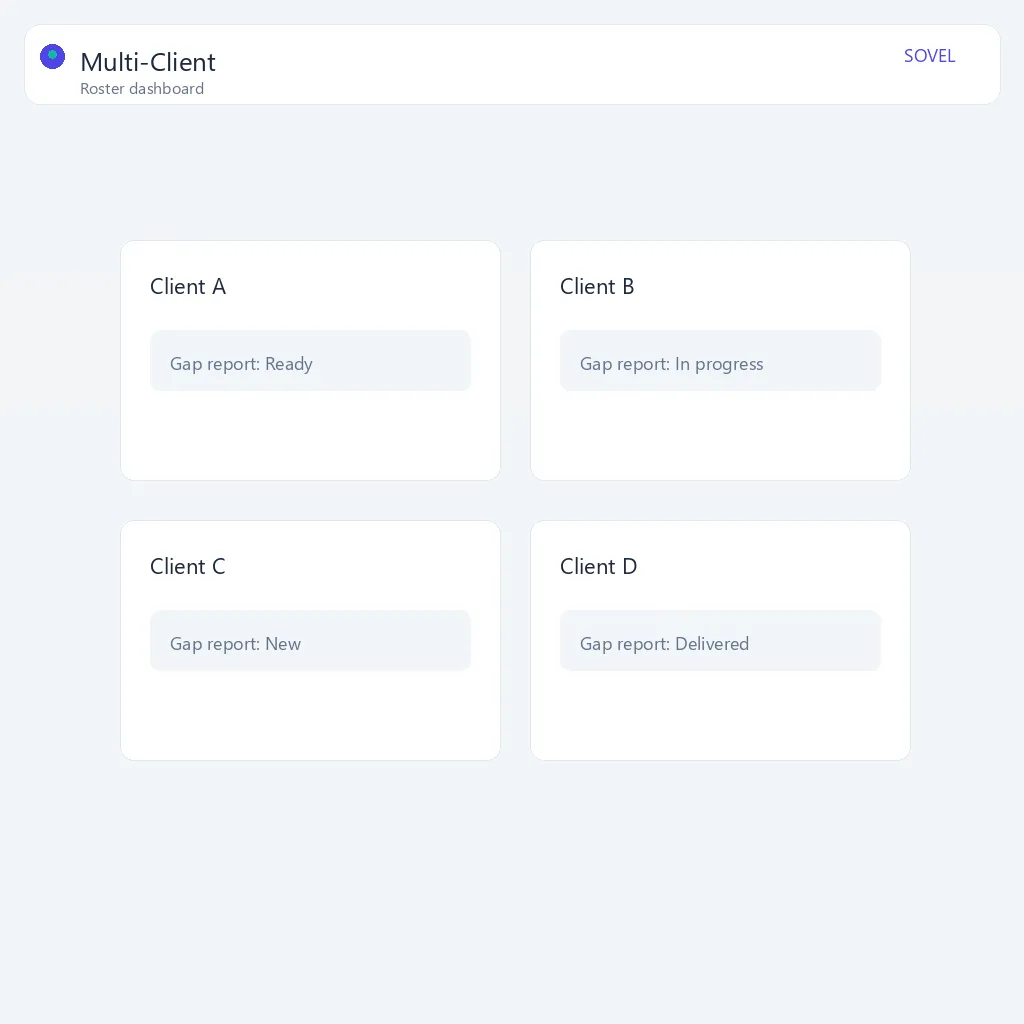
The real payoff of content gap analysis for agencies arrives when you run it across ten, twenty, or fifty clients. At that scale, the workflow stops being a project and becomes a production line. The key is to keep each client’s data, templates, and cadence organized. A shared folder structure per client, a standard report template, and a central log of every analysis mean an analyst can pick up any account and deliver within the hour. Standardization is what makes content gap analysis for agencies profitable at volume, because you reduce the only real cost left: people’s time.
You should also build a small internal library of best-practice gaps by industry. When a new client arrives in fintech, ecommerce, or SaaS, you already know the common coverage holes and can arrive with informed defaults rather than starting cold. This learning loop compounds: the more content gap analysis for agencies you run, the faster each new one gets. That speed becomes a selling point in itself and lets you price confidently without overstaffing.
Finally, watch your reporting habits as you scale. The same discipline that keeps a single client happy will keep fifty happy if you systemize review, branding, and delivery. When everything is templated, adding a client is marginal work, and that is exactly the outcome every agency owner wants. Every repeatable service needs a playbook, and content gap analysis for agencies is no exception.
Agency launch checklist
- Define a master topic list with the client.
- Run a pilot analysis on one topic before committing.
- Map gaps to funnel stages and score them.
- Pick the top five gaps for the quarter.
- Draft writer-ready briefs from those gaps.
- Build a branded PDF template and Markdown export.
- Set a fixed monthly delivery cadence.
- Agree on pricing (per-report, retainer, or outcome-linked).
- Assign one owner and one reviewer per client.
- Re-run the analysis quarterly and report coverage change.
Final word
Content gap analysis for agencies is a fast, white-labelable service that earns client trust and feeds your content team. Use the free tool to validate the workflow, then move to the lifetime Agency engine to scale across every client without a growing bill. Deliver prioritized, branded reports and let the data drive the content plan.