
Buying signals for prospecting answer a question a list cannot: why now. A company that matches your offer perfectly is still a bad email if nothing has changed there in two years. A company with a smaller budget and a vacancy on its own careers page is a conversation this week.
The short answer: buying signals for prospecting are dated, public events that make a conversation more likely than it was last month. They include a live vacancy, a blog that stopped, a new location, a page that changed since you last looked, a slow homepage and a new person in charge. Each one has a source and a date, and each one expires.
This guide covers the six signals, where each one actually appears, how long to trust it, and the stop rule that keeps a warm signal from turning into a nuisance. Every claim here comes from a public page, so you can check all of it before you write.
What are buying signals for prospecting?
What are buying signals, in plain terms? They are changes. A signal is something that was different last month: a role that did not exist, a post that stopped, a page that moved, a name that appeared on the team page.
That definition rules out a lot of what gets called a signal. A company’s size was the same size last month. An industry stays the same industry. A design you dislike has probably looked that way for years. Size, industry and taste are fit and pain, and they belong in a different part of the scoring.
Buying signals for prospecting only earn the name when they carry two things: a date and a source. A vacancy with a posting date is a signal. A vague sense that the company is growing is a mood. The discipline is keeping the first and ignoring the second.
That is why buying signals for prospecting starts with dated pages rather than with a database. A careers page, a feed, a sitemap and a team page all carry dates or visible changes, and all four are readable without an account.
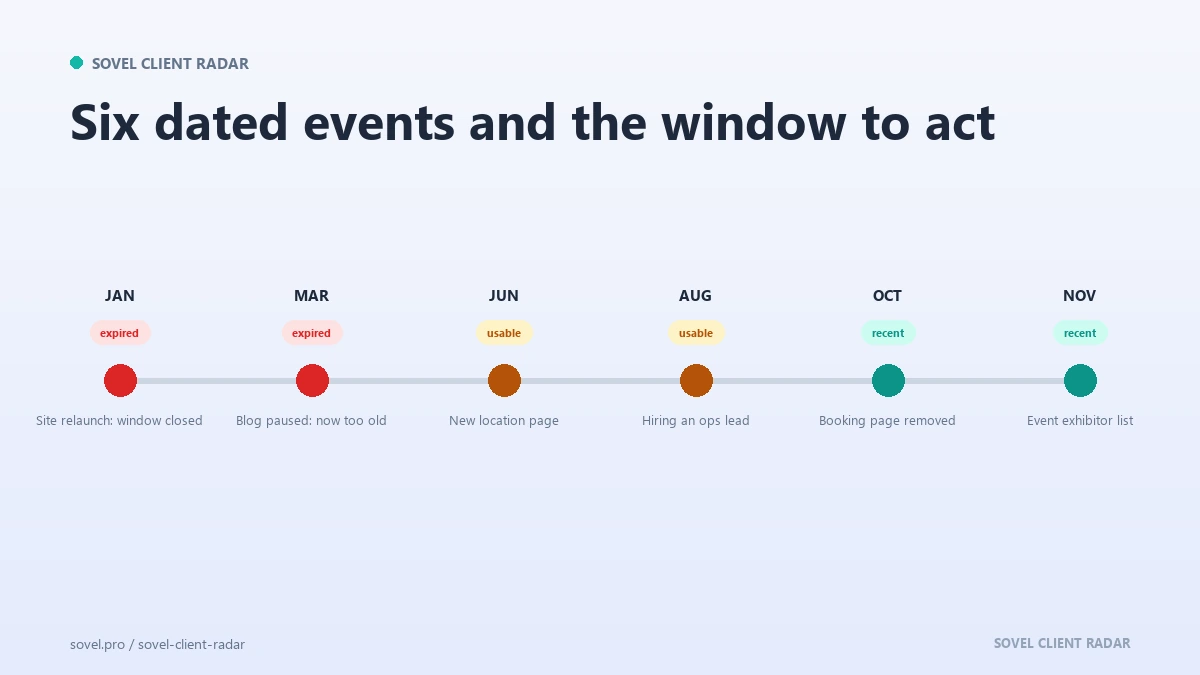
Signal 1: hiring activity
Hiring activity is the strongest signal in most buying signals for prospecting work, and the easiest to verify, because the employer publishes it on purpose.
Open the company’s own careers page rather than a job board. The board tells you a role exists somewhere. The company page tells you it exists there, and it usually carries a date, a location and a reporting line.
Read past the title to the role itself. A vacancy for a marketing manager means someone will own the website and the pipeline. A vacancy for an operations coordinator often means the owner is drowning in admin. A vacancy for a second developer means a product is being built. Each one supports a different opening line.

Then check the date. A role posted this week is a live problem. A role posted eight months ago is either unfilled or forgotten, and both answers change what you would say.
The signal also stacks. Three open roles in one month is a different situation from one role open since spring, and the stack is what makes a first line specific. The best buying signals for prospecting runs find two or three at once.
Signal 2: the publication gap
A publication gap is the distance between the last thing a company published and today. It shows up in a blog, a news page, a feed or a sitemap.
Check the feed before you check the page. A feed carries a last item date that a page can hide. Read the date, count the items, and measure the gap in weeks.
The gap only counts when the check finished. If a feed probe times out, you do not know that the blog stopped, and a report that claims otherwise is guessing. The honest form is a checked absence, recorded as a gap, or an unfinished check, recorded as unknown. That distinction separates a claim you can defend from one you have to withdraw. Most buying signals for prospecting lists have at least one gap in them, because a business that gets busy stops publishing first.
A gap like that is not an insult. Plenty of good businesses stop publishing when demand picks up. The signal tells you the site is not being maintained, and the conversation is about what would make publishing worth the effort again.

Signal 3: a new location or a rebrand
A new location or a rebrand is a moment when a business reconsiders the people it works with. Both events cost money, and both create a list of things that suddenly need doing.
Look for a new address on the contact page, a new trading name in the footer, a new domain that redirects from the old one, or a press page that announces the change.
A second location is the clearest version, and the one buying signals for prospecting finds easiest: new local pages, new opening hours, new photos, often a second phone number. A business that has just done that work is either proud of it or aware of what it missed.
A rebrand is subtler. The logo changed, the name changed, and half the site still carries the old version. That half-finished state is the signal, and it is visible without any analysis.
Record the date you first noticed the change and the page that shows it. A rebrand from eighteen months ago is history, and buying signals for prospecting that ignores the date sends email about a launch nobody remembers.
Signal 4: website change detection
Website change detection means comparing the same page between two runs and noting what is different. A new service page, a changed phone number, a new address, a section that disappeared.
The cheapest version is a saved copy and a diff. The systematic version is a sitemap check: the last modified date on each URL tells you which pages the business touched since you last looked. Google’s guide to sitemaps explains what the file contains and what the date field means, which is enough to read one without a tool.
That is how website change detection stays current without re-reading every site from scratch. You compare, you do not re-crawl. Two pages that changed in the last month are worth more attention than twenty that have not moved since spring.
One caution. A change is not automatically good news. A page that lost its phone number is a change, and it may mean the business is winding down. Read what changed before you assume it is an opportunity.
Signal 5: a slow homepage
Speed is a signal because it is measurable, dated and visible to the customer, which makes it one of the few buying signals for prospecting that needs no second source. A homepage that takes a long time to become usable on a phone is losing people right now, whether or not the owner knows.
Test it the way a customer would: a phone, mobile data, a stopwatch. Then test a competitor in the same town. The comparison turns a number into a sentence an owner will understand.
A slow homepage is also evidence that nobody is watching the site, which is why buying signals for prospecting tables pair it with others. Slow plus a gap plus no schema is a story about a site left alone. Slow on its own is a performance note.
Record the date, the device and the network. A speed result without those three is not reproducible, and a client who cannot reproduce it will not believe it.
Signal 6: a leadership change
A leadership change is the signal with the longest shelf life, and the one buying signals for prospecting handles worst, because the evidence is thin and the temptation to overread it is strong.
Look at the team page, the about page and the news page. A new managing director, a new head of marketing, a founder who now calls themselves an advisor. Sometimes the site says “under new management” in plain words.
A new person in a role is a reason to introduce yourself, because new people review the suppliers and agencies they inherited. That is the most common version of the signal in practice.
Do not stretch the evidence. Buying signals for prospecting loses credibility the moment one claim turns out to be a guess. A name that disappeared from a team page is not proof of a departure, and an old press release is not a current fact.
Verify with two sources before you use it. The team page and a press page, or the team page and a local news item. One mention on a page nobody updates is weak evidence, and weak evidence costs more than silence because it uses up the first email.
How do you weight recency?
Recency decides the order, and buying signals for prospecting lives or dies on that order.
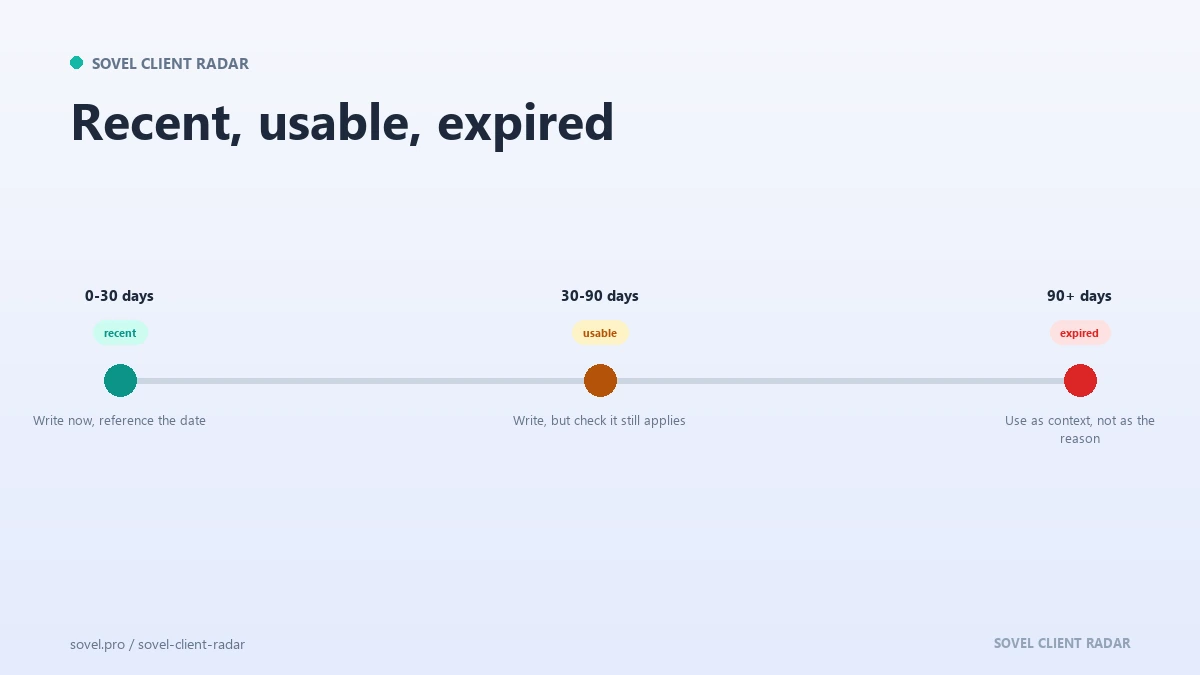
My working rule is simple. A signal from the last month goes to the top of the list. A signal from the last quarter stays in the list. A signal older than six months drops out unless it is the only evidence you have and the fit is strong.
That rule matters because buying signals for prospecting decay at different speeds. A vacancy can be filled in three weeks. A rebrand stays relevant for a quarter. A gap in publishing keeps its meaning for a year, because it describes a state rather than an event.
The decay is why a weekly run beats a quarterly one. A list refreshed weekly catches events while they are still true, and a list refreshed quarterly reports last season’s news with this month’s confidence.
The six signals side by side
Six signals, six shelf lives. The table is the version I keep open while the buying signals for prospecting review is running.
| Signal | Where it shows | How long it stays useful | What it justifies |
|---|---|---|---|
| Hiring activity | The company’s own careers page | Weeks | A workload or budget conversation |
| Publication gap | Feed, blog, news page | Months | A content or maintenance conversation |
| New location or rebrand | Contact page, footer, press page | A quarter | A launch-support conversation |
| Website change detection | Sitemap dates, page diffs | Weeks | A “we noticed you added” conversation |
| Slow homepage | A phone test on mobile data | Months | A performance conversation |
| Leadership change | Team page, about page, news | A year | An introduction with no pitch |
No row is a promise. Buying signals for prospecting tells you when a conversation is timely, and it says nothing about whether the company wants one.
When to contact a prospect
When to contact a prospect is a timing question with a short answer: within two weeks of the signal, and never more than three times without a reply.
The two-week rule matters because signals go stale fast. A vacancy posted this week is news. The same vacancy in six weeks is either filled or a problem the owner has learned to live with. When to contact a prospect with a hiring signal is measured in days.
The three-touch stop rule matters more, and it is the part of buying signals for prospecting that protects your name. First touch is the specific observation with a source. Second touch, a week later, adds one useful thing: a page that loads faster, a schema example, a competitor comparison. Third touch closes the loop and says you will stop.
Then stop. A fourth message after silence is a bad habit with a calendar reminder. Move the name to a later list, keep the date, and check again next quarter when a new signal may appear.
The rule protects the list as much as the reader. A prospect who was not ready in March is often ready in September, and you only get that second chance if you did not spend the first one sending five messages.
How do you record a buying signal?
Four fields: the signal, the page it came from, the date you saw it, and the evidence class. That record is what makes buying signals for prospecting auditable, and it is what you need when a colleague asks why one name sits above another.
SOVEL CLIENT RADAR writes one row per signal with its class, weight, source URL and retrieval date, and shows the strongest one in every report. Keep the screenshot beside the row as well, because pages change and the capture is the only copy of what you saw. A signal without those fields is a memory, and a record built on memory collapses the first time somebody asks for proof.
Why do signals beat a longer list?
A longer list feels like progress and usually is not. Two hundred names with no dates produce two hundred generic emails, and the replies reflect it.
Buying signals for prospecting changes the unit of work. Instead of asking how many names you have, you ask how many names have a reason this week. That number is smaller, and it is the only one that decides what you do on Monday morning.
The trade is depth for volume, and it fails in one direction only: with no list at all, a signal has nothing to attach to. Build the list first, then date every row, because buying signals for prospecting needs both halves. A list of thirty dated businesses will outproduce a list of three hundred undated ones, because the work of finding a reason has already been done.
There is a second effect, and it is the one people notice after a month. Buying signals for prospecting turns the weekly slog into a review habit. You stop asking who to contact and start asking what changed since Friday. That question has an answer, and the answer is short enough to read before lunch.
Which edition fits your work?
Signals are the part of the work a spreadsheet cannot keep up with, because every signal has a date and every date decays.
SOVEL CLIENT RADAR reads each candidate’s careers page, WordPress feed and sitemap, builds a why-now list per lead, and stores each signal with its weight and source. It also shows the strongest signal in the report, so the first line of an email starts from evidence.
The three licences differ in seats and in the leads one run can return. Personal at ₹5,999 covers 50 leads per run on one machine, which suits a solo consultant running one topic a week. Pro at ₹12,999 covers 200 leads per run for a small team. Agency at ₹39,999 covers five machines and 500 leads per run for a team working several niches at once. Every edition is a one-time licence with the full feature set and no daily or monthly run limit.
The SOVEL Client Radar product page sets out what each licence includes. For the design-side signals that sit beside these, read the website redesign leads guide. Once a signal has earned a reply, the qualify a prospect framework covers what to ask next, and the content gap analysis method helps when the signal is a publishing gap and you need to show what is missing.
FAQ
What counts as a buying signal?
A dated, public change at a company that makes a conversation more likely this month. A vacancy, a new location, a blog that stopped, a page that changed, a slow homepage, a new person in a role. If it has no date and no source, it is an opinion.
How old is too old for a signal?
Older than six months is usually too old to lead with, unless the signal describes a state rather than an event. A publishing gap stays meaningful for a year. A job posting rarely stays meaningful for two months.
Can I collect buying signals for prospecting without an API key?
Yes. Careers pages, feeds, sitemaps, team pages and contact pages are public, and all of them can be read without a key or a login. An optional search key widens the index, but the six signals in this guide do not need one.
Which signal is the strongest?
Hiring activity, because it is dated, public and tied to a budget. A new location is close behind, since the business has already spent money and still has work to do. A leadership change matters too, but it is harder to confirm.
Do signals replace fit scoring?
No. Fit tells you whether the company matches what you sell. Buying signals for prospecting tells you whether this is the month to say so. A strong signal on a poor fit is still a poor lead, and a perfect fit with no signal is a name for next quarter.
How often should I recheck a prospect?
Weekly for anything you plan to contact, and quarterly for the rest of the list. A weekly recheck catches a vacancy while it is fresh. A quarterly recheck tells you whether the company is still the same business.
What if a signal turns out to be wrong?
Correct the record, note the date, and leave the row alone until there is new evidence. A wrong signal is normal. What matters is that the correction lands in the file rather than staying in your head.