
To qualify a prospect is to decide, before you write, whether this company can buy and whether you should sell to it. Most outreach skips that decision and lets hope do the work.
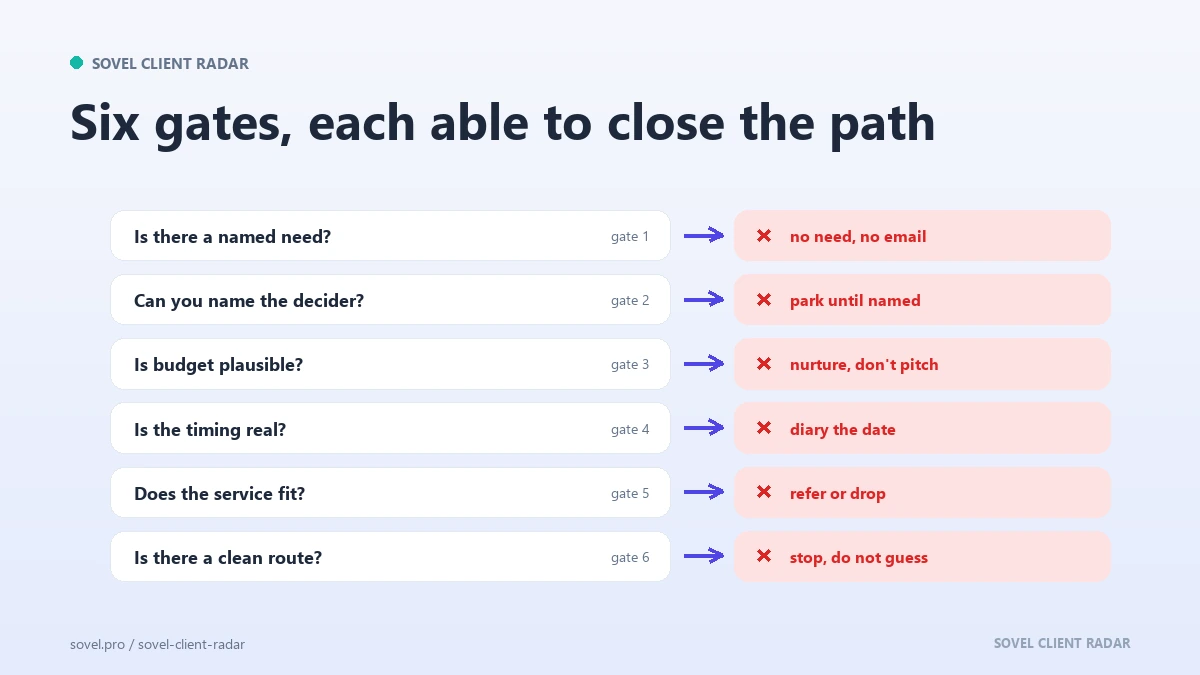
You qualify a prospect with six questions, answered in order, and four of them can be answered from public pages. Is there money for this kind of work. Who decides. Is the need real. When would it start. Can you deliver it. What would make you say no.
The last question carries the most weight. If you qualify a prospect on the good news alone, you build a pipeline of maybes and spend the month chasing them. This guide puts disqualification first for that reason.
Why should you disqualify before you qualify?
Time is the only resource a small seller cannot borrow. A week of emails to companies that cannot buy costs the same as a week of emails to companies that can. The habit that protects the week is a written list of disqualification criteria, applied before the first message, because the cheapest way to qualify a prospect is to remove the wrong ones early.
The sales process most teams draw has stages: find, qualify, propose, close. Qualification sits in the middle and quietly decides whether the later stages happen at all. When it is skipped, the proposal stage fills with names that were never going to buy.
Most advice on how to qualify a lead starts with a scorecard and a discovery call. That order is backwards for a solo seller, who pays for the call in hours and gets nothing back from a company with no budget. Reading first costs minutes, and minutes are refundable.
A disqualification rule also protects your reputation. A company that gets a well researched email about a service it does not need remembers the sender as someone who did not check. Two minutes of reading is usually enough to qualify a prospect and drop the row.
The practical version is blunt. Write three to five disqualification criteria at the top of your list: a budget floor, a service area, a sector you avoid, a conflict with an existing client. Then apply them in the first minute, which is when you qualify a prospect rather than after the proposal.
Question 1: is there a budget?
Start with money, because every other answer changes if there is none. You will rarely find a number on a website, so you qualify a prospect on the conditions that make a number likely: the company charges for its own work, it has customers, it invests in visibility.
Three checks take about two minutes. Look for a price list or a shop, which proves the business collects money. Look for signs of past spend, such as a professionally built site, paid advertising or a content archive. Both help you qualify a prospect without asking an intrusive question on a first contact.
Then read the language. A company that describes its work as an investment, publishes case studies and names outcomes buys services. A company that lists a phone number and nothing else may still buy, and may buy small. Size is not the test.
The four gates most sales teams use are budget, authority, need and timing. Written in that order they become budget authority need timing, and the order matters because each gate is cheaper to test than the one after it. Budget comes first because it is the only gate that makes the rest irrelevant.
One more clue sits in the pricing page of the company’s own suppliers. A business that pays for a tool with a monthly fee has a card on file and a habit of buying. That habit is weak evidence on its own, and it is enough to keep a row in the list long enough to qualify a prospect properly.
Question 2: who is the decision maker?
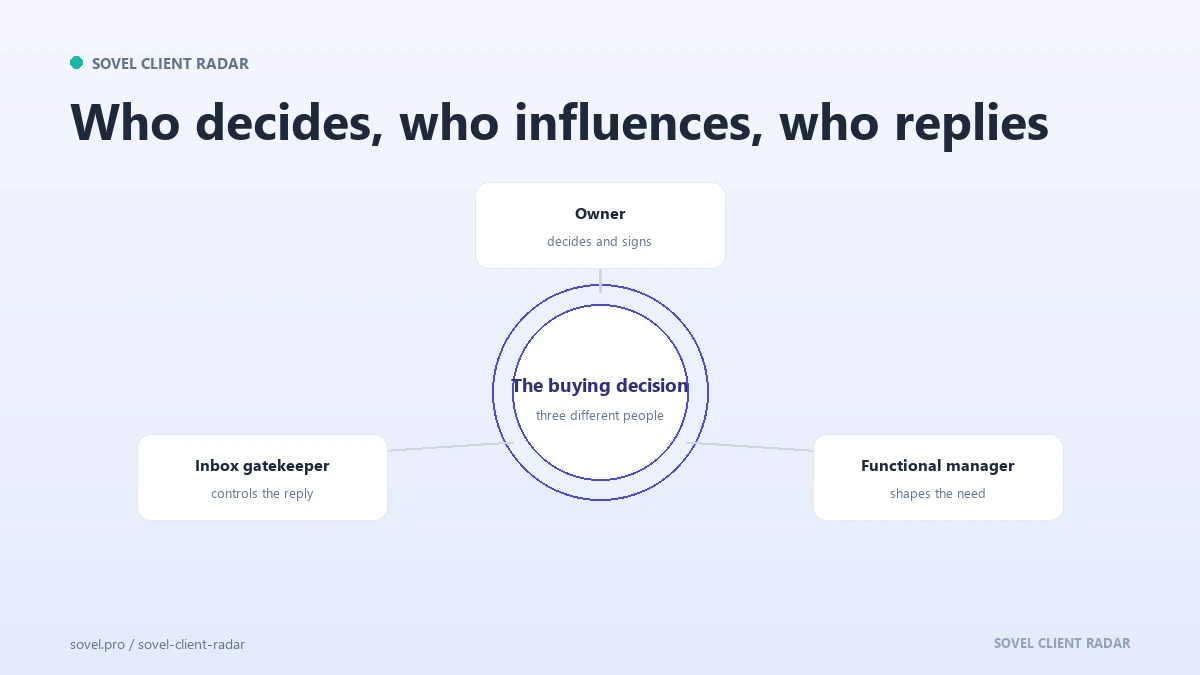
The person who replies is often not the person who decides, and that is not a reason to stop. It is a reason to map the route, because you cannot qualify a prospect on an inbox address alone.
A decision maker is the person who can say yes without asking anyone else, or the person whose no ends the conversation. Map three roles from public pages: the owner or founder, the manager who runs the function you serve, the gatekeeper who handles the inbox.
A job advert is the most useful page here. It names the role, the reporting line and often the tools the team uses, which tells you who owns the problem. The buying signals guide covers what a vacancy says about timing as well. Read one advert and you can qualify a prospect on authority in about four minutes.
Write the route as a sentence: “owner buys, office manager replies, marketing manager owns the site”. That sentence decides whether your email is a pitch or a request for an introduction, and it is the part of the work that lets you qualify a prospect before a call.
Question 3: is this a need or a want?
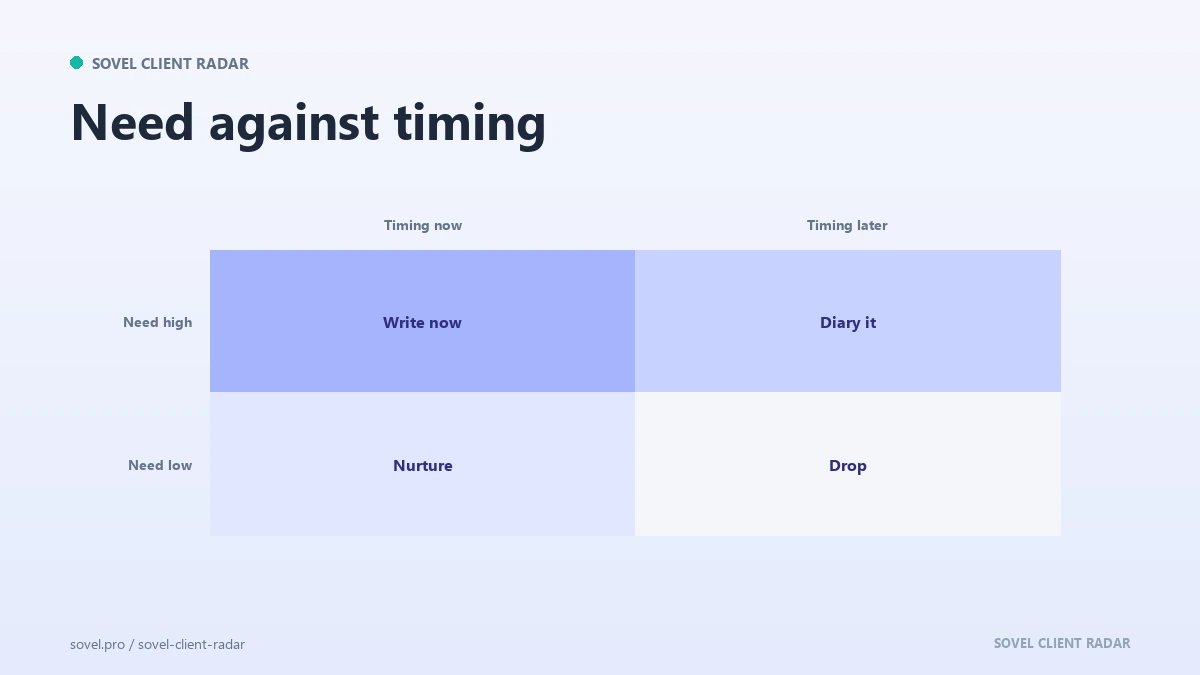
A need has a cost attached to leaving it alone. A want is a preference. Both can become work, and only one survives a busy month, so it pays to know which one you are looking at when you qualify a prospect.
A need sounds like a broken form, a certificate warning, a service the company sells but never describes, a competitor outranking it for its own name. Something is failing, and the owner can feel the failure without your help.
A want sounds like a new logo, a fresher look, a site like the one a competitor launched. Wants are real projects, and they close when the owner has decided, which can be any time. You can qualify a prospect with a want, and you should price the uncertainty into the work.
One question tests the difference: what happens if this waits six months. If the answer is nothing, you have a want. If the answer is lost bookings or a broken checkout, you have a need, and the email can say so. Ask it before you qualify a prospect in writing.
Question 4: when would this start?
Timing is the gate most lists ignore, and it decides whether a good prospect is good now. A company with a need, a budget and a buyer with authority can still be six months from starting. To qualify a prospect on timing is to find one date and write it down.
Four dates are worth finding. The end of a financial year, which frees or closes budget. A season the business depends on, such as the weeks before a holiday. A planned launch, visible on a coming soon page or a press note. A contract renewal, which you will rarely see and can ask about.
The strongest evidence is an event on the company’s own site: a job advert, a second branch, a dormant blog, a page that gained a section. A dated event gives your email a reason to exist today. It is also how you qualify a prospect without guessing at urgency, and it is the same logic any client discovery workflow runs on.
If you find no date at all, say so. “No timing signal, keep for next quarter” is a decision, and it is a legitimate way to qualify a prospect as a later conversation rather than a current one.
Question 5: can you deliver it?
This gate is about you, and it is the one sellers skip when the prospect looks exciting. Can you do the work, at the size it needs, in the time it needs, without breaking the work you already have. To qualify a prospect fairly you have to answer that honestly.
Check three things. Capacity, meaning the hours you actually have in the next eight weeks. Skill, meaning you have done this exact job before and can show it. Interest, meaning you would still want the project in month three, when the novelty has gone.
The answer can be no and still be useful. A prospect you cannot serve well is a referral, and a referral is worth more than a bad project. Send it to someone who does the work properly, and you qualify a prospect even as you pass it on.
Write the capacity line in the row before you write the email. “Two slots in April, none in March” is enough. A prospect that has to wait is still a prospect, and the wait is easier to explain now than after a proposal.
Question 6: what would make you say no?
The final question saves the most time. Before you send, name the reason this company might be wrong, then decide whether the reason is a blocker or a note. Most people qualify a prospect by listing the reasons to say yes, which is why so many lists look better than they are.
Blockers are structural: the wrong country, a franchise with no local control, a competitor of your best client, a business too small to afford the work, a business too large to notice you. Notes are softer: a site that is already good, a contact you could not find, a sector you have not worked in.
The disqualification criteria you wrote at the start are the test. If a company fails one blocker, drop it and write why. A dropped row with a reason teaches you something, and it is the cleanest way to qualify a prospect out of a list.
There is a conflict case worth its own check. If the prospect competes directly with an existing client, the same overlap logic applies that a site uses when two pages chase one keyword, which the cannibalization check explains. Two clients in one market can be fine, and two who would bid against each other is a decision you make on purpose.
What does a good answer sound like?
The table below sets a weak answer beside one worth acting on. Read the middle column as the sound of a hopeful list and the right column as the sound of a plan. The difference is whether the answer names something a stranger could check, which is the whole test when you qualify a prospect.
| Question | Weak answer | Answer worth acting on |
|---|---|---|
| Budget | “They seem successful” | “Sells online, has a shop, published a case study last year” |
| Authority | “I emailed the info address” | “Owner named on the about page, marketing manager hired in January” |
| Need | “Their site could be better” | “Booking form fails on mobile, two service pages missing” |
| Timing | “No rush mentioned” | “Hiring a marketing manager, new branch opening in spring” |
| Delivery | “We could probably do it” | “Two open slots in April, same job done twice before” |
| Say no | “Nothing obvious” | “Franchise, no local control over the website” |
Most rows will have four good answers and two weak ones. That is normal, and it is enough to write. A row with six weak answers is a row to drop, and dropping it early is the cheapest decision in the process.
How to qualify a lead, in practice, is mostly a reading exercise with a table beside it. The table is short on purpose. A longer one would catch more edge cases and fewer real decisions.
A row that passes every gate is worth a careful email. A row that fails one is worth a note and a date. The list shrinks either way, and a shorter list is the only reliable sign that you are starting to qualify a prospect rather than collect names.
What do you do with a maybe?
A maybe is a prospect where one gate is unclear and the rest pass. Treat it as a scheduled follow up, not a live lead. Give it a date, a reason and a next action, and take it out of the working list until that date arrives.
Three kinds of maybe are common. The budget may exist but is unproven. The decision maker may be the owner, and the reply came from an assistant. The need may be real but the timing is next year. Write the date, and qualify a prospect again when it arrives, with the same six questions in the same order.
The same rule applies to a prospect who asks you to wait. Put the date in the row, thank them once, and use the waiting time on a company that can start sooner. Politeness is not a pipeline.
How do you turn the answers into a first line?
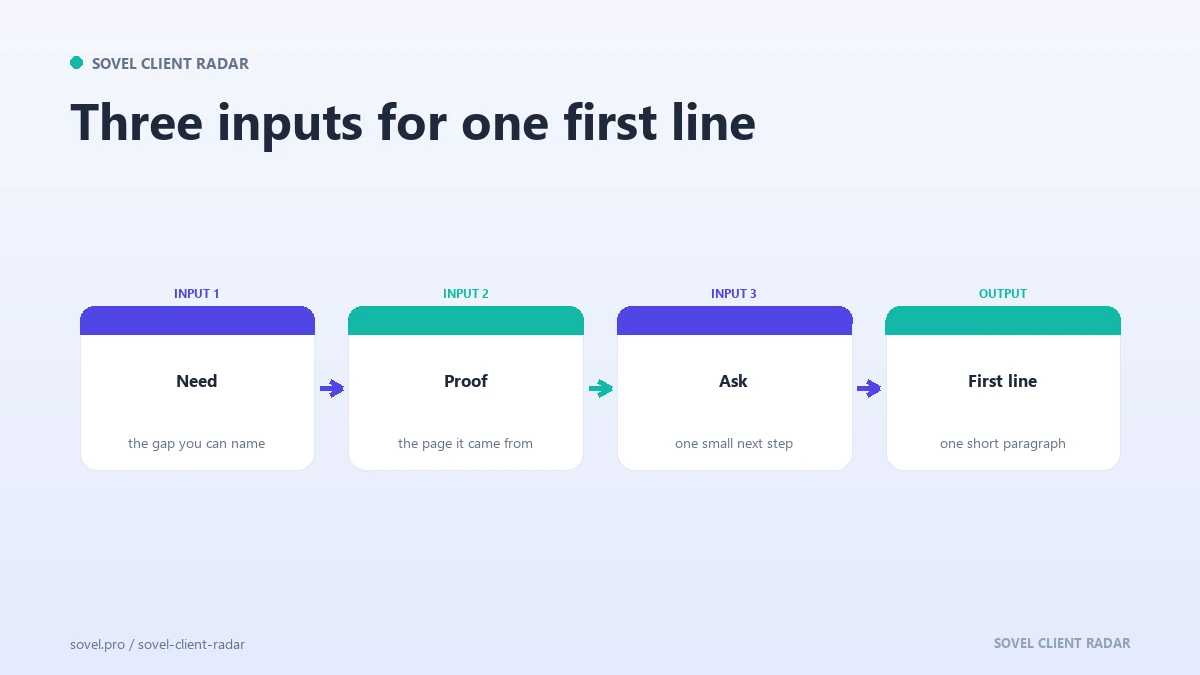
The first line should be the answer to question three, written as an observation. A need gives you a sentence the owner recognises. A want gives you a sentence about ambition, which is a harder sale and a different message.
Take the strongest fact from the row and say it plainly, with the page it came from. “Your pricing page menu does not open on a phone” is a first line. “I help businesses like yours grow” is a template. One proves you looked, and the other proves you did not.
Then connect the observation to the question the owner is already asking. If the need costs bookings, say bookings. If it costs enquiries, say enquiries. Keep the sentence short enough to read on a phone, because that is where it will be read.
The closing ask depends on the authority answer. A decision maker gets a 15 minute call. A gatekeeper gets a request to forward one paragraph. Both are small, and both are easier to answer than a proposal.
Check the row against the six questions one more time before you send. If any answer changed, rewrite the line. The six questions to ask a prospect are also six reasons to stop, and stopping is cheaper than a bad month.
None of this needs a script. A script is what you write when you have not decided anything, and the six questions exist so that you have. When you qualify a prospect properly, the first line almost writes itself, because the need and the proof are already sitting in the row.
Where does the engine fit the six questions?
SOVEL CLIENT RADAR does the reading that makes the six questions answerable. It visits the pages a company publishes, one page at a time from each host, and prints the address and date behind every email, phone number and profile, with a why-now reason beside each lead.
Nothing in the output decides for you. The score is a ranking aid with its formula printed in the report, and the approach plan suggests a contact, an angle and a stop rule. Whether a company can buy, and whether you should sell to it, stays a human call.
Three lifetime licences cover the range. Personal starts at ₹5,999 for one seat and a 50 lead cap on each run. Pro is ₹12,999 for that same single seat and 200 leads a run. Agency takes five seats and a 500 lead cap for ₹39,999. The optional AI second opinion and every team feature ship with all three, and nothing limits how often you start a run. The SOVEL Client Radar page spells out the differences.
FAQ
What does it mean to qualify a prospect?
It means deciding whether a company can buy your work and whether the timing suits both sides, using evidence rather than hope. You qualify a prospect on budget, authority, need, timing, your own capacity and the reason to walk away. The result is a yes, a no or a dated maybe.
Is budget authority need timing still useful?
Yes, as a checklist rather than a script. The four gates still catch most bad fits, and the order keeps you from pitching before you know who decides. Add capacity and a disqualifier, and the frame covers the way small sellers actually work.
How do I ask about budget without being rude?
Ask about the shape of the decision rather than the number: whether this is a project for this year, who signs it off, and what a sensible range looks like for the work described. Most owners answer a process question more readily than a price question.
What if the company is too small to afford me?
Say so in your notes and move on, or offer a smaller piece of work that fits their size. A tiny first project that runs well can grow. A large project sold to a company that cannot carry it damages both sides.
How many questions should I ask a prospect?
Six is enough for a first decision, and four of them can be answered from public pages before you write. The call confirms what you found and fills the gaps you marked. Most leads fail on two of the six, not on all of them.
When should I stop pursuing a prospect?
When a blocker appears and stays, or when three follow ups have produced nothing. Set the stop rule before you start, write it in the row, and honour it. A stopped prospect is a decision you can review, and a stalled one is just noise.
How long should qualification take?
About ten minutes per company with a template and a working list. The questions to ask a prospect do not need a meeting, and a meeting booked before the questions are answered usually costs more time than it saves.