
Amazon autocomplete keyword research reads buyer language rather than reader language. The suggestion box completes toward products, so every phrase it returns carries an object plus a qualifier, and the qualifier is where the unwritten article lives.
“Wireless earbuds” is a product. “Wireless earbuds for small ears” is a person with a problem. The second phrase is a content brief, and almost nobody writes it because it looks like a product query rather than an article query.
This guide covers the six qualifier families worth mining, the intent filter that keeps you out of seller territory, and the hard limits of a source that carries no volume data at all.
What makes Amazon autocomplete keyword research different?
It is the only free suggestion source where the reader is close to spending money. That changes the phrasing in a specific way: people name the product first and the constraint second.
Google suggestions often start with a question. YouTube suggestions often start with a verb. Amazon suggestions start with a noun, then add the reason the noun is not quite right. That second half is the useful half, and amazon autocomplete keyword research is mostly the practice of reading it.
The commercial value follows from the position in the funnel. Someone typing into Amazon has already decided to buy something in this category. They are choosing. An article that helps them choose sits closer to revenue than an article that explains the category, which is why this source pairs well with comparison and selection content.
The trap is equally clear. Amazon suggestions describe buyers, and not every buyer wants to read. A person searching for a specific model number wants a checkout page, not 2,500 words. Amazon autocomplete keyword research tells you what they are choosing between, and your job is to decide whether a page can help with that choice.
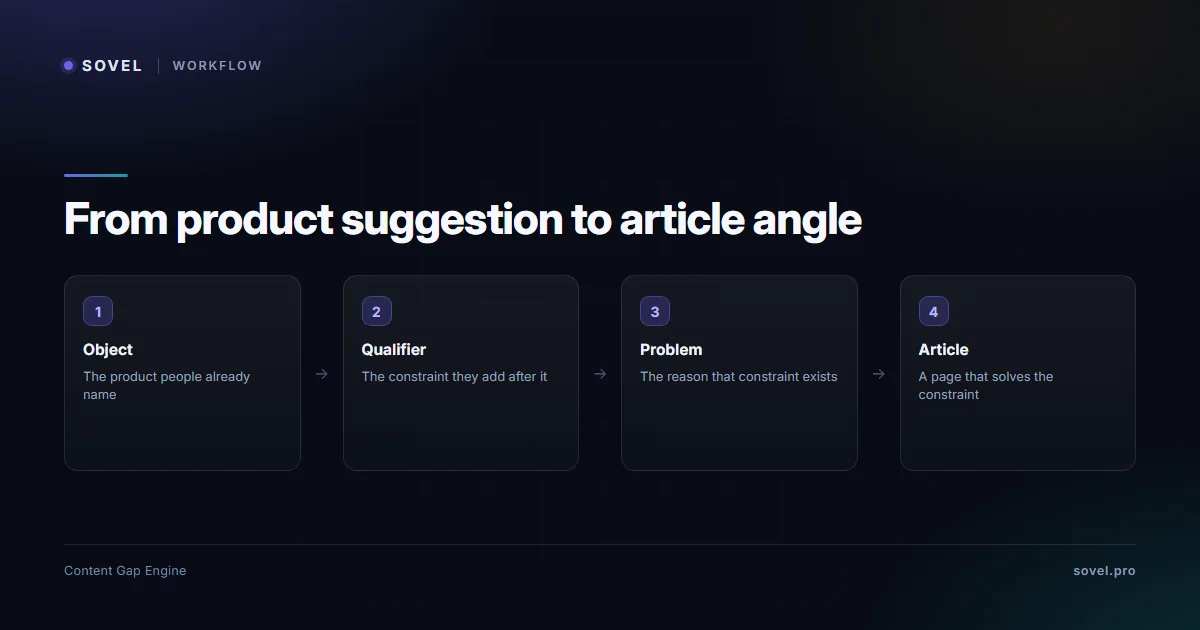
The object plus qualifier structure
Every Amazon suggestion has two parts, and separating them is the first move in amazon autocomplete keyword research. The object is the product category. The qualifier is the constraint, preference or context attached to it.
The object tells you the market in amazon autocomplete keyword research. The qualifier tells you the segment that amazon autocomplete keyword research is looking for. A page aimed at the object competes with every retailer and every affiliate site. A page aimed at the qualifier competes with almost nobody, because the qualifier is too specific to attract a mass-market writer.
Run the split explicitly, because it is the single habit that makes amazon autocomplete keyword research usable. Write the object in one column and the qualifier in another, then ask whether the qualifier describes a person, a situation, or a fear. Person qualifiers produce guides. Situation qualifiers produce scenario pages. Fear qualifiers produce the trust-building article that no competitor wrote.
There is a useful side effect to splitting phrases during amazon autocomplete keyword research. Once you split object from qualifier, you can see which qualifiers repeat across different objects. “For small ears” appears under earbuds, headphones and ear tips. That repetition is a segment, and a segment is a content cluster rather than a single article.
The six qualifier families
Six families cover most of what the box returns. Each one maps to a different page type.
| Family | Example qualifier | What it reveals | Page it justifies |
|---|---|---|---|
| Fit | for small ears, size 42 | Physical mismatch | Sizing and fit guide |
| Budget | under 5000, cheap | Price ceiling | Tier comparison |
| Use case | for travel, for studio | Context of use | Scenario guide |
| Durability | waterproof, heavy duty | Failure fear | Build quality analysis |
| Skill | for beginners, professional | Competence gap | Prerequisites page |
| Absence | without battery, no app | A rejected feature | Constraint article |
The absence family produces the most and is the least covered. A phrase like “without a subscription” tells you the buyer has been burned by recurring billing and is actively filtering for a product that avoids it. That is an objection with a purchase attached, and an article that addresses it honestly converts better than any feature list.
The skill family overlaps with YouTube suggestions, which is useful. When the same competence marker appears in both sources, you have confirmation that the reader needs orientation before detail. That is the section most product-adjacent articles skip.

How do you run the expansion?
Four loops, and the fourth one produces the qualifiers that make amazon autocomplete keyword research worth running.
- Plain seed. Type the object and read the ten completions. These are the most common qualifiers, which means they are the most competitive.
- Preposition loop. Object plus for, with, without, under, over, near. This surfaces constraints and price ceilings.
- Comparison loop. Object plus vs, or, better than, alternative to. This surfaces the two products the buyer is torn between.
- Problem loop. Object plus not working, keeps, too, leaking, noisy. This surfaces failure language, which is the richest source of article angles.
The problem loop is where amazon autocomplete keyword research earns its keep. Failure language is specific, emotional and almost never covered by brand content, because brands do not write about their products failing. A page that explains why a category fails, and what to check before buying, sits in a gap that nobody is defending.
Run all four loops on one object during amazon autocomplete keyword research and you get 120 to 200 rows. Most are duplicates of the same eight or nine qualifiers, which is the point: repetition tells you which qualifier is the real segment.
The intent filter
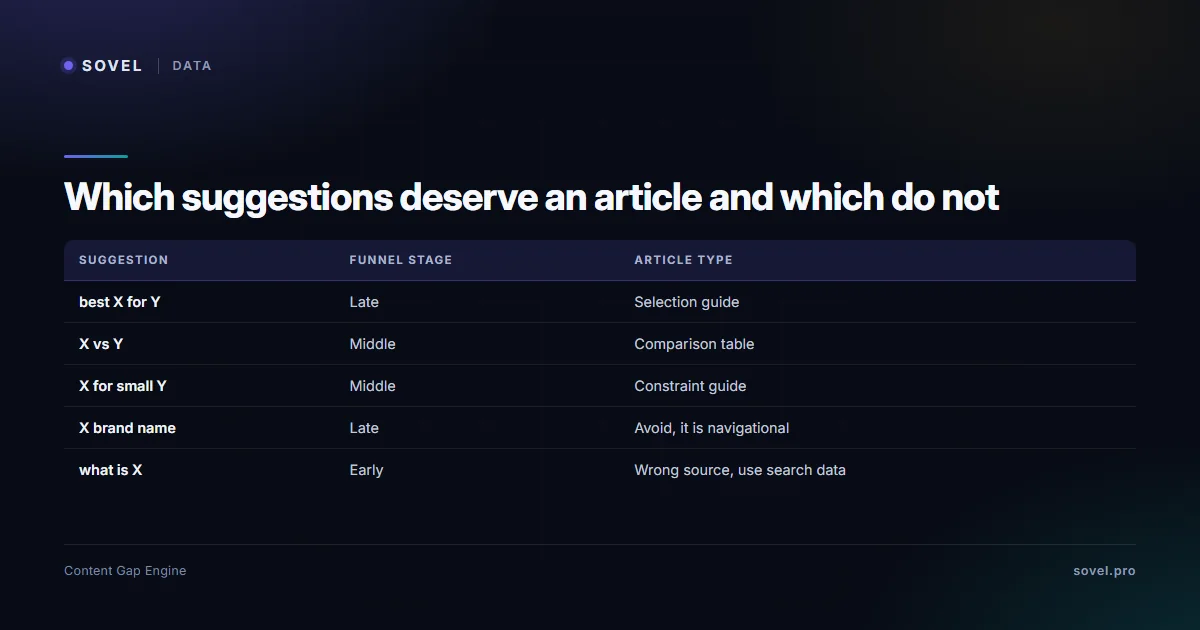
Amazon suggestions skew late in the funnel, which shapes what amazon autocomplete keyword research can produce. That is an advantage for comparison pages and a problem for everything else.
| Suggestion type | Funnel stage | Article it justifies | When to skip |
|---|---|---|---|
| best X for Y | Late | Selection guide | Never, this is the core |
| X vs Y | Middle | Comparison table | When one product is discontinued |
| X for small Y | Middle | Constraint guide | When the constraint is rare |
| X brand name | Late | Nothing, it is navigational | Always |
| what is X | Early | Nothing, wrong source | Always, use search data |
Two rules follow for anyone running amazon autocomplete keyword research. First, drop navigational suggestions immediately, because a brand name plus a model number is a person who already decided. Second, do not force an early-funnel article out of a late-funnel source. If you need definitional content, use Google or question research instead.
The middle of that table is where amazon autocomplete keyword research does its best work. A constraint guide aimed at “for small Y” has a defined audience, a defined problem and a defined purchase decision, and it is short enough to write well in a day.
Where the qualifiers become an outline
A qualifier becomes a section rather than a page unless it is large enough to carry one, and that decision is the second half of amazon autocomplete keyword research. Three tests decide.
Does the qualifier have its own sub-qualifiers? If “for travel” expands into “for travel with a laptop” and “for travel under 1 kg”, it is a page. If it expands into nothing, it is a section.
Does the qualifier conflict with another qualifier? “Cheap” and “professional grade” pull in opposite directions. A page that serves both serves neither, and the conflict is usually the most interesting article in the set.
Does the qualifier imply a decision the reader cannot make alone? Sizing and compatibility qualifiers imply a decision that needs criteria. Criteria produce tables, and tables produce the page.
Apply the three tests and a list of forty qualifiers collapses into six pages and a dozen sections, which is the realistic yield of one amazon autocomplete keyword research session. That is a normal ratio, and it is much healthier than forty thin product pages.
A worked example
Take one object: wireless earbuds. The plain seed returns the obvious qualifiers, which are the competitive ones. The preposition loop returns price ceilings and fit constraints. The comparison loop returns the two models buyers cannot separate. The problem loop returns failure language.
Now split object from qualifier and sort by family. Fit produces “for small ears” and “for running”. Budget produces “under 2000”. Use case produces “for calls” and “for travel”. Durability produces “waterproof”. Absence produces “without noise cancelling” and “no app needed”.
Six pages from one object, and the strongest is the absence phrase. A buyer filtering for “no app needed” has already been annoyed by a companion app requirement, and no brand writes that page.
That is the whole output of a fifteen-minute amazon autocomplete keyword research pass: six page titles, six reader states, and one objection nobody is answering.
When two qualifiers conflict
Some qualifiers cannot share a page. Cheap and professional grade pull against each other. Lightweight and long battery life pull against each other. Small and loud pull against each other.
The conflict is usually the article. A page that explains why you cannot have both, and what to trade, answers a question the buyer is already asking silently while reading two product pages.
Handle the conflict explicitly in the structure. Name both qualifiers in the heading, give each one a section, then add a short verdict that states the trade in one line. That format earns more trust than a list of ten products, because it admits the constraint the buyer has already discovered.
What Amazon autocomplete keyword research cannot tell you
The limits of amazon autocomplete keyword research are numeric. It cannot tell you search volume, keyword difficulty, or how many of those buyers read anything. It has no numbers.
It also cannot tell you whether the qualifier is growing or shrinking. A qualifier that appears today may be a seasonal spike, and the box does not date its suggestions. Capture monthly if a qualifier matters, and treat a single appearance as a hypothesis.
The third limit of amazon autocomplete keyword research is regional. Amazon runs separate storefronts, and the same object returns different qualifiers in different markets. The engine supports six regions, and the differences are large enough that a qualifier found in one market should be re-checked before it becomes a page for another.
The engine labels Amazon coverage as an engine-derived proxy rather than a difficulty score, which is the honest position. Amazon gives you no competition data, so any number derived from it is an inference, and inferences should be labelled as inferences.

Qualifiers that change with the season
Some qualifiers appear for eight weeks and disappear. Gift, back to school, festival, summer. They are real buyer language, and they are the wrong foundation for a page you plan to keep for three years.
The test is simple. Capture the same object in two different months and compare the qualifier lists. A qualifier that survives both captures is structural. A qualifier that appears in one and vanishes is seasonal, and it belongs in a dated section rather than in a page title.
Seasonal qualifiers are still useful. They tell you when to refresh a page, and they tell you which section to swap rather than which page to build. A gift section added in November and removed in January is a maintenance task, not a new URL.
Verifying a qualifier with a second source
One suggestion box is one sample. Before a qualifier becomes a page, confirm it somewhere else. A result page that shows the same phrasing, a forum thread with the same constraint, or a question box that asks the same thing.
Two independent sources turn a qualifier from a guess into a decision. One source is a lead. The difference matters most for absence qualifiers, because a phrase like “without an app” can look like a niche when it is really one frustrated buyer writing three posts.
Write the second source next to the qualifier in your sheet. Six months later that column is the reason you trust the page, and it is the reason a colleague can pick up the file without asking you what any of it meant at all.
Where buyer qualifiers help in AI answers
The same qualifiers that shape a product page also shape whether an AI answer engine cites a comparison. Generative engine optimization rewards pages that name the options, state the constraint and give a verdict, because that structure is easy to lift and attribute.
A page that says the lightest option in this range is X and it costs Y is citable. A page that says there are many good options is not. The qualifier work in this method produces the specific, checkable statements that answer engines prefer, which is why a buyer-language pass belongs before the writing rather than after it.
There is a second benefit. Naming the constraint gives the page an entity to be associated with. A page about fit problems for small ears is easier to place than a page about earbuds in general, and placement is what citation depends on.
Recording the output
Keep one sheet per object with four columns: phrase, object, qualifier family, and the page or section it feeds. Add the market and the capture date.
That sheet is the difference between a research session and a pile of notes. It also lets you spot a segment forming. When the same qualifier family appears under four unrelated objects, you have found a cluster rather than a page, and a cluster is worth a content series.
Where the engine fits
Manual amazon autocomplete keyword research covers one object in about five minutes. The engine queries Amazon autocomplete and Amazon search alongside Google, Bing, DuckDuckGo, YouTube and Quora, then merges the phrases and scores them.
In a live run on 7 November 2026, both Amazon sources returned data while Google Trends was rate limited and Reddit was blocked. The run produced 52 scored keywords and 54 gap records. The Amazon phrases arrived labelled as Amazon signals rather than being mixed silently into the keyword list, which matters when you are deciding whether a phrase is a buyer phrase or a reader phrase.
Two outputs help specifically here.
- Separate signal weighting. Amazon presence contributes to the score as its own component, so a phrase confirmed by Amazon and Google scores differently from a phrase confirmed by Google alone.
- Coverage verdicts. Each qualifier is checked against your sitemap and returned as NEW, REFRESH, EXPAND, MERGE, REDIRECT or DO NOT CREATE, which stops a new buying guide from competing with an existing one.
The full source list and the scoring detail sit on the Content Gap Finding Engine page, and the conversational layer is described at SOVEL Gap Brain.
Amazon’s own seller documentation at sell.amazon.com explains how the catalogue and search work, and the Sponsored Products overview shows how sellers bid on the same phrases. Both are worth reading once, because they explain why certain qualifiers dominate the suggestion box.
Using this without drifting into seller content
The easiest way to ruin amazon autocomplete keyword research is to drift into seller content. Seller content is a different audience with different vocabulary, and mixing the two produces pages that serve neither.
Three guardrails keep you on the reader side.
- Write about the decision, not the listing. A page that helps someone choose between two constraints is reader content. A page that explains how to optimise a listing is seller content.
- Keep the qualifier in the heading. If the heading could sit on a product page, it is too generic. The qualifier is what makes it an article.
- Never invent product claims. You do not have testing data, so do not imply you do. Describe the criteria, explain the trade-off, and let the reader apply it to their shortlist.
The pairing that works is this source plus zero search volume validation, because qualifiers often have no volume reported and still carry real buyer demand. For the upstream phrasing layer, the Google autocomplete guide covers lookup demand and the YouTube autocomplete guide covers task demand.
FAQ
Is Amazon autocomplete keyword research useful for article writers?
Yes, for a specific page type. It produces constraint guides and comparison pages for people choosing between options. It does not produce definitional content, because the people typing into Amazon have already chosen a category.
How is it different from Amazon seller keyword research?
Seller research aims at ranking a listing inside Amazon. Amazon autocomplete keyword research aims at writing a page that helps a buyer decide before they reach a listing. The phrases overlap and the intent does not.
Can Amazon autocomplete keyword research give me search volume?
No. Amazon returns suggestions without any volume or competition data. Any number attached to an Amazon phrase is an inference, and it should be labelled as one.
Why do the suggestions change between Amazon marketplaces?
Each storefront has its own catalogue, language and buying habits, so the same object returns different qualifiers. Re-check a qualifier in the target market before you build a page for it.
Should I write a page for every qualifier?
No. Apply three tests first: does the qualifier have sub-qualifiers, does it conflict with another qualifier, and does it imply a decision that needs criteria. Most qualifiers become sections rather than pages.
Which qualifier family produces the strongest angle?
The absence family, meaning phrases built around without, no and free from. Those phrases carry a rejected feature and a past bad experience, which is an objection with a purchase attached.
Where does Amazon autocomplete keyword research sit in the cluster?
It supplies buyer constraints. Google supplies lookup phrasing and YouTube supplies task phrasing. Running all three on one topic gives you the reader, the task and the purchase in one brief.