
Ask a developer what their coding agent remembers from yesterday and watch the pause. The honest answer, for most setups, is nothing. Every session starts from zero, re-reads the codebase, re-derives the decisions, and re-makes at least one mistake the previous session already made. Persistent memory for AI coding agents is the fix for that amnesia, and in 2026 it has become the difference between an agent that assists and an agent that actually carries work forward. The teams that have solved it treat memory as infrastructure, with the same seriousness they give to version control, and their agents arrive each morning already knowing the project.
The idea is simple to state and easy to get wrong. Persistent memory is a storage layer that survives session ends, machine restarts and context resets, and hands the right facts back to the agent when a new session begins. The hard parts are architectural: where the memory lives, what gets written into it, how it gets summarized back into a limited context window, and who can read it. Each of those choices has a failure mode, and most teams discover them by hitting them. This guide exists so you can choose deliberately instead of by accident. The topic is not one product or one trick; it is a small set of architecture patterns, and picking the right one for your workflow is most of the outcome.
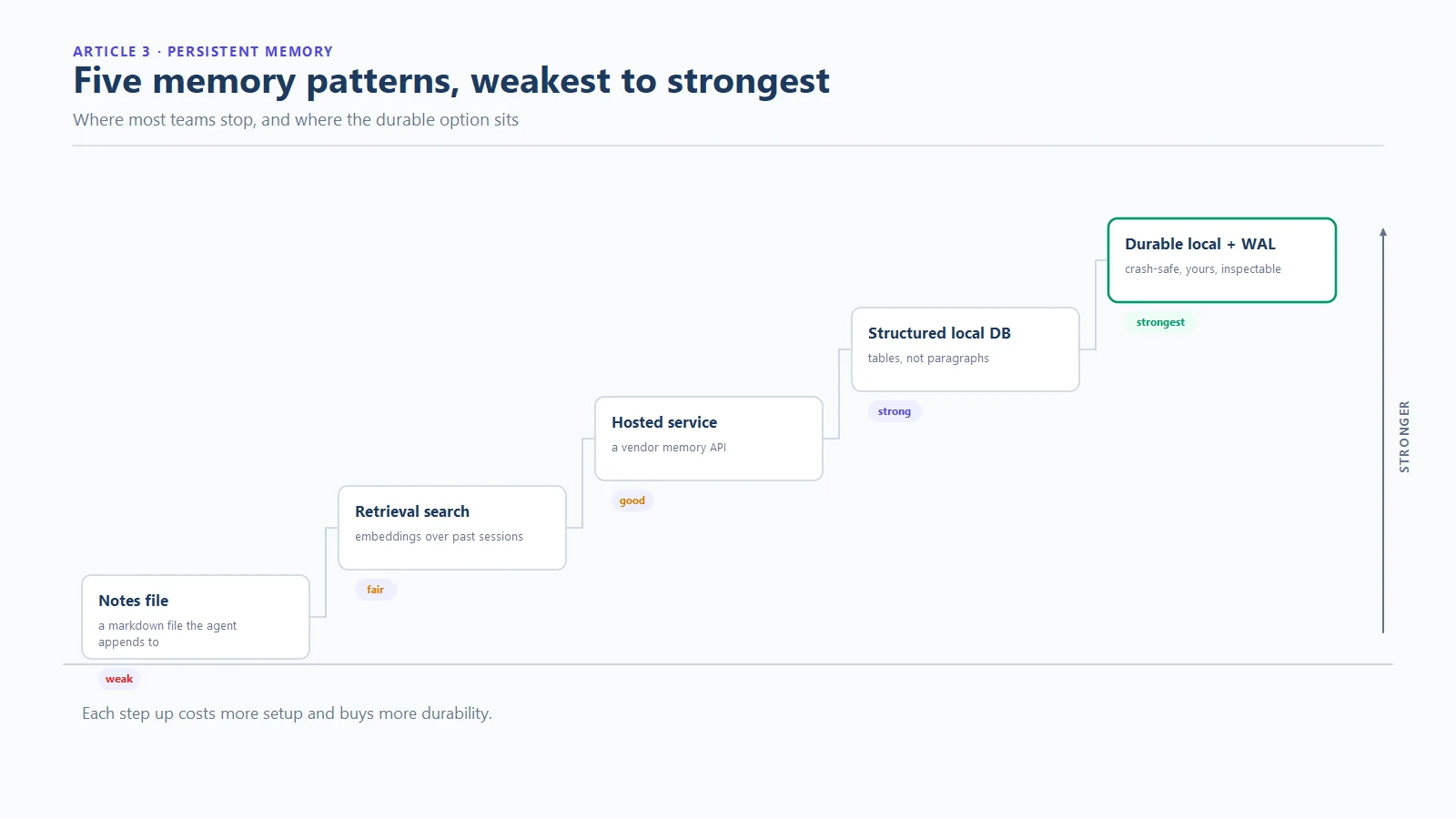
This article walks through five architecture patterns for persistent memory for AI coding agents, from a plain notes file to a local database with write-ahead logging. It compares self-hosted and hosted approaches on the dimensions that matter, explains why SQLite keeps winning the storage argument for local agent work, and shows what cross-session continuity looks like when the whole stack is wired correctly.
Why sessions alone keep failing
The default agent session is a bucket with a hole in it. Everything the agent learns during the session, the architecture decision you argued about, the test that fails for a known reason, the fact that the legacy parser owns three routes, lives in the conversation transcript. When the session ends, the transcript goes cold. Some tools let you resume it, but a resumed transcript is not memory; it is a very long letter the agent has to re-read in full, paying for every token of it.
The costs of that hole compound in three ways. Rework: the agent re-derives facts it already derived, and billed you for deriving. Contradiction: without a record of decisions, the agent happily makes a different choice on Tuesday than it made on Monday, and you discover the conflict in review. Fragility: a single context reset, the moment when the window overflows and older material gets trimmed, wipes understanding that took an hour to build. Anyone who has watched an agent re-explore a codebase after a reset has seen all three in one afternoon. Persistent memory for AI coding agents attacks all three at once, because the memory layer sits outside the session bucket entirely.
Pattern 1: the notes file
The first pattern is the one every team tries first: keep a markdown file in the repo, tell the agent to read it at session start and update it at session end. It works, which is why it survives everywhere. It has no dependencies, it diffs in version control, and a human can read it in seconds.
Its limits are structural. The file grows without bound, so the agent pays more every session to read it, which is the quiet way persistent memory for AI coding agents degrades when it has no schema. Updates depend on discipline: the one session where the agent forgets to write is the session that mattered. And there is no structure, so retrieving “what did we decide about auth” means the agent scanning prose with its attention, hoping it finds the right paragraph. As a first step toward persistent memory for AI coding agents, the notes file is genuinely good. As a memory architecture, it is a prototype that never graduated.
Pattern 2: retrieval search over transcripts
The second pattern keeps the full history and adds search on top: embed the transcript, index it, and let the agent retrieve relevant past exchanges when a task looks familiar. Retrieval here means finding stored text by meaning rather than exact words, usually with embeddings, which are numeric representations of text that let a machine judge similarity. This pattern preserves everything, which is its selling point and its problem. As an approach to persistent memory for AI coding agents, it trades simplicity for recall, and the trade gets worse as the project gets older.
The problems show up at scale. Embeddings and a vector index add moving parts: an embedding model, a vector database, a pipeline that keeps the index current. Retrieval quality is hit and miss for exactly the material that matters most, because a decision explained in passing on Tuesday does not look similar to Wednesday’s question about it. And the full transcript stays in the system, including the dead ends and the secrets someone pasted once. Search over everything is not the same as knowing what matters, and that gap is the recurring complaint about this flavour of persistent memory for AI coding agents.
Pattern 3: hosted memory services
The third pattern outsources the layer: connect a hosted memory API, and the service stores, organizes and serves the agent’s facts from its own cloud. Setup is fast, the retrieval quality is often good, and for hosted applications, chat products with many users, this is a reasonable choice.
For coding agents on private code, three costs deserve a hard look. The project context, your architecture, your client names, your unfinished ideas, now lives on someone else’s servers, governed by their retention policy. The bill is monthly and metered, so the memory layer becomes a subscription that grows with usage. And the workflow depends on the service’s continued existence at its current price, which is a dependency no engineering team chooses lightly. Persistent memory for AI coding agents that you cannot inspect or export is a lease, not an asset. Hosted memory solves a real problem; it just solves it on someone else’s terms. For a coding agent on private work, that trade rarely makes sense, and it is worth knowing why before a sales call makes it for you.
Pattern 4: structured memory with local database
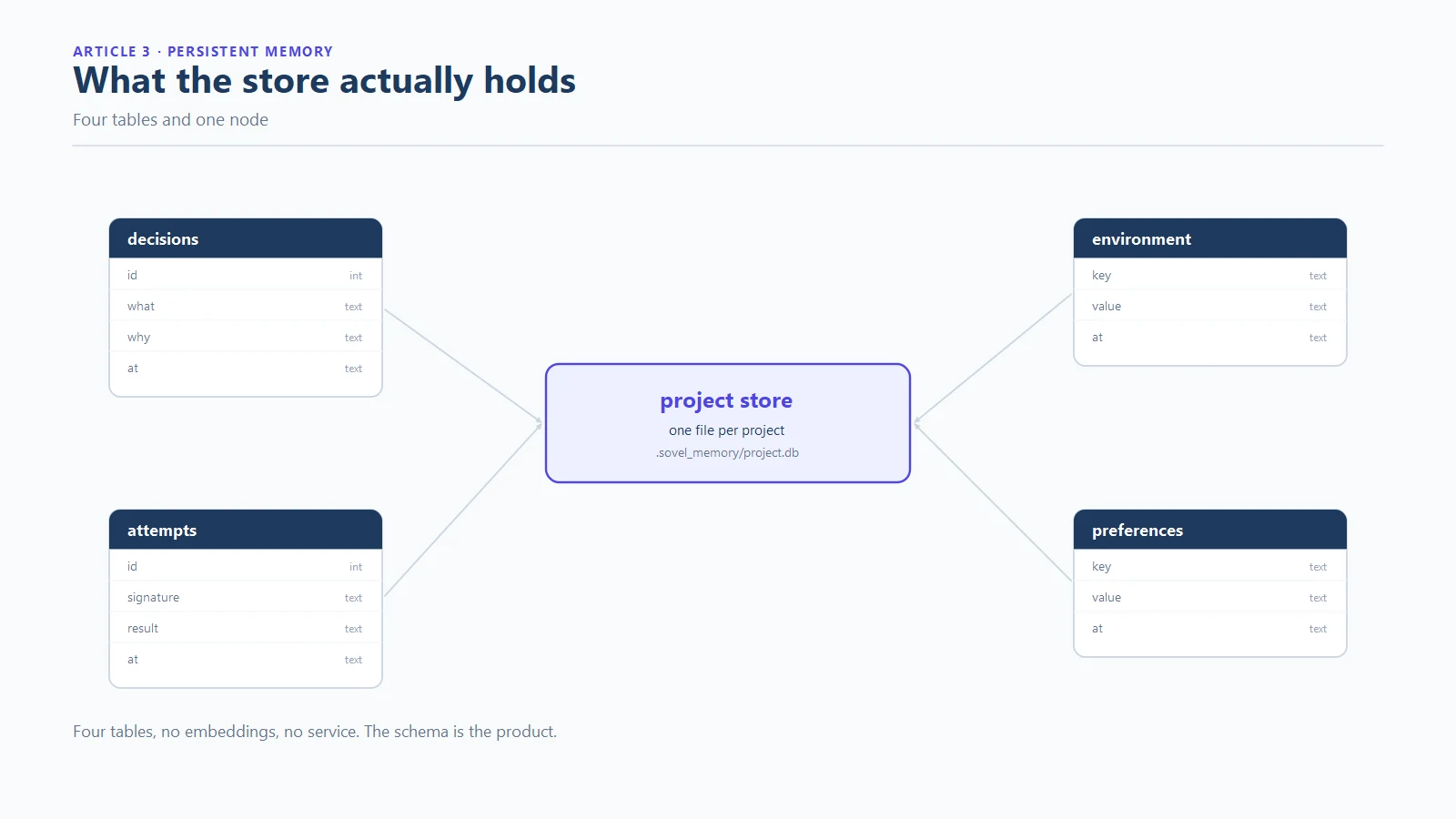
The fourth pattern is where the trade-offs start favouring the builder: keep memory local, but give it structure. Instead of prose in a file or blobs in a cloud, memory lives in a schema, which is a fixed layout defining what kinds of records exist and how they relate. Decisions, failed attempts, environment facts and preferences each get their own table, with timestamps and status fields.
Structure changes what the memory layer can do, and it is the property that separates serious persistent memory for AI coding agents from elaborate note-taking. Query beats scan. The agent can query “what did we decide about auth” instead of scanning prose. Stale facts can be detected and refreshed instead of silently misleading. And the write path can be automatic, because a schema makes it clear what a new fact should look like. The storage engine underneath matters less than the discipline of the schema, but the next section argues it matters more than people expect.
Pattern 5: durable local memory with write-ahead logging
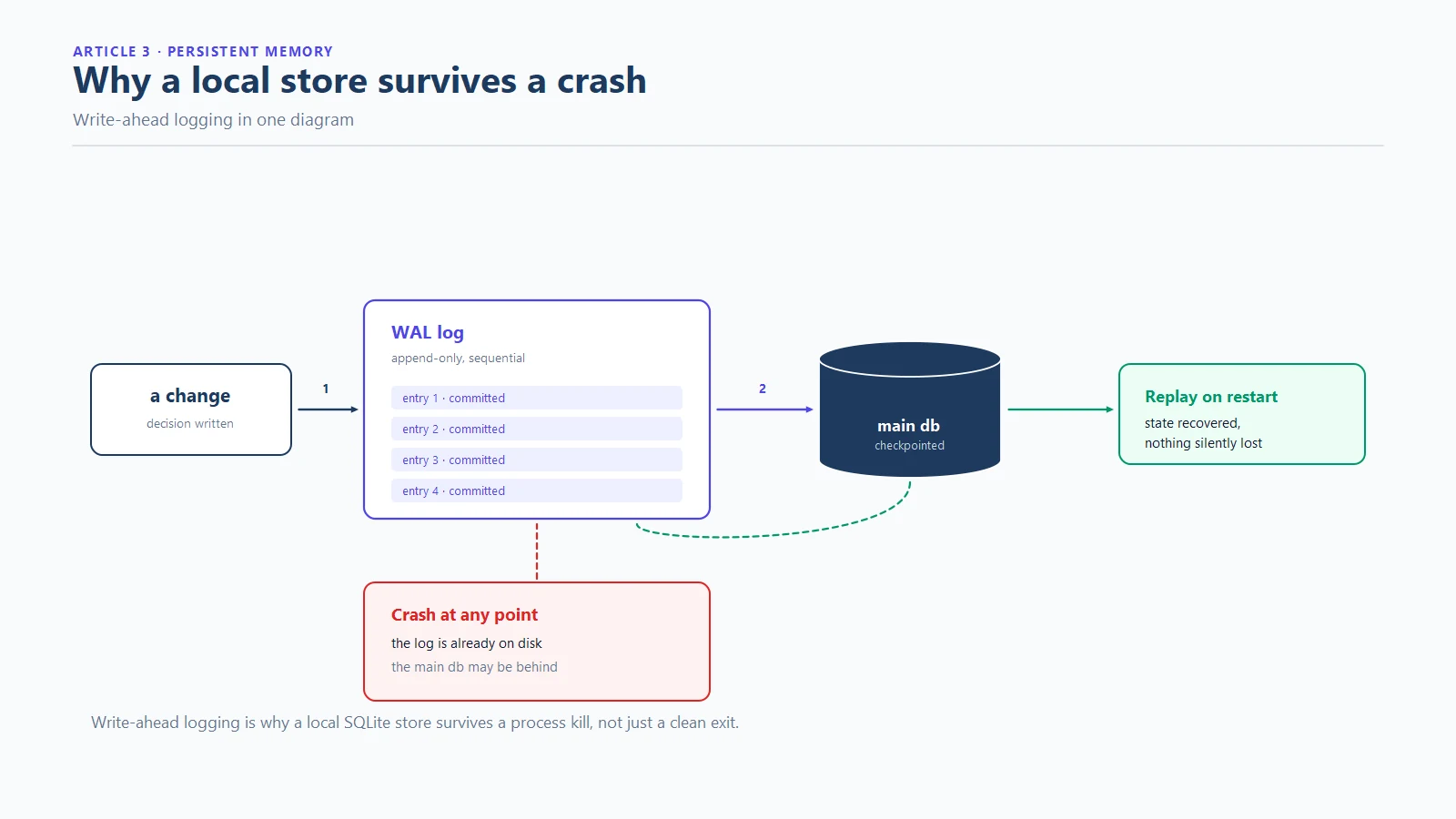
The fifth pattern takes the structured approach and hardens it for real-world interruptions. Persistent memory for AI coding agents has to survive the messy endings: the laptop that died mid-write, the agent killed mid-commit, the power cut during a long run. A 2026 research paper on this exact problem, Memory as Infrastructure (arXiv 2609.05510), makes the case that persistent agent memory deserves reliability engineering of its own, measured in months-long development runs rather than single sessions. The durability layer it argues for is what this pattern implements. Write-ahead logging, usually shortened to WAL, is the storage technique that makes that survivable: every change is first appended to a log on disk, and only then applied to the main database file. If the process dies between the two steps, the log replays on restart and the database lands in a consistent state.
SQLite implements WAL in its core, which is why it keeps winning this argument. It is a single file, it opens with standard tools, it needs no server, and its durability story is measured in decades of production use. For persistent memory for AI coding agents, the stack becomes almost boring: one schema, one file, one bridge that summarizes the state into a few hundred tokens at turn start. Boring, in infrastructure, is the compliment that matters. The engine that ships this pattern as a product is covered at the end of this article.
The five patterns compared
| Pattern | Survives restarts | Structure | Main weakness |
|---|---|---|---|
| Notes file | Yes, if written | None | Grows unbounded, discipline-dependent |
| Retrieval over transcripts | Yes | Index only | Pipeline complexity, retrieval misses |
| Hosted memory service | Yes | Vendor’s schema | Privacy, subscription, dependency |
| Structured local database | Yes | Full schema | Needs durability engineering |
| Durable local memory with WAL | Yes, crash-safe | Full schema | Requires the engine that maintains it |

Self-hosted versus hosted: the honest comparison
The pattern choice is really a values choice, and it is worth making explicitly. Here is the comparison on the five dimensions that decide it:
| Self-hosted memory | Hosted memory service | |
|---|---|---|
| Where context lives | Your disk | Vendor’s cloud |
| Cost shape | One-time tool or free library | Monthly, usage-metered |
| Works offline | Yes | No |
| Dependency risk | Your own backups | Vendor pricing and uptime |
| Best fit | Private code, client work, long-running projects | Hosted apps with many end users |
Neither column is cheating. A hosted application with thousands of users has no realistic local option, and a hosted memory service is the right call there. A developer or agency working on client code has every reason to prefer the local column, because the memory layer holds exactly the material that confidentiality agreements are written about.
Cross-session continuity: what good memory feels like
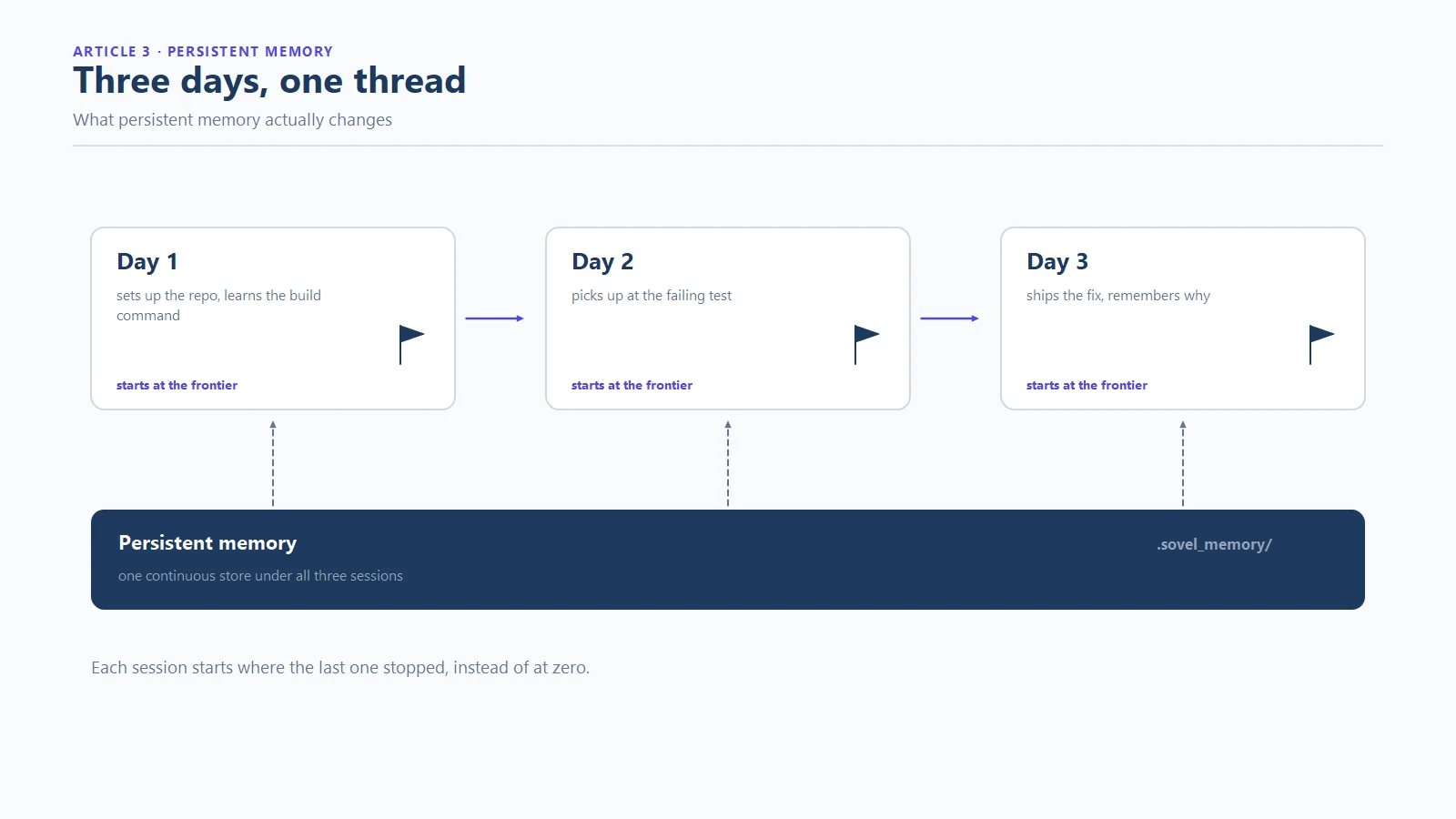
The test of persistent memory for AI coding agents is not the storage diagram; it is the second session. Everything before this point is architecture, and architecture only earns its keep at 9 am on a Thursday. Here is what continuity looks like when the stack works. You open the project on Thursday. Before you type anything, the agent already knows: the migration half-finished on Tuesday, the test that was red and the reason, the decision to keep the old parser, the fact that the client wants plain-language commit messages. The session starts at the frontier of the work instead of at zero.
That continuity is the everyday payoff of persistent memory for AI coding agents, and it is delivered by a summary, not a transcript. At the end of each turn, the engine writes what changed into the database. At the start of the next turn, it compresses the relevant state into roughly 200 tokens and injects them ahead of your prompt. The agent reads a handover note, not a diary. This is the design difference between memory that persists and memory that buries: the cabinet is only useful if the folder that comes out is short.

What this looks like as a working system
Patterns are easier to judge with a concrete implementation on the table. SOVEL Net-Routed Agentic OS implements the fifth pattern end to end, and it is the reference implementation for everything this article describes about persistent memory for AI coding agents. Its sovel-brain command-line tool creates a .sovel_memory/ folder per project, backed by SQLite with write-ahead logging, and exposes the memory layer to Claude Desktop, Cursor, Cline or any Model Context Protocol client over stdio. The record of what ran, including guarded commands and their outcomes, lands in the same store, which is what lets the engine connect memory to loop protection: the system knows what was tried because it wrote it down. That connection is the practical payoff of persistent memory for AI coding agents done as one system rather than as bolted-together scripts.
The write path is automatic, which is the part most DIY setups miss. A notes file pattern relies on the agent remembering to journal; a schema-backed engine records events as they happen, then summarizes on demand. You can inspect the whole memory layer with any SQLite browser, which is a quiet but real advantage: your agent’s brain is a file you can open, query, back up or delete. Ownership is the whole point of persistent memory for AI coding agents on private work, and this design takes it literally.
One boundary belongs in every memory design, and it deserves its own article: what should never be written into agent memory at all. Credentials, client-confidential material and secrets have a way of surviving in stores long after the session that mentioned them. We cover that in the AI memory security piece later in this series.
Frequently asked questions
What is persistent memory for AI coding agents?
It is a storage layer that keeps project knowledge across sessions: decisions, failed attempts, environment facts and preferences. Persistent memory for AI coding agents differs from a saved transcript in that it is structured, summarized and selective rather than a full replay of everything said. At the start of each session, a dense summary of that store is injected into the agent’s context, so the session begins at the frontier of the work instead of from zero. Persistent memory for AI coding agents is what turns a stateless assistant into a collaborator that accumulates project understanding.
Why is SQLite a good choice for agent memory?
Three reasons: it is a single file with no server to run, it implements write-ahead logging so writes survive crashes, and it is an open format that standard tools can read. For local-first agent work, that combination is hard to beat, and it keeps the memory layer inspectable by humans.
Do I need a vector database for agent memory?
Not necessarily. Vector retrieval shines when you need to find similar text among millions of records. For persistent memory for AI coding agents, the store is small and structured, so direct queries against a schema usually beat embedding pipelines on both accuracy and cost. Project memory is small, structured and queryable, so a schema-backed database with dense summaries usually retrieves the right facts faster and cheaper than embedding everything you ever did.
How is persistent memory different from the context window?
The context window is what the model can attend to during the current request, and it is cleared or trimmed as the session moves. Memory persists across sessions and feeds a compact summary back in. The context versus memory distinction article covers this in depth, including why bigger windows do not fix forgetting.
Can hosted memory services see my code?
They see whatever the agent writes to them, which in coding workflows routinely includes file paths, architecture descriptions and code fragments. If that material is confidential, local storage is the safer default: the memory never leaves your disk, and there is no vendor retention policy to trust.
How much context does a memory summary cost per turn?
A well-built summary runs about 200 tokens, which is a rounding error against the tens of thousands of tokens a full transcript re-read would cost. Density is the feature: the summary earns its place by being short enough to always include and dense enough to be worth reading.
Memory that outlives the session
The five patterns in this article are really one ladder: from prose nobody maintains, to search over everything, to renting a memory layer, to owning one. Persistent memory for AI coding agents stops being a luxury once you have watched a project accumulate two weeks of decisions, because the alternative is an agent that re-learns your project every morning and bills you for the lesson. Own the cabinet, keep it on your disk, and make the summary short. That is the whole discipline of persistent memory for AI coding agents, stated in three lines you can put above a desk. If you want the engine that implements the whole stack in one install, the SOVEL Net-Routed Agentic OS product page lists what each edition includes. The next article in the series covers the plumbing that connects it all: MCP memory servers and the token tax they can quietly impose.