
Every serious agent failure is a story about a loop that nobody was supervising. The doom loop article covered the problem from the user’s chair; this one covers it from the system designer’s chair. Agent loop middleware is the layer that sits between the raw agent loop and your machine, adding the supervision that the loop itself lacks: injected guidance at the right moments, watchdogs that notice stalls, heartbeats that prove liveness, and queues that decide what runs first when everything wants to run at once.
The ideas are not new. Networking solved them decades ago, which is why this article keeps borrowing its vocabulary from protocols: watchdogs from embedded systems, congestion control from TCP, priority queuing from QoS, label switching from MPLS. What is new is the application: the same supervision patterns that keep packets flowing now keep agent turns flowing. Agent loop middleware is old networking wisdom wearing new clothes, and the fit turns out to be exact.
This is the deepest technical piece in the series, and it assumes you have read the mechanics explainer or know what an agent loop is. Five safety nets follow, each with its job, its failure mode when absent, and what implementing it actually involves.

What agent loop middleware is
Direct answer: agent loop middleware is a software layer that intercepts and supervises the cycle of an AI agent, between the harness and the tools, providing functions the loop lacks natively: message injection at turn boundaries, failure-pattern interception, stall detection, rate control, priority queuing and audit recording. It is to agent runs what a network’s control plane is to its data plane: the part that watches, steers and protects the traffic that does the work.
The position in the stack matters. Middleware that sits inside the model’s prompt is advisory, because the model can ignore it. Middleware that sits between the harness and the tools is structural, because every tool call passes through it whether the model likes it or not. That structural position is what distinguishes agent loop middleware from yet another system prompt paragraph: one is a suggestion, the other is a checkpoint.
Safety net 1: message injection at the right moments
The first net is the quietest. At defined points in the loop, turn start, after a failure, before a destructive action, the middleware injects a message into the assembly: current state, the failure count so far, the rules in force. The model experiences these as context, but they arrive from the operator side, not from the user, and they carry authority the user’s chat text does not.
Injection is how agent loop middleware communicates policy without rewriting prompts, and it is the net that makes the other four smarter, because every interception arrives with context attached. The failure count after two strikes, the reminder that a fallback path exists, the notice that a budget threshold is near: each is a small, well-timed message that changes behaviour at the moment behaviour is being chosen. Without injection, the model argues with its own context; with it, the loop has a voice of authority that arrives exactly when decisions are made.
Safety net 2: the loop breaker, interception on two strikes
The second net is the one with the clearest return. Repetition detection compares each tool call against recent ones, catching both exact repeats and jittered variants, and on the second strike the loop breaker interrupts the cycle. The design question is never whether to intercept but when: one failure is noise, two is a pattern, and every additional strike is budget spent confirming what was already known.
Interception without an alternative just relocates the failure, so the breaker fires together with a prepared fallback path. The agent is not told to try harder; it is handed the next move. That pairing, intercept plus redirect, is what makes the interruption productive rather than punitive, and it is the difference between agent loop middleware that saves runs and middleware that merely cancels them.

Safety net 3: the watchdog and the heartbeat
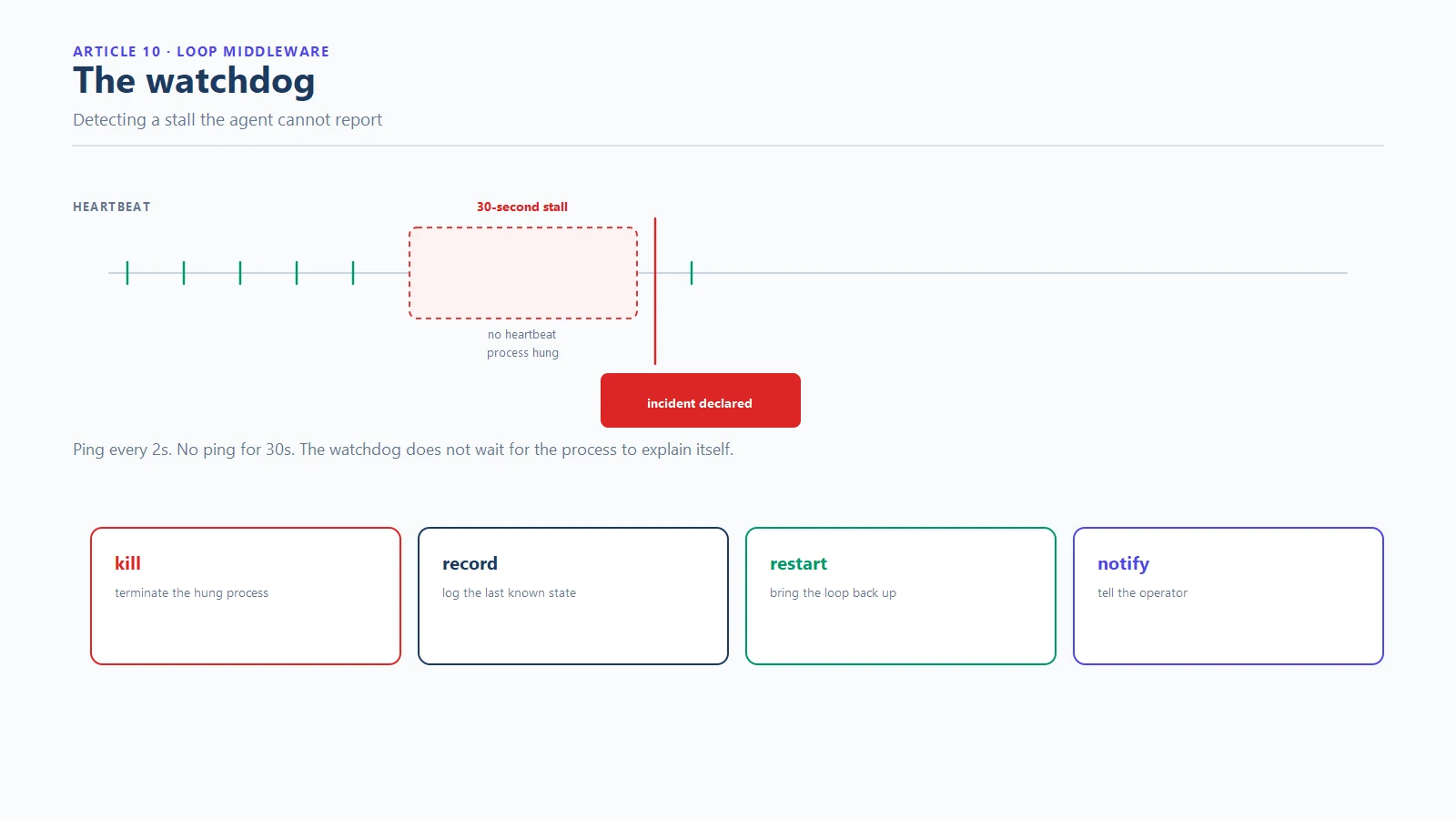
The third net covers the failure mode that produces no error at all: the hang. A tool call that never returns generates no exception, no exit code, nothing for a naive loop to react to, which is why hangs are discovered by humans staring at progress bars. Embedded systems solved this with a watchdog, a timer that must be periodically reset by the supervised process, and that resets only while the process is demonstrably alive.
The agent version pairs a watchdog with a heartbeat. The middleware pings the running process on a short interval, two seconds in the reference implementation, and a hard stall timer, thirty seconds, decides when silence stops being patience and becomes an incident. It is the quietest net in agent loop middleware and the one whose absence is most expensive. When the stall timer fires, the process is recorded as hung, the loop is interrupted, and the fallback machinery takes over. Liveness checking is the least glamorous net in the stack and the one people miss most, because everything else in agent loop middleware assumes the loop is actually turning.
Safety net 4: rate control that backs off like TCP
The fourth net governs the loop’s speed against the outside world. When an external API starts answering with HTTP 429, the correct response is to slow down, not to push harder. TCP congestion control, the algorithm that has kept the internet usable since the 1980s and is specified in RFC 5681, gives the pattern: on congestion, halve the sending rate; on success, ease it back up. The AIMD name, additive increase, multiplicative decrease, describes the two motions.
Applied to agent tool calls, the middleware tracks concurrency and response health, cuts concurrency in half on repeated rate-limit responses, and recovers gradually as the API recovers. The alternative, a fixed retry delay, is either too timid to matter or too aggressive to help, because it cannot tell the difference between a momentary hiccup and a sustained limit. Adaptive backoff is what turns rate limits from a session-ending event into a brief, self-healing slowdown, and it is one of the clearest cases where networking’s answer transfers to agents unchanged. It is also the net that pays for agent loop middleware by itself in API-heavy stacks.
Safety net 5: priority queuing, QoS for agent turns
The fifth net handles contention: the moment when background work and foreground work want the same resources. Quality of service, the networking discipline of prioritising traffic classes, translates directly. Your interactive request, the one you are watching, queues ahead of background indexing, report generation and cleanup jobs, the way emergency vehicles queue ahead of deliveries.
Without QoS, agent loop middleware has no answer to the Tuesday problem: the long-running background job that makes every interactive request sluggish, and the user who responds by killing the whole stack. With it, the middleware enforces a policy instead of a mood: interactive first, background when idle, starvation prevented by ageing rules so background work still completes. The result feels less like a faster system and more like a fair one, which is what users actually mean when they ask for performance.


The nets at a glance
| Net | Borrowed from | Failure it prevents |
|---|---|---|
| Message injection | Control-plane signalling | Model arguing with stale context |
| Loop breaker | Circuit breakers | Doom loops burning budget |
| Watchdog and heartbeat | Embedded systems | Undetected hangs |
| Adaptive rate control | TCP AIMD | Retry storms against rate limits |
| Priority queuing | Network QoS | Background work strangling interactive work |
One disclosure belongs next to every version of this table: the names are borrowed, the behaviours are agent-sized. This is networking-inspired engineering, not certified protocol implementation, and the engine that ships it says so plainly in its own documentation.
How the five nets work together
Individually, each net catches one failure class. Together, they change the character of a run, and composition is the real test of agent loop middleware, because a layer is only as good as its handoffs. A single scenario shows them. An agent runs an overnight migration. At turn forty, an external API starts rate-limiting; adaptive rate control halves concurrency, and the run slows instead of failing. At turn sixty, a tool call hangs; the heartbeat misses, the thirty-second stall timer fires, and the watchdog records the hang. The loop breaker had already counted one failed attempt at this step; the hung call becomes strike two, so the breaker fires and the fallback path activates. Injection delivers a state summary with the redirect, the migration resumes on the alternative route, and the morning report shows all of it.
Notice what the human did in that story: nothing. Each net covered the failure class it was designed for, and the handoffs between them are what turn five separate mechanisms into one supervision layer. That composition is the actual product of agent loop middleware: not five features, but a control plane that behaves coherently when the night goes badly.

Building versus buying the middleware layer
The five nets are buildable, and small teams do build crude versions of agent loop middleware: a retry counter here, a timeout there. The honest engineering question is not feasibility but maintenance, because each net needs tuning, the tunings interact, and the interactions are where the subtle bugs live. A loop breaker that fires too eagerly fights the rate controller; a heartbeat that is too patient defeats the stall timer; a QoS policy that starves background work creates a different 3 am incident. Supervision layers have their own failure modes, and supervising the supervisor is real work.
This is the buy case for agent loop middleware: the nets are commodity ideas with non-commodity tuning. SOVEL Net-Routed Agentic OS ships the full stack, two-strike interception, heartbeat and stall detection, AIMD-style rate control, priority queuing and state injection, as one local install with the tuning already done across its test matrix, and everything it observes lands in the audit trail the export suite produces. Building the nets yourself remains a legitimate choice when your constraints are unusual; choosing it should be a decision, not a default.
Frequently asked questions
What is agent loop middleware?
It is a supervision layer between the agent harness and the tools that adds what the raw loop lacks: message injection, loop breaking on repeated failures, watchdog and heartbeat liveness checks, adaptive rate control and priority queuing. It is the control plane for agent runs, watching and steering the traffic that does the work.
How is agent loop middleware different from a better system prompt?
Position and enforcement. A prompt lives inside the model’s context and is advisory; middleware sits between the harness and the tools, so every call passes through it structurally. One is a suggestion the model may ignore, the other is a checkpoint that cannot be bypassed.
Why does middleware borrow names from networking protocols?
Because the problems match. Rate limits, congestion, stalls, priority contention and boundary routing are networking problems that networking already solved, and the solutions transfer to agent loops with minimal translation. The names are a map of the borrowed ideas, and the engines using them disclose plainly that these are heuristics, not certified protocol implementations.
What is a watchdog in agent middleware?
It is a timer that must be periodically reset by the supervised process, proving the process is alive. Paired with a heartbeat ping and a hard stall timer, it catches hangs, the failure class that produces no error and would otherwise be discovered by a human staring at a progress bar.
Do I need all five safety nets?
Start with the two that match your worst incidents, usually the loop breaker and the watchdog, then add the rest. The nets compose, and the composition is where the value compounds, but a crude version of one net beats a perfect design of five that never ships.
Can agent loop middleware slow my agents down?
It adds milliseconds of interception per call, which is noise against model latency. What it does slow down is failure: loops end sooner, hangs are caught, rate limits are respected. Users experience middleware as faster because the disasters it prevents were the slowest thing in the old runs.
Supervision is the product
The raw agent loop is an engine without a governor, and every team eventually meets the night it needed one. Agent loop middleware is the governor: five safety nets, borrowed from disciplines that solved these problems decades ago, composed into a layer that watches every turn and answers for every failure. Build it if your constraints demand it; otherwise, let the engine that already tuned it do the watching. The full stack is documented on the SOVEL Net-Routed Agentic OS product page, the user-side view of these failures is in the doom loop article, and the governance discipline that sits above this layer is the loop engineering guide.