
An ai coding project audit reviews an AI-built project against evidence, then grades every gap by harm. Eight steps take a messy build to a written verdict with a fix plan. I run this audit before any release that carries my name.
AI builds accumulate invisible debt fast. Features half-work, files multiply, and claims outrun tests. An ai coding project audit restores the truth in one structured pass: what exists, what works, what is missing, and what deserves fixing first. Here are the eight steps I use, with the reports I keep.
Summary
An ai coding project audit is an eight-step review that grades an AI-built project against its own evidence. Each step writes down one fact: what was promised, what exists, what works, and what belongs on the fix list. The output is a report anyone can argue with line by line, and a re-audit that confirms the fixes held.
Why audits catch what testing misses
A testing pass and an ai coding project audit ask different questions: testing checks whether specific behavior works, while auditing checks whether you tested the right behavior, at the right depth, against the right claims. That difference is why a project can pass tests and still fail an audit.
The gap between claim and evidence is where AI projects hide their risk. A task note says “parser hardened” while the tests cover only happy input. An audit names that gap, ranks it, and blocks the release until it closes or is written down as a limitation.
My audits take two hours on a typical small project. The output is one report anyone on the team can argue with, because every line points at a file, a log, or a date.

Ai coding project audit steps 1 to 3: scope, inventory, dependencies
Step 1: scope check. Read the original outcome and the locked plan. List what was promised, then list what exists. The two lists always differ somewhere, and the difference is the audit’s first page.
Step 2: file inventory. Every file gets one line: purpose, owner, test status. Orphans surface here, files the model created that no task requested. Delete or adopt, but do not leave them nameless.
Step 3: dependency review. Versions pinned, licenses noted, actual usage confirmed. A declared dependency that nothing imports is clutter; an undeclared one is risk. Both show up in this step.
These three steps are read-only by design. No fixes yet, only facts. Fixing during discovery mixes the two mental modes and slows the whole ai coding project audit for no gain.
Ai coding project audit steps 4 to 6: data flow, tests, evidence quality
Step 4: data and dependency flow. Where does input enter, where does it get stored, where does it leave. Trace the paths in the actual code, not the diagram someone drew last month. Every storage location gets a note on what lives there and for how long.
Step 5: test review. Not a rerun, a review. Do the tests assert the promised behavior, cover the edges, and fail for the right reasons. A test that passes no matter what is worse than no test, because it funds false confidence.
Step 6: evidence quality. Grade each claim as verified, reported, or absent. Verified means you can point at a log or artifact. Reported means a doc or teammate says so, unconfirmed today. Absent means nobody knows. My own release notes carry that verified versus reported labeling, and it has prevented at least one embarrassing claim about live behavior (sources: SOVEL engine docs, read 18 Oct 2026).
the release verification checks
Ai coding project audit steps 7 to 8: severity, fix plan, re-audit
Step 7: severity grading. Three buckets, crash and data-loss issues first, contract and behavior breaks second, polish and docs third. Grade by harm to a real user, not by how loud the console was.
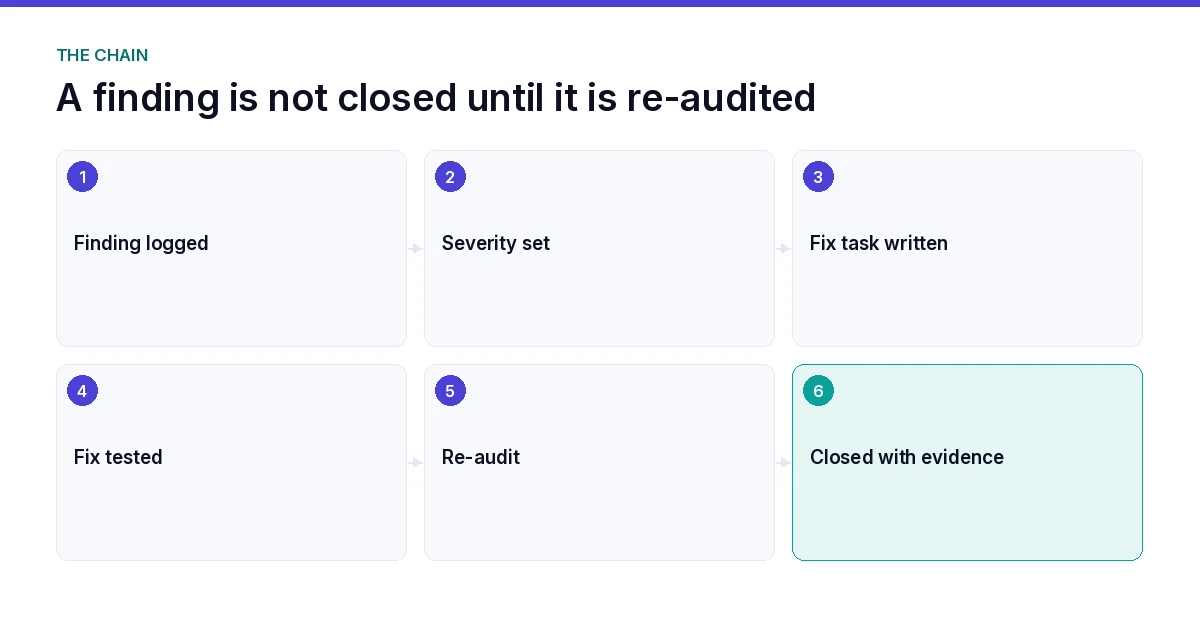
Step 8: fix plan and re-audit. Each high and mid gap becomes one bounded fix task with its own test. After fixes land, re-audit the touched areas and their neighbors, then update the verdict. The re-audit is the step teams skip, and it is the step that proves the fixes fixed.
The finished report has a fixed shape: scope delta, inventory stats, dependency notes, data flow summary, test review, evidence grades, severity table, fix plan, re-audit results, verdict. Ten sections, readable in ten minutes, arguable line by line.

What an audit cannot do
An ai coding project audit grades the evidence you have; it cannot conjure evidence you never collected. If tests were never run, the audit says absent, not pass.
It also does not fix anything by itself. The report’s job is to make fixes small and obvious. Confusing audit with repair drags both, which is why my steps keep discovery read-only until the fix plan exists.
Finally, an audit is a snapshot. Behavior drifts as code changes. Re-run the audit on any release that touches storage, auth, payments, or the data flow you traced today.
A worked audit in brief
One real audit last quarter: a small export tool, three hundred lines, two model clients. Scope delta found one promised feature never built, flagged as partial with a tracked note. Inventory found two orphan helper files, deleted. Dependencies clean. Data flow found one log line writing full input to disk, fixed as a high-severity gap. Tests reviewed: five happy-path cases, edges added for empty and huge input. Evidence grades: six verified, two reported. Fix plan: three tasks, all small. Re-audit: clean on the touched paths, verdict pass with one named limitation.
Total time, two hours twenty minutes. The equivalent debugging after a bad release would have cost a full day plus user trust.
An ai coding project audit example at full size: csvloader
Here is an ai coding project audit run end to end, on a tool I will call csvloader in place of the client name: six hundred lines of Python, built with a model across two evenings, importing a sales CSV into SQLite. It worked on the sample file and broke on the first real file, so the owner wanted a verdict before shipping.
Discovery stayed read-only. The scope check read the locked plan and found four promised features, three built. The inventory counted eleven files and flagged one retry helper with no callers. Dependencies were all standard library, so the licensing step closed in one minute. Data flow tracing then found the finding that set the tone: on every parse error the tool copied raw CSV bytes to a temp folder for crash recovery and never deleted the copy.
Test review ran quietly beside it. Every test passed, and every test used a clean single-row file. Nothing asserted empty input, huge input, or malformed rows, so the suite could not see the crash path where the temp folder habit lived.
The severity table from that report, condensed:
| Finding | Severity | Evidence | Fix |
| — | — | — | — |
| Parse errors copy raw CSV bytes to a temp folder that never gets cleaned | High | Directory listing after one forced failure: 214 stray files, oldest six weeks old, holding customer row data | Delete the copy in a finally block, plus a test that forces a parse failure and asserts the folder is empty |
| Duplicate-row report promised in the plan was never built | Mid | Plan line 12 versus a search for duplicate handling in the code, zero hits | Build a 20-line duplicate check with three fixture rows, or remove the promise from the readme |
| Test suite covers clean single-row files only | Mid | Test run showed five assertions, none touching empty, huge, or malformed input | Add three fixtures: empty file, 50k row file, one broken row |
| Orphan retry helper with no caller | Low | Search found no imports or references to the file | Delete it and note the deletion in the report |
| Readme still tells users to install pandas, which the code stopped importing weeks ago | Low | Readme line 4 versus the import list | Remove the stale install instruction |
Evidence grades at audit time: the temp folder finding was verified, backed by the directory listing and file timestamps; the duplicate-row claim was reported by the owner and confirmed during the flow trace; the edge tests, the orphan’s ownership, and the readme accuracy all stood absent until the fixes produced their own evidence.
What got fixed and confirmed: the finally block landed the same afternoon, and its test failed once before the cleanup call went in, which is the sound of a test earning its keep. Two forced parse failures after the fix left the folder empty both times. The duplicate check shipped with its three fixtures and caught a real duplicate on day one. The readme lost the stale install line.
Re-audit took forty minutes. The high gap closed, both mid gaps closed, and the verdict moved from fail to pass with one named limitation: the huge-file fixture asserts 50k rows, while production files can run larger, so the readme now states the tested ceiling. Writing the limitation down is all an honest audit can ask.
Total time, two hours and ten minutes including the report. The value of this ai coding project audit, one privacy-class bug that would otherwise have shipped and copied customer rows to disk for months, plus a readme that finally matches the code. That arithmetic is the argument for running all eight steps before any release.
The ai coding project audit report template
Use this skeleton and never wonder what to write:
Header: project, version, auditor, date. Scope delta: promised versus built, one line each. Inventory: file count, orphan count, test coverage per main module. Dependencies: added, removed, unpinned count. Data flow: entry points, storage locations, exits, with retention notes. Test review: suite size, edges covered, gaps named. Evidence grades: verified, reported, absent counts with examples.
Severity table: id, finding, bucket, harm one-liner, owner. Fix plan: one bounded task per high and mid finding, with tests named. Re-audit: date, areas rechecked, result. Verdict: pass, partial, or fail, approver, tracked limitations.
Filling this template takes the same two hours as the audit itself, because most of the writing already happened during discovery. What you are doing at the end is arranging facts, not inventing narrative. Keep the file in the repo beside the code it grades, and future audits can diff against it, which turns a series of snapshots into a trend line.

Common findings across AI-built projects
Twenty-odd runs of this ai coding project audit and the same eight findings keep appearing. Knowing them speeds your first pass.
Orphan files from abandoned approaches, usually helpers the model created for a plan it then replaced. Happy-path-only tests, with empty and huge input never asserted. Hard-coded sample credentials in example configs. Logs writing full payloads to disk for debugging nobody turned off. Docs describing the planned feature instead of the shipped one. Unpinned dependency versions drifting between machines. Duplicate implementations of one helper, the model re-solving a solved problem. And the evergreen, task notes claiming done while the integration test remained skipped.
None of these require genius to fix. All of them require someone to look, which is precisely what the ai coding project audit institutionalizes. Print the list of eight, check them by name in your first audit, and watch how fast the report fills itself.
Running the ai coding project audit on a schedule
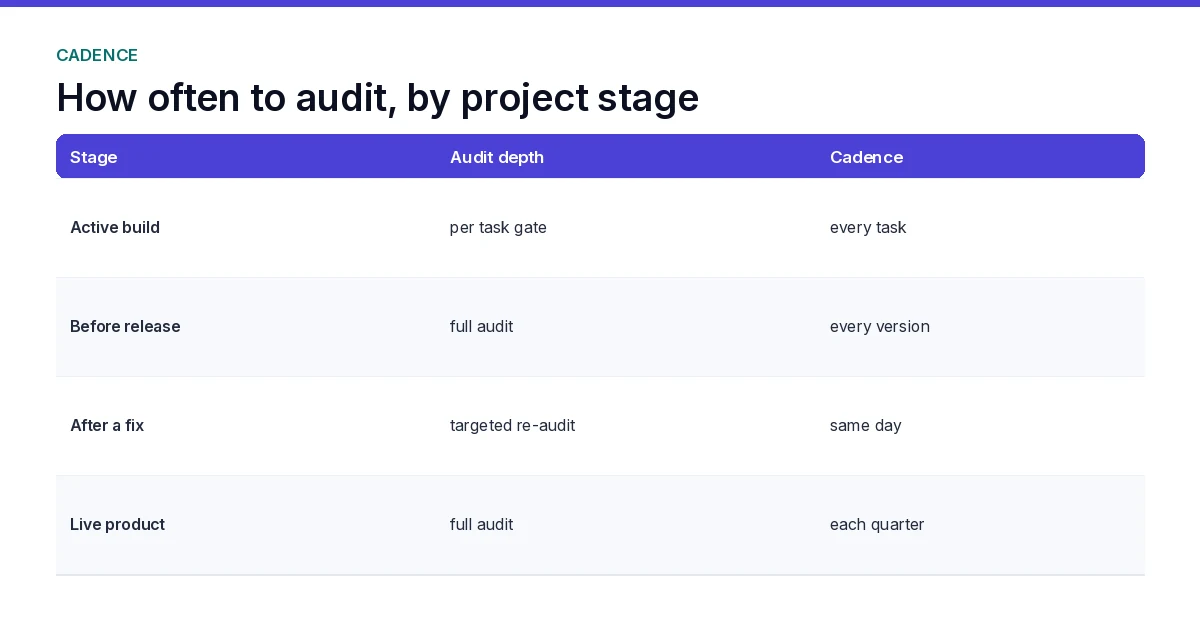
Ad hoc audits catch disasters. Scheduled audits prevent them. My cadence is one full audit per release candidate, plus a light scope-and-evidence pass every Friday on whatever shipped that week.
The Friday pass takes thirty minutes: scope delta, new files inventoried, evidence grades updated, verdict line refreshed. It prevents the monthly horror show where forty small changes have drifted so far from the plan that the full audit takes a day.
Schedule the full audit on the calendar, not in your intentions. Audit debt behaves exactly like test debt, invisible until compound interest comes due during your launch week.
Auditor mindset: skeptical, not hostile
The audit works when the auditor reads like a curious stranger, not a prosecutor. Questions framed as curiosity get honest answers: “help me understand what happens when this file is missing” beats “why did you skip this”.
That mindset also protects solo builders auditing their own work. Read yesterday’s code as if a stranger wrote it, because tired-you did, and tired-you optimistically assumed the file could never be missing. The audit persona exists to counteract that optimism with structure.
One practical trick: audit in a different window than you code, with the plan open and the editor closed. Every line in the report must cite evidence, never vibes. When the tone stays evidence-first, the ai coding project audit produces facts people act on instead of opinions people debate.
Tracing one finding end to end
Let me trace a single finding through the whole ai coding project audit machinery so the process stops being abstract.
Discovery: step 4 data-flow tracing shows the export feature writes a full input copy to a temp folder and never deletes it. Evidence: one code path, confirmed by running the export and listing the folder afterward. Harm: user data accumulating on disk indefinitely, which is a privacy problem on any shared machine.
Grading: high bucket, data exposure by retention. Fix plan: one bounded task, delete the temp copy in a finally block, plus a test asserting the folder is empty after run. Owner named, due before release.
Re-audit: rerun the export twice, confirm clean folder both times, recheck the neighboring import path for the same pattern, note the result in the report. Verdict updated from partial to pass with the limitation removed.
That chain, finding to fixed to re-checked, is the entire value of the audit compressed into one example. Multiply it by every gap the eight steps surface and you can see why releases built on this process surprise nobody.
Building audit reflexes between formal audits
The formal audit has a schedule, but small reflexes keep the project audit-ready in between. Read diffs with the plan beside them. Append evidence to the task note as you go instead of reconstructing later. When a task ends, ask the audit question early: what would an auditor want to see from this work?
Those reflexes cut the formal audit time roughly in half after a few months, because discovery becomes review of already-recorded facts. The ai coding project audit then feels less like a tribunal and more like a monthly accounting, which is exactly the emotional register you want around money and users.
FAQ
What is an ai coding project audit?
It is an eight-step evidence review of an AI-built project: scope, inventory, dependencies, data flow, tests, evidence quality, severity grading, and a fix plan verified by re-audit.
How is this different from a code review?
A code review reads the diff for quality. An ai coding project audit compares the whole project against its original promises and produces a graded report with a fix plan.
How long does the audit take?
A small project needs two to three hours of ai coding project audit time; larger ones take longer. Read-only discovery keeps it fast, and the fixed report shape prevents essay writing.
Who should run the audit?
Someone who did not implement the audited task, when a team exists. Solo builders run it the next day, when memory has cooled enough to read evidence honestly.
What if evidence is missing?
Record it as absent. Missing evidence is a finding inside the ai coding project audit, not a failure of the audit itself. It usually becomes a fix task that adds the test or log you needed.
Do I re-audit after every fix?
Re-audit the fixed area and its neighbors once per fix batch, then update the verdict. Daily tiny fixes can batch weekly; storage or auth changes re-audit immediately.
Can the audit guarantee a clean release?
No guarantee exists. The ai coding project audit raises the odds sharply and leaves a written trail that makes the remaining risk visible to whoever signs the release.
Eight steps, one report, zero blind spots left ungraded. Run the ai coding project audit on your next build, keep the severity table honest, and let the re-audit close the loop. For the release checklist that follows a clean audit, the guide on this site continues the same evidence-first pattern.
the twelve check release checklist