
Ethical lead generation starts before the first page is fetched. It starts with a decision about what you will not do: no logins, no evasion, no invented contacts, and no list that grows faster than you can check it.
The short answer: ethical lead generation means reading pages under the rules their owners publish, saying who you are, taking only what a conversation needs, and deleting a record when someone asks. It is a set of limits you can describe to a client on one page.
This guide covers five rules, the source behind each one, the AI boundary that catches people out, and the refusals that make the rest credible. SOVEL CLIENT RADAR is the reference point here, because it enforces these rules in code rather than in a policy document. If you are starting from public directories, the guide to finding clients without LinkedIn covers the routes that need no account.
Most people arrive here after a run that felt too easy. The list was long, several entries had no website, and a few addresses bounced on the first send. The fix is a slower method with a written boundary. Ethical lead generation is the name for that boundary.
What does ethical lead generation mean on a public page?
Ethical lead generation begins with a fact that surprises people: a page any browser can open is not therefore free to harvest. The owner published it for a reader.
The phrase that decides most arguments is public data. A company address, a phone number and a team page are public in the sense that anyone can read them. They are still the company’s information, published for a purpose, and a bulk list sold to strangers is rarely that purpose.
Ethical lead generation keeps the distinction in view. Read what a business published to win customers, keep the source, take the minimum needed to start a conversation, and stop when the owner says stop. Every rule below is a way of applying that one sentence.

Rule 1: read the robots file first
The first rule of ethical lead generation is technical, which is why it gets skipped. Every site can publish a robots.txt file naming the paths automated clients may read, and that file is the closest thing the web has to a stated preference.
The robots exclusion protocol is a convention rather than a law, and that is what makes it a useful test. A person who ignores a published preference will ignore a private request too. Ethical lead generation reads the file before the first fetch and treats a disallow as a final answer.
The engine checks every source against its own robots file, including the autocomplete endpoints it uses to expand a niche into buyer phrases. Several search engines and public databases were dropped during development because their robots file disallowed the query path, and the run notes still name them.
Reading that file first is also the cheapest form of responsible prospecting. It takes one request, it costs nothing, and it removes the sources that were never going to be allowed.
A site that publishes no robots file is not an invitation either. The engine applies the same throttle and the same cache to every host, whether or not a rule exists, because the absence of a stated preference is not permission for a faster read.

Rule 2: say who you are
The second rule of ethical lead generation is a name and a way to reach the person behind the requests. A request with a real contact in it is a request someone can complain about, and that accountability changes behaviour on both sides.
An honest identity costs something. Some sites block unknown clients on sight, so a named request gets refused more often than a request pretending to be a browser. Ethical lead generation accepts that cost, because a block is a clear no and a disguise is a lie that shifts the cost onto the site owner.
An identity is also a promise about volume. When a site owner replies to the address in your request and asks you to stop, that reply has to reach a person who can act on it. A shared inbox nobody reads fails the same test as a fake browser string.
That is why ethical lead generation asks for a reply address a real person reads. The request count stays low enough that a complaint is rare, and specific enough that a complaint can be traced to a run.
The same logic applies to the report you send. A client should be able to see which pages were read, which were blocked, and when. The engine writes that into verification-notes.md beside the results, so the record of the work is as visible as the work.
Rule 3: keep the throttle
Two seconds between requests to the same host is the engine default, and it is the least glamorous part of ethical lead generation. The rule is a queue that moves slower than the server would like, a cache that stops the same page being fetched twice, and a limit on how many hosts are read at once.
The throttle protects the site and it protects the list. Six sites are read at once, and no host receives two requests in parallel. A cache holds pages for 24 hours, so a rerun of the same topic asks for almost nothing new.
Politeness also scales better than speed. A run that reads six sites at once finishes a 25 lead topic in a few minutes, and the same run against 200 sites still finishes while you make coffee. Pushing harder buys seconds and costs access, which is a poor trade when the source you lose was the one that listed local businesses.
Ethical lead generation is a pacing decision as much as a moral one. The engine ships slow defaults, and raising the worker count still keeps one page at a time per host.
A slow read is easier to audit. When a run has a fixed pace, a blocked page has an obvious cause and the notes can name the request that failed. When a run fires 40 requests a second, every failure becomes a guess.
Rule 4: honour the first block
A 403, a 429 and an anti-bot page are answers. Ethical lead generation treats the first answer as final and moves on to the next source.
The status codes behind those answers are public and short. The HTTP specification defines 403 as a refusal and 429 as a rate limit, and neither code hides an invitation to try again with a different header. A tool that retries a 403 with a new user agent has read the code and decided the site did not mean it.
That decision is where ethical lead generation is actually tested, because evasion works often enough to be tempting. The engine refuses it in three specific ways: no second attempt under a different user agent, no proxy rotation, and no switch to plain HTTP to get around a wall. A host whose HTTPS fails is asked once for the plain address it also publishes, which is the site’s own address and not a way round anything.
A blocked source is dropped for the rest of the run, so a walled search engine cannot slow every query. The final count reflects what was read, and the gap is written down.
That note matters more than it looks. Hiding a block inside a log file is the sort of small dishonesty that turns into a large one when a client repeats your numbers in a pitch. Ethical lead generation reports the gap in the same report the client reads.
Rule 5: store the minimum and delete on request
The fifth rule of ethical lead generation is storage discipline. A contact you do not need is a liability with no upside.
Store the field, the source URL, the retrieval date and the evidence class. Skip the personal mobile number when the work inbox starts the conversation. Skip the home address. Skip the biography that never enters an email.
The habits that keep a list clean are the ones set out in outreach list building, and they start with sourcing. Cleaning is the second job.
Deletion matters as much as collection. An opt out request should be one command rather than a search through five systems. The engine keeps a suppression list that accepts a whole domain, a single page address or a mailbox, and adding an entry takes effect on every later run. The HTTP cache can be cleared in one command, and the database is a local file you own.
The storage rule has a physical side too. Results stay on the machine that ran them: a local database file and a folder of reports, with no upload step in between. Backups are your responsibility, and so is deleting the folder when a project ends.
A published opt out request that takes a week to honour is a policy failure. A dated log of every request, kept beside the policy, is the proof that the policy works.

How do the five rules compare?
| Rule | What it asks | Where it comes from |
|---|---|---|
| Read the robots file | Do not read a disallowed path | The site’s own robots.txt |
| Say who you are | A real identity and a contact route | The site’s terms and the wider convention |
| Keep the throttle | A slow, cached, bounded read | The site’s capacity |
| Honour the first block | No retry and no evasion | HTTP status codes |
| Store the minimum | Delete when asked | Data protection law and courtesy |
Five rules, five sources, and only one of them is a law. The other four are conventions a professional follows because the work has to survive a question six months after it was delivered.
How do you check a source before you add it?
Ethical lead generation adds one more check before a row enters the list: is this page the business speaking, or somebody speaking about the business?
A company’s own contact page is the strongest source. A chamber of commerce listing is strong because a membership was paid for. A roundup article is weaker, because the ranking may be paid placement and the details may be a year old. A data broker’s preview page is the weakest, because the reason it exists is to sell you the record.
Record the difference. The engine keeps an evidence class next to each field, so a phone number copied from a contact page and a number copied from a directory do not look identical in the report. When a client asks why one lead outranks another, the answer is a class and a date.
The test is simple: if you cannot name the page a fact came from in one sentence, the fact does not belong in the list. Responsible prospecting is mostly that habit repeated a few hundred times, and it is what makes a list auditable.
Where does the AI layer fit?
The AI layer is where ethical lead generation gets tested a second time, because a model can produce a sentence that reads like evidence. The optional step in the engine asks your own provider for one second opinion per lead: a verdict, the problems, a pitch and a first email draft.
Ask for a verdict rather than a biography. A prompt that says read this page and tell me whether this business sells locally produces an answer you can check. A prompt that asks for everything about the company produces prose that reads well and cannot be checked at all.
Three limits keep it honest. The key is yours, stored owner-only and shown as a hash. The request goes to the provider you chose and nowhere else. Every quoted phrase the model produces is checked against the page, and a quote that cannot be found is removed before the draft reaches you, with a note saying how many were dropped.
Ethical lead generation does not change because a model wrote the sentence. If the quote was not on the page, it does not go in the email. A confident paragraph with a made-up source is the most expensive kind of help.
What does ethical lead generation refuse to do?
A tool that claims ethical lead generation should be able to list its refusals in public. These are the ones that matter.
It does not log in anywhere. Google, LinkedIn, Facebook, Instagram, X, Quora and Reddit are out of scope by design, and the report says so instead of quietly returning nothing.
It does not invent a contact. When a page publishes no email, the field stays empty and the report says the value was not published.
It does not guess at absence. A blog with no recent posts is a signal only when the feed check finished, and a timed-out check is reported as unfinished.
It does not sell you platform vendors, directories and social networks as prospects. Those domains are blocklisted, because they sell products rather than buy client services.
How do you write a one-page policy?
A one-page policy is the practical output of ethical lead generation. It is the document you attach when a client asks how the list was built, and it should fit on one screen.
Write five short sections: what you read, how you identify yourself, how often you request, what you store, and how someone opts out. Add the name of the person who answers a complaint. Add the date of the last review.
Keep the language plain. A line such as “we read public pages that a site’s robots file allows, at no more than one request every two seconds per host, and we delete a record within one working day of a removal request” is something a client can repeat to their own lawyer.
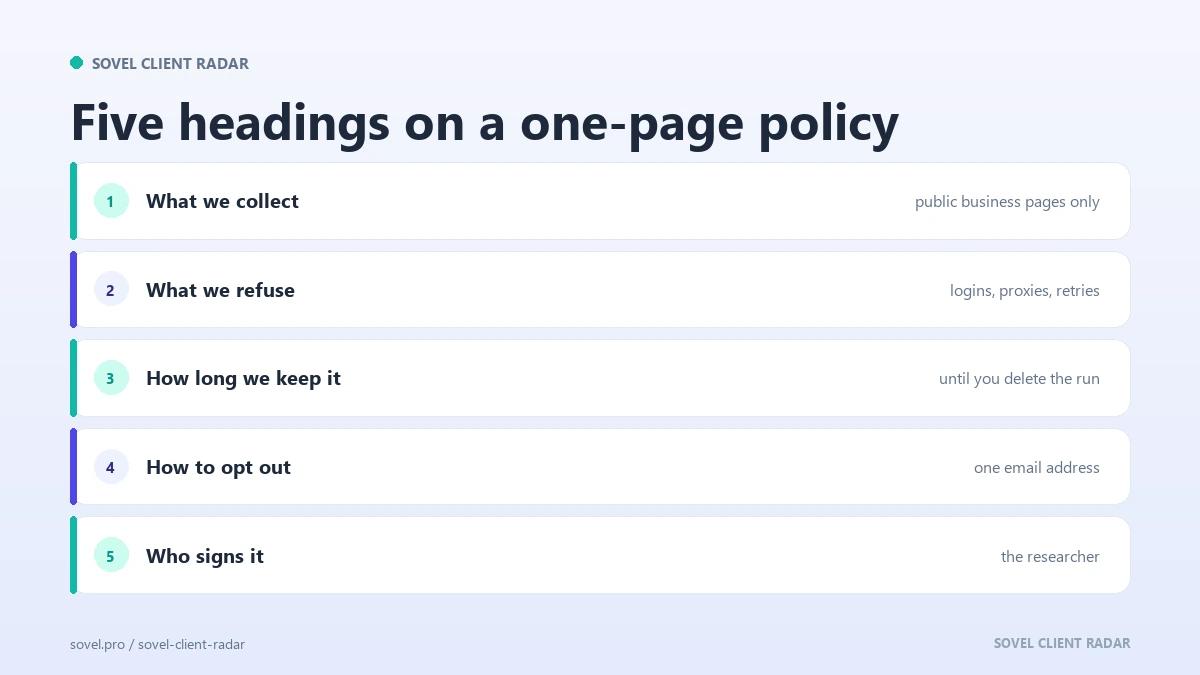
Then apply it to your own work. A policy that describes a standard the tool does not meet is worse than no policy, because it is a claim you cannot defend. Ethical lead generation is the rare case where the written version and the running version can be compared line by line, and the comparison is the point.
Which edition runs these rules?
All three editions apply the same rules, because the boundary sits in the engine and not in the licence tier.
| Edition | Machines | Leads per run | One-time price |
|---|---|---|---|
| Personal / Freelancer | 1 | 50 | ₹5,999 |
| Pro / Small Business | 1 | 200 | ₹12,999 |
| Agency / Enterprise | 5 | 500 | ₹39,999 |
Personal costs ₹5,999 for one machine and 50 leads a run. Pro costs ₹12,999 for one machine and 200 leads a run, with the AI layer available. Agency costs ₹39,999 for five machines and 500 leads a run. No edition limits runs by day or month, and a higher cap does not buy a looser rule.
Features, seats and prices for each edition sit on the SOVEL Client Radar product page. The security page explains how the local database, the optional key and the suppression list are handled.
FAQ
Is public data legal to use?
Reading it is usually fine and reusing it is where the risk sits. Public data can still be personal data when it identifies a person, so a work email and a named contact carry obligations in most jurisdictions. Keep the source, keep the purpose narrow, and take advice for your market.
What does robots.txt actually mean?
It is a file at the root of a domain that tells automated clients which paths they may read. The robots exclusion protocol is a convention with no statute behind it, and it is still the clearest statement a site owner makes about automated access. Treat a disallow as a no.
Is lead scraping legal?
People ask is lead scraping legal when the better question is what the site allows. Scraping at volume against a site’s rules creates contract and privacy exposure, while reading a small number of public pages politely sits in a different category. The rules above are the practical test.
What about GDPR and the DPDP Act?
Both give people rights over their personal data and both expect a lawful reason for processing it. Business contact details can count as personal data, so an opt out request has to be honoured and a record kept. Check the rules for your own market before you build a list at scale.
How do I handle an opt out request?
Honour it the same day, log the date, and remove the record from every copy you hold. The engine’s suppression list accepts a domain, a URL or an email address and applies to every later run. Keep the log so you can prove the request was handled.
Is AI allowed in this work?
Yes, with limits. A model can draft a first line, summarise a page or rank a shortlist, and it should never supply a fact the page does not contain. Every quote needs checking against the source before it reaches a client.
Does ethical lead generation slow the work down?
It does, and the slowdown is small. A two second delay per host and a 24 hour cache add minutes to a run that would otherwise take minutes anyway. What it removes is the rework that follows a complaint.