
Most buying pages for a fact checking tool compare features. This one compares trade-offs, because a fact checking tool that never loses a comparison is selling a brochure. Two of the five comparisons end with the cheaper or free option winning. A comparison that never loses is a brochure, and brochures are why buyers end up paying for something they stop using in month three.
Five comparisons follow. Each one names a winner and states the case where the other side wins, because almost every choice in this category depends on how you work rather than on which product is better.
If you want the method first, how to fact check AI generated content works entirely without a tool. If you want the engine this page is written from, it is at SOVEL SAAKSHI, with its limits published before purchase. A fact checking tool that lists the claims it misses is easier to trust than one that only lists its catches.
[Five comparisons, each with a winner and the case where it loses.]
What a fact checking tool is actually being asked to do
Before comparing, define the job. A fact checking tool is asked to take a draft and tell you which sentences cannot be defended.
Three outcomes are possible, and they are not equal.
A list of checkable claims. Useful and easy to build. It saves you the scanning, and it leaves all the judgement with you. Ask what happens when a claim fails, because a fact checking tool that warns has not decided anything.
A verdict per claim. Harder. It requires a source, which means a ledger, which means twenty minutes of setup per product. The first run on a page you already published tells you more about a fact checking tool than any sample file.
A decision that stops a publish. Hardest, and the only one that changes behaviour, because a decision does not require you to remember to act on it. Version the ledger with the draft, so a check from March still makes sense to a fact checking tool in September.
Most products on the market do the first and describe it as the third. When you evaluate any fact checking tool, find out which of the three it produces, and do not accept a feature list as an answer.
Comparison 1: offline versus cloud
Offline wins for anything confidential, and it wins by a wide margin.
A cloud tool uploads the draft. For a blog post about pricing, that is a small risk. For a client’s unreleased financial report, an NDA draft or an internal policy, it is a decision most agencies cannot make, and the ones who make it usually have not asked their client. A fact checking tool that needs a key needs a plan for the Sunday morning when the key stops working.
An offline fact checking tool keeps the draft on the machine. Nothing is transmitted, no account exists, and there is no server to be breached. The trade is that sources come from your ledger rather than a live fetch.
Cloud wins when the source work is the bottleneck. If you would rather not build a ledger at all and you are happy with a tool that searches on your behalf, a cloud product is faster on day one. You are buying speed with confidentiality and reproducibility, and that is a legitimate trade for public content. Test the failure rather than the happy path, since the happy path is what every fact checking tool demo already shows.
The question to ask is not which is more modern. It is whether the drafts you check could leave the building, and most people answering honestly say no. Teams usually learn their real requirement after the second fact checking tool, not the first.
Comparison 2: ledger versus live search
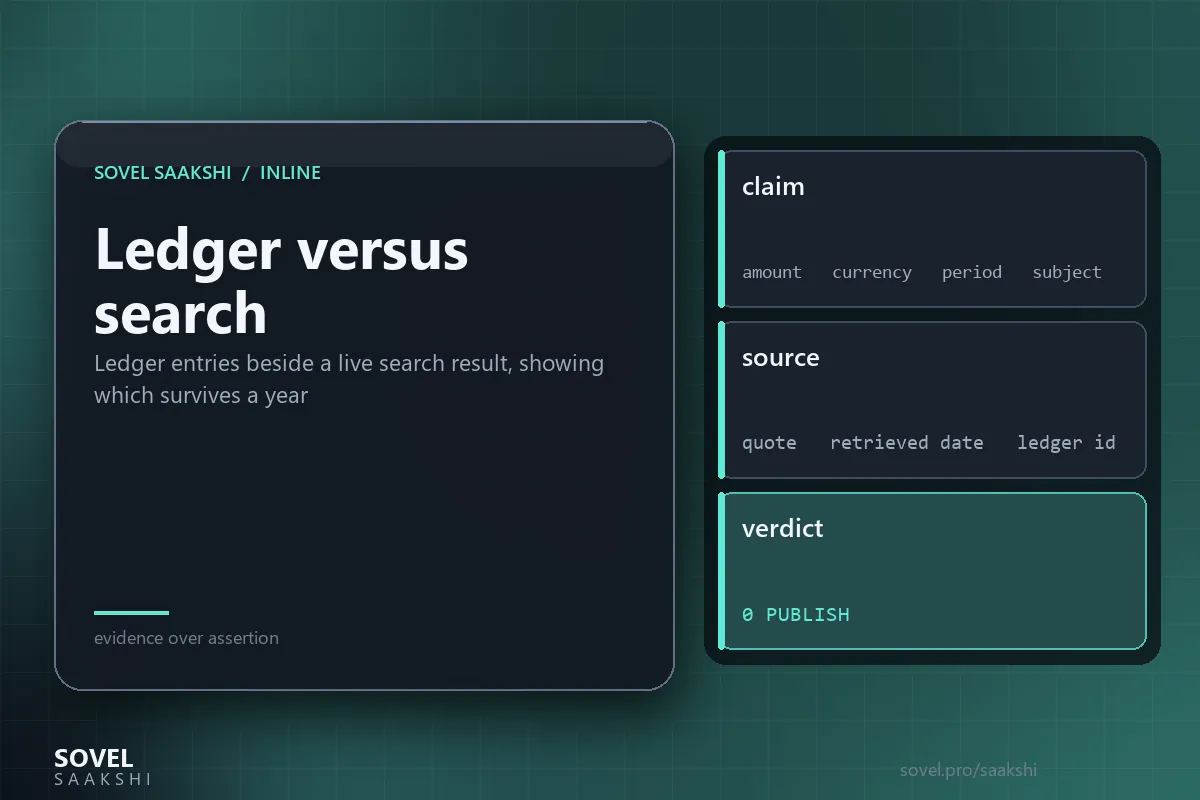
The ledger wins on reproducibility. A verdict you can reopen a year later, with the exact quote and the date, is the only kind of evidence that survives a dispute. An offline fact checking tool clears procurement faster because nobody has to answer a data transfer question.
Live search wins on convenience at the start, and loses on the thing you actually need. A tool that searches today and finds a page that changed since yesterday produces a verdict about today, not about the draft. When a customer asks in three weeks, the answer is a new search, and the new search may disagree with the old one. Count the claims your draft really makes before deciding you need a fact checking tool at all.
Two practical consequences.
Ledger entries are work you only do once. The first product takes twenty minutes. The tenth takes three, because eight sources are already recorded. A fact checking tool that marks every claim as review has told you nothing that a spell checker could not.
Live search feels like magic and ages badly. It produces the experience of checking without the artefact of having checked, which is why it demos better than it performs. Support quality matters more than the feature list once a fact checking tool is part of a weekly routine.
A fact checking tool that supports both is fine, as long as the ledger is the record of truth and the search is only a way to find candidates.
[Two approaches to evidence, one reproducible and one not.]
Comparison 3: decision versus score
The decision wins, and this is the comparison that matters most.
A score is a number out of a hundred. It invites negotiation, it degrades gracefully in conversation, and it never stops anything. A decision is a code. It stops a publish, and stopping a publish is the entire value of the category. Buy a fact checking tool for the draft you fear, not for the one you write most often.
Ask any vendor what happens when a claim fails. If the answer is a warning, a suggestion, an amber highlight or a confidence percentage, the product describes rather than decides. That is not fraud, it is a different product category, and it is the wrong one if your problem is a wrong number reaching a customer. The clearest sign of a good fact checking tool is what its users stopped doing after the first month.
The case where a score wins is triage. If you have four thousand pages and you need to find the fifty worst, a score is the right instrument for ordering work. Use a score to prioritise. Use a decision to publish. If a fact checking tool cannot run on the machine where the draft lives, it will not run often enough to matter.
Comparison 4: one time licence versus subscription
One time wins on cost certainty for a local tool, and this is arithmetic rather than ideology.
A local tool has no server cost. Charging monthly for software that runs entirely on the buyer’s machine is a business model, not a technical requirement. Over two years, a subscription at any reasonable monthly price exceeds a one time licence, and the buyer carries the risk of a price change. A price in rupees with GST shown separately is easier to approve than a foreign figure with a monthly renewal.
Subscriptions win when the vendor does work every month: updated databases, hosted inference, source monitoring. A live search tool does continuous work, and paying monthly for it is fair. A trial on a live page is honest evidence, and it takes ten minutes with any fact checking tool.
The question to ask is simple. What does the vendor do every month that costs money? If the answer is nothing on your behalf, a subscription is paying for access rather than service. Do not pay for a promise of accuracy, pay a fact checking tool for a record you can show somebody later.
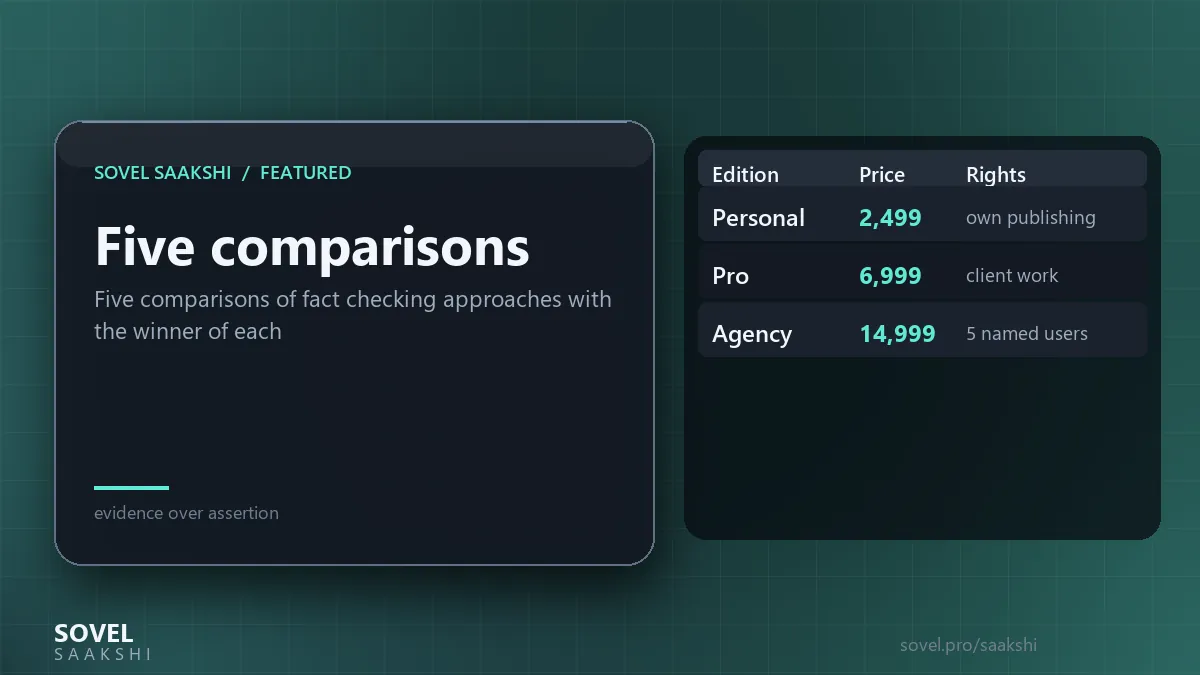
Our own pricing is one time: ₹2,499 for Personal, ₹6,999 for Pro, ₹14,999 for Agency, with GST where it applies, perpetual for the v0.x line. That is a consequence of the architecture, not a marketing position, and a vendor whose architecture is different should charge differently.
Comparison 5: tool versus checklist
The checklist wins for low volume, and it wins completely.
If you publish one page a week with four figures on it, a checklist is faster than buying, installing and learning anything. The seven checks take forty minutes by hand, the tool takes four minutes with a prepared ledger, and at one page a week the difference is thirty six minutes that you will spend learning the tool anyway.
The tool wins when any of four conditions appear: volume above a few pages a week, a client who asks for proof, two people who need to agree on a standard, or a page type where the subject mismatch is likely.
That fourth condition is the one people miss. If you run a catalogue with neighbouring products and similar prices, the failure that hurts most is the one a checklist catches only when someone happens to compare subjects. A tool catches it every time, because the comparison is the whole product.
[The volume threshold where a tool beats a checklist.]
How to trial any fact checking tool in ten minutes
No demo call. A page you already published is a better test than any sample file.
- Take a page with a price. Copy the text into a file.
- Open the real source and copy the sentence holding the same figure into the tool’s ledger.
- Run it. Check two things: how many claims it found, and whether the sourced claim passes.
- Break it deliberately: change the product name in your file to a different product, then run again.
Step four is the whole test. A fact checking tool that still passes after the subject changes is comparing digits. Our engine blocks in that case, and that rule cost us two audit rounds to get right, which is why it is the one thing we would test first if we were buying.
Ask for the undo path too. A tool that cannot say why it blocked is a tool you will learn to ignore, and an ignored tool is worse than no tool because it produces reassurance without evidence.
What to do when the tool disagrees with you
It will, eventually, and how you handle that moment decides whether the process survives.
Three rules, and the third one is the important one.
Read the source before arguing with the verdict. Half the disagreements end there.
Change the sentence, not the standard. A claim that cannot be sourced is a claim with a problem, not a standard with a problem.
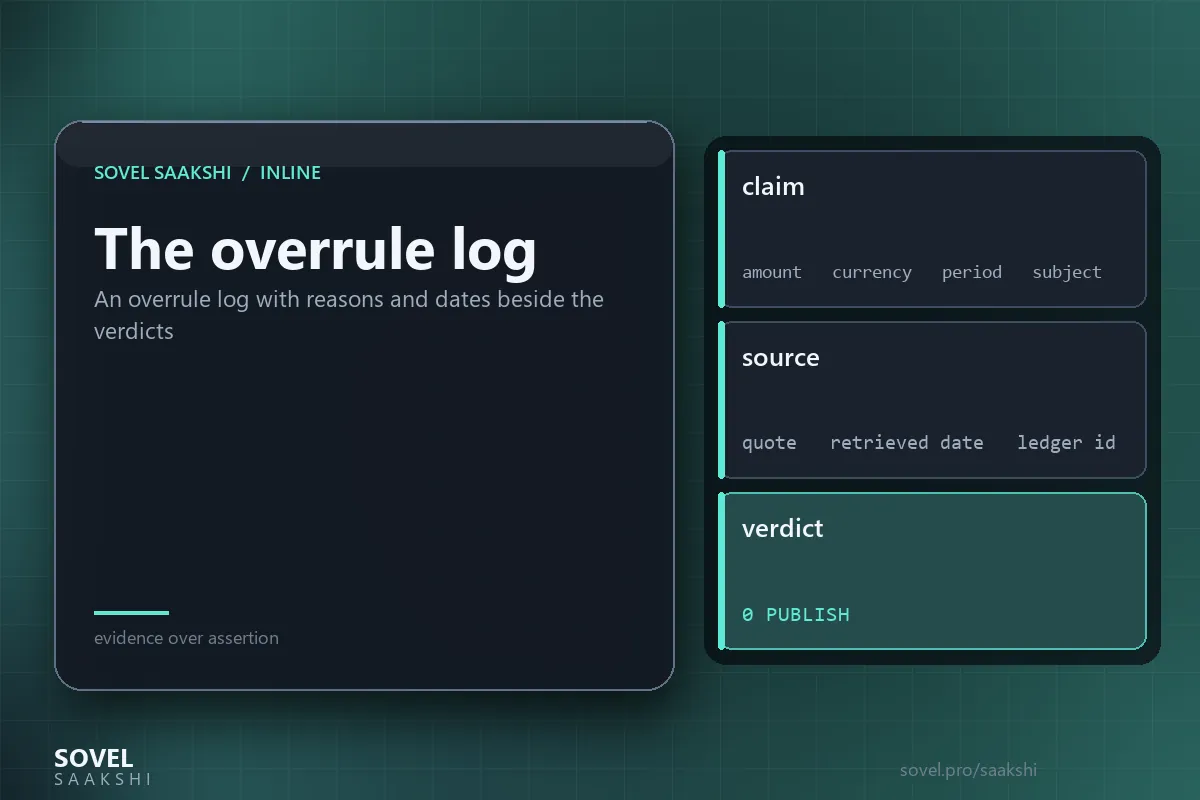
Write down every overrule. A written overrule is a decision with a reason. An unwritten overrule is the beginning of a culture where the tool is decoration, and six months later nobody remembers why the check exists.
The same rule applies to any fact checking tool you buy. The software is only as good as the habit of writing down why you disagreed with it.
[The three overrule rules, and the log that keeps them honest.]
Where a service beats a local tool
Being honest about this is the reason the rest of the page is credible.
A fact checker as a service, run by humans, beats any local tool for one job: research. Finding a source you do not know exists is a human task, and no offline engine will do it, ever, because it never opens a browser.
If your problem is that a claim needs a source you cannot find, buy research. If your problem is that a source you already found does not say what your draft claims, buy a tool or run the checklist.
Most buyers have the second problem and buy for the first, which is why so many purchases end in disappointment. The claim had a source. The source was about a different product. Nobody was going to find that by searching harder.
[The research case and the verification case, side by side.]
Where the money actually goes
Buying pages rarely explain the cost structure, so here it is in four lines.
Build cost, paid once. Extraction rules, the ledger format, the report writer, the tests. This is why software has a price at all.
Runtime cost, per check. For an offline tool this is effectively zero, because nothing is computed elsewhere. For a cloud tool it is real: inference, storage, source fetching.
Maintenance cost, per month. Font coverage, OS quirks, dependency updates, security advisories. A tool that ships an archive still needs releases.
Support cost, per buyer. Questions, refunds, platform problems. This is the cost that rises fastest when a vendor sells to people whose environment differs from the one they tested on.
A fact checking tool priced one time has to recover the first, third and fourth from the sale, and it has no way to recover the second because it does not incur it. A subscription tool recovers the second continually, which is legitimate when the second is real.
That is also why a one time licence and a subscription can both be honest, and why the only dishonest position is a subscription for software that runs entirely on the buyer’s machine while doing nothing on the seller’s. When you compare products, ask what the seller does every month. The answer tells you which model you are looking at.
There is a fifth cost that nobody puts on a pricing page, and it is the one that decides whether a purchase was worth it. Migration cost: the ledger you build, the habit you form, the folder structure you adopt. A tool you leave after two months costs the licence plus the migration, which is why the honest recommendation for low volume is a checklist rather than a purchase.
If your volume is four pages a month, the checklist in how to fact check AI generated content is the right answer and it is free. If your volume is forty, buying is cheaper than the hour you would spend on each one, and the folder is a bonus.
[The four line cost structure of a local tool.]
One more comparison that belongs here rather than in a table. A free extractor plus a paid human reviewer costs more per page than any tool in this category, and it produces no artefact. That is not an argument against human review, which is essential. It is an argument against buying the cheap half of a process and expecting the expensive half to happen by itself.
Google’s own wording is useful here, because it is free, dated and specific: the guidance on generative AI content asks for a manual review before publishing, and the Search documentation describes how the result is read afterwards. Neither document asks you to spend money. Both make clear that spending nothing and checking nothing is the option that carries the highest cost.
Prices were checked on 21 November 2026 and the engine version behind them is 0.1.9.
SOVEL SAAKSHI is the local tool compared above, and the comparisons apply to it as much as to anyone else.
The same gap appears in reference lists, which is why a citation verification tool belongs in the comparison.
Compare a fact checking tool on the ledger it keeps, because the ledger outlives the interface you were shown in the demo.
A cheaper route for one person is worth knowing about: fact check AI output one draft at a time and keep the ledger in the same folder as the draft.
Questions people ask before buying a fact checking tool
Is a fact checking tool the same as an ai detector?
No. A detector estimates authorship from style. A fact checking tool compares claims with sources. The second is the one that prevents a wrong number, and the difference is the first thing to check in any comparison.
Do I need to be technical to use one?
No. The engine we ship runs three commands and a Windows batch file is included. A user who can open a terminal and type a path can use it. Everything else is a text file you edit.
What if I have no sources at all?
Then the tool will block everything, which is the correct answer rather than a failure. Start with one product and one ledger. Twenty minutes on the first one, three minutes on the next.
Is a free tool enough?
Sometimes. A free extractor that lists claims saves you the scanning. What a free tool rarely gives you is a verdict with a stored quote, which is the part that becomes evidence later.
Does a subscription ever make sense?
Yes, when the vendor does continuous work: live search, source monitoring, hosted models. If the software runs entirely on your machine and the vendor does nothing monthly, a subscription is paying for access rather than service.
How do I compare two tools fairly?
Run both on the same page from your own site, with the same ledger, then break the subject deliberately. The tool that catches the subject change is the one that will save you money.
What does the engine cost, and what is in each edition?
Editions cost ₹2,499, ₹6,999 and ₹14,999 respectively, billed once, plus GST. The editions differ on rights: Personal for your own publishing, Pro for commercial use of your own products, Agency for client deliverables with five named users. The engine is identical in all three.
Where are the limits?
On the product page, before purchase, in nine lines. PDF font coverage, URL redaction by parameter name rather than entropy, deterministic Markdown extraction, no live fetch, and the rest. A buyer who discovers a limit afterwards is a refund, so the list is published rather than discovered.
For the six claim types an engine catches, ai fact checker is the closer read. For the difference between checking and detecting, ai hallucination checker settles it. For a document rather than a page, verify claims in a document is the routine.
One line to finish on. A fact checking tool is worth its price only when it produces a decision you cannot argue with at eleven at night, and everything else on a feature list is decoration around that one property.