
We published a price that was wrong for eleven days. The number was real, taken from a live page in our own catalogue. The currency was right, the “one-time” wording was right, and the product it described was a different product. A customer found it. Nobody on our side did.
That is the ordinary shape of the problem, and it is why learning how to fact check AI generated content is less about spotting nonsense than about catching a true statement attached to the wrong thing. Most guides to how to fact check AI generated content begin with a tool. This one begins with the failure, then builds the seven checks that would have caught it. Nobody on our team was careless in the obvious way. The sentence read perfectly, and every part of it was true except the subject.
[An AI drafted paragraph being pulled apart into the four things a claim needs before it counts as evidence.]
This page is the method we built afterwards: how to fact check AI generated content in seven checks, in the order they catch the most damage. You can do all seven by hand. Doing them by hand is why we wrote a program, but the checks matter more than the program.
What fact checking AI content actually means
Learning how to fact check AI generated content starts with three separate confirmations for every checkable claim in a draft:
- That the claim exists in a source at all, rather than in the model’s summary of a source.
- That the source says it about the same thing the draft says it about.
- That it was true on the day you publish, not on the day the source was written.
Most drafts fail at the second point while everyone involved is looking at the first. That is the most useful single thing to know about how to fact check AI generated content at speed, and it is also the thing that a checklist of links will never tell you. A model is good at producing a sentence that sounds like it came from a document. It is indifferent to whether the document was about the same product. That indifference is not a bug you can prompt away, because the model does not have a concept of a source when it writes. It has a distribution over sentences.
This is also the definition we use when we explain how to fact check AI generated content to a client: three questions per claim, and a card to hold the answer. So the human habit has to change shape. Reading a draft for accuracy is not the same as checking a draft for evidence, and the second one needs a place to write an answer down.
[One claim, one source, one quote, one date, on a card that can be sent to a client.]
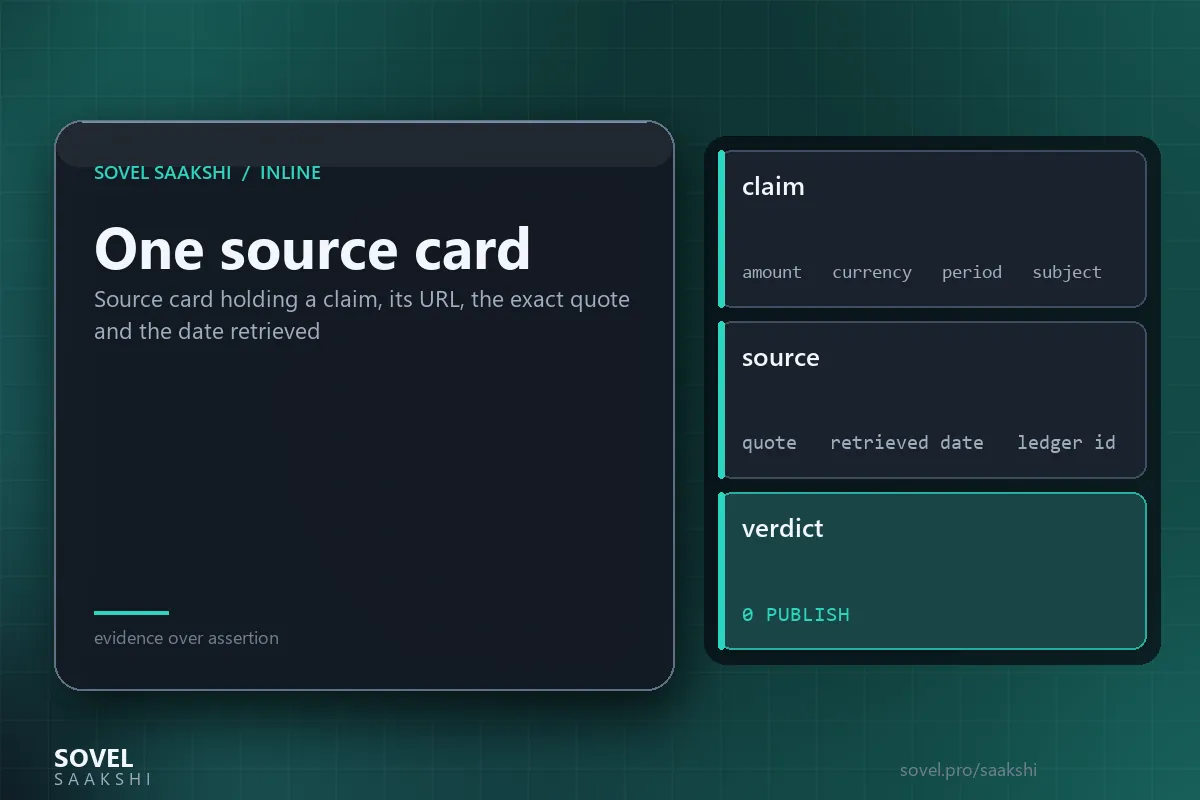
That card is the unit of the whole method. One claim, one link, the exact sentence from the page, and the date you looked. If a check does not end in a card, it ends in an impression, and impressions do not survive a client email six months later.
Check 1: the number itself
The first step in how to fact check AI generated content is the figure itself, because the figure is what a reader will repeat. Start here in every draft, every time.
Ask four questions of the same line. Is this the amount that appears in the source, to the digit? Is it a unit price or a total? Is it before or after tax? Is it the amount for the plan the sentence names, or for the cheapest plan in the table?
The fourth question is the one that fails. Price tables are dense, and a model reading a table will happily pick a number from the wrong row, because the row and the column both look like they belong to the sentence.
Two habits fix most of this, and they matter more than any tool choice, which is the part of how to fact check AI generated content that nobody sells. First, quote the row, not the number: copy the line of the table that carries the figure, so the row label travels with it. Second, write the unit down in words in your draft. If the sentence says 6,999, the sentence also says what 6,999 buys.
There is a smaller trap inside this one. A percentage of an amount is not an amount. If the draft says the saving was forty percent and the source says the price dropped from twelve thousand to seven thousand, both statements are true and only one of them can be checked against a rupee figure. Pick the one you can check.
Check 2: the currency and the period
Anyone learning how to fact check AI generated content meets this second check quickly. A figure without a currency is not a claim, it is a string of digits. The same number means different things in rupees and in dollars, and a draft that dropped the currency during editing looks exactly like a draft that never had it.
The period fails more quietly. An annual price written beside the word “monthly” is a different claim. A statistic from 2024 presented as current is a different claim, and one that attracts a correction rather than an argument.
Any practical approach to how to fact check AI generated content writes both into the sentence, not into a footnote. “₹6,999 one time” survives an edit. “6,999” does not, because the next person to touch the draft has no idea what it meant and will guess.
The edge cases are where how to fact check AI generated content stops being obvious. This check also covers one that looks like a period but is not: the quarter, the financial year and the Indian fiscal year all start in different months. If your source states a date range, copy the range rather than translating it into a month.
Check 3: the named subject, which is where most drafts actually fail
This is the check that would have caught our eleven day mistake. When an answer to how to fact check AI generated content stays vague, this is almost always the check that was skipped.
A source supports a claim only when the source names the same thing your sentence names. Not a similar thing, not a thing in the same family, the same named thing.
This is the centre of how to fact check AI generated content done properly. Read the source sentence and the draft sentence side by side. Underline the subject in each. If the two subjects are not the same words, stop, because you now have a claim with no witness, even though the number matches perfectly.
[Two sentences side by side, identical numbers and different products, with the differing subject highlighted.]

Three subject problems appear again and again in any serious attempt at how to fact check AI generated content:
- The neighbouring product. The draft is about one product and the source is about the one next to it in the catalogue.
- The edition or tier. The draft names Pro and the source prices Personal. Both are real prices, one is not evidence for the other.
- The older name. A product renamed six months ago still appears under its old name in a cached page, and the draft uses the new name with the old figure.
A program can compare these mechanically, and the version we ended up shipping does exactly that: it canonicalises known tier words so that Pro and Professional are the same tier, and then it refuses to credit a source whose subject differs by a real word. A word inserted between the subject and the thing it shares with the source is treated as narrowing the offer, which means a different offer. That single rule closed the largest source of false approvals in our own testing, and it is the one we would keep if asked how to fact check AI generated content at volume.
What a program cannot do is decide what a name means in the world. If two sentences both say “the atlas plan” and one of them means a different atlas plan, the machine treats them as the same subject and the operator has to catch it. That is why the operator writes the ledger, and why the ledger quote matters more than the link.
Check 4: the tier, the edition and the seat
Tier claims are where a tidy answer to how to fact check AI generated content starts to break, and where most checklists leave the reader as an exercise. Any claim that carries a version, a tier or a seat count has a second dimension of failure.
Ask what a buyer at the named tier actually gets, because it decides most version based claims in how to fact check AI generated content. If the draft says the Pro edition includes five seats and the source shows five seats for Agency, the claim is wrong even though five seats appears in the table.
The mechanical version of this check is simple and worth doing by hand: does the source show the tier at all? A price list that shows three editions can support a claim about one of them, because it displays the one you named. A page that shows only the cheapest edition cannot support a claim about any other, because the tier you named is absent.
Write it as a yes or no per claim, and be strict about the no. Missing tier is not partial support. It is no support, and a partial credit system will let it through at nine in the evening when you are tired.
Check 5: the date, and whether the claim still holds
In practice, how to fact check AI generated content is mostly a question about time. A check is a statement about a moment. The card carries the date you looked, and the date is part of the evidence, not paperwork.
Two things go wrong here, and both are about time rather than about how to fact check AI generated content as a skill. The first is drift: the source was true in March and the figure changed in July. The second is a stale copy: a search snippet, a cached page, or a page that was updated without the number being touched.
Practical rule: the date on the card must be no more than thirty days before the publish date for prices and availability, and no more than ninety days for statistics and reports. Anything older gets re-checked rather than re-used. If you cannot re-check it today, the claim ships as an estimate with the date stated in the sentence.
This is also where a model’s own training cut-off becomes a real problem rather than a technical footnote. A generated sentence can describe a pricing page as it looked months ago, in the present tense, with no hesitation. The date on your card is the only thing that can tell you whether that sentence is still true.
Check 6: the quote and who said it
This is the part of how to fact check AI generated content that needs a human eye. A quote is the strongest form of evidence and the easiest to damage, because the reader trusts it more.
A workable method for how to fact check AI generated content verifies four things before keeping a quote: the words are exact, the speaker is named, the speaker held the role at the time, and the quote is about your subject. Paraphrasing inside quotation marks is fabrication with extra steps.
Then there is the second order problem, which most tutorials on how to fact check AI generated content skip: is the quotation actually the source, or a press release summarising the source? A summary of a statement is weaker evidence than the statement, and if the statement is public, link the statement.
One more habit worth keeping. When a quote is attributed to a company rather than a person, write which part of the company. A support page and a founder carry very different weight, and that difference is what makes a claim survive a challenge.
Check 7: the four surfaces Google names, not just the body
On 1 October 2026, Google updated its guidance on generative AI content and made a point that most checklists miss:
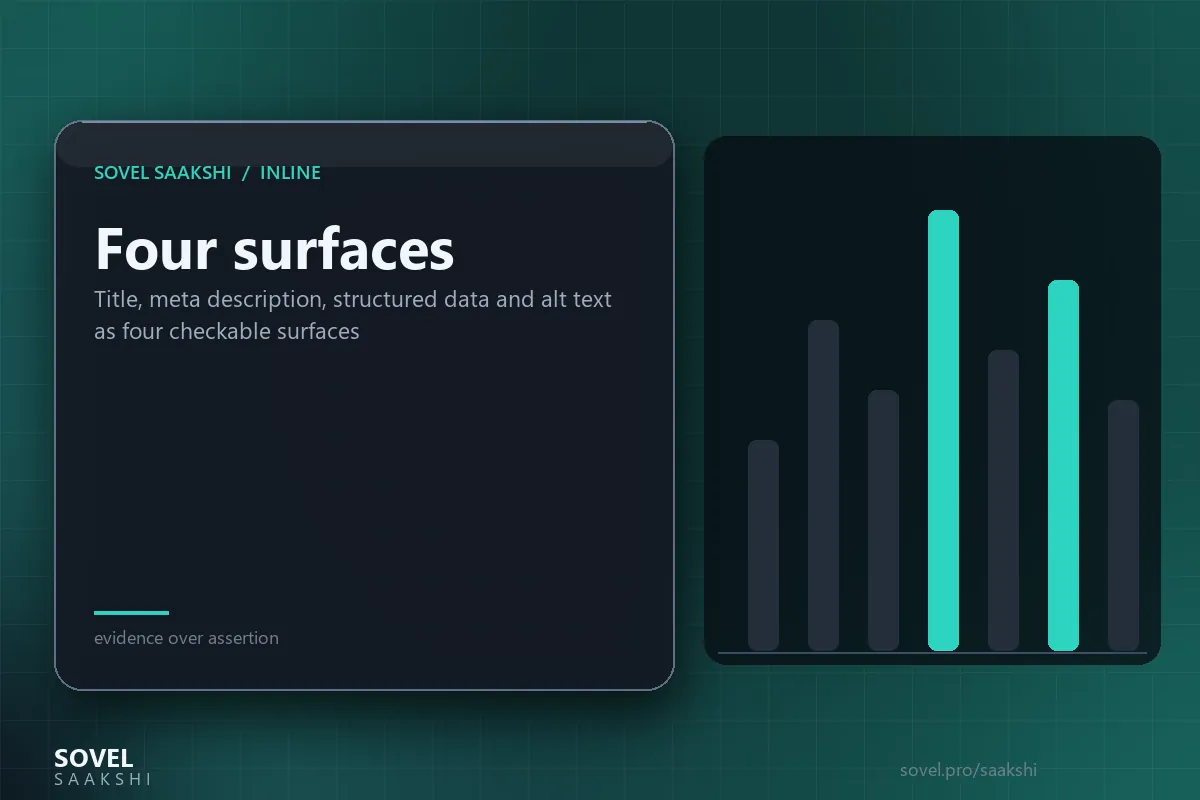
It is critical to manually factcheck and review all AI-generated content for accuracy and trustworthiness before publishing. The same review covers page titles, meta descriptions, structured data and the alternate text on images, which can appear in Search results.
This is the step most guides to how to fact check AI generated content leave out. The four surfaces are the title, the meta description, the structured data and the image alt text. These are generated in bulk by plugins and models, they appear in search results without the body around them, and almost nobody reads them line by line.
How to check them without wasting an hour, and this is where most advice on how to fact check AI generated content stops too early, because these four surfaces are where a model writes without anyone reading:
- Read the title as if it were the only thing a buyer sees. Does it carry a claim the body supports?
- Read the description the same way. A description promising something the page does not do is the cheapest possible way to lose a customer.
- Open the structured data and read the price, rating, availability and date fields. These produce rich results and these are the fields that cause trouble when wrong.
- Read every alt text. An alt text that says “best price ₹6,999” when the price is ₹2,499 is a claim sitting on a surface no human reads.
The primary source is Google Search Central, and the wider set of requirements sits in the Search documentation. Neither asks you to buy a tool. Both ask for a review, which is a habit plus a record.
[The four metadata surfaces a claim can hide in, with the body text as the fifth.]
How to fact check AI generated content in one pass
Forty minutes is the honest answer to how to fact check AI generated content by hand on a three thousand word draft, and fatigue lands exactly where the fourth check is. That is why we automated it, and why the workflow below is the one we use rather than the one that sounds best.
node bin/saakshi.js scan draft.md
node bin/saakshi.js prove draft.md --ledger ledger.json
node bin/saakshi.js pack draft.md
In the automated version of how to fact check AI generated content, scan lists every claim that carries something checkable. prove binds each claim to a line in your ledger and returns one of seven verdicts. pack writes the report folder.
The exit code is the decision:
0  PUBLISH   every claim has a witness
3  REVIEW    inference or estimate, a human decides and signs
2  BLOCK     no source, or a source about something else
1  ERROR     the engine could not run
[The four exit codes, and the action each one asks for.]
What you do with the output decides whether how to fact check AI generated content becomes a habit or a one off. Our rule, learned the hard way: fix every BLOCK before reading the draft for style. Style reading makes you fond of sentences, and fondness is what lets a wrong number through.
The command level version with the exact ledger format is in verify AI content before publishing. If the document is a report or a proposal rather than a web page, use verify claims in a document.
The ledger: what a source card needs to be usable
The answer to how to fact check AI generated content that still holds six months later is a ledger, not a memory. A ledger is a list of sources, and a source is usable only if it can answer three questions: what did the page say, when did you look, and where was it.
Six fields per entry, none of them optional, because the ledger is the whole answer to how to fact check AI generated content without starting from zero every time:
| Field | What it holds | Why it is needed |
|---|---|---|
| url | the exact page, without tracking parameters | a link with a session token expires and looks like a mistake |
| quote | the sentence, copied rather than summarised | the quote is what the claim is compared against |
| retrieved | the date you read it | prices and statistics have a shelf life |
| subject | the product or entity the quote is about | the check that would have caught our eleven day failure |
| tier | the edition or plan, when the claim names one | a missing tier is no support, not partial support |
| note | one line on why this source was chosen | the next person should not have to re-derive your judgement |
Two rules about the ledger itself, and both are about how to fact check AI generated content without paying for the same source twice. Do not let it grow into a link dump: one entry per claim, and no entry that supports nothing. And keep it beside the draft in the repository, because a ledger in a chat history is not a ledger.
What to do when a check fails
Checks fail often, and how you end them is the practical half of how to fact check AI generated content. There are three honest endings, and the order matters.
- Find the source. Fastest, best, and possible about half the time.
- Soften the claim into an estimate. Around seven thousand rupees is honest when the exact figure cannot be pinned, and it removes the exposure, though the review still has to be signed.
- Delete it. The most common correct answer and the least popular one. A sentence that cannot be supported is not carrying information, it is carrying risk.
[The three honest endings, and the fourth option that is not honest.]

The fourth option is where most attempts at how to fact check AI generated content quietly stop: widen the claim until it is technically true. One of the cheapest in its category is not a fact, and a reader who checks will treat it as a dodge.
What people ask about how to fact check AI generated content
Is fact checking AI content different from checking human writing?
The checks are identical, which surprises people who expect how to fact check AI generated content to need a different method for machine text. Either way, the seven checks are the answer. What changes is the volume and the failure pattern. A human draft usually fails on a stale number; a generated draft fails more often on a true statement attached to the wrong subject, because the model recombines sentences it has seen without keeping track of what each one was about.
Do I need a tool for this, or can I do it by hand?
By hand is fine for one page a week, and it is how the seven checks were written. If you publish often, how to fact check AI generated content becomes a program’s job rather than a person’s. A tool becomes worth it when you publish often, when a client asks for proof, or when two people have to agree on the same standard.
How long does one draft take?
That is the honest answer to how long how to fact check AI generated content takes, and it does not shrink with better writing. Forty minutes by hand on three thousand words, about four minutes with a prepared ledger. The saving is not the reading, it is the writing down. A second run on the same draft takes seconds because the ledger already exists.
What if the source has changed since I checked it?
Re-check it. If the page no longer says what your card says, the card is history and the claim needs a new source. This is the normal lifecycle rather than an emergency, which is why the date sits on the card.
Can I check content a model wrote for a client?
Yes, and that is the common commercial case. The deliverable becomes the draft plus the report folder, which is a stronger handover than a paragraph promising you read carefully. Check the licence terms for which edition covers client work before you promise it.
Does this replace an editor?
No. It replaces the mechanical part of editing and removes the excuse for skipping it. An editor reads for sense, order and tone. A check reads for evidence. Treating the two as the same job is how eleven days happen.
What about claims I cannot check, like opinions and predictions?
Label them as opinions and predictions in the sentence. A claim marked as a judgement is not a claim that needs a witness, and the label costs four words.
Start with one page you already published. Pick a page with a price on it. That single page is the fastest way to learn how to fact check AI generated content, and it costs one evening. One page, one evening, one habit, and the answer to how to fact check AI generated content stops being theoretical. Run the seven checks tonight, by hand if you have no ledger yet. Most people find one thing, and the one thing is usually the fourth check, which means the number was right and the subject was not.
That find is worth more than this article. If you want the mechanical version, the engine we built is described at SOVEL SAAKSHI, including the nine limits it publishes. If you want the policy that makes this urgent, start with what Google changed about AI content.
The figures and the sources on this page were last checked on 21 November 2026. SOVEL SAAKSHI is the engine this method was written for, and it is honest about the four checks it cannot make.
The four steps above are the whole of ai content verification, and the rest is tooling.
If the draft cannot leave the machine, an offline fact checker is the only category that applies.