
Google fact check ai content is not a phrase the company uses, but the search phrase describes a real obligation. On 1 October 2026, Google said the manual review that applies to AI content also applies to metadata: titles, descriptions, structured data and image alt text.
That one sentence changed what a compliance failure looks like. A page can now be accurate in every paragraph and still publish a false claim, because the four surfaces that reach a search result are written by software, not by a person.
This is the practical guide to google fact check ai content after that change. Not a summary of the announcement, and not a claim that Google wants you to buy anything. It is a worked method across the four places a machine writes without a human reading, with one real example per surface. If you want the pre-launch routine rather than the policy, start with verify AI content before publishing.
[The date, the sentence and the four surfaces it adds to the review.]
What changed on 1 October 2026
The guidance on generative AI content has asked for a manual review for a while. What is new is the scope of that review. The current sentence reads:
It is critical to manually factcheck and review all AI-generated content for accuracy and trustworthiness before publishing. This review also applies to metadata: title elements, meta descriptions, structured data, and alternate texts for images, which can appear in Search results.
Read the second sentence slowly. Title elements, meta descriptions, structured data, alternate texts. Four surfaces, three of which are produced by software rather than by a person, and all four of which appear in a search result without the article around them.
Any serious approach to google fact check ai content starts by accepting that these four are not decoration. They are claims. A title that says “cheapest in India” is a claim. A description that says “free forever” is a claim. A price field in structured data is a claim. An alt text that says “before and after in 4 weeks” is a claim.
None of that is optional under a working google fact check ai content routine. The page carrying the guidance is Google Search Central. Read it once yourself rather than trusting a summary, including this one.
The four surfaces the review now covers
For google fact check ai content, the surfaces group into four jobs. Each fails in its own way, and each has a cheap check.
| Surface | Where it comes from | How a false claim gets in | Check |
|---|---|---|---|
| Title element | template, plugin, model suggestion | a claim added to earn a click | read it as a standalone sentence |
| Meta description | plugin template, model summary | a promise the page does not make | compare against the first section |
| Structured data | theme, plugin, hand written JSON | a price or rating that drifted | open the JSON, read the value |
| Image alt text | author, model, bulk upload tool | a figure or an outcome in words | read each alt as a caption |
The common thread is that none of the four is written while someone is thinking about accuracy. Titles are set in a field. Descriptions are auto-generated from the first paragraph. Structured data comes from a plugin that reads a price field somewhere else. Alt text is typed in a hurry during upload.
That is exactly why google fact check ai content has to include them. The surfaces where nobody is paying attention are the surfaces that reach the search result.
[The four surfaces, and where each one is actually written.]
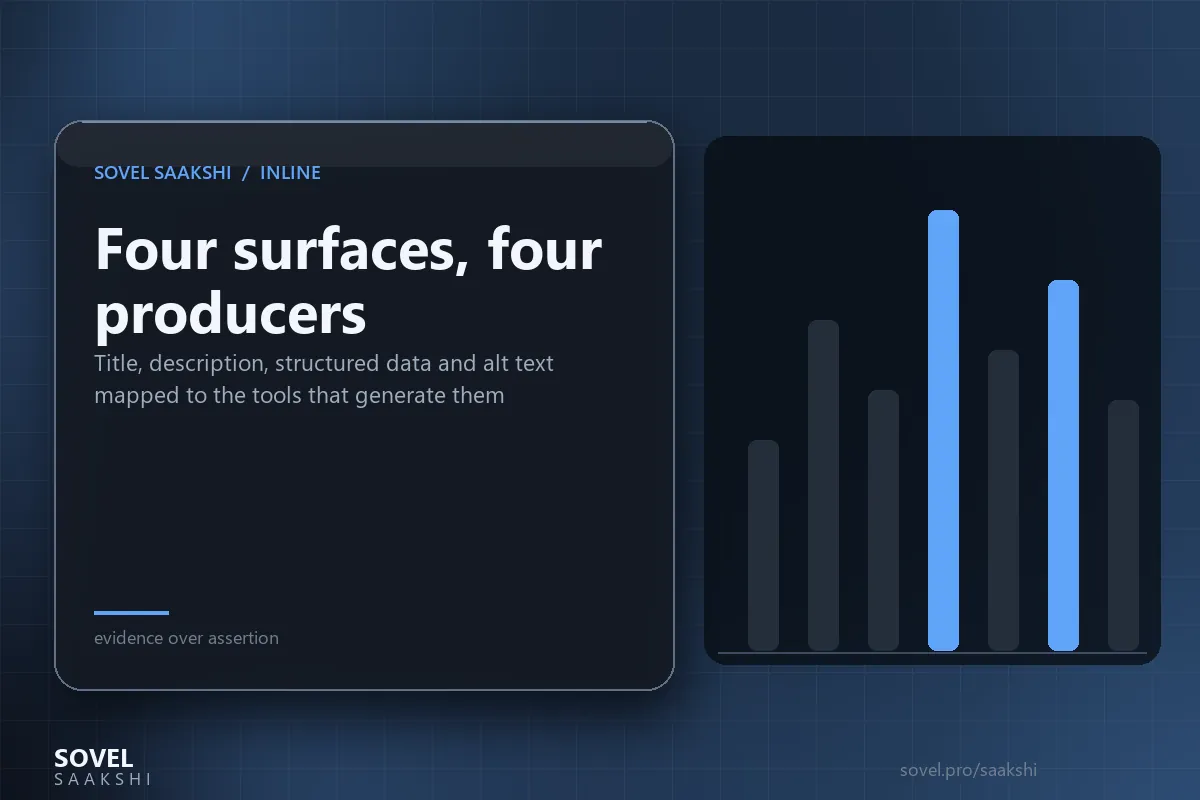
Why metadata errors survive every normal review
A body text error usually gets caught, because somebody reads the body. Four things protect a metadata error from the same fate.
- It is generated after review. The draft is approved, then the plugin fills the title, the description and the schema. Nobody re-reads a field they did not type.
- It is short. A false claim in forty characters looks like a formatting choice, not a statement.
- It is not in the document. Editors review a draft file. The metadata lives in a database field, which is not in the draft file.
- It changes without an author. A price update in WooCommerce changes the structured data. An SEO plugin update changes the description template. The page body does not move, so no one thinks to look.
A fifth reason matters more than the rest, and it is the one that turns google fact check ai content from a good practice into an urgent one: the four surfaces are the only part of the page that gets republished by other systems. A search result, a social card, a rich result, a voice answer. A wrong claim there travels further than a wrong claim in paragraph nine.
If you are running google fact check ai content checks on the body and not on the metadata, you are checking the part that already gets read.
What a generated title tag gets wrong
Titles fail three ways, and all three are about being asked to do two jobs at once: rank, and stay true. Most of google fact check ai content work on titles is separating those two jobs.
The unsupported superlative, which is the most common title failure in any google fact check ai content review. “The best fact checker in India” is a claim with no source and no definition. It also reads as a claim to any buyer comparing options. If the page cannot support it, the title cannot carry it.
The number that drifted. A title written as “cut review time by 70 percent” survives long after the study, the measurement or the sample changed. Titles are rarely the first thing edited when the underlying figure changes, which is why a stale number lives longer in a title than in a body.
The comparison the page does not make. “Faster than every other tool” is a claim about a set of tools the page never lists. A comparison needs its subjects named, and a title has no room to name them.
[One title, three failures, and the corrected line underneath.]
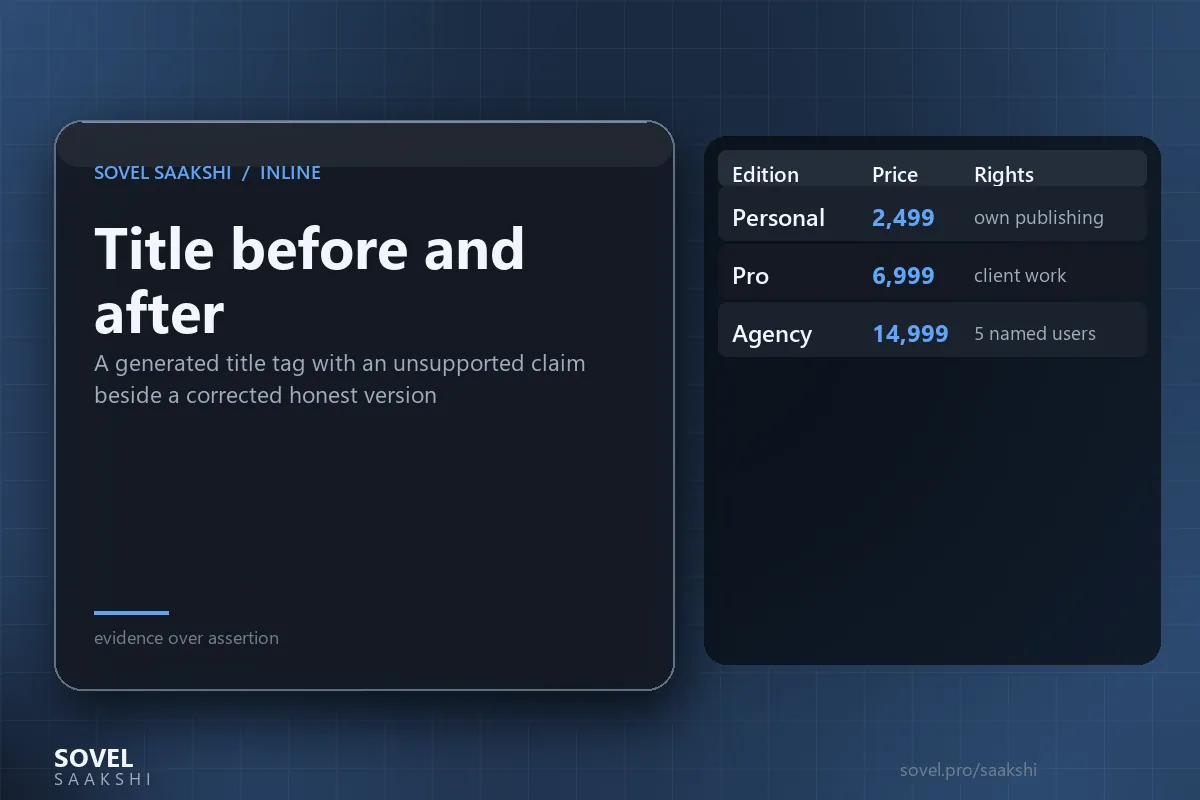
The check takes ten seconds. Read the title as a sentence on its own, with no page under it. If it makes a claim, the page must be able to answer for it in the first screen. For the pattern rather than the example, the seven checks in how to fact check AI generated content apply unchanged here.
What a generated meta description gets wrong
Descriptions fail by promising, and that is the second place google fact check ai content finds the expensive mistakes. A plugin that builds the description from the first paragraph inherits whatever the first paragraph claims, including an offer that was edited out of the page in a later revision.
Two failures are common enough to name.
The price in the description, and this is where google fact check ai content stops being theoretical. A description that says “from ₹2,499” is a price claim on a surface that updates separately from the pricing table. When the price changes, the description does not, and the search result keeps advertising the old figure for weeks.
The outcome promise. “Publish with confidence”, “never get fact checked again”, “guaranteed accurate”. These are not descriptions of a product, they are promises about outcomes, and a buyer who measures the promise has a complaint.
[The description that advertises a retired price, and the corrected version.]

Check: does the description contain a number, a price, a date or an outcome word? If yes, it needs the same source card as a body claim. If the number is not in the ledger, it comes out of the description.
This one rule removes most of the risk from google fact check ai content in about a minute per page.
What generated structured data gets wrong
Structured data is the most valuable surface to publishers and the most dangerous to get wrong, because it is the only one written for machines to act on directly. It is also the surface where google fact check ai content is skipped most often, since the JSON is invisible on the page.
The fields that matter:
priceandpriceCurrency, which must match the visible price on the page, on the same day.availability, which stops being true the moment stock runs out.aggregateRatingandreviewCount, which must describe reviews of this item and nothing else.datePublishedanddateModified, which are the two fields a reader uses to judge whether a figure is current.
[One structured data block with a price that no longer matches the visible page.]
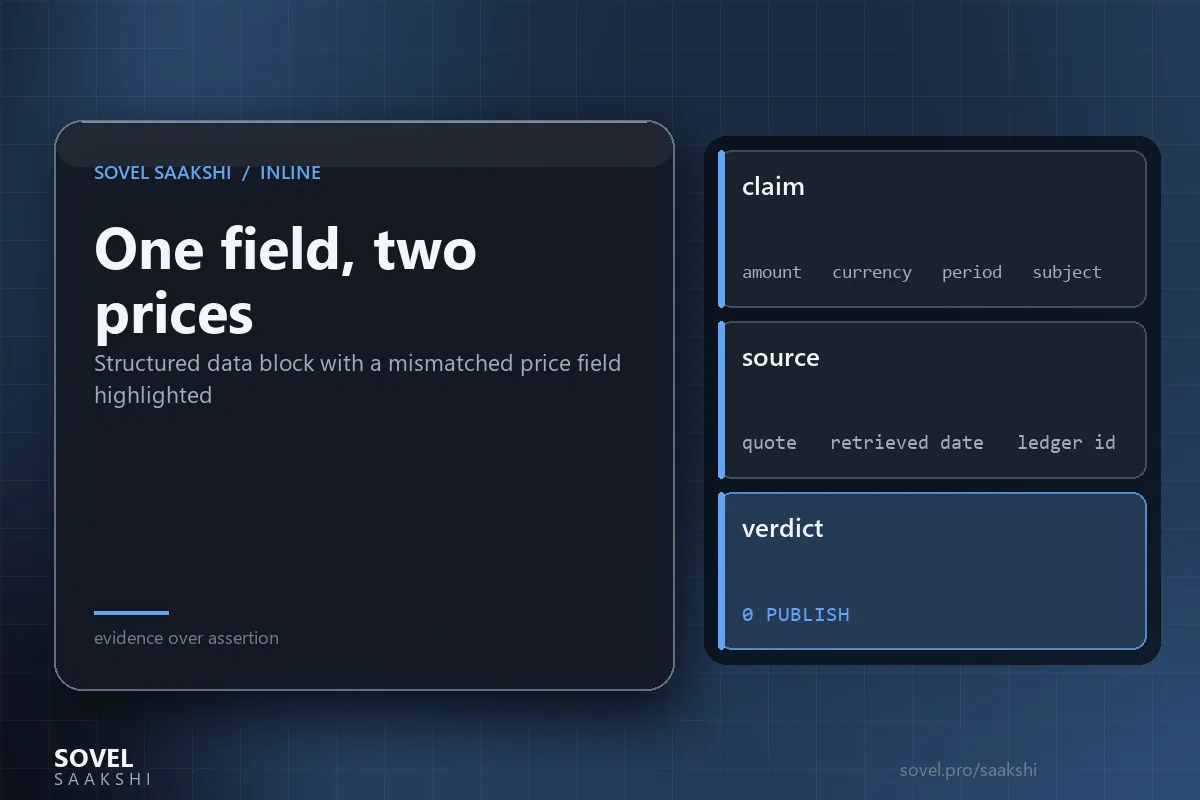
The failure that hurts most is the rating, and it is the clearest argument for adding google fact check ai content to a scheduled check: Borrowing a rating from another product in the same catalogue produces a star rating for something nobody reviewed. That is the same error as our eleven day price mistake, in a field that appears beside the search result.
For google fact check ai content, the check is a diff: open the JSON, compare each value against the visible page, and treat a mismatch as a blocked claim rather than a rounding problem.
What generated alt text gets wrong
Alt text is the fourth surface, and the one most people forget when they think about google fact check ai content. It is written for people who cannot see the image, and it is read by machines. Both of those audiences get misled by the same habit: describing what the image is supposed to prove rather than what it shows.
Three failures, each of which a google fact check ai content pass will pick up in seconds:
The outcome claim. “Customer revenue up 40 percent after switching” on an image that shows a generic dashboard. The alt text is making a claim the image does not contain.
The number that is not in the figure. Alt text saying “supports 5 users” on a screenshot that shows a seats field of three.
The decorative keyword block. Alt text stuffed with keywords, which helps nobody and reads badly in a screen reader.
Check: does the alt text state anything the image itself does not show? If yes, it is a claim, and it belongs in the body with a source, or nowhere.
Alt text is the surface where google fact check ai content is easiest to skip and most embarrassing to get wrong, because the person harmed is a reader who cannot see the picture and trusted your description of it.
The forty page problem: when one template repeats a claim
A single page with a wrong description is a mistake. The same wrong description on forty pages is a policy problem, and metadata templates are built to repeat.
This is the failure that makes google fact check ai content worth scheduling rather than doing once. A plugin that builds descriptions from the first paragraph will produce the same sentence on every page that opens the same way. A schema template that reads a price field will print whatever the field holds, including a placeholder that nobody updated. A theme that appends a brand claim to every title will append it to the pages where the claim is false as well as the pages where it is true.
Three patterns are worth looking for specifically, and each one is a google fact check ai content problem visible only at site level.
The template phrase. Open five pages of the same type and read the titles in a row. If a phrase repeats, it is a template, and the question is whether it is true on all five. A phrase like “trusted by thousands” is true on none of them if nobody counted.
The stale field. Find the price, the date and the count that the schema reads from. Then change one of them in the admin and watch the structured data on the front end. If it does not update, your schema is reading a copy, and the copy is what search results show.
The inherited promise. Descriptions built from the first paragraph inherit the first paragraph’s claim, including claims that were edited out later. A page revised three times usually has a description that reflects revision one.
[Five page titles in a column, one repeating phrase highlighted across all five.]

The fix is not a rewrite of forty pages. It is a description pattern that carries no claim, plus a schema field that is read from the live value rather than from a copy. Take the number out of the template and the template stops being able to lie.
If you have a site audit already, this is the cheapest week of work available: search the title and description fields for numbers, prices, percentages, superlatives and year words, and look at what comes back. Most publishers find between five and fifty pages where google fact check ai content was never applied to the metadata at all, and every one of them is a live claim with no source behind it.
That is why the four surface check belongs in a weekly routine rather than a launch checklist. Templates drift, plugins update, prices move. The review that happened in March is not a review of the page in July.
Google’s own spam policies page is the other document worth reading beside the guidance, because it is where the consequences live: Google spam policies. Scaled content abuse is defined there in terms of pages produced primarily to manipulate rankings, and a forty page template repeating an unsupported claim is exactly the shape that attracts a manual action, whatever the intentions were.
That is the practical version of google fact check ai content at site level, and it is cheaper than rewriting anything. Read the two documents together and the instruction is unambiguous. Do not publish claims you cannot support, and treat the metadata as claims.
How to check all four in one pass
Four checks, one pass, about six minutes per page once the habit exists. This is the routine we run as google fact check ai content on our own pages before anything publishes.
Run the four in this order, because the cheap ones teach you what to look for in the expensive ones. 1. Open the page as a search result would see it. Read title and description as two standalone claims. Anything a buyer could hold you to needs a source.
- Copy the structured data into a validator and read the price, date and rating fields against the live page.
- Read every alt text aloud. If a sentence makes a claim, it is not alt text.
- Write what you changed on the source card, with the date. A review with no record is a mood.
The mechanical version, if you want it in a script:
node bin/saakshi.js scan page.md
node bin/saakshi.js prove page.md --ledger ledger.json
node bin/saakshi.js pack page.md
Exit code 0 publishes, 3 sends it to a human, 2 blocks it. The engine is described, with its limits, at SOVEL SAAKSHI.
Any working method for google fact check ai content ends the same way: with a person reading four short fields and signing off. The habit matters more than the tool, though. A page where google fact check ai content extends to the metadata is a page that cannot embarrass you in a search result, and that is the whole point of the change.
What Google did not say
Three things the announcement did not say, and each one is being said by somebody online. Getting these right is a large part of any honest answer on google fact check ai content.
Google did not require a tool. No sentence in the guidance asks for software, which is worth repeating in any discussion of google fact check ai content. The guidance asks for a manual review and a record. Any product claiming Google mandates it is misrepresenting a document that anyone can read.
Google did not say AI content ranks worse. The guidance is about accuracy and trustworthiness, not about authorship. A careful page written with a model is fine, and Google says as much elsewhere.
Google did not define “manual”. A person reading carefully is one way. A person running a deterministic check and reading the failures is another. The obligation is on the review happening, not on the method.
Keeping those three separate from the actual guidance is the difference between a page that will be cited and a page that will be corrected in the comments. Most pages on google fact check ai content blur at least one of them.
Google’s sentence is dated 1 October 2026, and this page was last read against it on 21 November 2026.
The tool built against Google’s wording is SOVEL SAAKSHI, and it checks the four metadata surfaces named above.
The way to google fact check ai content is to compare a draft against the record it came from, and no engine can google fact check ai content on your behalf without that record.
Questions about google fact check ai content
What exactly changed on 1 October 2026?
The guidance made explicit that the manual review applies to metadata as well as body content, naming titles, meta descriptions, structured data and image alt text. It is the narrowest useful statement of google fact check ai content to date. The obligation to review is older. The scope is what is new.
Does this mean every AI written page must be read by a person?
The guidance asks for a manual review before publishing. How you get that review done is your decision. What it rules out is publishing generated text without anyone checking it, and that was never a good idea.
Do I need to check metadata on pages I did not write with AI?
If a plugin generated the title, the description or the schema, then a machine wrote part of your page. The review applies to what is published, not to who typed it, so yes.
What is the most common metadata error on publisher sites?
A price in the description or in structured data that no longer matches the page. It is the single most common failure we find when we run google fact check ai content checks on a catalogue. It is common because prices change in one system and metadata is generated in another, and nobody diffs the two.
Is a schema error a ranking problem or a compliance problem?
Both, in different ways. A rich result built on a wrong price can be removed, and a complaint about a misleading price does not care which field carried it. Treat the structured data as a claim, not as markup.
How long does the four surface check take?
About six minutes per page once you have done ten of them, and about twenty for the first. The expensive part is the first pass, where you discover the plugin template is generating the same unsupported phrase on forty pages.
Can I automate the four surface check?
Partly. A script can extract claims from a title, a description and a schema block, and block the ones with no source in your ledger. That covers most of google fact check ai content work on a large site. It cannot read an image or judge whether a phrase is a promise, which is why the review still ends with a person and a written record.
If your site is small, doing google fact check ai content by hand on four fields a week is enough. If you want the full editorial routine rather than the metadata subset, how to fact check AI generated content covers seven checks in order. If the question is which engine to buy, the honest limits are published on the product page before you pay, not after.