
To verify ai content before publishing is to answer one question per claim: does a source say the same thing about the same subject, dated recently enough to still be true. Four checks produce that answer, and the four are what people skip when they verify ai content before publishing in a hurry. Each check ends in a decision rather than an opinion.
The reason this needs saying is that most pre-publish routines produce opinions. Someone reads the draft, someone feels better about it, and everyone moves on. That is a review, and a review is worth having, but it cannot be reopened three weeks later when a client asks where a number came from. It takes four minutes to verify ai content before publishing one page, and nobody has ever regretted that wait.
These four checks can be reopened. That is the whole difference, and it is why the routine below is short enough to survive a busy Friday. The cheapest moment to verify ai content before publishing is the hour after the last edit, while the draft is still open.
[A draft entering four checks and leaving with a decision.]
What verified has to mean to be useful
The word verified gets used loosely. In this page it means four things at once, and if any one is missing the claim is not verified. Anyone who has to verify ai content before publishing for a client will want the folder rather than a verbal verdict.
A source exists. A page you can open, not a memory and not a search snippet.
The source says it. The exact quote, copied, not paraphrased into agreement.
About the same subject. The same product, edition, tier and period. A neighbouring product is a different subject.
Recently enough. Prices and availability within thirty days of publication. Statistics and reports within ninety.
Any claim that fails one of those four is unverified, and unverified blocks. There is no partial credit in verify ai content before publishing, because partial credit is how a near match gets approved at nine in the evening.
Check 1: every claim has a witness
The first check is arithmetic. Count the checkable claims, count the sources, and see whether every claim has one.
A claim is checkable when it carries a number, a price, a date, a percentage, a quote, a named person or a ranking word. Everything else is opinion or arrangement and does not need a source. A team that chooses to verify ai content before publishing on a schedule stops finding errors in public instead.
Pass condition: the two counts match, one source per claim. If a single entry is being used for four claims, you have a page you trust rather than evidence you have checked, and the difference only shows up when one of the four changes. Even a five line page deserves the run when you verify ai content before publishing for somebody who paid for it.
In practice the count is the useful part. A commercial page usually holds between twenty and sixty claims, and a page that reports three is either unusual or under-extracted. The habit to verify ai content before publishing survives a job change, a tool change and three model upgrades.
That number also tells you what the run will cost in time before you start it. To verify ai content before publishing on a pricing page with ninety figures is a different job from verifying a blog post with six, and knowing which one you are in prevents a half finished job at the end of the day.
Check 2: the quote, not the link
The second check is where most routines quietly fail. People collect links and call it evidence.
A link records where you looked. A quote records what the page said when you looked. Only the second can be compared with a sentence written six days later, and only the second survives a page being edited after your run. Write the ledger entry as you write the sentence, or you will not verify ai content before publishing at all.
Pass condition: every entry has a copied sentence, with the row label when the source is a table and the period when the period lives in a heading. No summaries, no paraphrase wearing quotation marks. Two people who verify ai content before publishing the same draft will disagree about severity, and that argument is the useful part.
Two habits make this fast. Copy the row rather than the cell, so the subject travels with the number. And when the page has a date in its footer, copy that too, because a source with its own date is stronger evidence than a source without one. Because the ledger is a plain file, you can verify ai content before publishing a draft that never touches a network.
This is the check that decides whether verify ai content before publishing takes four minutes or forty. A ledger of quotes is reusable. A ledger of links has to be reopened every time.
[One claim bound to a quote, with the row label carried across.]

Check 3: the subject, and the tier
The third check is the one that caught our own eleven day price error, and the only one that cannot be automated away. The routine to verify ai content before publishing stops feeling like paperwork once the sources already exist for the third page.
Read the draft sentence and the source sentence side by side. Underline the subject in both. If the words differ, the claim has no witness, even when the amount matches to the rupee. Nobody needs permission to verify ai content before publishing, which is why it survives a slow approval queue.
Three variants account for most failures. The neighbouring product. The adjacent edition. The renamed product, where the source still carries the old name. A draft that was edited after the run is a new draft, so verify ai content before publishing again rather than trusting the old report.
Pass condition: the subject matches on the same words, and where the claim names a tier, the source displays that tier. A price list showing all three editions can support a claim about any of them. A page showing one edition supports one. The first page you verify ai content before publishing teaches you what your own writing tends to get wrong.
This asymmetry is the most useful rule to carry in your head when you verify ai content before publishing at speed. Showing the tier is support. Hiding the tier is not partial support, it is none.
Check 4: the date, and the rule
The fourth check is a comparison against the calendar, and it is the cheapest one to skip.
Pass condition: the retrieval date is inside the validity window, and the window is written down somewhere a reader can find it. Thirty days for prices and availability, ninety for statistics and reports. Anything older is re-checked rather than re-used. Where a claim has no source, the run to verify ai content before publishing will block it, and the block is the correct answer.
If it cannot be re-checked today, the claim ships as an estimate with its date in the sentence, which is honest and takes four words. What must not happen is a stale figure shipping as a current one because the draft was written in March and published in July. One named owner per product is enough to verify ai content before publishing across a whole catalogue.
Dates also catch a failure the other checks miss: a page that was correct when written and has been overtaken by the world. Nothing in the text is wrong. The world moved. If you verify ai content before publishing only once a quarter, choose the pages that carry a price.
[The validity windows, and what to do when a claim falls outside them.]

Turning the four checks into exit codes
Checks produce a verdict. A verdict needs to become a decision that a script or a person can act on. Four codes do that. The report explains the block, and the exit code stops it, which is the whole reason to verify ai content before publishing at that point.
0  PUBLISH   every claim has a witness
3  REVIEW    inference or estimate, a human decides
2  BLOCK     no source, or a source about something else
1  ERROR     the engine could not run
Two habits make the codes useful. Treat 2 as a hard stop, because softening a block under deadline pressure is exactly how a wrong figure reaches a customer. Treat 3 as work rather than permission, because review means someone writes down the decision and its reason. Keep the run folder beside the draft and the next person can verify ai content before publishing without asking you anything.
The codes also make it possible to verify ai content before publishing without a conversation. A script can run the check and refuse to publish on 2, which is the only version of this process that survives a busy week.
[Four codes and the action each one asks for.]

The five minute version for a short page
Not every page deserves the full routine. A six hundred word post with two figures needs a short version, and having one prevents the whole process from being abandoned as too heavy. A short limitation line at the bottom of the page is worth more than another paragraph explaining ai content before publishing. A page edited at nine in the evening is the page to verify ai content before publishing at half past nine.
Minute one. Read the draft and underline every number. Two figures, two underlines.
Minute two. Open both sources. Copy the two sentences that hold the figures.
Minute three. Compare subjects and periods. If they match, keep going. If not, stop and fix.
Minute four. Write the date beside each source, in the draft notes if nowhere else.
Minute five. Publish or fix. There is no minute six, and that is the point.
The short version is not a compromise on the checks, it is the same four checks with fewer claims. That distinction matters, because teams that build a heavy process first usually stop running it by week three, and a routine you actually run beats a standard you admire. Reading the ledger after a run is how most teams learn to verify ai content before publishing with fewer corrections next time.
The three failures that survive a careful read
Some failures cannot be caught by reading, which is why verify ai content before publishing is a comparison rather than a proofread.
The right number in the wrong sentence. Every word correct, the subject wrong. Reading cannot catch it because reading has nothing to compare against.
The true statement that expired. Correct on the date it was written. Reading cannot catch it because the calendar is not in the document.
The claim that quietly narrowed. A general statement edited into a specific one during a revision, while the source stayed general. Reading cannot catch it because the revision looks like an improvement.
All three require a second document in the room. That is the whole argument for keeping a ledger rather than a memory.
[Three failures a careful read cannot catch, each with the second document it needs.]
Where this fits in a publishing routine
The order is not arbitrary. Verification goes before the style pass, and the style pass goes before the design pass.
Verification first because it is the only step that produces blocks. Fixing a block early costs a sentence. Fixing it after layout means moving sections.
Style second because style reading makes you fond of sentences, and fondness is what lets a wrong claim survive a second read.
Design last because layout work separates claims from their subjects. A figure that sat beside its product name in the draft can end up three sections away, and the claim becomes false without anyone editing a number.
Anyone who wants a single rule for verify ai content before publishing across a team: blocks before beauty. It sounds glib and it prevents the specific failure where a beautiful page ships with a wrong price.
What the run leaves behind
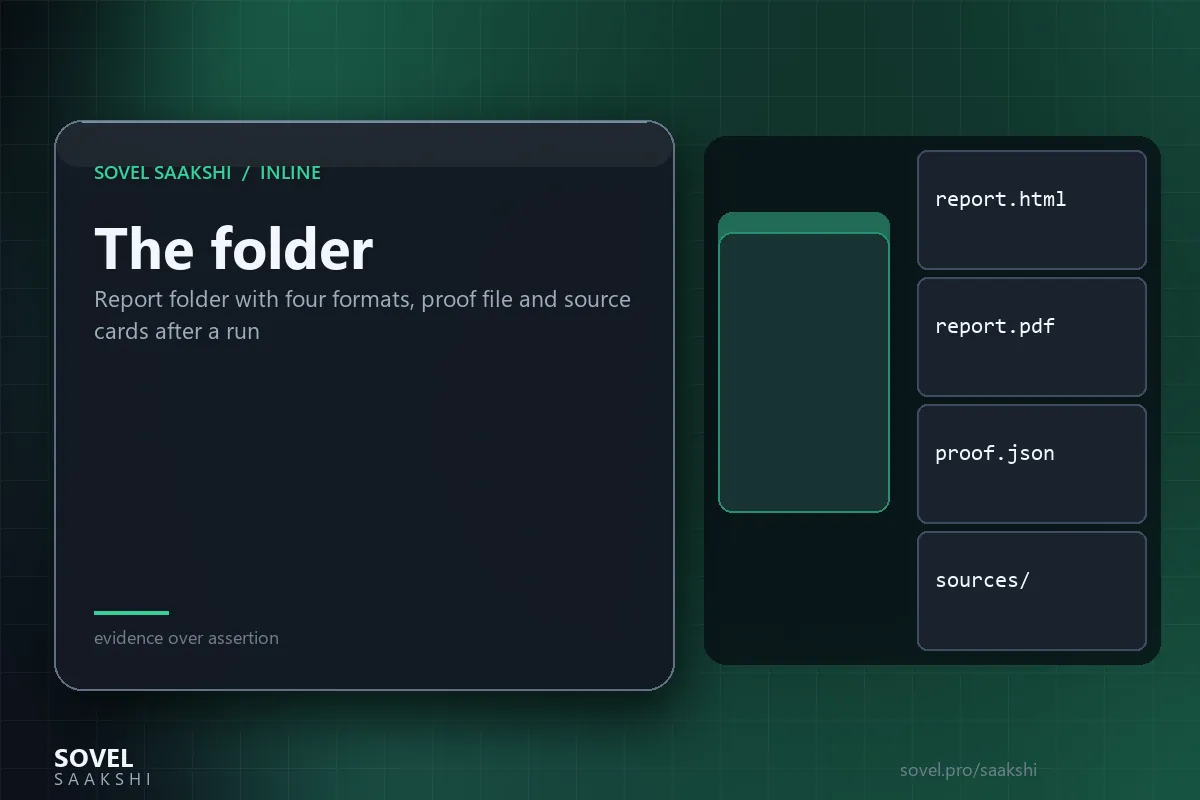
A folder named for the date and the draft, holding a report in HTML, PDF, DOC and Markdown, a proof file with a hash and a source card per bound claim.
The hash proves the file was not altered after the run. It does not prove who ran it, and no offline tool can. If you need identity, that is a process question answered by a register, not by cryptography.
The folder is also the artefact that answers the question three weeks later. When someone asks where a figure came from, the reply is a source card, and the conversation is short.
[The folder with four report formats, a proof file and source cards.]
Doing it with a command instead of a checklist
The four checks can be run by hand, and they should be for the first week. After that a command is faster and, more importantly, repeatable.
node bin/saakshi.js scan draft.md
node bin/saakshi.js prove draft.md --ledger ledger.json
node bin/saakshi.js pack draft.md
The engine behind those commands runs offline, needs no account, and publishes its nine limits before purchase. It is described at SOVEL SAAKSHI, including the parts it cannot do, which is the section worth reading first.
The policy reason to verify ai content before publishing is dated and short. Google’s generative AI content guidance asks for a manual accuracy review before publishing and extends that review to titles, descriptions, structured data and alt text. The Search documentation covers how a page is read once it is live, which is where the cost of a wrong claim compounds.
If the editorial method is what you want, how to fact check AI generated content is the long version. If the question is a document rather than a page, verify claims in a document handles the scale problem.
What a block actually costs you
A block is the least popular output in publishing software and the only one that saves money.
Three costs of a block, stated honestly, because a tool that hides them is selling you a surprise.
It costs four minutes. You stop, find the source, and rewrite a sentence. Four minutes, once, on a claim that would otherwise sit on a page for weeks.
It costs a conversation. Occasionally a block lands on a sentence someone is attached to, and the rewrite is political rather than technical. That conversation is shorter than the one a customer starts later.
It costs a habit change. The first month feels slow because you are building a ledger while writing. By the second month the ledger exists and the blocks get rarer, not because the tool softened but because you stopped writing unsupported claims.
Against those, the cost of the three failures that reach a customer is not four minutes. It is a refund, a correction, and a small permanent discount on everything else you publish.
That asymmetry is why the exit codes matter more than the reports. A report is read once. A code stops a publish, and a publish that did not happen cannot cost you anything.
Questions a team asks in week one
Three questions come up whenever more than one person uses this process.
Who owns the ledger? One person per product, named. Shared ownership of a ledger means nobody maintains it, and an unmaintained ledger produces confident wrong answers, which is worse than no ledger.
Who can overrule a block? Only the owner of the ledger, in writing, with a reason. An overrule that is not written down is the same as deleting the check.
How do we handle a claim we cannot source? It ships as an estimate with its date in the sentence, or it is removed. There is no third option, and inventing one is how a process becomes a formality.
The timing figures below were measured on 21 November 2026 on a laptop, not on a server.
SOVEL SAAKSHI is the engine in the examples above, priced at ₹2,499 for Personal, ₹6,999 for Pro and ₹14,999 for Agency, paid once.
The cheapest way to verify ai content before publishing is to check the four fields of each claim, and teams that verify ai content before publishing by rereading alone will keep shipping the same error.
Questions about how to verify ai content before publishing
Is this the same as proofreading?
No. Proofreading checks the sentence against the language. These checks compare the sentence with a source. A page can pass proofreading and fail all four checks, which is exactly what happened to us for eleven days.
How long does it take?
Five minutes for a short page with two figures, forty minutes for a three thousand word commercial page by hand, and about four minutes once the ledger exists. The saving is not reading speed, it is the writing down.
Do I need a tool to do it?
No. The four checks work by hand and that is how they were written. A tool earns its place when volume rises, when a client asks for proof, or when two people must agree on the same standard.
What if a claim is an opinion?
Label it. An opinion does not need a source, it needs a marker in the sentence: in our view, we expect, on current evidence. The label costs four words and removes the claim from the check.
What if the source is a PDF?
Copy the sentence by hand with the page number. Deterministic extraction over Markdown cannot see inside a PDF table, so the operator supplies the quote. That is a limitation, stated here rather than discovered later.
Can I run this on a page that is already live?
Yes, and it is the best way to learn. Run the four checks on your most popular page tonight. Most people find one thing, and the one thing is usually the subject rather than the digit.
What happens with a contradiction inside the draft?
Two different prices for the same product block the run before any source is opened, because at least one of them is wrong and no amount of checking settles which.
Which edition covers client work?
Agency edition, since what separates the editions is rights rather than features. Personal covers your own publishing, Pro covers commercial use of your own products, Agency covers deliverables for clients. The engine is identical in all three archives.
One line to end on. To verify ai content before publishing is not to distrust the writing. It is to accept that a document cannot check itself, and to build the one habit that supplies the second document while there is still time to act on it.