
An offline fact checker runs entirely on the machine where the draft lives. No account, no API key, no upload, no server, no telemetry. The draft is read, the claims are compared with a ledger you wrote, and the report is written to a folder beside the file.
That single design decision changes what the tool can be used for. It also costs something, and the cost is stated on this page rather than discovered later, because a buyer who finds it afterwards is a refund and a lesson. The archive is the product, and an offline fact checker keeps working after the vendor’s site changes.
Four reasons the constraint is worth it, then the honest section on what you give up. If you want the buying comparison instead, fact checking tool covers the trade-offs. A machine that never calls out is a machine a security reviewer can approve in a single meeting, which is why an offline fact checker wins there.
[The draft, the ledger and the folder, with nothing leaving the machine.]
What offline actually means here
Four properties, and a vendor should be able to demonstrate all four rather than assert them.
No network call. Not a quiet one, not a licence check, not a crash report. The engine has no HTTP client in the code path that runs a check, and our own release gate fails the build if a request appears. Version the ledger, because an offline fact checker reading last year’s sources is answering a different question.
No account. There is nothing to sign into, which means there is no user database to be breached and no password to be lost. The results folder is the whole interface of an offline fact checker, and a folder opens in five years.
No API key. No model is called, so no key exists. That removes a whole category of failure: leaked keys, expired keys, billing surprises and rate limits. No account means no offboarding task when a contractor finishes, which is a quiet benefit of an offline fact checker.
No telemetry. Nothing is counted, sampled or reported. The only artefact is the folder you can read.
The fourth property is the one that surprises people who are used to modern software. Nothing is counted because nothing can be counted locally, which is a stronger guarantee than a privacy policy promising restraint. A local run on forty drafts finishes while a cloud queue is still waking up, and that gap is where an offline fact checker earns its price.
Reason 1: client drafts never leave the machine
For an agency, this is the whole argument and everything else is secondary.
A draft under NDA cannot be uploaded to a third party service without a conversation, a data processing agreement and, in most cases, a client’s written consent. That conversation is slow and it is usually refused, which means cloud tools get used on the drafts that matter least and the confidential ones get checked by eye. Read the threat model before the feature list, since an offline fact checker that names its gaps is easier to approve.
An offline fact checker inverts that. The drafts that most need checking are the ones that cannot be shared, and they are exactly the drafts an offline tool can take.
The same reasoning applies inside a company. An unreleased pricing change, a draft policy, a legal review, an incident report. Each one is a document where a wrong number costs the most and where uploading is the hardest to justify. Two files and a folder is a smaller surface than a service, which is the argument for an offline fact checker in one line.
Reason 2: reproducibility
A cloud tool produces a verdict about today. Run the same check next month and the inputs may have changed, so the answer may differ, and neither answer is wrong. Where a draft cannot leave the building, the only workable answer is an offline fact checker on the machine that holds it.
An offline fact checker produces a verdict about a ledger. The ledger is a file, the file has a date, and the verdict can be reproduced a year later by anyone holding the same two files.
That property is what makes a check into evidence. Without it, a verdict is an opinion delivered by software, and opinions delivered by software are not more reliable than opinions delivered by people, they are just faster. A hash proves the file did not change, and an offline fact checker cannot prove who ran it, which is the honest boundary.
This is also why the proof file carries a hash. A matching hash shows the file was untouched since the run. It does not prove who ran it, and no local tool can, which is the honest boundary of what reproducibility gives you. Keep the previous folder when you re-run, so an offline fact checker leaves a readable history rather than a single overwritten answer.
Reason 3: no key, no account, no outage
Three failure modes disappear at once.
Nothing expires. An API key that lapses on a Sunday morning is a publishing routine that stops without warning. A local engine has no key to lapse. Manual updates are a real cost, and an offline fact checker keeps that cost visible instead of hiding it in a subscription.
Nothing rate limits. A batch of forty drafts is a batch of forty, not a negotiation with a quota.
Nothing goes down. A vendor outage is not your outage, because the only dependency is the machine you are sitting at. The absence of telemetry is structural in an offline fact checker, because there is no server to receive anything.
Against that, the tool has to be installed, and installation is where offline products lose to cloud ones on first impressions. A single archive with a documented version requirement is the right shape, and anything more elaborate is a sign the vendor has not thought about the buyer’s ten minutes. Font coverage is a genuine limit of an offline fact checker, and it belongs in the documentation rather than a support thread.
[Three failure modes that vanish when there is no server.]

Reason 4: speed and cost, in that order
A local check is fast because there is no round trip and no queue. Our own runs on a three thousand word draft finish in seconds once the ledger exists, and the report is on disk before a network call would have completed a handshake. Testing on three systems is not support for every distribution, and an offline fact checker should say so on the page.
The cost argument is simpler. A local tool has no inference cost, so the vendor has no per-use expense, so the price can be one time. Our pricing reflects that: ₹2,499, ₹6,999 and ₹14,999, paid once, perpetual for the v0.x line. When the network is down the routine still runs, which is the entire point of buying an offline fact checker.
Be careful with this argument in either direction. A cloud tool charging monthly is not gouging if it runs inference on every check, because it is paying for something each time. An offline tool charging monthly would be charging for access to software that costs the vendor nothing to run, which is a business model rather than a service. Store the quote beside the claim, so a colleague can audit the entry without an offline fact checker or without you.
What you give up, stated plainly
Four things, and the first one is the one that matters.
No source discovery. An offline fact checker cannot find a source you do not have. It never opens a browser, so research stays your job. If your problem is that a claim has no source at all, this tool will block the claim and you will still have to go and find one.
No live price watching. A ledger entry is a snapshot. When a vendor changes a price, the ledger does not update itself, and the run will keep approving the old figure until you re-check. The thirty day rule exists for exactly this reason. A local check is reproducible in a way a live search is not, because an offline fact checker works from files.
No teamwork features. No shared dashboard, no assignments, no notifications. The collaboration artefact is a folder that people can read, which is less convenient and more durable than a dashboard. Buy an offline fact checker only when confidentiality is the reason, because convenience still favours the cloud.
No judgement of sources. A forum post and a vendor page are treated identically. Credibility is your call, recorded in the ledger note. An offline fact checker that runs on the machine holding the draft removes the entire question of data transfer.
Those four are the price of the four reasons above. Anyone selling an offline tool without this section is selling you a surprise. Where a policy forbids the network, an offline fact checker is the only category that can be approved at all.
[The four trade-offs, each mapped to the reason it exists.]
An offline fact checker is judged on the same four questions as any tool in this category, and the answers here are deliberately narrow. Source discovery, live price watching, teamwork and source judgement are all human work. What the tool adds is a decision per claim, with the quote and the date attached, produced without a network call.
That narrowness is the point. A product that claimed all eight would be claiming to research, monitor, collaborate and judge, and no offline engine does any of them. Install once, run it weekly, and an offline fact checker becomes the cheapest part of the publishing routine.
When online is the right choice
Being honest about this is why the rest of the page holds up.
Choose a cloud tool when the drafts are public, the volume is high and the research is the bottleneck. A newsroom checking public claims at speed, a marketing team with a thousand live pages and no ledger, a team that would rather not maintain source files at all. Those are real situations and a local tool is the wrong answer for them. Where the draft is a client deliverable, the folder from an offline fact checker travels with it as evidence.
Choose an offline fact checker when any of these is true: the drafts are confidential, a client asks for a reproducible record, the routine must work without a subscription, or the machine has to stay off the network by policy.
Most agencies fall in the second group and buy from the first. That mismatch is the most expensive mistake in this category, and it is not a product problem, it is a scoping problem. An offline fact checker cannot research for you, and every honest page in this category says so early.
What the folder looks like
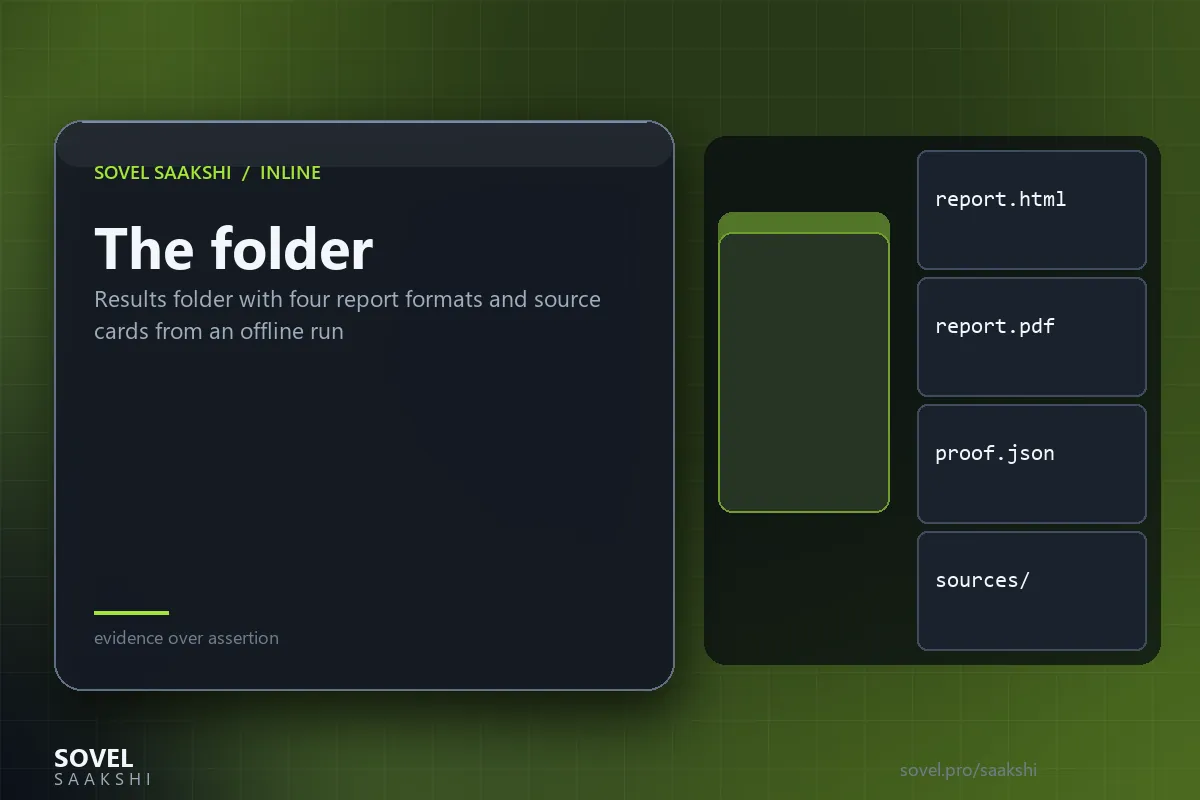
One run writes a folder named for the date and the draft. Inside: a report in HTML, PDF, DOC and Markdown, a proof file with a hash, and a source card per bound claim.
The PDF font is WinAnsi, which means Devanagari and CJK characters appear as question marks in the PDF only. HTML and Markdown keep full Unicode. That limitation is stated here, on the product page and in the archive, because it is the kind of thing a buyer discovers at the worst moment otherwise.
The engine is documented with a quickstart, an evidence policy and a threat model, all inside the archive. Read the threat model first if you are evaluating it for a security review, because it names what the engine does not defend against, which is more useful than a page claiming it defends everything.
[The folder, its four report formats and the source cards.]
A security review you can do yourself
Offline is a claim, and a claim worth checking. Four things you can verify in the archive without being a security engineer.
Grep for a network client. Search the source for the HTTP and HTTPS modules. In our archive you will find them in the URL redaction code, where they exist to recognise a URL rather than to call one, and nowhere in the path that runs a check. Our own release gate fails the build if a request appears in the check path, and the gate is in the repository you receive.
Read the threat model first. The document names what the engine does not defend against, which is more informative than a page claiming it defends everything. Limits on PDF font coverage, URL redaction by parameter name rather than entropy, and deterministic extraction over Markdown are all body limitations, and each one is written down.
Check the dependency list. Ours is empty. There are no runtime dependencies, which means there is no supply chain to attack and no package that can be deprecated under you. That property is unusual enough to be worth verifying yourself with one command and one file.
Look for telemetry. None at all, and the reason is structural rather than a promise: nothing exists to receive it. A privacy policy asks you to trust a company. An absent network client asks you to trust nothing.
If you are evaluating this tool for an organisation with a security review process, those four checks answer most of the standard questions before a questionnaire is needed. The remaining questions are usually about support and versioning, and the honest answers are in the archive rather than on a marketing page.
Where offline gets uncomfortable
Two honest difficulties, both worth knowing before purchase.
Updates are manual. A cloud tool updates itself. An offline tool ships a new archive, and you decide when to install it. For a small team this is fine. For a large organisation with a deployment process it is a small project, and pretending otherwise would be the kind of optimism that ends in version drift across five machines.
Collaboration is file based. Two people working from the same ledger produce two copies, and merging them is a manual job. The pattern that works is one owner per product, with a shared read-only archive for reviewers. That is less convenient than a shared dashboard, and it is the price of the four reasons at the top of this page.
Neither difficulty is hidden in the archive. Both are consequences of the same design decision, and a buyer who wants a dashboard should buy one from someone else rather than install this and complain that it is not one.
The release referenced here was built on 20 November 2026 and has not changed since.
SOVEL SAAKSHI is the offline engine on this page, and it ships as an archive with no account attached.
An offline fact checker is the only category that can be installed on a machine that never joins a network.
The questions a procurement team asks
Four questions come up in every security review, and they are all answerable in a paragraph.
Where does data go? Nowhere. The draft is read from disk and the report is written to disk. There is no transmission, so there is no data processor to name and no transfer to justify.
What is the dependency surface? Zero runtime dependencies, Node standard library only, with a documented minimum version. That removes the usual third-party review entirely.
How are vulnerabilities handled? Security reports go to a dedicated address, and fixes ship as a patch version across all three editions, with the licence line maintained for v0.x. The contact is in the archive and on the product page.
How do we verify the artefact? Each release publishes a SHA-256 checksum per edition. Compare the hash of the archive you downloaded with the published one before installing. A mismatch means the file changed after build, which is the one thing an integrity manifest can prove.
That last point is the honest scope of what the proof file and the checksums do. They prove integrity, meaning nothing was altered after the run or the build. They do not prove identity, meaning they cannot tell you who produced a file or ran a check. Any vendor in this category claiming otherwise is overclaiming, and the NIST AI Risk Management Framework is a useful vocabulary for separating those two ideas.
The policy context matters here too. Google’s guidance on generative AI content asks for a manual review before publishing and extends it to metadata. An organisation that has to evidence that review will find a local tool easier to approve than a cloud one, because approval of a cloud service is a data protection question and approval of a local archive is a software question.
[A ledger entry beside the folder it produced, with nothing in between.]

Questions about an offline fact checker
How can it check a claim without internet access?
It compares your claim with the quote you stored in a ledger. The judgement is a text comparison, not a search, so it needs no network. The searching was done by a person when the ledger was written.
Is a ledger hard to maintain?
One entry per claim, six fields, and about twenty minutes for the first product. The tenth page about the same product takes minutes because the sources are already recorded. Ledgers rot when they collect links that support nothing, so keep one entry per claim.
Does it work on Windows, macOS and Linux?
Yes, with Node installed. The archive includes a Windows batch file and a shell entry point. CI runs the suite on Windows, Ubuntu and macOS. Debian, Fedora and WSL2 are supported but not in the CI matrix, and Alpine is not supported.
What if I need to check a document on a machine with no Node?
Then this tool is not the right fit, and the checklist in verify claims in a document still works with a pen. Being honest about the requirement is cheaper than a support thread about it.
Can two people share a ledger?
Yes, as a file. There is no shared database, so the pattern that works is one owner per product ledger and a copy for whoever needs to run a check. Merging two diverged ledgers is manual, which is the cost of not having a server.
What happens to the folder afterwards?
It stays where you put it. Retention is your policy, not a vendor setting. For client work, a twelve month retention line in the scope note is a reasonable default.
Is there any telemetry at all?
None. There is nothing to send anything to. Our own release gate fails the build if the code path makes a network request, which is a stronger claim than a privacy policy and it is verifiable in the archive.
What does it cost?
One payment of ₹2,499, ₹6,999 or ₹14,999 covers the edition you pick, with GST added. Perpetual for the v0.x line, no subscription, no renewal, no activation. The engine is identical in all three archives and the licence is about rights.
Read the limits on the product page before buying: SOVEL SAAKSHI. Read the method before that if you want to run the checks by hand first: how to fact check AI generated content. And if the question is what the engine catches, ai fact checker answers it with six claim types and three limits.
One line to end on. An offline fact checker is not a smaller version of a cloud product. It is a different trade, made for drafts that cannot leave the room, and the trade is only worth making if you know what it costs.
[Four checks a buyer can run in the archive before installing.]

Keep the archive on the machine, and an offline fact checker needs no network policy exception at all.