
AI content verification is not a review, and it is not a checklist either. A review is an opinion about a draft, delivered by someone who is usually tired. AI content verification is a decision about each claim, delivered with the evidence attached and a date on it.
The difference shows up in what you can hand to someone else. A review produces a comment in a document. Verification produces a folder with a verdict per claim. Only one of those survives a staff change, a client question or a dispute nine months later.
This page is the four steps we run, each with a pass condition, because a step without a pass condition is a ritual. If you want the tool that automates them, that comes later. The steps are the part that transfers.
[Four steps in a line: extract, bind, judge, prove.]
What ai content verification has to produce
One thing: a decision per claim, with the evidence attached. Not a score, not a grade, not a percentage of confidence.
This matters more than it sounds, because ai content verification is a phrase used loosely across the industry and a score has become the standard output. A score invites negotiation, and negotiation is how a wrong number reaches a page at eleven at night. A decision does not. The claim is supported or it is not, and if it is not, the page does not publish.
For ai content verification to mean anything, the four steps below must produce that outcome in order. Each one has a pass condition, which is the sentence that tells you whether you are finished with the step or still inside it.
Step 1: extract, and count before you read
The first step in any ai content verification run is finding the claims. Not judging them, finding them.
A claim is a sentence fragment that carries something checkable: a number, a price, a date, a percentage, a quote, a named person, a ranking word. Everything else is opinion or arrangement, and both are legitimate, they simply do not need a source.
Pass condition: you have a list, and the list has a count. This is the first real test of ai content verification done properly. A three thousand word draft usually holds between twenty and sixty claims depending on how commercial it is. If your count is three, either the draft is unusual or the extraction is incomplete and you should look again.
Counting first has a second benefit, and it is the one that keeps ai content verification honest. It tells you the size of the job before you start it, which is the difference between a routine and a surprise at the end of the day.
Step 2: bind, and write the quote rather than the link
Binding is where ai content verification differs from every other kind of checking. You attach each claim to a source, and the source is not a link. It is a link, an exact quote, a date and the subject.
The quote is the load bearing part. A link says where you looked. A quote says what the page said when you looked, which is the only thing that can be compared against a sentence written six days later.
Pass condition: every claim in the list has an entry with all five fields, and no entry supports more than one claim. If an entry supports four claims, it is a page you are trusting rather than evidence you have checked.
Two failures are common at this step of ai content verification. The first is binding to a search result rather than the page. The second is binding to a summary rather than the source. Both feel like progress and neither survives a challenge.
[One claim and one ledger entry, with the five fields marked.]

Step 3: judge on four dimensions
Judging is the part people think is the hard part of ai content verification, and it is mechanical once binding is done properly.
Four dimensions, every time. Amount, currency, period and subject are the four fields that have to agree before anything is published. All four have to agree. When one is missing, the claim is unverified rather than roughly right.
The subject dimension is the one that decides most disputes. Not a similar product, not a neighbouring edition, the same named thing. If the claim names the middle tier and the source prices the cheapest, the claim has no witness no matter how close the figures are.
At this step ai content verification stops being a reading exercise. Pass condition: every claim has one of four verdicts written against it, and the verdict names the dimension that failed when it failed. A verdict of unverified with no reason is not a verdict, it is a shrug.
This is also where ai content verification earns its keep against a human review, because the list does not get bored. A human reads ten claims and remembers four. A list of verdicts is a list of verdicts, and the tenth claim gets the same attention as the first.
Step 4: prove, and make the proof reopenable
The last step of ai content verification is the one that turns checking into a record.
A proof file holds the claims, the verdicts, the source entries and a hash of the whole thing. The hash proves integrity, meaning nothing was edited after the run. It does not prove identity, meaning it cannot tell you who ran it, and no local tool can.
Pass condition: a person who was not present can open the folder, read a claim, read the source and the quote, and reach the same verdict without asking you anything. That is the whole test.
If the proof fails that test, the run produced paperwork. Paperwork is what verification becomes when nobody plans to read it again.
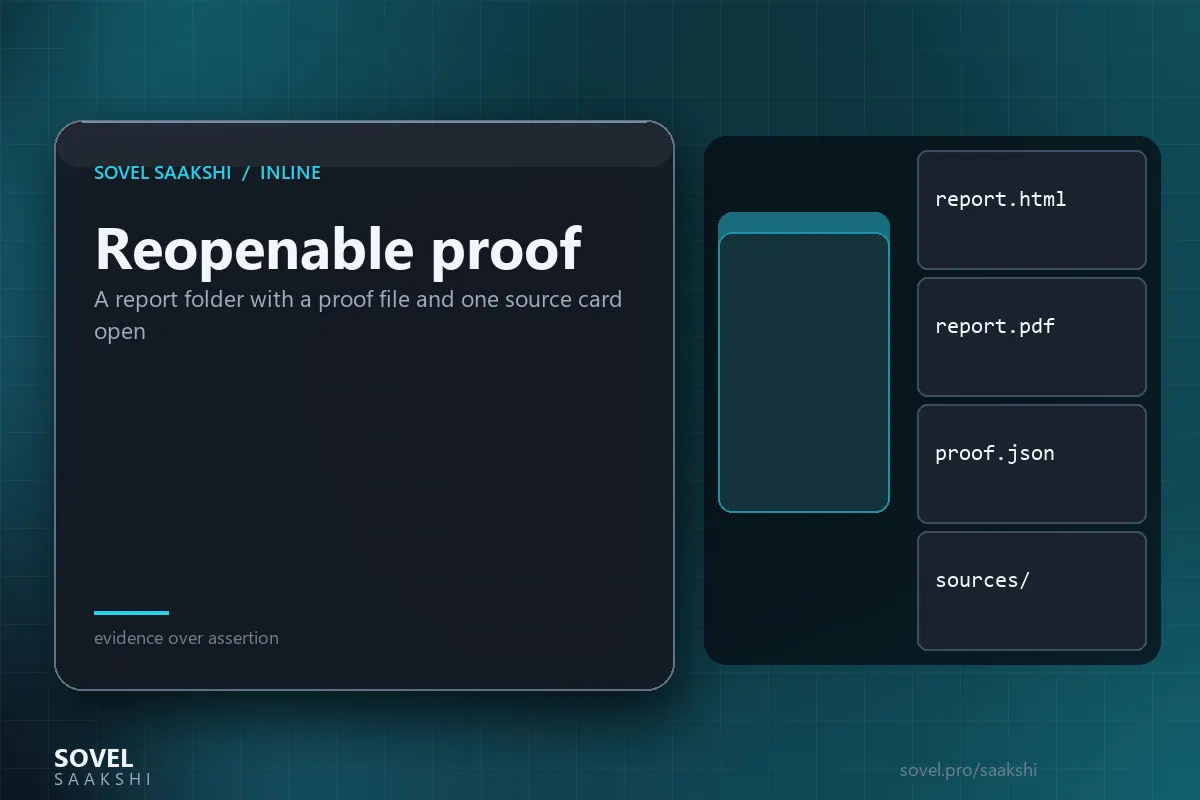
[The report folder, with one source card open beside the proof file.]
The four pass conditions together
| Step | Pass condition | What fails it |
|---|---|---|
| Extract | a list with a count | three claims in a commercial draft |
| Bind | five fields per claim, one claim per entry | a link with no quote |
| Judge | a verdict that names the failing dimension | unverified, no reason |
| Prove | a stranger can reproduce the verdict | a folder nobody can read |
Read the table backwards and you have the four ways ai content verification turns into theatre. The most common is the first: extraction that misses half the claims, followed by a report that is accurate about the half it found.
Where ai content verification usually stops early
Three places, and each one leaves a recognisable trace.
After extraction. A tool lists sixty claims and calls it a report. Nothing is judged, so the operator has more work than before and no decision to act on. The tell is a long document with no verdicts.
After judging. Verdicts exist, sources do not. The operator knows something is wrong and cannot say what the source said. The tell is a confident summary with no quotes.
After proving. A folder exists and nobody opens it. This is the most expensive failure, because the work was done and the benefit was dropped. The tell of ai content verification that has become a ritual is a directory of reports from six months ago that were never read.
The fix in all three cases is the same: one step, one pass condition, and no moving to the next step until the condition holds. That sounds slow and it is faster than doing the run twice.
[The three stopping points, with the trace each one leaves.]

What changes when the draft is marketing copy
Everything above is written for a draft where the author wants to be right. Marketing copy is written by someone who wants it to work, and those two goals pull apart on exactly the claims that matter.
Three adjustments make ai content verification usable on commercial pages.
Check the offers, not the adjectives. A landing page carries more claims per hundred words than an article, because every feature sentence can hide a number, a scope or a comparison. Extract first and you will find that a single section holds twelve claims, not two.
Verify the metadata as part of the run. Titles and descriptions are where a promise survives longest, because they are generated by a template and read by nobody. Google’s guidance on generative AI content is explicit that the review covers metadata, and a commercial page is the page where that matters most.
Treat comparison claims as a category of their own. “Cheaper than the alternatives” needs a named set, a named date and a named measure. Most comparison claims fail not because they are false but because they are undefined, and an undefined claim cannot be verified by anyone including the person who wrote it.
There is a fourth adjustment that is less obvious and worth more. On a commercial page, run ai content verification before the design pass rather than after. Layout changes move claims around, and a figure that was next to its subject in the draft can end up three sections away from it, which is how a true number becomes a false sentence without anyone editing the number.
That single reordering has caught more problems for us than any tool feature. A claim needs its subject within reach, and design work is what puts distance between them.
Where ai content verification sits in a release
A release has an order, and the order is why verification works.
Before the draft. Decide what the page will claim. A page that discovers its claims while writing produces sentences with no source, because the writing came first and the evidence never arrived.
During the draft. Extract as you go on long pieces. A claim count that grows faster than the word count is a warning that the page is becoming a list of assertions.
Before publication. Run the four steps, fix the blocks, then read for style. This is the step people skip when the launch date moves, and it is the step that decides whether the launch costs a refund.
After publication. Re-run on prices and dates on a schedule. A page that was verified in March is not verified in July, because the world moved and the page did not.
An ai content verification routine that includes the fourth step is the only version that keeps working. The first three prevent a mistake. The fourth catches the one the world made for you.
That is also the honest answer to the question every buyer asks: does this fix my pages? It does not fix them. It tells you which ones stopped being true, and telling you is the whole service.
A worked example: one paragraph, four steps
A draft paragraph: the Pro edition costs six thousand nine hundred and ninety nine rupees one time and includes two machines.
Extract. Two claims. The price, and the machine count, which is a number that needs a source of its own.
Bind. The pricing page holds the Pro row, the amount, the currency and the one time wording. The documentation holds the machine count. Two entries, one claim each.
Judge. The price agrees on amount, currency and period, and the subject is named on the page. The machine count agrees, and the source names the same edition. Both claims are supported, and the paragraph publishes.
Now change one word. If the draft says Agency instead of Pro, the pricing page still lists all three editions, so the claim is still supported and the verdict does not change. If the draft says Pro and the ledger holds a page showing only Personal, the tier is absent and the claim is unverified, because missing tier is no support.
That single asymmetry is the most useful thing to understand about ai content verification. Evidence that shows the tier can support a claim about the tier. Evidence that hides the tier cannot.
[One paragraph, four claims, four verdicts.]
Doing this with a tool rather than by hand
By hand, ai content verification takes about forty minutes on a three thousand word draft and the fatigue lands on step three. With a ledger already built, a run takes seconds and the operator reads only the failures.
node bin/saakshi.js scan draft.md
node bin/saakshi.js prove draft.md --ledger ledger.json
node bin/saakshi.js pack draft.md
Exit 0 publishes, 3 sends it to a human, 2 blocks, 1 means the engine could not run. The engine is at SOVEL SAAKSHI, with its nine limits published before purchase.
The policy reason to run ai content verification at all is dated. Google’s guidance on generative AI content asks for a manual review before publishing and extends that review to titles, descriptions, structured data and alt text. A four step process covers those surfaces as well, which is why it generalises from articles to product pages.
If you want the method behind the tool, how to fact check AI generated content is the long version. If the draft is a document rather than a page, verify claims in a document handles the scale problem.
[The run, the exit code and the folder it leaves behind.]

The run order on this page was last tested on 21 November 2026, on a three thousand word draft.
SOVEL SAAKSHI implements the four steps above and nothing else, which is why its report has four fields and not forty.
Done in that order, ai content verification is a ten minute task, and skipping the order is why most ai content verification fails on the last page.
Questions about ai content verification
Is ai content verification the same as proofreading?
No. Proofreading checks the sentence against the language. Verification checks the sentence against a source. Both are useful and only one of them catches a wrong price, which is why the two are separate steps in a publishing routine.
How many claims does a typical page hold?
Between twenty and sixty on a three thousand word commercial page. Editorial pages sit lower, product pages sit higher, and a pricing page can exceed a hundred because every figure in a table is a separate claim.
Do I need a ledger for a single page?
Yes, and building one for a product takes about twenty minutes. It then serves every future draft about that product, which is why the second page takes four minutes and the twentieth takes seconds.
What if two claims contradict each other inside the draft?
That is a contradiction rather than a verification result, and it should block. A draft that states two different prices for the same edition is wrong in at least one place before any source is opened.
Can I verify content a model wrote for a client?
Yes, and the deliverable becomes the draft plus the proof folder, which is a stronger handover than a paragraph promising care. Check the licence terms for which edition covers client work before promising it.
Does this need an internet connection?
No. Sources come from your ledger, so the run is offline and reproducible. The trade is that you supply the quote and the date rather than relying on a live fetch, and that trade is deliberate.
What does it cost?
Pricing runs from ₹2,499 to ₹14,999 across the three editions, one payment, plus GST where it applies. Perpetual licence for the v0.x line, no subscription and no activation step.
Where should this sit in a publishing routine?
Before the style read, not after. Style reading makes you fond of sentences, and fondness is what lets a wrong claim through. Fix the blocks first, then read for rhythm.
Start with one page you have already published. Run the four steps on it tonight, by hand if you have no ledger. Most people find the same thing we did: the number was right and the subject was not, and ai content verification is mostly the discipline of checking the second one.
The smallest useful version of this process
If everything above sounds like a programme, here is the version that fits in a lunch break.
One page. One ledger with three entries. One run. Read the report once.
That is enough to find out whether your own drafts contain the failure this page describes, and it is enough to decide whether the fuller process is worth building. Most teams that try it find one unsupported figure in the first three pages, which is a cheaper discovery than finding it on a customer call.
Nothing about ai content verification requires a programme on day one. It requires one page, checked properly, and the willingness to change a sentence you liked.
There is one more thing worth saying, and it is the reason this page keeps returning to the same three failures. The tool is not the hard part. The hard part is agreeing, before the first run, what a passing sentence looks like. A team that agrees on that will get value from a spreadsheet. A team that does not will get a folder of reports nobody reads, and the process will be blamed for a problem it did not create.