
An ai hallucination checker answers one question: does this sentence have a source that says the same thing about the same subject. An ai detector answers a different question: does this text look machine written. Both products exist, both are sold under similar names, and buying the wrong one is the most common mistake in this category.
The mistake is expensive in a specific way. A detector gives you a number between zero and one hundred, you feel reassured, and the wrong price stays on the page. An ai hallucination checker gives you a list of claims with verdicts, you feel annoyed, and then the wrong price comes out.
Annoyance is the correct response to a working ai hallucination checker, and it fades the first time the block saves you a refund. This page is why.
[Two questions side by side: was this machine written, and is this true.]
The comparison here was last run on 21 November 2026 against a page that had already shipped.
SOVEL SAAKSHI refuses the ranking question entirely, because a number out of a hundred would be a guess dressed as a measurement.
A wrong figure that survived two editors belongs with a claim verification tool, not with another read.
Numbered sources are checked by a citation verification tool rule, not by counting references.
Run any ai hallucination checker on a page you already shipped and the exercise stops being theoretical.
When the volume is low, the plain habit of reading a draft to fact check AI claims by hand still beats every tool on the first pass.
Two different questions that sound the same
A detector reads style. Sentence length variance, lexical diversity, punctuation habits, phrase frequency. From those signals it estimates the probability that a machine produced the text.
An ai hallucination checker reads claims. An ai hallucination checker does not look at how the sentence is built. It looks at what the sentence asserts and whether a source agrees.
Neither is a better version of the other. They answer different questions, and only one of them can prevent a factual error from publishing. There is no style signal that tells you a price is wrong, because a wrong price is written in exactly the same register as a right one.
The confusion is understandable. Both products appear in the same articles, both are marketed to the same buyer, and both have the word AI in the name. The confusion becomes expensive the moment somebody runs a detector on a draft, sees a low score, and concludes the numbers are fine.
[The same sentence, read by a detector and by an ai hallucination checker, producing two unrelated answers.]

Limit 1: an ai hallucination checker reads claims, not style
The first limit is the one that makes the tool useful: it cannot tell you anything about authorship.
If a person wrote a wrong price, an ai hallucination checker blocks it. If a model wrote a perfect article full of sourced figures, the same ai hallucination checker passes it. That is the correct behaviour and it is why the tool cannot be sold as a detector.
The reverse is also true and less comfortable. An ai hallucination checker will not tell you whether a draft reads like a machine wrote it, and no amount of tuning will make it. Style measurement and claim comparison use different inputs.
This matters when a client asks for both things in one purchase. The honest answer is that they are two purchases, and the second one, the one that catches factual errors, is the one with a business case behind it. A grader might flag a page. A wrong price costs money.
That is also the reason our own product does not claim detection anywhere, including in the style report. saakshi style measures evenness and reports signals. It does not pronounce authorship, because a pronouncement of authorship is a guess with a decimal point attached.
Limit 2: an ai hallucination checker cannot see inside a screenshot
Extraction is deterministic over text. A paragraph becomes claims. A table cell becomes a claim. A figure inside a screenshot does not, because the sentence containing it is not text.
This limit surprises people who test with a page full of images, get a short claim list, and conclude the tool is weak. It is not weak. It is blind by design, and the design choice was made because reading images reliably requires either a network model or an error rate nobody wants in a verification product.
Two practical consequences.
Write claims in text. A price that appears only in an image is a price nobody can check, including the next person who edits the page. A short caption with the figure in text fixes the accessibility problem and the verification problem at the same time.
Copy image claims by hand into the ledger. When a screenshot genuinely matters, such as a dashboard or an invoice, transcribe the figure and record the image name and the date. An ai hallucination checker will then compare the transcribed claim like any other.
The third consequence is the one to remember: a screenshot of a source is not a source. It is a copy that can be edited, and a verification system that accepts copies is verifying nothing.
[One figure inside an image and the same figure as text, with the claim list each produces.]
Limit 3: an ai hallucination checker cannot rate the source
A price on a vendor page and the same price in a forum post are treated identically, because the tool compares sentences, not credibility.
This is deliberate, and it is where the operator’s judgement enters an ai hallucination checker run. Two things have to be decided by a person.
Which source counts. The vendor’s own page, a page dated today, a page that carries the tier you need. That judgement is not mechanical and no tool should pretend otherwise.
What a disagreement means. When the vendor page and a reseller page show different prices, the tool reports the mismatch. Which one is current is a decision about the world, and the person writing the ledger makes it.
The practical form of this limit is a habit: record why you chose a source, in one line, in the ledger note field. Six months later the note is the difference between a defensible decision and a guess that happened to be convenient.
An ai hallucination checker with a rating feature would be a checker with an opinion about publishers, and opinions about publishers do not survive contact with a real dispute. The note field is the honest version.
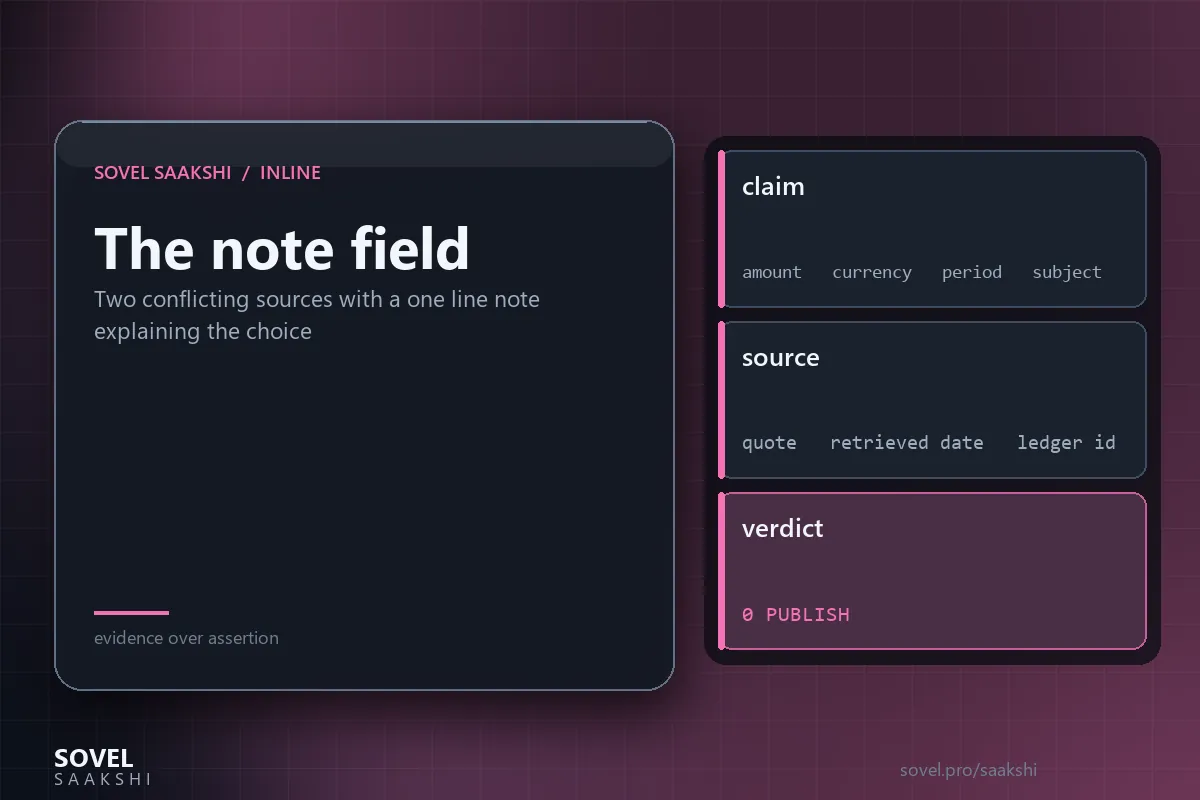
[Two sources with different prices, and a note recording why one was chosen.]
What an ai hallucination checker does that a detector cannot
Four things, and each one shows up on the first day of use.
It blocks. A verdict produces a code, the code stops a publish, and the stop is the value. A detector produces a number that nobody can act on without inventing a threshold.
It leaves a record. A verdict with a source card and a date is a defence six months later. A style score is a mood with a decimal point.
It generalises across claim types. Prices, dates, percentages, quotes, tiers, rankings. A detector sees one thing, the shape of the prose, and reports on that one thing forever.
It survives an honest disagreement. When two people disagree about a claim, the source card settles it. When two people disagree about a style score, the conversation is over before it starts.
The fourth point is the one buyers underestimate. A tool that ends arguments is worth more in an agency than a tool that produces them.
A worked example under both tools
A draft sentence: the Pro edition supports five users and costs six thousand nine hundred and ninety nine rupees for a year.
Under a detector. The sentence is eighteen words, one comma, low burstiness, and the detector returns a high probability of machine authorship. That number tells you nothing about whether the claim is true.
Under an ai hallucination checker. Three claims appear. The price, the currency with its period, and the seat count. Each is bound to a source. The pricing page confirms the price and the period. The documentation shows three seats for Pro and five for Agency. The seat claim is unverified because the source names a different tier.
The second tool produced a block. The first produced a score. Only one of them stopped a wrong sentence from reaching a pricing page, and it is the one that never looked at style.
[The same sentence producing a score and a set of verdicts.]
The three questions a buyer should ask before paying
Any product in this category will be sold with a feature list. Three questions decide whether the feature list is relevant to your risk.
Does it block publication or describe it? A description is advice. A block is a decision. Ask for the exit codes, and if the answer arrives as a percentage, the product is describing rather than deciding.
Where does the evidence come from? If the answer is a live search, ask what happens when the search finds a page that says something different from yesterday. An ai hallucination checker built on live search produces a verdict that cannot be reproduced, because the input changed. A ledger produces the same verdict in six months, which is the property that matters in a dispute.
What does it refuse to do? Every tool has limits. A vendor who lists them before purchase has thought about the buyer’s risk. A vendor who reveals them in support tickets has thought about the sales page. Our own list runs to nine items, including the blind spot on images and the PDF font limitation, because discovering a limit after paying is how a refund conversation starts.
Ask the same three questions of a detector and the answers are different in a revealing way. A detector describes rather than blocks. Its evidence is a corpus it cannot show you. Its limits are usually a sentence about false positives, without numbers.
That difference is not an accusation. It is a description of the two product categories, and it is the reason this page keeps saying they are not substitutes.
How to test any ai hallucination checker in ten minutes
You do not need a trial, an account or a demo call. A single page you already published is a better test than a sample file, because it has your own failures in it.
Step one. Take a page with a price on it. Copy the text into a file.
Step two. Open the real source, the vendor page or your own admin, and copy the sentence that holds the same figure into a ledger entry.
Step three. Run the check. Look at two things only: how many claims the tool found, and whether the claim that carries your real source comes back supported.
Step four. Now break it on purpose. Change the product name in the file to a different product, run again, and see whether the verdict changes. A tool that still says supported after the subject changes is a digit comparer, and an ai hallucination checker that cannot see the subject is not one.
That fourth step is the whole test. Most tools pass steps one to three and fail step four, because comparing numbers is easy and comparing subjects is not.
If you run that test on our engine, the fourth step produces a block. That is the intended behaviour, and it comes from a rule that took us two rounds of audit to get right: a declared tier alias is the same tier, and a real word between subject and offer makes it a different offer. The rule exists because the alternative, partial credit for a near match, is how a wrong product gets approved at nine in the evening.
[Four test steps, with the fourth one highlighted.]

A tool that survives step four will feel slower than a tool that does not. That is not a defect. Speed in this category usually means the comparison was skipped, and a skipped comparison produces a confident answer with nothing behind it.
The second external source worth reading beside Google’s guidance is the NIST AI Risk Management Framework, which is the closest thing to a standard vocabulary for describing model failure modes. It will not tell you how to check a price. It will tell you that measuring outputs, rather than trusting processes, is the only reliable approach, which is the same conclusion this page reaches from the other direction.
Why the detector category exists anyway
Plagiarism anxiety, academic policy and editorial standards. A publisher with a contributor network wants to know whether a submission was written by the person it claims to be from, and a detector is the only tool aimed at that question.
That is a real problem and it is not the problem this page is about. Buying an ai hallucination checker to solve it will disappoint you, and buying a detector to catch factual errors is worse, because it will not, and you will not find out until a customer tells you.
The honest framing for a buyer is two purchases with two budgets. If the risk you are worried about is a false claim reaching a customer, buy the ai hallucination checker. If the risk you are worried about is authorship misrepresentation, buy a detector and accept its error rate. The two risks are not the same size, and only one of them produces a refund.
Google’s own guidance is about the second risk rather than the first, which is worth reading in the original: the generative AI content guidance asks for a manual accuracy review before publishing and extends it to metadata. Nowhere does it ask for a detector.
That absence is the strongest argument in this page. The policy obligation is a review of accuracy. Any tool that does not check accuracy is not answering the obligation, whatever it is called.
Where an ai hallucination checker and a detector overlap
Almost nowhere, and the one overlap is worth naming.
Both need the draft as text. A PDF, an image or a locked document has to be converted before either tool can see it. That shared step is why people assume the tools are similar, and it is the only step they share.
Everything after that diverges. The detector computes a style distribution. The ai hallucination checker extracts claims and compares them with a ledger. One output is a probability. The other is a decision.
If you have already bought a detector and it is not helping, the diagnosis is not that it is broken. It is doing its job on a question you are not asking. The question that keeps producing refunds is the accuracy question, and that is the one an ai hallucination checker exists to answer.
Questions about an ai hallucination checker
Is an ai hallucination checker a detector?
No. A detector estimates whether a machine wrote the text. An ai hallucination checker compares claims with sources. The names are similar and the outputs are unrelated.
Can it find a hallucinated statistic on its own?
It can find the claim. It cannot find the source, because it does not search the web. You supply the source in a ledger, and the tool tells you whether the source supports the sentence. The searching is the part that requires a person or a browser.
What if I do not know whether a claim needs a source?
If the sentence carries a number, a date, a price, a percentage, a quote, a named person or a ranking word, it needs one. Everything else is opinion, and opinion does not need a source, it needs a label.
Does it detect AI writing at all?
No, and the tool is honest about that in its documentation rather than in a footnote. Style signals are reported separately and described as signals, not as authorship evidence.
What happens to a claim with no source?
It comes back unverified and the run blocks with exit code 2. The page does not publish until a source exists, an estimate label is added, or the claim is removed.
Is this useful for content a person wrote?
Yes, and most of our own blocks are human written. A person copying a number from a neighbouring page produces exactly the failure pattern the tool is built for, which is why the eleven day incident in our own catalogue happened without any model being involved.
How does it handle a price list with three editions?
It compares the tier the claim names with the tiers the source displays. A list that shows all three supports a claim about any one. A page that shows one edition supports that edition only.
What does it cost?
The three editions are ₹2,499 for Personal, ₹6,999 for Pro and ₹14,999 for Agency, charged once, GST extra. Perpetual for the v0.x line, offline, no activation, no account. The nine limits are published on the product page before purchase rather than discovered later.
If the question is what the tool actually catches, ai fact checker lists the six claim types. If the question is how to run the checks by hand first, how to fact check AI generated content is the method. The engine, with its limits and editions, is at SOVEL SAAKSHI.
One sentence to close on. An ai hallucination checker does not know anything about your subject. It knows whether the sentence you published can be defended, and that is the only question that matters at the moment a customer asks.